The Ultimate Guide: 401(k) vs IRA: Which Should I Contribute to First?
By Peiman Daneshgar
Table of Contents
- Introduction: The Great Retirement Debate
- Understanding the Basics
- The Golden Rule of Prioritization
- Step 1: The Employer Match – Free Money First
- Step 2: The IRA Decision – Traditional vs. Roth
- Step 3: Return to Your 401(k)
- Special Cases and Exceptions
- 2026 Tax Rules at a Glance
- Advanced Strategies: Beyond the Basics
- Frequently Asked Questions
- Conclusion
Introduction: The Great Retirement Debate
If you are saving for retirement, you have likely asked yourself a critical question: “401(k) vs IRA: which should I contribute to first?” It is one of the most common and consequential dilemmas in personal finance. With the start of a new year, and with updated contribution limits and rules for 2026, now is the perfect time to build a strategy that maximizes your wealth and minimizes your taxes.
Both 401(k)s and Individual Retirement Accounts (IRAs) offer powerful tax advantages designed to help you build a nest egg. However, they function differently, have distinct benefits and drawbacks, and often, the best answer is not one or the other, but a specific order of operations.
This comprehensive guide will provide you with a clear, data-driven framework to answer “401(k) vs IRA: which should I contribute to first?” once and for all. We will explore the nuances of each account, analyze the latest 2026 tax laws, and provide a step-by-step prioritization strategy that works for beginners and seasoned investors alike.
how much house can I afford on a $70,000 salary?
Understanding the Basics
Before we can prioritize, we must understand the key players in this decision.
What is a 401(k)?
A 401(k) is an employer-sponsored retirement plan. You authorize your employer to deduct a percentage of your pre-tax (or, in some cases, after-tax for Roth 401(k)s) paycheck and deposit it into an investment account.
Key Features of a 401(k):
- High Contribution Limits: For 2026, you can contribute up to $24,500 if you are under 50.
- Employer Match: Many employers will match a portion of your contributions. This is the closest thing to “free money” in finance.
- Automatic Payroll Deduction: Saving is automatic and requires no effort once set up.
- Limited Investment Choices: You are typically restricted to a menu of pre-selected mutual funds chosen by your employer’s plan administrator.
- Required Minimum Distributions (RMDs): You must begin withdrawing money at age 73.
What is an IRA?
An Individual Retirement Account (IRA) is opened by you, directly with a financial institution like Vanguard, Fidelity, or Charles Schwab. There is no employer involvement. There are two main types:
FHA loan vs Conventional loan requirements
Traditional IRA:
- Tax Treatment: Contributions may be tax-deductible (depending on your income and whether you have a workplace plan). You pay income tax when you withdraw the money in retirement.
- RMDs: Yes, required at age 73.
Roth IRA:
- Tax Treatment: Contributions are made with after-tax dollars (no upfront tax break). However, qualified withdrawals in retirement are completely tax-free, including all the growth.
- RMDs: No RMDs for the original owner, offering more flexibility in retirement.
Key Features of an IRA:
- Lower Contribution Limits: For 2026, you can contribute up to $7,500 if you are under 50 (or $8,600 if 50+).
- Vast Investment Choices: You can invest in almost anything: individual stocks, bonds, ETFs, and thousands of mutual funds.
- Income Limits: Roth IRAs have income limits that phase out your ability to contribute directly. Traditional IRA deductibility phases out if you or your spouse has a workplace plan and your income is too high.
The Golden Rule of Prioritization
So, 401(k) vs IRA: which should I contribute to first? The answer is a three-step ladder:
- First: Contribute enough to your 401(k) to get the full employer match.
- Second: Max out an IRA (Roth or Traditional).
- Third: Go back to your 401(k) and increase your contribution up to the annual limit.
This is the universally recommended “best practice” among financial advisors. Let’s break down why.
mortgage pre-approval process step-by-step
Step 1: The Employer Match – Free Money First
The very first dollars you save for retirement should go into your 401(k), but only up to the point where you capture your employer’s full matching contribution.
- Why? An employer match is a 100% guaranteed return on your investment instantly. If your employer matches 50% of your contributions up to 6% of your salary, and you earn $60,000, contributing that 6% ($3,600) means your employer deposits an extra $1,800 into your account. That is an immediate 50% profit.
- The Consequence of Skipping It: Failing to contribute enough to get the match is like throwing away a portion of your compensation. No other investment can guarantee a 50% or 100% return with zero risk.
Action Item: Check with your HR department to understand your employer’s match formula. Contribute at least the minimum percentage required to get the full match.
Step 2: The IRA Decision – Traditional vs. Roth
Once you have secured your employer match, the next step in answering “401(k) vs IRA: which should I contribute to first?” is to fund an IRA. But why an IRA before going back to the 401(k)?
- Better Investment Choices: 401(k) plans often have limited, sometimes high-cost fund options. An IRA gives you access to the entire investment universe, allowing you to build a more diversified, lower-cost portfolio.
- More Control: You are in complete control of the account, not your employer’s plan administrator.
Now comes the critical sub-question: Traditional or Roth IRA? The answer depends on your income and your tax situation today versus your expected tax situation in retirement.
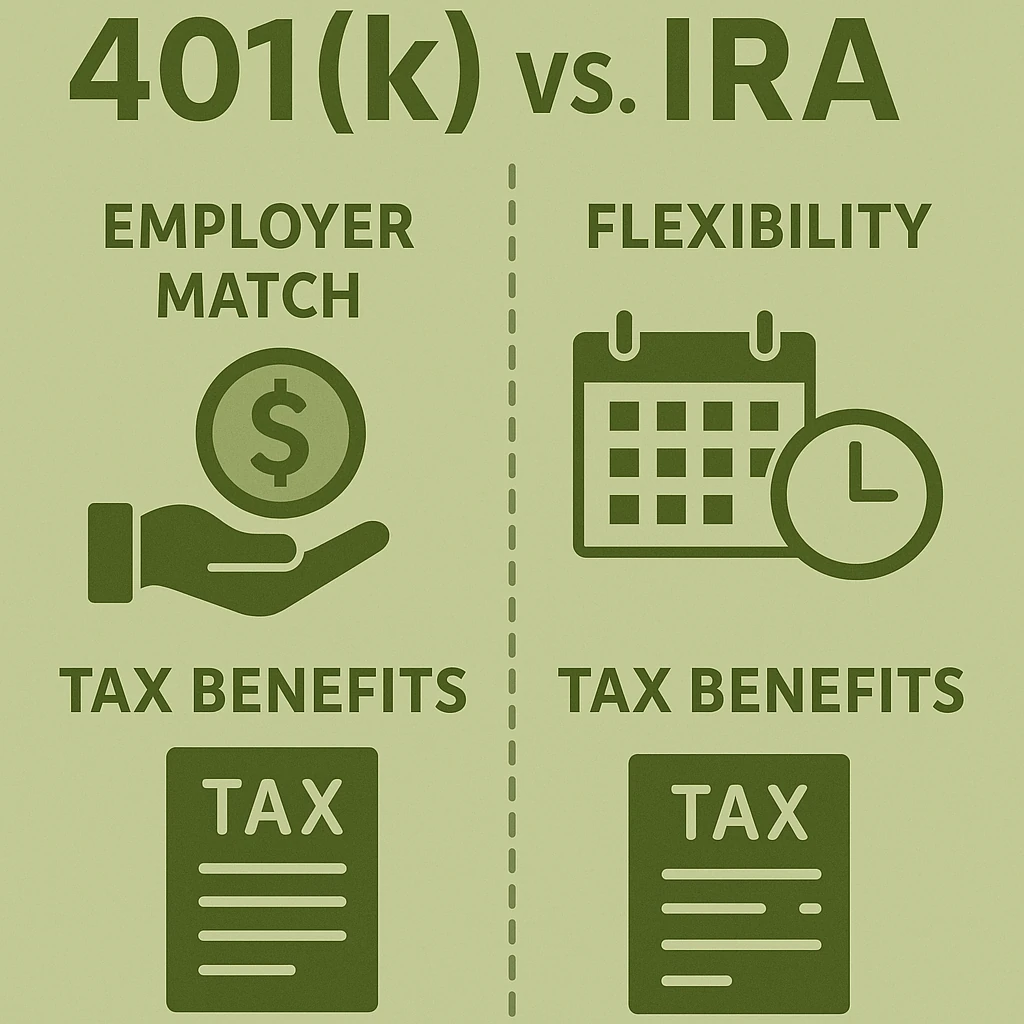
When to Choose a Roth IRA
A Roth IRA is generally the better choice if you believe your tax rate in retirement will be higher than it is today. You pay taxes now at a lower rate to avoid paying higher taxes later.
Roth IRA benefits:
- Tax-Free Growth and Withdrawals: This is the primary draw. All the compounded growth over decades is yours tax-free.
- Flexibility: You can withdraw your contributions (but not earnings) at any time, for any reason, tax-free and penalty-free. This makes a Roth IRA an excellent “emergency fund of last resort.”
- No RMDs: You are never forced to withdraw the money, allowing it to grow for your heirs or your own later years.
- is it better to rent or buy a home right now?
Roth IRA Income Limits for 2026:
- Single Filers: Can contribute the full $7,500 if your Modified Adjusted Gross Income (MAGI) is less than $153,000. Contributions phase out between $153,000 and $168,000. You cannot contribute directly if your MAGI is over $168,000.
- Married Filing Jointly: Can contribute the full amount if your MAGI is less than $242,000. The phase-out range is $242,000 to $252,000.
When to Choose a Traditional IRA
A Traditional IRA is often the better choice if you believe your tax rate in retirement will be lower than it is today. You get a tax break now, when you are in a higher bracket, and pay taxes later, when you are in a lower bracket.
Traditional IRA benefits:
- Upfront Tax Deduction: Your contribution reduces your taxable income for the year, which could even drop you into a lower tax bracket.
- Tax-Deferred Growth: Your money grows without being taxed until you withdraw it.
Important Caveat: The tax deductibility of a Traditional IRA is not available to everyone. If you (or your spouse) have a workplace retirement plan like a 401(k), the deduction phases out based on your income.
Traditional IRA Deductibility Phase-Outs for 2026 (if you have a workplace plan):
- Single Filers: Deduction phases out between $81,000 and $91,000 of MAGI.
- Married Filing Jointly: Deduction phases out between $129,000 and $149,000 of MAGI.
If your income is above these limits, you can still make a non-deductible contribution to a Traditional IRA, but a Roth IRA (or a “Backdoor Roth IRA”) is almost always a better option in that case.
how to improve credit score before applying for a mortgage
The “Tax Diversification” Argument
Many financial experts, including those at Schwab, argue that the best strategy is not to pick one, but to have both. Having a mix of pre-tax (Traditional 401k/IRA) and after-tax (Roth) money in retirement gives you incredible flexibility to manage your tax bracket. You can withdraw from your Traditional accounts up to the limit of a low tax bracket, and then use your Roth money for larger expenses without pushing yourself into a higher bracket.
Step 3: Return to Your 401(k)
You have secured your match and maxed out your IRA. Now what? If you still have money to save for retirement, the final step in answering “401(k) vs IRA: which should I contribute to first?” is to circle back to your 401(k).
- Why? The 401(k) offers a much higher contribution limit than an IRA. For 2026, you can contribute up to $24,500 (or $32,500 with catch-up) on top of any employer match.
- Tax Advantages: Whether you use the pre-tax (Traditional) or Roth option within your 401(k), you are still shielding a substantial amount of money from taxes in a given year. The total contribution limit (including employee/employer contributions) is even higher.
This is where you can significantly accelerate your retirement savings. If you are maxing out your IRA and still have savings capacity, increasing your 401(k) deferral is the most effective way to build long-term wealth.
Special Cases and Exceptions
The “Golden Rule” above works for most people, but there are always exceptions.
Case 1: You Have a Bad 401(k) with High Fees
If your employer’s 401(k) plan has exceptionally high fees and poor investment options with no match, the math changes. In this specific scenario, you might prioritize an IRA first, even before contributing to the 401(k). However, you should still consider contributing to the 401(k) after maxing the IRA for the tax benefits.
Case 2: You are a High-Earner and Cannot Use a Roth IRA Directly
If your income exceeds the Roth IRA limits, you cannot contribute directly. However, you may be able to utilize the “Backdoor Roth IRA” strategy. This involves making a non-deductible contribution to a Traditional IRA and then converting it to a Roth IRA. It is a legal loophole, but it requires careful execution to avoid tax complications. Consult a tax professional.
Case 3: You Want Early Retirement Flexibility
If you plan to retire significantly before age 59½, having money in a Roth IRA is advantageous because you can always withdraw your contributions tax-free and penalty-free. Furthermore, 401(k)s have a special rule (the “Rule of 55”) that allows penalty-free withdrawals if you leave your job in or after the year you turn 55. Understanding these nuances can influence your decision.
what to look for in a fixed-rate mortgage
Case 4: You Want Access to Funds for a Home or Education
IRAs offer more flexibility for penalty-free withdrawals for specific reasons, such as a first-time home purchase (up to $10,000) or qualified higher education expenses. 401(k)s generally do not allow these types of withdrawals, making them less flexible if you think you might need the money before retirement.
2026 Tax Rules at a Glance
To make an informed decision on “401(k) vs IRA: which should I contribute to first?”, you need the current numbers. Here is a summary of the key 2026 limits and rules.
| Feature | 401(k) | IRA (Traditional & Roth) |
|---|---|---|
| Standard Contribution Limit (Under 50) | $24,500 | $7,500 |
| Catch-Up Contribution (50+) | $8,000 | $1,100 |
| Total with Catch-Up (50+) | $32,500 | $8,600 |
| “Super Catch-Up” (Ages 60-63) | $11,250 (instead of $8,000) | N/A |
| Key Rule for 2026 | If you earn >$150k in FICA wages and are 50+, your catch-up must go into a Roth 401(k). | Roth IRA phase-out: $153k-$168k (Single) / $242k-$252k (Married). |
Advanced Strategies: Beyond the Basics
Once you have mastered the fundamental question of “401(k) vs IRA: which should I contribute to first?”, you can explore advanced tactics.
The Mega Backdoor Roth IRA
Some 401(k) plans allow for “after-tax” contributions beyond the standard $24,500 limit. If your plan supports it, you can contribute up to a total of $72,000 (for 2026) across all contribution types (pre-tax, Roth, and after-tax). You can then convert those after-tax funds to a Roth 401(k) or Roth IRA, effectively allowing you to super-fund your Roth savings. This is an incredibly powerful wealth-building tool for high-income earners.
costs of buying a home besides the down payment
Health Savings Accounts (HSAs) as a Retirement Tool
If you have a High-Deductible Health Plan (HDHP), you should consider maxing out a Health Savings Account (HSA) before or alongside your retirement accounts. An HSA is the only “triple tax-advantaged” account:
- Contributions are tax-deductible.
- The money grows tax-free.
- Withdrawals for qualified medical expenses are tax-free.
After age 65, you can withdraw funds for any purpose without penalty (though you’ll pay income tax on non-medical withdrawals), making it a powerful retirement supplement. For 2026, contribution limits are $4,400 for individuals and $8,750 for families, with a $1,000 catch-up for those 55+.
Frequently Asked Questions
Q1: Can I have both a 401(k) and an IRA?
Absolutely. In fact, this is the recommended strategy for most people. You can (and should) contribute to both to maximize your tax-advantaged savings and achieve tax diversification.
Q2: What if I can’t afford to max out both?
That is perfectly normal. The prioritization ladder is designed for exactly this situation: 1) 401(k) to the match → 2) IRA to the max → 3) back to the 401(k) . Following this order ensures you get the most “bang for your buck” from every dollar you save.
Q3: Should I choose a Traditional or Roth 401(k)?
This mirrors the IRA decision. If you want a tax break now and expect a lower tax rate in retirement, choose Traditional. If you want tax-free withdrawals in retirement and expect a higher rate later, choose Roth. Many plans allow you to split your contributions between both.
how much to save for retirement by age 30, 40, 50
Q4: What are the 2026 contribution limits?
For 2026, the 401(k) limit is $24,500 ($32,500 with catch-up). The IRA limit is $7,500 ($8,600 with catch-up). There is also a special $11,250 “super catch-up” for those aged 60-63 in 401(k) plans.
Q5: Is an IRA better than a 401(k) for investment options?
Yes, almost always. IRAs offer a vast universe of investment choices (individual stocks, bonds, thousands of funds), while a 401(k) is limited to the options your employer selects. This is a primary reason to prioritize an IRA after capturing the match.
how to invest in REITs for passive income
Q6: What is a “Backdoor Roth IRA”?
It is a strategy for high-income earners who cannot contribute directly to a Roth IRA due to income limits. You make a non-deductible contribution to a Traditional IRA and then convert it to a Roth IRA. It is legal but complex, so consult a tax advisor.
Q7: When do I have to start taking money out (RMDs)?
For 401(k)s and Traditional IRAs, you must start taking Required Minimum Distributions (RMDs) at age 73. Roth IRAs do not have RMDs for the original owner.
Q8: What happens to my 401(k) if I change jobs?
You have several options: leave it with your former employer, roll it over into your new employer’s 401(k), or roll it over into a Traditional IRA. Rolling it into an IRA is often a good move to gain more control and investment choices.
Q9: Can I withdraw money from my IRA to buy a house?
Yes, for a first-time home purchase, you can withdraw up to $10,000 from a Traditional or Roth IRA penalty-free (though taxes may still apply to Traditional IRA earnings). 401(k)s generally do not offer this feature.
Q10: I’m over 50. Does the 2026 rule about Roth catch-ups apply to me?
It applies if you are 50 or older and your FICA wages from the previous year (2025) exceeded $150,000. If you meet both criteria, your 2026 catch-up contributions to your 401(k) must be made to a Roth account.
pros and cons of a 15-year vs 30-year mortgage
Conclusion
Deciding “401(k) vs IRA: which should I contribute to first?” does not have to be complicated. By following the simple, three-step ladder—maximize the employer match, fund an IRA, and then return to your 401(k)—you create a robust, tax-efficient savings plan that leverages the best of both worlds.
In the 2026 landscape of higher contribution limits and new Roth catch-up rules, the opportunities to save have never been greater. Start where you are, use the steps outlined in this guide, and take control of your financial future today. Your retirement self will thank you.
This article is for informational purposes only and does not constitute financial advice. Tax laws are complex and subject to change. You should consult with a qualified financial professional or tax advisor to create a plan tailored to your individual needs and circumstances.