By: Peiman Daneshgar | Email: daneshgar781@gmail.com**
Published: February 21, 2026**
Table of Contents
- Is Cryptocurrency Taxable in the US/UK/EU? (The Short Answer: Yes, and 2026 Changes Everything)
- Introduction: The “I Thought It Was Anonymous” Panic
- What This Article Will Actually Give You
- Part 1: The One-Sentence Answer (For the Impatient)
- Part 2: The Big News for 2026—The Anonymity Era Is Over
- Part 3: United States—The 1099-DA Has Arrived
- Part 4: United Kingdom—HMRC Finally Has the Data
- Part 5: European Union—DAC8 Makes Everything Visible
- Part 6: What Counts as a Taxable Event? (The Cheat Sheet)
- Part 7: What If You’ve Never Reported Before?
- Part 8: How to Actually Calculate What You Owe
- Part 9: Crypto Tax Software—You Need It Now
- Frequently Asked Questions
- The Emotional Bottom Line
Introduction: The “I Thought It Was Anonymous” Panic
I know that feeling.
You bought some Bitcoin back in 2021 when everyone was talking about it. Maybe you dabbled in Ethereum. Swapped a few tokens on some platform with a weird name. Made a little profit. Lost a little too. Then you forgot about it.
Now it’s 2026, and you’re hearing rumblings. New rules. New forms. New data-sharing agreements between countries. Your crypto exchange is asking for your tax ID. Your friend got a letter from HMRC. Someone on Reddit says the IRS is about to send 1099s for crypto.
And you’re sitting there thinking: “Wait… did I need to pay taxes on that?”
You’re not alone. For years, crypto existed in a gray area. People treated it like digital cash—anonymous, off the books, nobody’s business but theirs. Governments knew they were losing tax revenue, but they couldn’t track it.
That era ended. On January 1, 2026, it ended for good.
🧠 Quick Reality Check:
Forty-eight countries—including the US, UK, and all EU members—started implementing global crypto reporting standards on January 1, 2026 . The IRS is sending out Form 1099-DA. HMRC has a dedicated crypto section on tax returns. The EU’s DAC8 includes a “kill switch” that blocks your account if you don’t provide tax info. The anonymity is gone.
What This Article Will Actually Give You
Here’s the deal. Most crypto tax articles are either too basic (“you have to pay taxes!”) or so technical they’re unreadable.
This one is different.
By the time you finish reading, you’ll know:
- The massive 2026 changes in the US, UK, and EU—and what they mean for your wallet .
- Exactly what counts as a taxable event (and what doesn’t) .
- The rates you’ll actually pay in each jurisdiction .
- What to do if you’ve never reported before (before it’s too late) .
- How crypto tax software can save you from a spreadsheet nightmare .
This is the playbook. Let’s run it.
can I retire early with $500,000 saved?
Part 1: The One-Sentence Answer (For the Impatient)
If you’re in a hurry, here’s the short version:
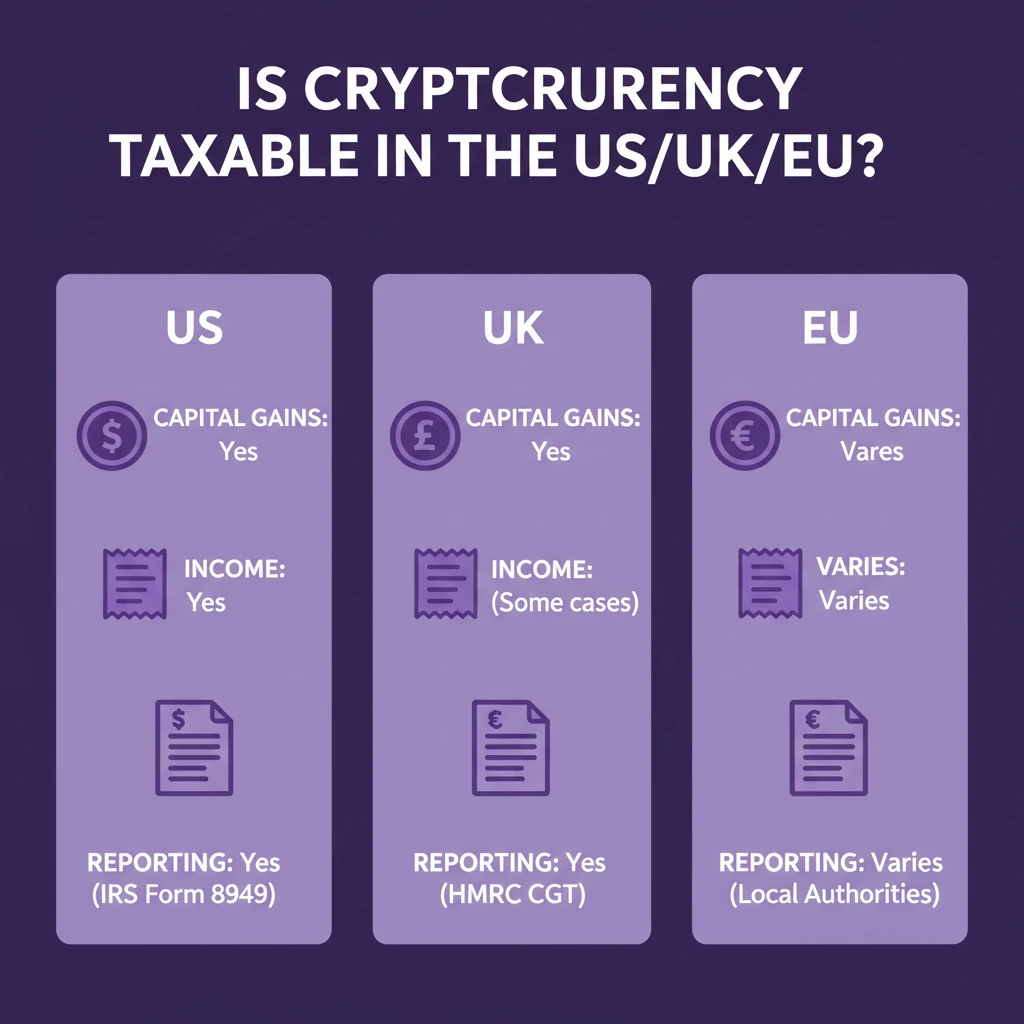
Yes. Cryptocurrency is absolutely taxable in the US, UK, and EU.
In all three jurisdictions, crypto is treated as property (not currency) for tax purposes . That means:
- You don’t owe tax just for holding crypto .
- You do owe tax when you sell, swap, spend, or earn crypto .
- The tax can be either capital gains tax (on profits from selling) or income tax (on mining, staking, airdrops, or getting paid in crypto) .
And as of January 1, 2026, the days of flying under the radar are over. Governments are sharing data internationally . Exchanges are reporting directly to tax authorities . The wall of anonymity has crumbled.
best target-date funds for 2045 retirement
Part 2: The Big News for 2026—The Anonymity Era Is Over
Before we dive into each country’s rules, you need to understand what just happened globally.
What Is CARF?
The Crypto-Asset Reporting Framework (CARF) is an OECD-developed global standard for crypto tax transparency . Think of it as the crypto version of the Common Reporting Standard (CRS) that banks have used for years to share financial account information across borders.
Starting January 1, 2026, the first wave of countries—including the UK, all EU members, Brazil, and others—began implementing CARF . What this means:
- Crypto exchanges must collect full transaction records for customers
- They must report users’ tax residency information to their local tax authority
- Starting in 2027, tax authorities will automatically share this data with other countries
More than 75 countries have committed to implementing CARF, including crypto hubs like the UAE, Hong Kong, Singapore, and Switzerland (though some start later) . The US will implement in 2028 .
What Is DAC8?
In the European Union, CARF is being implemented through DAC8 (the 8th iteration of the Directive on Administrative Cooperation) . It applies from January 1, 2026, with the first reporting year being 2026 .
Under DAC8:
- Crypto-asset service providers (CASPs) must collect users’ tax information, including tax residence and Tax Identification Numbers (TINs)
- They must report crypto-to-fiat exchanges, crypto-to-crypto exchanges, and transfers of crypto-assets
- Information will be shared automatically between EU tax authorities
What This Means for You
The Koinly blog puts it bluntly: “2026 crypto tax changes focus on better data, not higher rates, with governments sharing transaction data at scale” .
Translation: They’re not necessarily raising taxes. They’re just making sure they know about everything so you can’t hide.
The 48-Country Club (And Growing)
The first wave of CARF implementation includes :
- All EU countries
- The United Kingdom
- Brazil
- The Cayman Islands
- South Africa
- The Channel Islands
By 2027-2028, it expands to include the UAE, Hong Kong, Singapore, Switzerland, and eventually the US .
retirement planning for self-employed individuals
🤔 Pause and Think:
If you’ve been trading on international exchanges thinking “they’ll never find out,” 2026 is the year that strategy dies. The data is being collected now. The sharing starts soon.
Part 3: United States—The 1099-DA Has Arrived
The New Form You’ll Get in 2026
The IRS finalized broker reporting rules, and Form 1099-DA is now a reality . Crypto exchanges and brokers are required to report sales and other taxable transactions occurring on or after January 1, 2025 .
These forms must be sent to taxpayers by February 17, 2026 at the latest .
Important caveat: For the first year, the IRS has given exchanges some breathing room on cost basis reporting—many simply don’t have systems to track this accurately yet . This means some forms may be inaccurate, and you’ll still need to calculate your actual gain or loss .
The ForkLog article quotes Andrew Duka of Awaken Tax: “Platforms like Coinbase provide information only on sales income and cannot report the tax basis for a specific digital asset” . The responsibility to “fill in” missing information falls on you through Form 8949 .
What the IRS Considers Taxable
The IRS classifies cryptocurrencies (including coins, tokens, stablecoins, DeFi tokens, and NFTs) as digital assets . Taxable events include :
- Selling crypto for fiat currency (USD)
- Trading one crypto for another
- Using crypto to purchase goods or services
- Receiving crypto as payment for goods or services
- Mining rewards
- Staking rewards
- Airdrops
- Token incentive programs
- Referral bonuses
- how to rollover an old 401(k) to an IRA
What’s NOT Taxable
You don’t owe tax when you :
- Simply hold crypto (no sale, no tax)
- Transfer crypto between your own wallets (it’s just moving assets)
- Donate crypto to a qualified charity
- Give crypto as a gift (though the recipient inherits your cost basis)
Tax Rates (The Same as Stocks)
The IRS applies the same capital gains rules to crypto as to stocks :
- Short-term (held ≤1 year): Taxed at your ordinary income rate (10%–37%)
- Long-term (held >1 year): Taxed at 0%, 15%, or 20% depending on income
For income from mining, staking, airdrops, or getting paid in crypto, it’s taxed as ordinary income at your marginal rate .
State-Level Surprises
While federal rules get attention, states are making moves too :
- Missouri eliminated state income tax on capital gains starting with the 2025 tax year
- Kentucky, Mississippi, and Oklahoma are gradually eliminating state income tax entirely
- Washington implemented a 2.9% surtax (effective top rate 9.9%) for capital gains exceeding $1 million, but with a $278,000 exemption
The Infamous Digital Asset Question
Every tax return now asks the digital asset question: “At any time during 2025, did you: (a) receive (as a reward, award, or payment for property or services); or (b) sell, exchange, gift, or otherwise dispose of a digital asset (or a financial interest in a digital asset)?”
You must answer “yes” or “no.” Lying is perjury.
what is a Roth IRA and how does it work?
Part 4: United Kingdom—HMRC Finally Has the Data
CARF Implementation from January 2026
The UK confirmed it will implement CARF-aligned rules starting January 1, 2026 . Cryptoasset service providers must now collect and report information to HMRC about users’ tax residency and transactions .
HMRC expects this new framework to lead to £535 million in additional tax collected across 2026-2031 .
The Dedicated Crypto Section on Self Assessment
For the first time, the 2024-25 Self Assessment tax return form (filed by January 31, 2026) includes a dedicated section where taxpayers can declare crypto gains and losses .
Taxable Events (When You “Dispose”)
HMRC says you pay Capital Gains Tax when you “dispose” of crypto assets . Disposals include :
- Selling crypto for fiat currency
- Exchanging one crypto for another
- Using crypto to purchase goods or services
- Gifting crypto to someone other than a spouse or civil partner
Only in “exceptional circumstances” will HMRC accept that buying and selling crypto amounts to a trade for tax purposes (which would attract income tax) .
The £3,000 Allowance
For the 2024/2025 tax year, the UK offers a tax-free allowance of £3,000 on capital gains . If your total gain for the tax year is £3,000 or below, you pay no tax on your profits .
Rates for 2025-2026
If your gains exceed the allowance :
- Basic rate taxpayers: 18% on gains
- Higher rate taxpayers: 24% on gains (recently reduced from 28%)
For income tax on mining, staking, or being paid in crypto, rates range from 0% to 45% depending on your total income .
401(k) vs IRA: which should I contribute to first?
The 65,000 Letters
HMRC isn’t messing around. They sent 65,000 compliance letters to suspected crypto tax evaders in the 2024-25 tax year—more than double the previous year’s 27,700 .
Part 5: European Union—DAC8 Makes Everything Visible
DAC8 Takes Effect January 2026
Across the EU, DAC8 applies from January 1, 2026, with 2026 being the first reporting year . Crypto-asset service providers must :
- Collect users’ tax information (tax residence, TINs, date of birth)
- Report crypto-to-fiat exchanges, crypto-to-crypto exchanges, and transfers
- Retain all due diligence and reporting records for at least five years
The “Kill Switch” Rule (This Is Serious)
Here’s the most striking feature of DAC8: if a user fails to provide the required tax information despite two reminders, and 60 days have elapsed since the initial request, the crypto platform must prevent that user from carrying out reportable transactions .
This “kill switch” is mandatory—not discretionary . Fail to provide your tax info, and your account gets frozen.
No Unified EU Tax Rate—Each Country Sets Its Own
The EU doesn’t have a single crypto tax rate. Each member state sets its own rules . Here’s the current landscape.
Country-by-Country Guide (What You’ll Actually Pay)
Germany (Most Favorable) :
- Crypto held for over 12 months: completely tax-free
- Encourages long-term holding
Italy (Rates Going Up) :
- From 2026: 33% substitute tax on crypto gains (up from 26%)
- €2,000 exemption removed
- Transitional re-basement option: taxpayers holding crypto before 2026 may reset cost basis to market value by paying a one-off substitute tax
- how much to save for retirement by age 30, 40, 50
France :
- Flat 30% tax rate for annual gains above €305
- Also moving to tax crypto as “unproductive wealth” with broader levy
Spain :
- Gains taxed between 19% and 28%
- Proposed amendments could shift gains to Personal Income Tax rate capped at 47%
Austria :
- Flat 27.5% rate on capital gains
Belgium :
- Up to 33% on capital gains
Denmark :
- Up to 53% on capital gains (highest in EU)
Ireland :
- Capital gains tax on profits above €1,270 annual allowance
- Disposals include exchanging coins, paying with crypto, or gifting
The Netherlands:
- Unique “box 3” system taxing deemed returns on assets rather than actual gains
Japan (Not EU, but notable) :
- Moving from up to 55% to flat 20% rate for “specified crypto assets” handled by registered firms
- Three-year loss carry-forward introduced
- pros and cons of a 15-year vs 30-year mortgage
Brazil :
- New flat 17.5% capital gains tax on all net crypto gains (no monthly exemption)
Part 6: What Counts as a Taxable Event? (The Cheat Sheet)
Here’s the simple version, applicable across all three jurisdictions.
✅ Taxable Events
| Event | US | UK | EU |
|---|---|---|---|
| Selling crypto for fiat | Yes (CGT) | Yes (CGT) | Yes (CGT) |
| Trading one crypto for another | Yes (CGT) | Yes (CGT) | Yes (CGT) |
| Spending crypto on goods/services | Yes (CGT) | Yes (CGT) | Yes (CGT) |
| Getting paid in crypto (employment) | Yes (Income) | Yes (Income) | Yes (Income) |
| Mining rewards | Yes (Income) | Yes (Income) | Yes (Income) |
| Staking rewards | Yes (Income) | Yes (Income) | Yes (Income) |
| Airdrops | Yes (Income) | Yes (Income) | Yes (Income) |
| Referral bonuses | Yes (Income) | Yes (Income) | Yes (Income) |
❌ Non-Taxable Events
| Event | US | UK | EU |
|---|---|---|---|
| Simply holding crypto | No | No | No |
| Transferring between your own wallets | No | No | No |
| Donating to qualified charity | No (often) | No (to registered charities) | Varies |
| Gifting to spouse/civil partner | No | No | Generally no |
The Stablecoin Confusion
Italy created a carve-out for certain euro-denominated stablecoins that qualify as electronic money tokens—they may continue to be taxed at 26% rather than the higher 33% rate . Other jurisdictions are still figuring out stablecoin treatment.

The NFT Problem
NFTs are generally treated as digital assets subject to the same rules . However, if they represent ownership of physical art or collectibles, different rules may apply. This area remains murky.
how to invest in REITs for passive income
Part 7: What If You’ve Never Reported Before?
If you’re reading this with a sinking feeling because you’ve never reported crypto gains… you’re not alone. But you need to act.
The Disclosure Window Is Closing
HMRC has a voluntary disclosure facility where taxpayers can come clean on undeclared gains and unpaid tax prior to April 2024 . Dawn Register of BDO warns: “Specialist tax advice and assistance should be sought where this is applicable” .
HMRC’s Voluntary Disclosure Facility
The UK’s disclosure mechanism allows you to correct past mistakes. Given that HMRC sent 65,000 compliance letters recently, coming forward voluntarily is better than waiting for them to find you .
IRS Options
The IRS has various disclosure programs for unreported income. Given the new 1099-DA reporting starting, historical non-compliance may be detected. Consult a tax professional.
The Statute of Limitations Trap
Generally, tax authorities can go back 3-7 years depending on the jurisdiction and severity. But if they deem your non-compliance “fraudulent,” there’s no limit.
🚨 Urgent Warning:
With CARF data collection starting January 2026 and the first international exchanges of information expected in 2027, 2026 is your last chance to get compliant before the data starts flowing automatically .
Part 8: How to Actually Calculate What You Owe
The FIFO Problem (First In, First Out)
In the US, the IRS default method assumes you sell your oldest shares first (FIFO) . This can maximize your gain because those oldest shares likely have the lowest cost basis.
You can choose specific share identification if you keep good records, but it’s more work.
Pooling in the UK
The UK uses a “pooling” method—all your holdings of the same crypto are treated as one asset with an average cost basis . This simplifies things somewhat.
Tracking Cost Basis Across Wallets
This is the nightmare. If you’ve moved crypto between wallets, exchanges, and DeFi protocols, tracking your original cost basis becomes a forensic accounting challenge .
The 2026 Wallet-by-Wallet Rule in the US
The IRS has pointed taxpayers to Revenue Procedure 2024-28 on allocating basis to wallets/accounts as of January 1, 2025 . If you’ve historically “pooled” lots across multiple wallets/exchanges, 2026 is where reconciliation gets painful
Part 9: Crypto Tax Software—You Need It Now
If you’ve done more than a handful of transactions, you cannot do this manually. It’s not possible.
What Good Software Does
Crypto tax software :
- Connects to exchanges and wallets via API
- Imports all your transactions
- Categorizes them by type (trade, sale, income)
- Calculates gains and losses using correct accounting methods
- Generates ready-to-file reports and forms (Form 8949, Schedule D, etc.)
- Saves you countless hours and prevents mistakes
- costs of buying a home besides the down payment
Top Tools for 2026
According to the XT.com guide, here are the leading options :
| Software | Best For | Price Range | Key Features |
|---|---|---|---|
| Koinly | All-around choice | $49–$199 | 700+ exchanges, GDPR/SOC2 compliant |
| CoinLedger | Frequent traders | $49–$199 | DeFi, NFT, derivatives, tax-loss harvesting |
| CoinTracker | Centralized exchange users | $59–$3499 | 500+ wallets, TurboTax integration |
| CryptoTaxCalculator | DeFi enthusiasts | $49–$499 | AI categorization, advanced DeFi/NFT |
| TokenTax | High-volume investors | $65–$3499 | CPA consultation, real-time tracking |
These tools pay for themselves in time saved and mistakes avoided.
Frequently Asked Questions
Q: Is cryptocurrency taxable in the US?
A: Yes. The IRS treats crypto as property. You pay tax when you sell, swap, spend, or earn it .
Q: Is cryptocurrency taxable in the UK?
A: Yes. HMRC requires Capital Gains Tax on disposals and Income Tax on mining, staking, and crypto salaries .
Q: Is cryptocurrency taxable in the EU?
A: Yes, but rates vary by country. Germany is most favorable (tax-free after 1 year). Italy now charges 33%. France charges 30% .
Q: What is Form 1099-DA?
A: The new IRS form that crypto brokers must send to taxpayers and the IRS, reporting digital asset transactions .
Q: What is CARF?
A: The Crypto-Asset Reporting Framework—an OECD global standard for crypto tax transparency implemented by 48 countries starting 2026 .
Q: What is DAC8?
A: The EU directive implementing CARF, requiring crypto platforms to report user data to tax authorities and automatically share across borders .
Q: Do I pay tax if I just hold crypto?
A: No. Tax is only triggered by selling, swapping, spending, or earning .
Q: Is trading one crypto for another taxable?
A: Yes. In the US, UK, and most EU countries, crypto-to-crypto trades are taxable disposals .
Q: What about stablecoins?
A: Generally treated like other crypto. Italy created a carve-out for certain euro-denominated stablecoins at 26% .
Q: What if I never reported before?
A: Consider voluntary disclosure programs. With CARF data collection starting, it’s better to come forward before they find you .
Q: What’s the UK tax-free allowance?
A: £3,000 for the 2024-25 tax year .
Q: What’s the Irish allowance?
A: €1,270 annual exemption .
Q: Do I need crypto tax software?
A: If you have more than a few transactions, absolutely. Manual tracking is nearly impossible .
The Emotional Bottom Line
Look, I’m not going to pretend that crypto taxes are fun.
They’re not. They’re complicated. They’re stressful. And for years, the ambiguity made it easy to just… not think about it.
But here’s the thing: January 1, 2026, changed everything.
The data is being collected. The forms are being filed. The international sharing is starting. The era of crypto anonymity isn’t ending—it’s already over .
The good news? The rules aren’t necessarily harsher. Many countries are actually lowering rates or creating clearer frameworks . What’s changed is enforcement. They can finally see.
Your move is simple:
- Get your records together
- Use crypto tax software to calculate what you owe
- File accurately
- If you have past issues, consider disclosure programs now—before the data starts flowing automatically in 2027
The days of hiding are done. But the days of clarity? Those are just beginning.
You’ve got this.