
The Ultimate Guide on How to Invest in REITs for Passive Income
By Peiman Daneshgar
Table of Contents
- Introduction
- What Are REITs and How Do They Work?
- Why REITs Are Ideal for Passive Income
- Types of REITs: Choosing Your Path
- How to Start Investing in REITs for Passive Income
- Evaluating REITs: Key Metrics and Analysis
- Top REIT Sectors for Passive Income in 2025-2026
- Building a Diversified REIT Portfolio
- REITs vs. Other Passive Income Investments
- Tax Implications for US and European Investors
- Risks and How to Mitigate Them
- Case Study: Building a $100,000 Monthly Income Portfolio
- Frequently Asked Questions
- Conclusion
Introduction
In an era where traditional savings accounts offer negligible returns and bond yields remain volatile, the search for reliable passive income has led many investors to real estate. However, the barriers to direct property investment—high capital requirements, tenant management, maintenance headaches—often seem insurmountable. Enter Real Estate Investment Trusts (REITs): the gateway to real estate wealth without ever having to unclog a drain.
If you’ve been researching how to invest in REITs for passive income, you’ve come to the right place. This comprehensive guide is designed to answer every question you might have, providing a roadmap for both US and European investors to build a robust, income-generating portfolio. REITs offer a unique combination of high dividend yields, liquidity, and professional management that makes them one of the most compelling vehicles for wealth building in 2025 and beyond.
Unlike the misleading allure of “get rich quick” schemes, how to invest in REITs for passive income is fundamentally a “get rich slow” strategy—one backed by historical data showing that REITs have often outperformed the broader stock market while providing steady cash flow . Whether you’re a retiree seeking to replace employment income or a young professional building towards financial independence, understanding how to invest in REITs for passive income is a crucial skill in modern portfolio management.
What Are REITs and How Do They Work?
A Real Estate Investment Trust (REIT) is a company that owns, operates, or finances income-producing real estate. Modeled after mutual funds, REITs pool the capital of numerous investors, making it possible for individual investors to earn dividends from real estate investments—without having to buy, manage, or finance any properties themselves .
The Legal Structure
To qualify as a REIT in the US, a company must comply with specific IRS regulations:
- Invest at least 75% of total assets in real estate, cash, or US Treasuries
- Derive at least 75% of gross income from rents, interest on mortgages financing real property, or real estate sales
- Pay at least 90% of taxable income to shareholders annually in the form of dividends
- Be taxable as a corporation and managed by a board of directors or trustees
- Have at least 100 shareholders after its first year
- Have no more than 50% of shares held by five or fewer individuals during the last half of the taxable year
This mandatory 90% payout requirement is the engine that drives the high yields associated with REITs. Because they distribute most of their earnings, REITs pay little to no corporate income tax, passing the tax liability directly to shareholders.
how to talk to creditors when you can’t pay
The Income Mechanics
When you invest in a REIT, your income comes from two primary sources:
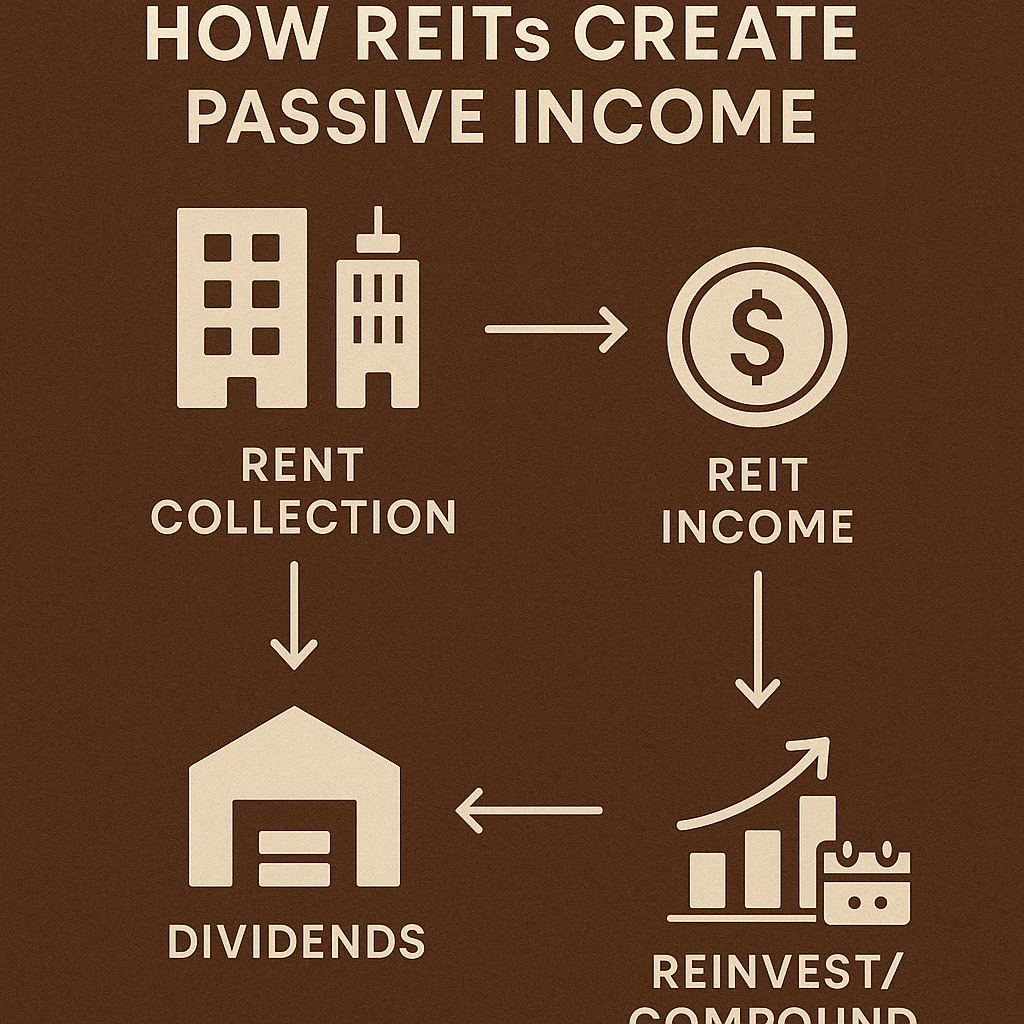
- Dividend Distributions: The rent paid by tenants of the REIT’s properties is collected, expenses are deducted, and the remaining income is distributed to you, the shareholder. Most REITs pay dividends quarterly, though many pay monthly, making them exceptionally attractive for investors seeking regular cash flow .
- Capital Appreciation: As the underlying properties increase in value or as the REIT acquires more assets, the share price may rise, allowing you to sell your shares for a profit.
Why REITs Are Ideal for Passive Income
When considering how to invest in REITs for passive income, it’s essential to understand why they stand out among income-generating assets.
1. Truly Passive Nature
Unlike direct rental properties, which often require late-night phone calls and costly repairs, REITs are managed by professional teams. “With REITs, you don’t have to deal with tenant issues or property maintenance. Professional managers take care of everything, from buying properties to leasing and upkeep” . Your role is simply to own the shares and collect the dividends.
is debt consolidation a good idea?
2. Attractive Yields
REITs are known for their above-average dividend yields. As of 2025, REIT dividend yields average around 4%, compared to the S&P 500’s average yield of approximately 1.27% . Some individual REITs, like Realty Income (O), offer yields around 6% with a long history of monthly payouts and annual increases .
3. Liquidity
Publicly traded REITs trade on major stock exchanges just like stocks. This means you can buy or sell shares on any trading day, providing a level of liquidity that direct real estate investing simply cannot match .
4. Diversification
A single REIT may own hundreds or thousands of properties across different geographic regions and property types. REIT ETFs take this further, offering exposure to entire sectors of the real estate market in one purchase .
5. Inflation Hedge
Real estate has historically served as a hedge against inflation. As prices rise, so do property values and the rents landlords can charge. Since REITs must distribute most of their income, rising rents translate directly into higher dividend payouts for investors .
first-time home buyer grants and programs 2024
6. Accessibility
You can begin how to invest in REITs for passive income with as little as the price of a single share, often under $100. This contrasts sharply with direct property investment, which typically requires tens of thousands of dollars for a down payment .
7. Historical Performance
Over the long term, REITs have delivered compelling returns. Since 1972, REITs have delivered an average annual total return of 12.6%, according to the National Association of REITs (Nareit) . The FTSE Nareit All Equity REITs Index posted a 25-year annual total return of 9.53% through April 2025, outperforming the S&P 500’s 7.52% over the same period .
Types of REITs: Choosing Your Path
Not all REITs are created equal. Understanding the different types is crucial when learning how to invest in REITs for passive income, as each category carries distinct risk and return profiles.
how much house can I afford on a $70,000 salary?
By Share Type
Publicly Traded REITs
- Description: Listed on stock exchanges and trade like stocks
- Liquidity: High—can be bought or sold any trading day
- Minimum Investment: Price of one share (often $10-$100)
- Volatility: Subject to stock market fluctuations
- Transparency: Required to file regular reports with SEC
Public Non-Traded REITs
- Description: Registered with SEC but not listed on exchanges
- Liquidity: Low—redemptions may be limited or unavailable for years
- Minimum Investment: Typically $1,000-$2,500
- Volatility: Appear less volatile due to infrequent pricing, but underlying risks remain
- Transparency: More disclosure than private REITs, but less than public traded
Private REITs
- Description: Not registered with SEC; sold through private placements
- Liquidity: Very low—capital may be locked for 5-10 years
- Minimum Investment: Often $25,000-$100,000+
- Accreditation: Usually limited to accredited investors
- Transparency: Limited public information
- FHA loan vs Conventional loan requirements
By Property Type
Equity REITs
These REITs own and operate income-producing real estate. They generate revenue primarily through rent, not property sales. This is the most common type of REIT and the primary focus for income investors.
Mortgage REITs (mREITs)
These REITs provide financing for income-producing real estate by purchasing or originating mortgages and mortgage-backed securities. They earn income from interest. mREITs can offer very high yields but are more sensitive to interest rate changes and carry different risk profiles than equity REITs.
Hybrid REITs
These combine the strategies of equity and mortgage REITs, both owning properties and holding mortgages.
Sector-Specific REITs
When exploring how to invest in REITs for passive income, you’ll encounter REITs specializing in various property sectors:
| Sector | Description | Example |
|---|---|---|
| Residential | Apartments, manufactured housing, single-family rentals | Equity Residential (EQR), AvalonBay (AVB) |
| Industrial | Warehouses, distribution centers, logistics facilities | Prologis (PLD) |
| Retail | Shopping malls, strip centers, freestanding retail | Simon Property Group (SPG), Realty Income (O) |
| Office | Commercial office buildings | Boston Properties (BXP) |
| Healthcare | Hospitals, senior living, medical offices | Welltower (WELL), Ventas (VTR) |
| Data Centers | Server farms, digital infrastructure | Digital Realty (DLR), Equinix (EQIX) |
| Self-Storage | Personal and business storage facilities | Public Storage (PSA), Extra Space Storage (EXR) |
| Infrastructure | Cell towers, energy pipelines | American Tower (AMT), Crown Castle (CCI) |
How to Start Investing in REITs for Passive Income
Now that you understand the basics, let’s move to the practical steps of how to invest in REITs for passive income.
mortgage pre-approval process step-by-step
Step 1: Choose Your Investment Vehicle
Individual REITs
Purchasing shares of individual REITs allows you to target specific sectors and potentially earn higher yields. However, this approach requires more research and carries company-specific risk. “It’s equivalent to buying an individual stock, so you need to make sure you’re on top of the research. Each REIT is different, and oftentimes, one might be more concentrated in certain sectors” .
REIT ETFs
Exchange-traded funds that hold baskets of REIT stocks offer instant diversification. “A great way for beginners to start generating passive income from real estate is through REIT ETFs. These ETFs hold a broad basket of REITs, which reduces the risk of losing income if a single investment cuts its dividend” . Examples include the Vanguard Real Estate ETF (VNQ) and the Schwab US REIT ETF (SCHH).
REIT Mutual Funds
Similar to ETFs but typically actively managed, REIT mutual funds may offer the potential for outperformance but often come with higher expense ratios and minimum investment requirements .
is it better to rent or buy a home right now?
Step 2: Open an Account
To invest in publicly traded REITs or REIT ETFs, you’ll need a brokerage account. Popular options include:
- US: Vanguard, Fidelity, Charles Schwab, Robinhood
- Europe: DEGIRO, Interactive Brokers, Saxo Bank
For private REITs or real estate crowdfunding, you’ll need to register directly with platforms like Fundrise, CrowdStreet, or RealtyMogul.
Step 3: Set Your Investment Strategy
Before buying, consider:
- Income Needs: Do you need maximum current income or long-term growth?
- Risk Tolerance: Can you handle stock market volatility?
- Time Horizon: When will you need to access your capital?
- Tax Situation: Are you investing in a tax-advantaged account?
Step 4: Start Small and Build
You don’t need a large sum to begin. Consider starting with a REIT ETF to gain diversified exposure while you research individual REITs. Many investors use dollar-cost averaging—investing a fixed amount regularly—to build their positions over time.
how to improve credit score before applying for a mortgage
Evaluating REITs: Key Metrics and Analysis
If you choose to invest in individual REITs, you’ll need to look beyond the standard metrics used for common stocks. Here are the essential metrics for evaluating how to invest in REITs for passive income effectively:
1. Funds from Operations (FFO)
Real estate depreciates on paper due to accounting rules, even when property values are actually rising. This makes net income a misleading metric for REITs. FFO adds back depreciation and amortization to net income, providing a clearer picture of operating performance.
Formula: FFO = Net Income + Depreciation & Amortization – Gains on Property Sales
costs of buying a home besides the down payment
2. Adjusted Funds from Operations (AFFO)
AFFO goes further by subtracting capital expenditures required to maintain the property portfolio. This represents the truly distributable cash flow and is the best indicator of a REIT’s ability to sustain and grow its dividend.
3. Dividend Yield
The annual dividend divided by the share price. While attractive, be wary of yields that are significantly higher than peers—they may signal market concern about dividend sustainability.
4. Payout Ratio
Calculate AFFO payout ratio (Dividends per Share / AFFO per Share). A ratio below 90% suggests the dividend is well-covered, while ratios consistently above 100% may indicate an unsustainable payout.
5. Debt Ratios
REITs use debt to finance property acquisitions. Key metrics include:
- Debt-to-EBITDA: Lower is generally better; above 7x may indicate high leverage
- Interest Coverage Ratio: EBITDA / Interest Expense; above 3x is typically healthy
- Debt-to-Total-Assets: Provides perspective on overall leverage
6. Net Asset Value (NAV)
NAV estimates the underlying value of a REIT’s properties minus its liabilities. Comparing share price to NAV can help identify undervalued opportunities.
7. Same-Store NOI
This metric shows how revenue from properties owned for at least one full year has changed, providing insight into organic growth independent of acquisitions.
Top REIT Sectors for Passive Income in 2025-2026
Based on current market conditions and long-term trends, these REIT sectors offer compelling opportunities for passive income investors:
1. Industrial REITs
E-commerce growth continues to drive demand for warehouse and distribution space. Industrial REITs like Prologis (PLD) have shown strong rent growth and occupancy rates.
2. Residential REITs
Housing affordability challenges are driving rental demand. Apartment REITs such as Equity Residential (EQR) and Killam Apartment REIT (KMP.UN) demonstrate the resilience of this sector. “Apartment REITs are among the most dependable REITs out there, as they lease a property type that will always be needed. Malls can die, hotels can lose their lustre, but people will always need places to sleep at night” .
3. Healthcare REITs
Aging demographics in the US and Europe support demand for senior housing and medical office buildings. Welltower (WELL) and Ventas (VTR) are major players in this space.
government programs for medical debt relief
4. Net Lease REITs
These REITs own properties leased to single tenants under long-term, triple-net leases where the tenant pays insurance, taxes, and maintenance. Realty Income (O) is the archetypal example, with a portfolio of over 15,000 properties and a history of monthly dividend payments since its 1994 listing .
5. Data Center REITs
The digital economy’s backbone, data center REITs like Digital Realty (DLR) and Equinix (EQIX) benefit from the insatiable demand for cloud computing and data storage.
Building a Diversified REIT Portfolio
A well-constructed portfolio is essential to successful how to invest in REITs for passive income. Here’s a framework for building yours:
The Core-Satellite Approach
Core (60-70% of portfolio): Invest in broad REIT ETFs or large-cap, diversified REITs to establish a stable foundation. VNQ or SCHH provide exposure across all sectors and market capitalizations.
Satellite (30-40% of portfolio): Add individual REITs in sectors where you have particular conviction or want to overweight specific themes like healthcare or industrial.
Sample Portfolio Allocation
For a balanced passive income portfolio targeting 5-6% yield with growth potential:
| Allocation | Sector | Purpose |
|---|---|---|
| 25% | REIT ETF (e.g., VNQ) | Broad diversification, core holding |
| 20% | Residential | Stable demand, demographic tailwinds |
| 15% | Industrial | E-commerce growth, supply chain trends |
| 15% | Net Lease | Predictable income, low volatility |
| 10% | Healthcare | Aging demographics, defensive |
| 10% | Data Center/Infrastructure | Digital economy exposure |
| 5% | Self-Storage | Resilient, high-margin business |
Geographic Diversification
While US REITs dominate the market, consider adding international exposure:
- European REITs: Access through ETFs like the iShares Developed Markets Property Yield ETF
- Canadian REITs: Consider RIOCAN (REI.UN) or Granite REIT (GRT.UN), which offers a 4.4% yield with 14 consecutive years of distribution increases
- Asian REITs: Singapore and Japan have mature REIT markets
REITs vs. Other Passive Income Investments
Understanding how to invest in REITs for passive income also means understanding how they compare to alternatives:
REITs vs. Direct Rental Properties
| Factor | REITs | Direct Rental |
|---|---|---|
| Passiveness | Truly passive | Active management required |
| Liquidity | High—sell anytime | Low—months to sell |
| Capital Required | Low—price of one share | High—20% down payment |
| Diversification | Built-in across properties | Single property |
| Control | None | Full control |
| Leverage | Professional management | Personal mortgage required |
REITs vs. Dividend Stocks
| Factor | REITs | Dividend Stocks |
|---|---|---|
| Average Yield | ~4% | ~1.3% (S&P 500) |
| Payout Requirements | Must pay 90% of income | No requirement |
| Dividend Growth | Growing rents support increases | Varies by company |
| Tax Treatment | Generally ordinary income | Qualified dividends taxed lower |
REITs vs. Bonds
| Factor | REITs | Bonds |
|---|---|---|
| Income Stability | Variable, can grow | Fixed payments |
| Principal Risk | Can lose value | Return principal at maturity (if held) |
| Inflation Protection | Yes—rents rise with inflation | No—fixed payments lose purchasing power |
| Upside Potential | Capital appreciation | None |
Tax Implications for US and European Investors
Tax considerations are a crucial part of how to invest in REITs for passive income, and they differ significantly between US and European investors.
For US Investors
Taxable Accounts
Most REIT dividends are taxed as ordinary income at your marginal tax rate, not at the lower qualified dividend rate. This is because REITs generally don’t pay corporate tax, so the tax preference doesn’t pass through to shareholders. However, a portion of the dividend may be classified as:
- Return of Capital: Reduces your cost basis and isn’t taxed until you sell shares
- Capital Gains: Taxed at capital gains rates
Tax-Advantaged Accounts
REITs are ideally suited for IRAs and 401(k)s, where the ordinary income tax treatment doesn’t matter, and dividends can compound tax-deferred or tax-free.
For European Investors
Tax treatment varies by country, but general principles apply:
Withholding Taxes
The US imposes a 30% withholding tax on dividends paid to foreign investors, which may be reduced under tax treaties. For example, the US-UK treaty reduces this to 15% for UK residents.
Local Taxation
Most European countries tax REIT dividends as ordinary income. However, some countries have special treatment for real estate investment vehicles. For instance, UK REITs must distribute 90% of income and UK residents pay tax on these dividends at their marginal rate, but the REIT itself pays no corporation tax on qualifying property income.
EU REITs
Consider investing in domestic or EU-domiciled REITs, which may offer more favorable tax treatment. Many EU countries (UK, France, Germany, Netherlands, Belgium) have their own REIT regimes.
Risks and How to Mitigate Them
No discussion of how to invest in REITs for passive income would be complete without addressing risks:
1. Interest Rate Sensitivity
REITs often underperform when interest rates rise, as higher rates increase borrowing costs and make bonds more competitive for income.
Mitigation: Focus on REITs with low leverage, long-term fixed-rate debt, and the pricing power to pass higher costs to tenants.
2. Economic Cyclicality
Some REIT sectors (office, retail) are more sensitive to economic downturns than others (healthcare, residential).
Mitigation: Diversify across sectors and favor defensive sectors with essential demand.
3. Dividend Cuts
Economic stress or poor management can lead to dividend reductions, impacting your passive income.
Mitigation: Evaluate payout ratios, AFFO coverage, and management track records before investing .
4. Market Volatility
Publicly traded REITs can experience significant price swings, even when underlying property values are stable.
Mitigation: Maintain a long-term perspective and consider dollar-cost averaging.

5. Sector-Specific Risks
- Retail: E-commerce competition affecting brick-and-mortar
- Office: Remote work trends reducing demand
- Healthcare: Regulatory changes impacting reimbursement
Mitigation: Stay informed about sector trends and maintain diversified exposure.
Case Study: Building a $100,000 Monthly Income Portfolio
Let’s apply the principles of how to invest in REITs for passive income to a real-world example. Imagine you have $100,000 to deploy in a portfolio designed to generate monthly income.
The Goal
Generate approximately $4,000-$5,000 in annual passive income ($333-$416 per month) with potential for dividend growth.
The Portfolio Construction
| Investment | Allocation | Yield | Annual Income | Rationale |
|---|---|---|---|---|
| Vanguard Real Estate ETF (VNQ) | $30,000 | 4.1% | $1,230 | Core diversified holding |
| Realty Income (O) | $20,000 | 5.8% | $1,160 | Monthly payer, net lease focus |
| Prologis (PLD) | $15,000 | 3.2% | $480 | Industrial growth + income |
| Welltower (WELL) | $15,000 | 3.5% | $525 | Healthcare exposure |
| Killam Apartment REIT (KMP.UN) | $10,000 | 4.1% | $410 | Residential, monthly payer |
| Granite REIT (GRT.UN) | $10,000 | 4.4% | $440 | Industrial, 14-year growth streak |
| Total | $100,000 | 4.45% (weighted avg) | $4,245 |
Expected Monthly Income: $354
This portfolio provides:
- Diversification across sectors and geographies
- Monthly payers like O and KMP.UN for regular cash flow
- Growth potential from industrial and healthcare holdings
- Reinvestment opportunity: Dividends can be reinvested to compound growth
Frequently Asked Questions
Q1: What is the minimum amount needed to invest in REITs?
You can start investing in publicly traded REITs with as little as the price of one share, often $50-$100. REIT ETFs can be purchased for similar amounts. Private REITs typically require $1,000-$25,000 minimums .
Q2: Are REIT dividends really passive income?
Yes. Unlike rental properties, REITs require no active involvement from shareholders. Professional management teams handle all property operations, leasing, and maintenance. You simply collect dividends .
Q3: How often do REITs pay dividends?
Frequency varies by REIT. Many pay quarterly, but a significant number—particularly those focused on income investors—pay monthly dividends. Realty Income (O) and Killam Apartment REIT (KMP.UN) are examples of monthly payers .
Q4: Can I lose money investing in REITs?
Yes. Like all investments, REITs carry risk. Share prices can decline due to rising interest rates, economic downturns, or company-specific issues. However, diversification and long-term holding can help manage these risks .
Q5: Are REITs good for retirement accounts?
REITs are excellent for tax-advantaged retirement accounts like IRAs and 401(k)s. Since REIT dividends are typically taxed as ordinary income, holding them in tax-advantaged accounts defers or eliminates this tax drag .
Q6: What’s the difference between a REIT and a real estate syndication?
REITs are companies that own diversified property portfolios, while syndications pool money for specific properties or projects. REITs (especially public ones) offer liquidity; syndications typically lock up capital for 5-10 years. Syndications may offer higher potential returns but require larger minimum investments and accredited investor status .
Q7: How are REITs affected by interest rate changes?
REITs can be sensitive to interest rates. When rates rise, borrowing costs increase, and income-oriented investors may shift to bonds. However, many REITs can raise rents with inflation, potentially offsetting rate impacts over time.
Q8: Should I invest in REIT ETFs or individual REITs?
For beginners, REIT ETFs offer instant diversification and lower risk. As you gain experience, you can add individual REITs to target specific sectors or potentially enhance yield. Many investors use a combination of both .
Q9: Do REITs perform well during inflation?
Historically, REITs have served as an inflation hedge. Property values and rents tend to rise with inflation, and REITs must distribute most income to shareholders, so dividend payments typically increase over time .
Q10: Can European investors buy US REITs?
Yes. European investors can purchase US-listed REITs through international brokerage accounts. However, be aware of currency exchange rates and withholding taxes, which may be reduced under tax treaties between the US and your country of residence.
Conclusion
Learning how to invest in REITs for passive income opens the door to one of the most accessible and effective wealth-building strategies available to modern investors. REITs combine the income potential of real estate with the liquidity and simplicity of stock market investing, all while requiring none of the hands-on work that direct property ownership demands.
As we’ve explored throughout this guide, successful REIT investing involves understanding the different types of REITs, evaluating key metrics like FFO and AFFO, diversifying across sectors, and considering your personal tax situation. Whether you’re just starting with a REIT ETF or building a portfolio of individual holdings, the principles remain the same: focus on quality, prioritize sustainable dividends, and maintain a long-term perspective.
The data supporting REITs as a core portfolio component is compelling. With historical returns that have often exceeded the S&P 500, current yields that far outpace the broad market, and a legal structure designed to flow income directly to shareholders, REITs represent a powerful tool for generating passive income .
Remember that how to invest in REITs for passive income is not about finding a shortcut to wealth. It’s about building a reliable, growing income stream through disciplined investing and the power of compounding. As financial advisor Chad Olivier notes, buying individual REITs requires thorough research, but the rewards can be significant .
For US investors, consider holding REITs in tax-advantaged accounts to maximize after-tax returns. For European investors, explore both local REIT markets and US options while being mindful of tax treaties and currency considerations.
The journey to financial independence through passive income is a marathon, not a sprint. By incorporating REITs into your investment strategy, you’re building a foundation that can provide cash flow for years to come—without ever having to answer a 2 a.m. maintenance call or scrub an Airbnb toilet .
Start small, stay diversified, reinvest your dividends, and let time and compounding work their magic. Whether your goal is to supplement your retirement income, achieve financial independence, or simply put your savings to work more effectively, mastering how to invest in REITs for passive income is a skill that will serve you well for a lifetime.