Introduction: Embarking on Your Investment Journey
Choosing your first mutual fund is a pivotal step toward financial independence and wealth building. For many new investors in the United States and Europe, the world of mutual funds can seem complex and overwhelming. With thousands of funds available, each with different strategies, fees, and risk profiles, how do you make an informed decision that aligns with your financial goals?
This comprehensive guide will walk you through every aspect of how to choose your first mutual fund. Whether you’re saving for retirement, a down payment on a house, or your child’s education, understanding how to select the right mutual fund is crucial. By the end of this article, you’ll have the knowledge and confidence to make an intelligent choice that suits your unique financial situation and risk tolerance.
Is Investing in Cryptocurrency Safe for Beginners?
Understanding Mutual Funds: The Foundation
What Exactly Is a Mutual Fund?
A mutual fund is a professionally managed investment vehicle that pools money from multiple investors to purchase a diversified portfolio of stocks, bonds, or other securities. When you buy shares in a mutual fund, you’re essentially buying a small piece of a large, diversified portfolio, which would be difficult and expensive to recreate on your own.
Key Advantages of Mutual Funds
- Professional Management: Experienced fund managers make investment decisions on your behalf.
- Diversification: Your investment is spread across many securities, reducing risk.
- Accessibility: You can start investing with relatively small amounts of money.
- Liquidity: Mutual fund shares can typically be bought or sold on any business day.
- Variety: Funds exist for nearly every investment objective and risk tolerance.
Types of Mutual Funds
Understanding the different types of mutual funds is essential when learning how to choose your first mutual fund:
- Equity Funds: Invest primarily in stocks. They offer higher growth potential but come with greater volatility.
- Bond Funds: Invest in government and corporate debt. Generally more stable but with lower return potential.
- Balanced Funds: Mix of stocks and bonds to provide growth and income.
- Index Funds: Designed to track a specific market index like the S&P 500.
- Sector Funds: Focus on specific industry sectors (technology, healthcare, etc.).
- International/Global Funds: Invest in securities from outside your home country.
- Money Market Funds: Invest in short-term debt securities and are considered very low risk.
how to invest in S&P 500 from Europe (or UK, Germany, etc.)
Step-by-Step Guide: How to Choose Your First Mutual Fund
Step 1: Define Your Financial Goals and Timeline
Before you even look at specific funds, you must clarify why you’re investing:
- Short-term goals (1-3 years): Consider more conservative options like bond or money market funds
- Medium-term goals (3-10 years): A balanced approach with mixed asset allocation
- Long-term goals (10+ years): Can afford more risk with equity-heavy funds
Ask yourself:
- What am I investing for? (Retirement, home purchase, education, etc.)
- When will I need this money?
- How much risk can I comfortably tolerate?
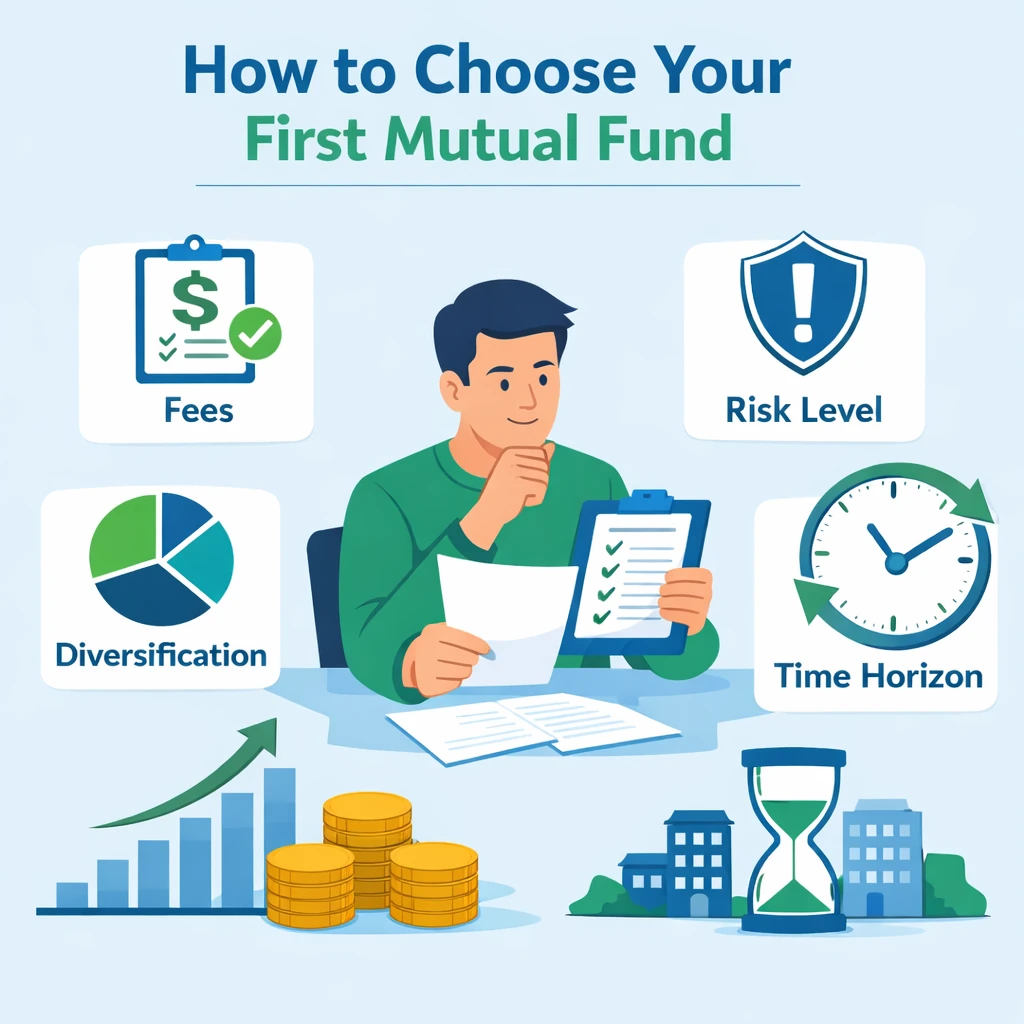
Step 2: Assess Your Risk Tolerance
Your risk tolerance is personal and depends on several factors:
- Time Horizon: Longer timelines generally allow for more risk
- Financial Situation: Stable income and emergency savings enable more aggressive investing
- Emotional Comfort: How will you react if your investment drops 20% in a year?
Take a risk assessment questionnaire (many brokerage firms offer these free online) to determine whether you’re conservative, moderate, or aggressive in your investment approach.
best stocks for dividend income for beginners
Step 3: Understand Asset Allocation
Asset allocation—how you divide your investments among different asset classes—is arguably more important than which specific funds you choose. A common guideline is the “100 minus age” rule for stock allocation: Subtract your age from 100 to determine what percentage of your portfolio should be in stocks. However, this is just a starting point and should be adjusted based on your personal circumstances.
Step 4: Research and Compare Funds
When learning how to choose your first mutual fund, thorough research is non-negotiable. Key factors to examine:
Performance Metrics
- Look at long-term performance (5-10 years) rather than short-term results
- Compare performance to relevant benchmarks and peer groups
- Consider both bull and bear market performance
how to start investing with $100 or less
Expense Ratios
The expense ratio represents the annual fee charged by the fund, expressed as a percentage of assets. For example, a 1% expense ratio means you pay $10 annually for every $1,000 invested. Lower expense ratios generally translate to higher returns over time.
Fund Manager Tenure and Strategy
- How long has the current manager been in place?
- Is there a consistent investment philosophy?
- What is the manager’s track record?
Fund Size and Age
- Very large funds may face challenges in being nimble
- Very new funds lack a substantial track record
- Consider funds with at least $100 million in assets and several years of history
Step 5: Evaluate Costs and Fees
Beyond the expense ratio, be aware of:
- Sales loads: Commission charges when buying (front-end) or selling (back-end) shares
- Transaction fees: Charges for buying or selling fund shares
- Account minimums: Some funds require substantial initial investments
best robo-advisors for beginners 2024 comparison
No-load funds with low expense ratios are generally preferable for beginners learning how to choose your first mutual fund.
Step 6: Consider Tax Implications
Tax efficiency matters, especially in taxable accounts:
- Turnover rate: Higher turnover typically generates more taxable capital gains
- Tax-managed funds: Specifically designed to minimize tax consequences
- Location strategy: Place tax-inefficient funds in tax-advantaged accounts (like IRAs)
Step 7: Diversification Within Your Choice
Even within a mutual fund category, ensure proper diversification:
- Don’t invest all your money in one sector or geographic region
- Consider how the fund complements your other investments
- Remember that some funds may overlap in their holdings
Step 8: Make Your Selection and Implement
After thorough research:
- Start with a single fund that matches your risk profile and goals
- Consider low-cost broad market index funds for your first investment
- Implement a regular investment plan (dollar-cost averaging)
- Set up automatic contributions if possible
Common Pitfalls to Avoid When Choosing Your First Mutual Fund
Chasing Past Performance
One of the biggest mistakes beginners make is selecting funds based solely on recent high returns. Past performance does not guarantee future results, and yesterday’s top performer may become tomorrow’s laggard.
ETF vs index fund: which is better for a beginner?
Overlooking Fees
Even small differences in fees can compound significantly over decades. A fund with a 1% expense ratio versus 0.1% can cost you tens of thousands of dollars over an investment lifetime.
Ignoring Your Own Risk Tolerance
Choosing an aggressive growth fund because it has high returns, despite having a conservative risk tolerance, sets you up for panic selling during market downturns.
Failing to Rebalance
Once you’ve chosen your first mutual fund, your work isn’t done. Regular portfolio reviews and rebalancing are essential to maintain your target asset allocation.
Trying to Time the Market
Many new investors wait for the “perfect time” to invest. Time in the market generally beats timing the market. Start as soon as you’ve done your research.
Recommended First Mutual Funds for Beginners
While specific recommendations depend on individual circumstances, here are some fund types particularly suitable for first-time investors:
For Conservative Investors
- Total Bond Market Index Funds: Provide broad exposure to the U.S. bond market with minimal fees
- Balanced Funds: Offer automatic diversification between stocks and bonds
For Moderate Investors
- Target Date Funds: Automatically adjust asset allocation as you approach a specific date (like retirement)
- Total Stock Market Index Funds: Provide exposure to the entire U.S. equity market
For Aggressive Investors
- Growth-Oriented Index Funds: Focus on companies with above-average growth potential
- S&P 500 Index Funds: Track the 500 largest U.S. companies with very low fees
how to open a brokerage account for the first time
How to Monitor Your First Mutual Fund
After you’ve completed the process of how to choose your first mutual fund, establish a monitoring routine:
- Review Quarterly Statements: Check performance against appropriate benchmarks
- Annual Check-up: Conduct a thorough review of your fund and overall portfolio annually
- Watch for Changes: Be alert to changes in fund management, strategy, or fee structure
- Avoid Over-monitoring: Daily checking can lead to emotional decisions; focus on long-term trends
The Role of Technology in Choosing Mutual Funds
Modern technology has simplified the process of how to choose your first mutual fund:
- Robo-advisors: Automated platforms that create and manage portfolios based on your goals
- Comparison Tools: Websites that allow side-by-side comparison of fund metrics
- Screening Tools: Filter funds based on specific criteria (fees, performance, minimum investment)
- Educational Resources: Online courses, webinars, and articles to enhance your knowledge
Frequently Asked Questions (FAQs)
Q: How much money do I need to invest in my first mutual fund?
A: Many mutual funds have minimum initial investments ranging from $100 to $3,000. However, some brokerages offer funds with no minimums, and many employer-sponsored retirement plans allow you to start with small regular contributions.
Q: Should I choose active or passive funds for my first investment?
A: For most beginners, low-cost index funds (passive) are an excellent starting point. They provide broad market exposure, have lower fees, and historically outperform most actively managed funds over the long term.
Q: How many mutual funds should I own as a beginner?
A: Start with one or two well-diversified funds. A single target-date fund or a combination of a total stock market fund and a total bond market fund can provide excellent diversification. Avoid “di-worsification”—owning too many overlapping funds.
Q: Are mutual funds safer than individual stocks?
A: Mutual funds are generally less risky than individual stocks due to diversification. If one company in the fund performs poorly, others may perform well, cushioning the impact. However, mutual funds are still subject to market risk.
Q: How do I actually buy my first mutual fund?
A: You can purchase mutual funds through:
- Online brokerage accounts
- Directly from mutual fund companies
- Employer-sponsored retirement plans (401k, 403b)
- Financial advisors
Q: What’s the difference between mutual funds and ETFs?
A: While similar, ETFs trade like stocks throughout the day, while mutual funds are priced once daily after market close. ETFs often have lower minimum investments and may be more tax-efficient, but mutual funds allow automatic investing in dollar amounts.
what is dollar-cost averaging and how to set it up
Q: How important is a fund’s star rating?
A: Ratings from companies like Morningstar can be helpful screening tools but shouldn’t be the sole deciding factor. These ratings are based on past performance and don’t predict future results. Use them as one data point among many.
Q: Can I lose all my money in a mutual fund?
A: While it’s theoretically possible, it’s extremely unlikely with a diversified mutual fund. The fund would need all its holdings to go to zero, which is improbable with a properly diversified portfolio.
Q: How often should I contribute to my mutual fund?
A: Regular contributions, regardless of market conditions (dollar-cost averaging), is a sound strategy. Many investors contribute with each paycheck through automatic transfers.
Q: When should I sell my mutual fund?
A: Consider selling if:
- The fund consistently underperforms its benchmark for several years
- There’s a significant change in fund management or strategy
- Your financial goals or risk tolerance have changed
- The fund’s fees increase substantially
how to stop impulse buying online
Conclusion: Taking the First Step with Confidence
Learning how to choose your first mutual fund is an empowering process that sets the foundation for your financial future. While the array of options may seem daunting initially, following a systematic approach—defining your goals, understanding your risk tolerance, researching thoroughly, and avoiding common pitfalls—will lead you to an appropriate choice.
Remember that your first mutual fund selection isn’t a lifetime commitment. As your knowledge grows and your circumstances change, you can adjust your investments accordingly. The most important step is to begin. Start small if needed, but start. Time is one of the most powerful forces in investing, thanks to compound growth.
By applying the principles outlined in this guide on how to choose your first mutual fund, you’re positioning yourself for long-term financial success. You’re not just picking an investment vehicle; you’re establishing habits of research, due diligence, and disciplined investing that will serve you throughout your financial journey.
Take your time, do your homework, and make a choice that aligns with both your head and your gut. Your future self will thank you for the careful consideration you gave to choosing your first mutual fund.