Meta Description: Compare the snowball vs avalanche method calculator side-by-side. See real examples, interest savings, and payoff timelines to choose the best debt strategy for you. Updated for 2026.
Table of Contents:
- Introduction
- Section 1: Understanding the Two Titans of Debt Repayment
- Section 2: The Psychology vs. The Math
- Section 3: Real-World Examples with Numbers
- Section 4: How to Use a Snowball vs Avalanche Method Calculator
- Section 5: Top Free Calculators Compared
- Section 6: The Hybrid “Debt Blizzard” Strategy
- Section 7: Step-by-Step Implementation Guide
- Section 8: When to Switch Methods
- Section 9: Advanced Tips to Supercharge Your Payoff
- Section 10: Common Pitfalls and How to Avoid Them
- Frequently Asked Questions (FAQ)
- Conclusion
Introduction
If you’re carrying credit card balances, student loans, or any other debt, you’ve likely encountered two popular strategies: the debt snowball and the debt avalanche. But which one is right for you? The answer isn’t always mathematical—it’s personal.
A snowball vs avalanche method calculator is the tool that can help you make this decision with clarity. By inputting your actual debts, balances, interest rates, and monthly payments, these calculators show you exactly how much each strategy will cost in total interest, how long until you’re debt-free, and—most importantly—how quickly you’ll see your first “win” .
This comprehensive guide will walk you through everything you need to know about choosing between these methods, using calculators effectively, and customizing a plan you’ll actually stick with. Whether you’re a spreadsheet enthusiast who wants to optimize every dollar or someone who needs psychological momentum to stay motivated, we’ve got you covered.
Section 1: Understanding the Two Titans of Debt Repayment
Before we dive into calculators, let’s establish a rock-solid foundation of what these methods actually are and how they differ.
What Is the Debt Snowball Method?
The debt snowball method is a debt repayment strategy where you focus on paying off your smallest debts first, regardless of interest rate, while making minimum payments on all other debts .
How It Works:
- List all debts from smallest balance to largest balance (ignore interest rates entirely at this stage)
- Make minimum payments on every debt except the smallest one
- Throw every extra dollar at that smallest debt until it’s gone
- Celebrate! You’ve just eliminated an entire debt
- Roll that payment (the minimum plus the extra) into the next smallest debt
- Repeat until all debts are eliminated
The name comes from the visual: as you roll payments forward, your debt-fighting power grows like a snowball rolling downhill, picking up more snow (money) along the way .
What Is the Debt Avalanche Method?
The debt avalanche method, sometimes called “debt stacking” or “roll-down,” prioritizes paying off debts with the highest interest rates first .
How It Works:
- List all debts from highest interest rate to lowest interest rate (balance size doesn’t matter)
- Make minimum payments on every debt except the highest-rate one
- Throw every extra dollar at that highest-rate debt until it’s gone
- Roll that payment into the next highest-rate debt
- Repeat until all debts are eliminated
This approach is mathematically optimized to minimize the total interest you’ll pay over your debt repayment journey .
Side-by-Side Comparison
| Feature | Debt Snowball | Debt Avalanche |
|---|---|---|
| Order of Attack | Smallest balance first | Highest interest rate first |
| Primary Focus | Psychological momentum | Mathematical efficiency |
| Total Interest Paid | Potentially more | Minimized |
| Payoff Speed | Can be slower overall | Generally fastest |
| First “Win” | Fast (often 1-3 months) | Can take months or years |
| Best For | Those who need motivation, have many small debts | Disciplined, analytical personalities, large rate differences |
Section 2: The Psychology vs. The Math
This is where the snowball vs avalanche debate gets interesting—and where a good calculator becomes essential.
Why the Avalanche Wins on Paper
Mathematically, the avalanche method is objectively superior. By attacking the highest interest rate first, you’re stopping the most expensive debt from growing. Every dollar you put toward a 24% credit card saves you 24 cents per year in interest—far more than the same dollar would save on a 6% car loan .
The Math Doesn’t Lie:
Consider two debts:
- Debt A: $1,000 at 24% APR
- Debt B: $5,000 at 6% APR
If you have $500 extra monthly to put toward debt:
- Avalanche attacks Debt A first. You’ll pay it off in about 2 months, saving approximately $40 in interest that would have accrued over those two months.
- Snowball attacks Debt A anyway (it’s also the smallest), so you get the same result.
But what if the numbers were reversed?
- Debt A: $5,000 at 24% APR (large balance, high rate)
- Debt B: $1,000 at 6% APR (small balance, low rate)
Now the choice matters:
- Avalanche attacks Debt A first. You might spend 8-10 months throwing everything at that big, high-rate debt before seeing any account completely paid off.
- Snowball attacks Debt B first. You’ll have that small debt eliminated in 2-3 months, giving you a psychological win.
Why the Snowball Wins in Real Life
Here’s the truth that pure mathematicians often miss: debt repayment is a behavior problem, not a math problem .
Research has shown that people using the snowball method are more likely to eliminate their debt entirely, even when avalanche would have saved them money. The completion rate advantage often outweighs the interest cost .
Why? Because motivation matters. When you see progress—when you can actually cross a debt off your list—you feel empowered. That feeling keeps you going when the journey gets hard. The snowball method provides quick wins that build momentum and confidence .
The 3-Question Strategy Picker
To help you decide which method fits your personality, ask yourself these questions honestly :
Question 1: How patient are you with long-term goals?
- A) I can grind for months without visible progress if I know it’s working
- B) I need regular wins to stay motivated—if I don’t see progress, I’ll quit
Question 2: How many debts do you have?
- A) 2-3 debts
- B) 4 or more debts
Question 3: What’s your emergency fund situation?
- A) I have at least $1,000 saved for emergencies
- B) I have little to no emergency savings
Scoring:
- Mostly A’s: Avalanche is probably your best bet. You have the patience and financial cushion to optimize for interest savings.
- Mostly B’s: Snowball will likely serve you better. You need wins, you have many debts to juggle, and psychological momentum matters more than saving a few hundred dollars.
- Mixed: Consider a hybrid approach (we’ll cover this later).
- Embarking on Your Investment Journey
Section 3: Real-World Examples with Numbers
Let’s walk through detailed examples so you can see exactly how these methods compare with real numbers. We’ll use a typical debt portfolio that might represent someone in their late 20s or early 30s.
The Example Debt Portfolio
| Debt | Balance | APR | Minimum Payment |
|---|---|---|---|
| Store Credit Card | $800 | 26.99% | $25 |
| Credit Card A | $2,500 | 19.99% | $50 |
| Personal Loan | $5,000 | 11.99% | $150 |
| Credit Card B | $8,500 | 22.49% | $200 |
| Total | $16,800 | $425 |
Assumptions:
- You have an extra $300 per month to put toward debt beyond minimum payments
- Total monthly debt payment budget: $725 ($425 minimums + $300 extra)
Snowball Method Results
With snowball, we order debts by balance (smallest to largest):
- Store Card: $800 at 26.99%
- Credit Card A: $2,500 at 19.99%
- Personal Loan: $5,000 at 11.99%
- Credit Card B: $8,500 at 22.49%
Timeline:
- Months 1-3: Attack the store card with $300 extra + $25 minimum = $325/month. It’s gone in about 2.5 months.
- First win achieved: Month 3! One debt eliminated, and you feel great.
- Months 3-8: Now you have $375 to throw at Credit Card A ($300 extra + $25 freed + $50 minimum). It’s gone in about 6 months.
- Months 8-15: Now you have $525 to throw at the Personal Loan ($300 extra + $25 + $50 + $150 minimum). It’s gone in about 7 months.
- Months 15-24: Finally, you have $725 to throw at Credit Card B. It’s gone in about 9 months.
Snowball Totals:
- Debt-free date: Month 24 (2 years)
- Total interest paid: Approximately $3,850
- First debt eliminated: Month 3
Avalanche Method Results
With avalanche, we order debts by interest rate (highest to lowest):
- Store Card: $800 at 26.99%
- Credit Card B: $8,500 at 22.49%
- Credit Card A: $2,500 at 19.99%
- Personal Loan: $5,000 at 11.99%
Timeline:
- Months 1-3: Attack the store card first (same as snowball—it’s both smallest and highest rate). It’s gone in about 2.5 months.
- First win achieved: Month 3 (same as snowball).
- Months 3-14: Now you attack Credit Card B (the next highest rate at 22.49%). You have $325 extra ($300 + $25 freed) + $200 minimum = $525/month toward this $8,500 debt. It takes about 11 months.
- Second win achieved: Month 14—finally, another debt gone.
- Months 14-18: Now attack Credit Card A at 19.99%. You have $725/month ($525 + $200 freed + $50 minimum). It’s gone in about 4 months.
- Months 18-22: Finally, attack the Personal Loan at 11.99%. You have $875/month ($725 + $50 freed + $100? Actually careful math needed). It’s gone in about 4 months.
Avalanche Totals:
- Debt-free date: Month 22 (1 year, 10 months)
- Total interest paid: Approximately $3,450
- First debt eliminated: Month 3
- Second debt eliminated: Month 14 (11 months between wins)
Comparison and Analysis
| Metric | Snowball | Avalanche | Difference |
|---|---|---|---|
| Time to Debt-Free | 24 months | 22 months | Avalanche wins by 2 months |
| Total Interest | $3,850 | $3,450 | Avalanche saves $400 |
| First Win | Month 3 | Month 3 | Tie |
| Second Win | Month 8 | Month 14 | Snowball wins by 6 months |
Key Insight: Avalanche saves $400 and gets you debt-free 2 months sooner. But snowball gives you that second win at Month 8 instead of Month 14—a full 6 months earlier. Which matters more to you? That’s the question only you can answer .
Section 4: How to Use a Snowball vs Avalanche Method Calculator
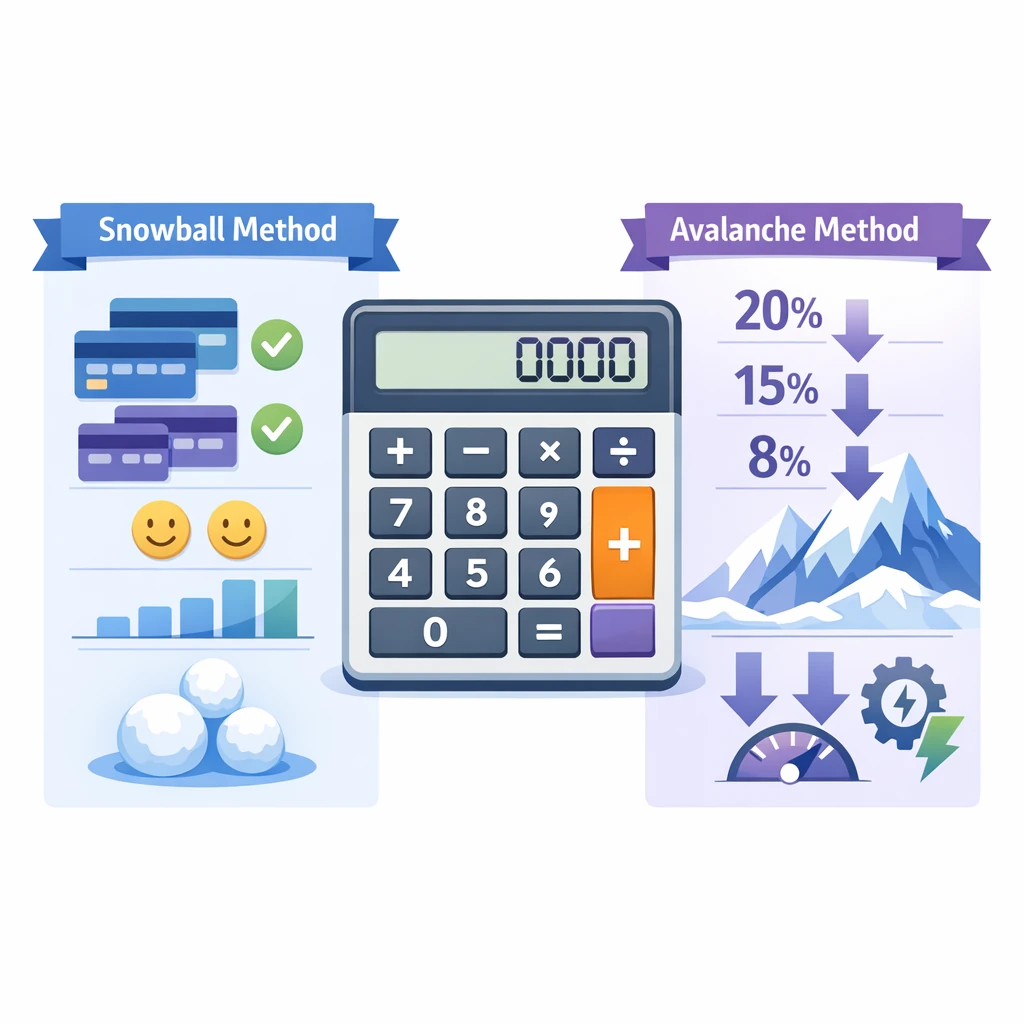
Now that you understand the concepts, let’s talk about the tools that bring them to life. A good snowball vs avalanche method calculator does more than simple math—it helps you visualize your journey and make informed decisions.
What Information You’ll Need
Before using any calculator, gather these details for each of your debts :
- Debt name (e.g., “Chase Visa,” “Car Loan,” “Student Loan”)
- Current balance—the exact amount you owe today
- Interest rate (APR)—found on your monthly statement or online account
- Minimum payment—the lowest amount due each month
Pro Tip: Don’t estimate. Log into each account and grab the real numbers. Even small differences in APR can shift the optimal strategy.
Step-by-Step Calculator Usage
Step 1: Enter Your Debts
Input each debt’s name, balance, APR, and minimum payment. Most calculators will have fields for each of these .
Step 2: Set Your Extra Payment Amount
This is the money you’ll put toward debt beyond all your minimum payments combined. Be realistic here. If you can consistently free up $200 per month, enter $200. Overcommitting leads to burnout and abandoned plans .
Not sure how much extra you can afford? A common starting point is 10-20% of your take-home pay, but even $50 extra makes a meaningful difference over time.
Step 3: Run Both Scenarios
A quality calculator will show you results for both methods side-by-side. Look for these key metrics :
| Metric | Snowball Result | Avalanche Result |
|---|---|---|
| Debt-Free Date | Month/Year | Month/Year |
| Total Interest Paid | $X,XXX | $X,XXX |
| First Debt Paid Off | Month X | Month X |
| Total Time to Debt-Free | X months | X months |
Step 4: Examine the Motivation Score
Some advanced calculators include a “motivation score” that estimates how motivating each path will be based on how quickly you’ll eliminate individual debts . A score of 8-10 means frequent wins to keep you engaged. A score of 4-6 means longer stretches between payoffs—manageable if you’re disciplined, but risky if you need regular encouragement.
Step 5: Make Your Decision
Look at both the numbers and your personality. If avalanche saves you $400 but your motivation score drops significantly, snowball might still be the smarter choice. The “best” strategy is the one you’ll actually complete.
How to Open a Brokerage Account for the First Time
Section 5: Top Free Snowball vs Avalanche Method Calculators
After researching dozens of options, here are the best free calculators available as of 2026. Each has been verified to support both snowball and avalanche methods .
1. Undebt.it
Cost: Free or $12/year for premium
Platform: Web-based
Best For: Advanced users who want multiple strategies and integrations
Undebt.it is the most feature-rich free option available. It offers five payoff methods—including smallest balance, highest interest, fastest payoff, by date, and custom ordering. The premium version ($12/year) integrates with YNAB and calendar apps (Google Calendar, Apple Calendar, Outlook) and sends SMS payment reminders .
Key Features:
- Unlimited debts
- Side-by-side strategy comparison
- Printable amortization schedules
- Export to Excel/PDF
2. Unbury.me
Cost: Free
Platform: Web-based
Best For: Simplicity and speed
If you want the simplest overview of your debts with minimal hassle, Unbury.me is perfect. It doesn’t even require a login—visit the website, input your debts, and get a clear payoff visualization in minutes. You can create a login to save your details for later, but it isn’t required .
Key Features:
- No registration required
- Simple, clean interface
- Clear charts showing principal diminishing over time
3. OpeSway Avalanche vs Snowball Calculator
Cost: Free
Platform: Web-based
Best For: Visual learners
This calculator provides a side-by-side comparison with visual charts highlighting interest saved versus payoff time for each strategy. It’s particularly good at helping you see the trade-offs at a glance .
4. CalculatorLive Debt Payoff Calculator
Cost: Free
Platform: Web-based
Best For: Customizable debt entries
This tool allows for highly customizable debt entries and extra-payment scheduling. You can adjust your extra payment month by month to account for variable income or one-time windfalls .
5. Credit Counselling Society Debt Repayment Calculator
Cost: Free
Platform: Web-based
Best For: Canadian users and those wanting professional guidance
This calculator compares four approaches: current minimum payments, snowball, avalanche, and a Debt Management Program (often interest-free consolidation through credit counseling). It’s run by a non-profit credit counseling organization, so there’s no sales pressure .
6. Ramsey Solutions Debt Snowball Calculator
Cost: Free
Platform: Web-based
Best For: Those committed to the snowball method
While this calculator only supports the snowball method (Dave Ramsey is its biggest advocate), it’s excellent for visualizing your debt-free date and progress. It’s integrated with the EveryDollar budget app .
7. Vertex42 Debt Reduction Calculator (Extended)
Cost: Free basic version, $9.95 for Extended
Platform: Excel/Google Sheets
Best For: Spreadsheet lovers
If you prefer to manage your finances in spreadsheets, Vertex42 offers downloadable templates. The free version allows up to 10 creditors, while the Extended version allows up to 40 for a one-time fee. You can switch between snowball and avalanche to see how your payoff timeline changes .
8. TowneBank Snowball Budgeting Calculator
Cost: Free
Platform: Web-based
Best For: Banking customers and those wanting minimum payment calculations
This calculator includes a helpful feature: it can calculate your minimum payment as 4% of your outstanding balance, which is a common method used by credit card companies. This gives you a more realistic projection if you’re not sure what your minimum payments will be as balances decline .
Quick Reference Comparison Table
| Calculator | Cost | Snowball | Avalanche | Hybrid | Account Sync | Best Feature |
|---|---|---|---|---|---|---|
| Undebt.it | Free/$12 | ✓ | ✓ | ✓ | YNAB only | 5 payoff methods |
| Unbury.me | Free | ✓ | ✓ | ✗ | No | No login required |
| OpeSway | Free | ✓ | ✓ | ✗ | No | Visual side-by-side |
| CalculatorLive | Free | ✓ | ✓ | ✗ | No | Customizable extra payments |
| Credit Counselling | Free | ✓ | ✓ | ✗ | No | Non-profit, Canadian focus |
| Ramsey Solutions | Free | ✓ | ✗ | ✗ | No | Integrated with EveryDollar |
| Vertex42 | Free/$9.95 | ✓ | ✓ | ✓ | No | Spreadsheet format |
| TowneBank | Free | ✓ | ✗ | ✗ | No | Minimum payment calculator |
Section 6: The Hybrid “Debt Blizzard” Strategy
What if you don’t have to choose? A hybrid strategy—sometimes called the “debt blizzard” —lets you capture quick wins from snowball, then pivot to avalanche’s interest optimization once you’ve built momentum .
How the Hybrid Approach Works
The basic framework is simple:
- Pay off your 1-2 smallest debts first (snowball style), regardless of interest rate
- Once those quick wins are complete, reorder remaining debts by interest rate (avalanche style)
- Continue until debt-free
This gives you the dopamine hit of early victories while still minimizing total interest on your larger, longer-term debts.
Real-World Hybrid Example
Using our earlier debt portfolio:
| Debt | Balance | APR | Minimum |
|---|---|---|---|
| Store Card | $800 | 26.99% | $25 |
| Credit Card A | $2,500 | 19.99% | $50 |
| Credit Card B | $8,500 | 22.49% | $200 |
| Personal Loan | $5,000 | 11.99% | $150 |
Hybrid Plan:
- Months 1-3: Pay off the $800 store card (quick win—also happens to be highest rate, so no conflict)
- Months 3-8: Now, instead of following snowball to Credit Card A ($2,500 at 19.99%), switch to avalanche logic and attack Credit Card B ($8,500 at 22.49%) because it has a higher rate
- Months 8-14: After Credit Card B is gone, attack Credit Card A
- Months 14-18: Finally, attack the Personal Loan
Results:
- First win: Month 3 (same as pure snowball)
- Second win: Month 8 (Credit Card B paid off—much faster than pure avalanche’s Month 14)
- Total interest: Approximately $3,550 (better than snowball’s $3,850, slightly worse than avalanche’s $3,450)
- Debt-free date: Month 18 (better than both!)
Why This Works: By getting that quick win first, you build momentum. Then by switching to avalanche ordering, you optimize for interest savings. The result is often the best of both worlds .
When Hybrid Makes Most Sense
The hybrid approach is particularly effective when:
- You have at least one very small debt you can eliminate in 1-3 months
- Your highest-rate debt is also your largest (so pure avalanche would mean no wins for many months)
- The interest rate difference between methods is significant (over $500)
- You’re motivated but also value efficiency
- How to Invest in the S&P 500 from Europe, UK, Germany, and Beyond
- How to Invest in the S&P 500 from Europe, UK, Germany, and Beyond
- ETF vs Index Fund: Which Is Better for a Beginner? The Ultimate 2024 Guide
Section 7: Step-by-Step Implementation Guide
Theory is great, but execution is everything. Here’s how to implement your chosen method starting today.
Step 1: List All Your Debts
Create a master list with these columns :
| Debt Name | Balance | APR | Minimum Payment | Due Date |
|---|---|---|---|---|
| Chase Visa | $3,450 | 22.99% | $95 | 15th |
| Car Loan | $8,200 | 6.5% | $320 | 10th |
| … | … | … | … | … |
Step 2: Order Your Debts
- For Snowball: Sort by Balance (smallest to largest)
- For Avalanche: Sort by APR (highest to lowest)
- For Hybrid: Sort by Balance first, then after 1-2 wins, re-sort by APR
Step 3: Set Your Monthly Debt Payment Budget
Calculate your total debt payment budget. This should include:
- All minimum payments
- Your chosen “extra” amount
Example:
- Total minimum payments: $425
- Extra you can afford: $300
- Total monthly debt budget: $725
Step 4: Automate Minimum Payments
Set up automatic payments for all minimums. This is crucial—missing a minimum payment triggers fees and penalties that can erase your progress .
Step 5: Attack Your First Target
Each month, manually pay your “extra” amount plus that debt’s minimum toward your first target debt. For all other debts, only pay the minimum.
Step 6: Celebrate Each Win
When you pay off a debt, celebrate! This doesn’t mean spending money—it means acknowledging your achievement. Tell someone, post on social media (if you’re comfortable), or simply do a happy dance. This positive reinforcement keeps you motivated .
Step 7: Roll Your Payments
After each debt is paid:
- Add its former minimum payment to your “extra” amount
- Attack the next debt on your list with this larger payment
Example of Rolling:
- Month 1-3: Extra = $300, Target = Debt A ($25 min)
- Month 3: Debt A paid off
- Month 4+: New extra = $325 ($300 + $25 freed), Target = Debt B
Step 8: Review and Adjust
Life happens. Your income may change, interest rates may adjust, or promotional periods may expire. Review your plan quarterly and adjust as needed .
The Ultimate Guide 2024: Best Robo-Advisors for Beginners – In-Depth Comparison
How to Invest in the S&P 500 from Europe, UK, Germany, and Beyond
Section 8: When to Switch Methods
Your financial situation and psychology aren’t static. There are times when switching methods makes sense.
Scenario 1: Promotional Rates Are About to Expire
If you have a 0% balance transfer offer that’s about to expire and jump to 24%, that debt should become your top priority immediately—even if it doesn’t fit your current method’s ordering .
Action: Pause your current method, attack the expiring promo debt aggressively until it’s paid or the promo period is secured, then return to your original plan.
Scenario 2: You’re Losing Motivation
If you’re 8 months into avalanche with no debts paid off and you’re feeling burned out, consider switching to snowball temporarily. Pay off your smallest debt (even if it’s low-rate) to get a win and rebuild momentum .
Scenario 3: You Receive a Windfall
A tax refund, bonus, or inheritance can accelerate your plan. Consider whether to:
- Put it all toward your current target (fastest progress)
- Pay off a small debt completely (psychological boost)
- Split between emergency fund and debt (balanced approach)
Scenario 4: Interest Rates Change
If you have variable-rate debts (like credit cards or some student loans), rates can change. If a debt’s rate jumps significantly, it may move up in avalanche priority. Recalculate your plan when rates change .
Section 9: Advanced Tips to Supercharge Your Payoff
Beyond choosing between snowball and avalanche, these strategies can accelerate your debt freedom.
1. Negotiate Lower Interest Rates
Many people don’t realize they can negotiate credit card APRs. Call your card issuers and ask :
Script: “Hello, I’ve been a customer since [year] and always aim to pay on time. I’m focused on paying off my balance faster. Could you review my account for a lower APR or a promotional rate? A reduction would help me pay reliably and stay with you.”
Even a 2-3% reduction can save hundreds over the life of your repayment.
2. Request Late Fee Waivers
If you ever miss a payment (it happens), call and ask for a courtesy waiver. Most issuers will waive the first late fee, especially if you have a good payment history .
3. Align Due Dates with Payday
Call your creditors and ask to move your due date to align with your salary. This ensures on-time payments and reduces the risk of missed payments .
4. Find “Leaky” Expenses
Audit your recurring subscriptions and expenses. You might find :
- Streaming services you don’t use
- Gym memberships you haven’t visited
- Insurance policies with better rates available
- Phone plans that can be reduced
Even finding an extra $50 per month can shave months off your debt payoff timeline.
5. Use Windfalls Strategically
When you receive unexpected money:
- Tax refunds → Debt payoff
- Work bonuses → Debt payoff
- Gifts → Consider splitting 50/50 between debt and something fun (balance matters)
- Side hustle income → Allocate 70-80% to debt, 20-30% to treat yourself
6. Consider the “Debt Snowflake” Method
The debt snowflake method involves making small, irregular extra payments whenever you have a little extra cash—from selling something, skipping a coffee, or getting a small rebate. These “snowflakes” add up over time and can be applied to your current target debt .
Section 10: Common Pitfalls and How to Avoid Them
Even with a solid plan, there are traps that can derail your progress. Here’s what to watch for.
Pitfall 1: Missing Minimum Payments
The Risk: Missing a minimum payment triggers late fees (often $35-40) and can cause your interest rate to jump to a penalty APR (often 29.99% or higher). This can erase months of progress .
The Fix: Automate all minimum payments. Set calendar reminders to ensure sufficient funds are in your account.
Pitfall 2: Only Paying Attention to One Debt
The Risk: When you’re hyper-focused on your target debt, it’s easy to forget about due dates for other debts .
The Fix: Use a debt tracking app or spreadsheet that shows all debts and their due dates. Review it weekly.
Pitfall 3: Ignoring Promo Expiry Dates
The Risk: 0% balance transfer offers eventually expire. If you’re not prepared, that debt can jump from 0% to 24% overnight, adding hundreds in interest .
The Fix: Put a reminder in your calendar 2-3 weeks before any promotional rate expires. Have a plan to either pay it off or transfer it again.
Pitfall 4: Changing Plans Too Often
The Risk: Switching between snowball and avalanche every few months based on what you read online leads to confusion and lack of progress .
The Fix: Pick a method and stick with it unless there’s a significant change in your situation (rate changes, income shift, etc.). Consistency beats perfection.
Pitfall 5: Not Celebrating Wins
The Risk: If you never acknowledge your progress, you’ll burn out. Debt repayment is a marathon, and you need positive reinforcement .
The Fix: Celebrate each paid-off debt. Share the news, treat yourself to a small (free or low-cost) reward, and take a moment to feel proud.
Pitfall 6: Neglecting Your Emergency Fund
The Risk: If you throw every spare dollar at debt and have no emergency fund, one unexpected expense (car repair, medical bill) will send you right back into debt .
The Fix: Maintain at least $1,000 in emergency savings while paying off debt. Once debt is gone, build this to 3-6 months of expenses.
Frequently Asked Questions (FAQ)
Q1: Which method saves more money, snowball or avalanche?
A: The avalanche method always saves more money mathematically because it minimizes total interest paid. By attacking highest-rate debts first, you stop the most expensive interest from accruing .
However, the difference is sometimes small. If your highest-rate debts are also your smallest, both methods produce nearly identical results .
Q2: Which method is faster?
A: The avalanche method is typically faster because you’re reducing high-interest balances that would otherwise accumulate and extend your payoff time. However, the speed difference is often just a few months .
Q3: Can I switch methods halfway through?
A: Absolutely. Many people start with snowball to build momentum, then switch to avalanche for the remaining debts. This hybrid approach can be highly effective .
Q4: What if my highest-interest debt is also my largest?
A: This is the classic dilemma. Avalanche would have you attack that large, high-rate debt first—which might mean no paid-off accounts for many months. Snowball would have you attack smaller, lower-rate debts first—giving you wins but potentially costing more interest.
Use a calculator to compare the interest difference. If it’s under $500, snowball might be worth it for the motivation. If it’s over $1,000, avalanche likely wins .
Q5: Should I include my mortgage in my snowball or avalanche plan?
A: Most experts recommend excluding your mortgage from these payoff strategies until other consumer debts (credit cards, car loans, student loans) are eliminated. Mortgages typically have lower interest rates and tax-deductible interest, making them less urgent .
Q6: What if I can only afford minimum payments?
A: If you can only afford minimum payments, neither method will make significant progress. Minimum payments are designed to keep you in debt for decades. You need to find ways to increase your income or decrease expenses to free up extra payment money .
Q7: How do I calculate my minimum payment if it changes?
A: Credit card minimum payments are often calculated as a percentage of your balance (typically 2-4%). Some calculators can model this, but for simplicity, you can estimate that your minimum will decrease as your balance decreases. A fixed minimum payment (like most loans) is easier to model .
Q8: What’s the best free snowball vs avalanche method calculator?
A: For most people, Undebt.it offers the best combination of features and free access. For pure simplicity, Unbury.me is excellent. For spreadsheet lovers, Vertex42 provides downloadable templates .
Q9: Should I invest or pay off debt?
A: Generally, pay off debt with interest rates above 4-5% before investing beyond your employer match. For low-interest debt (under 4%), investing may mathematically outperform. However, the psychological benefit of being debt-free is also valuable .
Q10: What if I have multiple debts with the same interest rate?
A: If rates are identical, pay them off in whatever order motivates you most—usually smallest balance first (snowball style) to get quick wins .
Q11: How do I stay motivated for years of debt repayment?
A: Several strategies help:
- Use visual trackers (printable charts you color in)
- Celebrate each paid-off debt
- Join online communities for support
- Focus on the “why” behind your debt freedom
- Use a calculator to watch your debt-free date get closer
Q12: What is the debt snowflake method?
A: The debt snowflake method involves making small, irregular extra payments whenever you have a little extra cash—from selling something, skipping a coffee, or getting a small rebate. These “snowflakes” add up over time and can be applied to your current target debt .
Q13: Can I use these methods for business debt?
A: Yes, both methods work for business debt. However, business debt may have different tax implications (interest may be tax-deductible) and early repayment penalties. Consult with a tax professional for business debt strategies .
Q14: What if I have a 0% APR balance transfer?
A: Treat promotional 0% rates carefully. If the 0% period is long (12-18 months), you might prioritize other debts with active interest. But set a calendar reminder 2-3 months before the promo expires to ensure that debt is paid or transferred again before interest kicks in .
Q15: How do I talk to my partner about debt repayment?
A: Approach the conversation collaboratively, not critically. Use “we” language. Review your debts together, discuss your financial goals, and jointly decide on a method. Both partners should be involved in financial decisions so they feel equal ownership .
Conclusion: Your Path to Debt Freedom
The snowball vs avalanche debate doesn’t have a universal answer—and that’s okay. The best method is the one you’ll actually stick with until every debt is paid.
Use a snowball vs avalanche method calculator to see your personalized numbers. Look at both the financial outcomes and the psychological timeline. If avalanche saves you significant money and you’re disciplined enough to wait months between wins, go for it. If snowball’s quick wins keep you motivated and the interest difference is small, that’s your answer .
Remember these key takeaways:
- Avalanche saves the most money mathematically and is typically fastest
- Snowball builds momentum through quick wins and increases completion rates
- Hybrid strategies can give you the best of both worlds
- Free calculators make it easy to compare your options
- Consistency matters more than perfection—stick with your chosen method
Your debt-free date is out there, waiting for you. Every extra dollar you throw at debt today brings that date closer. Whether you’re rolling a snowball or sliding down an avalanche, you’re moving in the right direction.
Your Next Step: Open a snowball vs avalanche method calculator right now. Input your debts. Compare your options. Choose your path. And start your journey to financial freedom today.