By: Peiman Daneshgar | Email: daneshgar781@gmail.com**
Published: February 22, 2026**
Table of Contents
- Term Life vs Whole Life Insurance: Which Do I Need? (The Answer Is Simpler Than They Want You to Think)
- Introduction: The Sales Pitch You Just Sat Through
- What This Article Will Actually Give You
- Part 1: The Absolute Simplest Breakdown (Start Here)
- Part 2: What Is Term Life Insurance? (The Honest Version)
- Part 3: What Is Whole Life Insurance? (The “Investment” That Isn’t)
- Part 4: The Side-by-Side Comparison (See the Difference)
- Part 5: The “Investment” Myth—Why Whole Life Fails as an Investment
- Part 6: When Whole Life Actually Makes Sense (The Exceptions)
- Part 7: How Much Life Insurance Do You Actually Need?
- Part 8: How Long Should Your Term Be?
- Part 9: Common Objections (And Why They’re Wrong)
- Frequently Asked Questions
- The Emotional Bottom Line
Introduction: The Sales Pitch You Just Sat Through
I know that feeling.
You’re sitting across from someone—maybe at their office, maybe at your kitchen table—and they’re showing you a fancy brochure with charts and graphs and words like “guaranteed returns” and “cash value accumulation” and “permanent protection.”
They’re friendly. They’re professional. They’re telling you this is the smartest financial decision you’ll ever make.
But something feels off.
The premiums they’re quoting are… a lot. Like, hundreds of dollars a month. And when you ask simple questions, the answers get complicated fast. “Well, that depends on your dividend scale.” “The cash value grows tax-deferred.” “It’s actually an investment AND insurance combined.”
You nod along, pretending to understand, but inside you’re thinking: “Is this a good deal or am I getting played?”
You’ve heard about term life too. It’s cheaper—way cheaper. But is it “throwing money away” like some people say? And if term is so great, why is everyone trying to sell you whole life instead?
investment mistakes to avoid in your 20s
Sound familiar?
You’re not alone. The life insurance industry spends billions on marketing and commissions, and they’ve gotten very good at making simple things sound complicated. Because complicated is where they make money.
Here’s the truth: Life insurance has one job. Just one. And when you understand that job, the choice between term and whole life becomes painfully obvious.
How to Choose Your First Mutual Fund
🧠 Quick Reality Check:
The purpose of life insurance is not to make you rich. It’s not to fund your retirement. It’s not to leave a giant inheritance. The purpose of life insurance is to replace your income if you die. That’s it. That’s the whole job .
What This Article Will Actually Give You
Here’s the deal. Most insurance articles are either sales pitches in disguise or so full of jargon you need a translator.
This one is different.
By the time you finish reading, you’ll know:
- The dead-simple difference between term and whole life (with analogies that actually stick) .
- Why whole life premiums are 5-10x higher —and where that money really goes .
- The truth about “cash value” —why it’s not the wealth-builder they claim .
- The exact situations where whole life actually makes sense (it’s a very short list) .
- How much coverage you really need —with formulas that take 5 minutes .
- How to shut down the sales objections so you can make a clear decision .
This is the playbook. Let’s run it.
Is Investing in Cryptocurrency Safe for Beginners?
Part 1: The Absolute Simplest Breakdown (Start Here)
Let’s start with an analogy that makes everything clear.
Term Life: The Rental
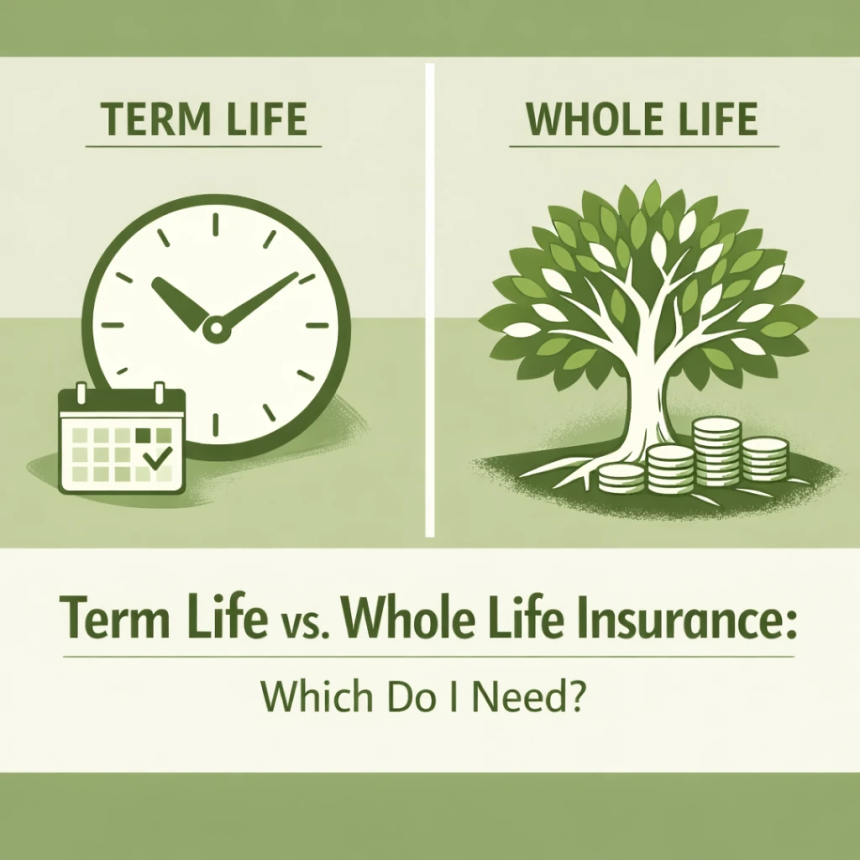
Term life insurance is like renting an apartment. You pay every month, and as long as you pay, you have a place to live. If something happens to the apartment (in this case, if you die), the insurance company pays your beneficiaries. But if you live through the lease term and move out, you get nothing back. The coverage ends.
That’s the point. You needed a place to live during those years. You didn’t expect to get your rent money back .
Whole Life: The Timeshare
Whole life insurance is like buying a timeshare. It sounds like an investment. They tell you it builds value. But the upfront cost is massive, there are fees everywhere, and when you try to sell it, you find out it’s worth way less than you paid. Plus, you’re stuck paying maintenance fees forever .
And if you die? Your family gets the timeshare, but the “investment” part? The company keeps it .
The One-Sentence Answer
If you need life insurance to protect people who depend on your income, you almost certainly need term life . It’s cheaper, simpler, and does exactly what insurance is supposed to do.
Whole life is a hybrid product that tries to be both insurance and an investment—and fails at both .
how to invest in S&P 500 from Europe (or UK, Germany, etc.)
Part 2: What Is Term Life Insurance? (The Honest Version)
How It Actually Works
Term life insurance is brutally simple:
- You choose a term length (usually 10, 15, 20, 25, or 30 years) .
- You choose a death benefit (the amount your beneficiaries get if you die).
- You pay a fixed premium every month for that term .
- If you die during the term, your beneficiaries get the death benefit—tax-free .
- If you outlive the term, coverage ends. That’s it .
There’s no cash value. No investment component. No complicated charts. Just pure insurance .
The Different Flavors of Term Life
Most people get level term—the premium stays the same for the entire term, and the death benefit doesn’t change . This is what you want.
There are other options, but they’re usually worse:
- Yearly renewable term: Starts cheaper but gets more expensive every year. Over a full term, you pay more .
- Return of premium: They pay back your premiums if you outlive the term. Sounds great, but your premiums are 2-5x higher. You’re just lending them money interest-free .
- Guaranteed issue: No medical exam, but sky-high premiums and limited coverage the first few years .
Stick with level term.
The Conversion Option (Don’t Ignore This)
Many term policies let you convert to permanent insurance without a new medical exam . This matters because if you develop serious health problems during your term, you might want coverage that lasts your whole life—and without conversion, you’d have to re-qualify with your new health issues .
Guardian, for example, lets you convert level term policies at any point in the first five years, and with an optional rider, for the whole term .
best stocks for dividend income for beginners
What Happens at the End of the Term?
Ideally, by the time your term ends, you no longer need life insurance.
Why? Because you’ve paid off your mortgage, your kids are grown and independent, and you’ve built enough savings and investments that your loved ones would be fine without your income . Dave Ramsey calls this being “self-insured” .
That’s the goal. Insurance is a bridge, not a destination.
🤔 Pause and Think:
If someone tries to sell you whole life by saying “but term life is just throwing money away,” ask them this: Do you feel the same way about renter’s insurance? Homeowner’s insurance? Car insurance? You pay for those every year and hope you never need them. That’s not “throwing money away”—that’s protection.
Part 3: What Is Whole Life Insurance? (The “Investment” That Isn’t)
How It Actually Works
Whole life insurance is… more complicated.
You pay premiums—much higher premiums—for your entire life. In exchange, the insurance company promises to pay a death benefit whenever you die, as long as you’ve kept up payments .
But here’s where it gets messy: part of your massive premium goes toward the insurance, and part goes into a cash value account that’s supposed to grow over time .
The Cash Value Account (Where Your Money Goes to Die)
The cash value account is the main selling point of whole life. Agents make it sound like a magical savings vehicle that grows tax-deferred and builds wealth.
Here’s what they don’t tell you:
- The returns are terrible. We’re talking 1-2% on average . A high-yield savings account pays better with zero complexity.
- Fees eat everything. In the early years, almost none of your premium goes to cash value—it all goes to commissions and fees .
- It grows slowly. Really slowly. Like, “buy a used RV in 30 years” slowly .
The Three Ways to Access Cash Value (All Bad)
After years of overpaying, you might have some cash value built up. How do you get it?
1. Withdrawals: You can take money out, but if you withdraw more than you’ve paid in premiums, the gains are taxable as income .
2. Loans: You can borrow against the cash value. Sounds okay until you realize:
- You’re paying interest on your own money
- Unpaid loans reduce the death benefit
- If the policy lapses with an outstanding loan, the entire loan can become taxable
3. Surrender the policy: You can cancel the policy and get the cash value, minus surrender charges that can be massive in the early years .
how to start investing with $100 or less
The “Kicker”: What Happens to the Cash Value When You Die?
Here’s the part that makes people rage.
If you die without touching the cash value, the insurance company keeps it .
Your beneficiaries get the death benefit—the same amount they’d get from a term policy that cost 1/10th the price. All those extra dollars you paid for years? Gone. Puff of smoke. The insurance company’s parting gift to themselves .

Part 4: The Side-by-Side Comparison (See the Difference)
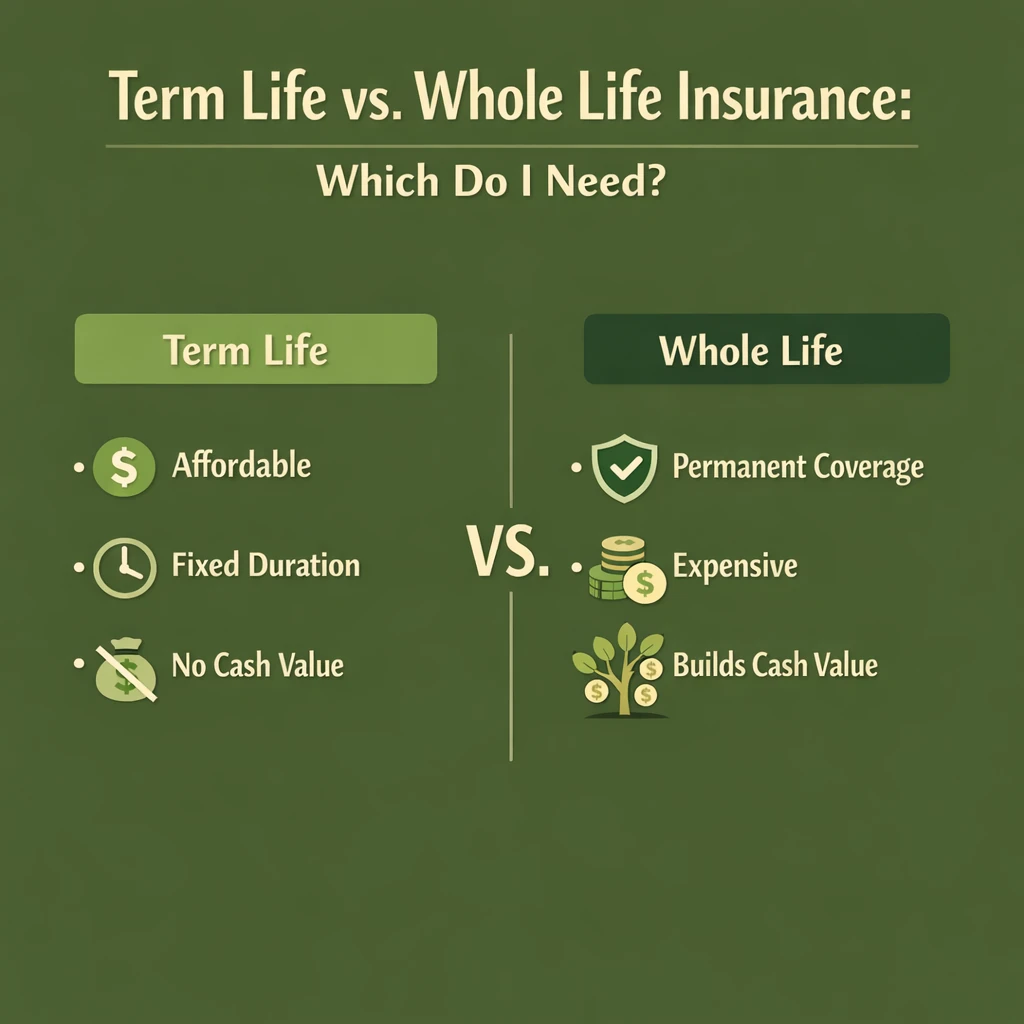
| Factor | Term Life | Whole Life |
|---|---|---|
| What it does | Pure insurance—replaces income if you die | Insurance + forced savings account |
| How long it lasts | Set term (10-30 years) | Your whole life (as long as you pay) |
| Premiums | Low and fixed during term | 5-10x higher, fixed forever |
| Cash value | None | Yes—with terrible returns |
| What beneficiaries get | Full death benefit | Death benefit only (cash value gone) |
| Complexity | Simple—one job | Complex—layers of fees and rules |
| Best for | Protecting dependents during working years | Paying estate taxes, special needs trusts |
| Cost per $1M coverage (35yo male) | ~$30-40/month | ~$300-400/month |
Cost Comparison: The Number That Will Make Your Jaw Drop
Ramsey Solutions ran actual quotes for a $1,000,000 policy :
| Age/Gender | Term Life (20yr) | Whole Life | You Pay Extra |
|---|---|---|---|
| 25-year-old male | $29.09 | $234.34 | $205/month |
| 25-year-old female | $21.63 | $195.74 | $174/month |
| 35-year-old male | $32.63 | $326.17 | $294/month |
| 35-year-old female | $28.07 | $278.40 | $250/month |
That extra $200-300 per month? Invested in a decent mutual fund over 20-30 years, that’s hundreds of thousands of dollars you’re giving up .
Part 5: The “Investment” Myth—Why Whole Life Fails as an Investment
The 1-2% Lie
Whole life policies often guarantee a minimum return—usually around 1-2% . That’s less than inflation. You’re literally losing purchasing power.
Compare that to the stock market’s historical average of 7-10% after inflation. Over 30 years, that difference is massive.
The Fees You Never See
The first year of a whole life policy, almost none of your premium goes to cash value. It all goes to commissions and fees . Some policies don’t even have cash value for the first two years .
You’re paying for an “investment” that doesn’t exist yet.
best robo-advisors for beginners 2024 comparison
The Opportunity Cost (This Is the Real Killer)
Here’s the real math:
Take that extra $250/month a 35-year-old pays for whole life. Instead, buy term for $33/month and invest the $217 difference in a Roth IRA.
At 8% average return:
- After 20 years: ~$128,000
- After 30 years: ~$308,000
That money is yours. You control it. You can leave it to your kids tax-free. And unlike whole life, you don’t have to die for them to get it .
📊 The Math of Opportunity
Strategy Monthly Cost After 30 Years Whole Life $326 Cash value ~$50-80k + death benefit Term + Invest Difference $33 + $293 invested Investment account ~$308,000 This isn’t hypothetical. This is the actual choice you’re making .
Part 6: When Whole Life Actually Makes Sense (The Exceptions)
I said “almost never.” Here are the rare exceptions where whole life might be the right tool.
ETF vs index fund: which is better for a beginner?
Exception 1: You’ll Owe Estate Taxes
If your estate is large enough to owe federal estate taxes (over $13.61 million in 2024, indexed for inflation), your heirs might need cash to pay the tax bill without selling assets .
Whole life can provide that liquidity. The death benefit is tax-free and can be used to pay estate taxes .
Exception 2: You Have a Special Needs Dependent
If you have a child or dependent with special needs who will require care their entire life, permanent coverage ensures there’s money for their care no matter when you die .
Often this is done through a special needs trust with the insurance as funding .
Exception 3: You’ve Maxed Every Other Tax-Advantaged Account
If you’ve maxed your 401(k), IRA, HSA, and 529, and you still have money left over and want another tax-advantaged vehicle, whole life’s tax-deferred growth might be a consideration. But this applies to maybe 0.1% of people.
Exception 4: You Want to Leave Money to Charity
If you want to leave a guaranteed gift to a charity regardless of when you die, a whole life policy naming the charity as beneficiary works .
The Bottom Line on Exceptions
If none of these apply to you—and for 99% of people, they don’t—you don’t need whole life .
Part 7: How Much Life Insurance Do You Actually Need?
If term is the right choice (it is), the next question is: how much?
The 10-12x Rule (Simple but Effective)
Dave Ramsey recommends 10-12 times your annual income . If you make $75,000, you need $750,000 to $900,000 in coverage.
This is simple and gets you in the right ballpark.
The DIME Formula (More Precise)
Guardian recommends the DIME method :
- Debt: Total up all your debts (mortgage, car loans, credit cards, student loans)
- Income: Your annual income × number of years your family needs support (usually until kids are grown)
- Mortgage: The full amount needed to pay off your home
- Education: Estimated college costs for each child ($100,000-150,000 per child)
Add it all up. That’s your coverage need.
The Human Life Value Formula (For the Math Nerds)
Some experts use more complex formulas. Guardian’s chart gives rough guidelines :
| Age | Coverage Multiple of Income |
|---|---|
| 18-40 | 30x income |
| 41-50 | 20x income |
| 51-60 | 15x income |
| 61-65 | 10x income |
| 66-70 | 1x net worth |
| 71-75 | 0.5x net worth |
The Rule of Thumb Chart
| Your Situation | Suggested Coverage |
|---|---|
| Single, no dependents | Maybe none, or enough for funeral/debts |
| Married, both work, no kids | 5-10x your income each |
| Married with kids | 10-12x income of primary earner |
| Stay-at-home parent | Enough to cover childcare/household services |
| Business owner with partners | Enough to fund buy-sell agreement |
Part 8: How Long Should Your Term Be?
Match your term to your responsibilities :
- 20-year term: Good if you have young kids—covers them until they’re out of college
- 30-year term: If you’re starting a family later or want coverage until retirement
- 15-year term: If your kids are older or you’ll pay off mortgage soon
- 10-year term: If you’re close to financial independence
The goal is to be “self-insured” by the time the term ends .
Part 9: Common Objections (And Why They’re Wrong)
Objection 1: “But Term Life Is Throwing Money Away”
Reality: Only if you think all insurance is throwing money away. You pay for car insurance, health insurance, homeowner’s insurance—and you hope you never use it. That’s not waste. That’s protection.
The “waste” argument assumes you should get something back from insurance. But insurance isn’t an investment. It’s protection .
how to open a brokerage account for the first time
Objection 2: “But I’ll Outlive My Term Policy”
Reality: That’s the goal! If you outlive your term, it means you’re still alive (good) and hopefully financially independent enough that your loved ones don’t need your income anymore .
Objection 3: “But Whole Life Builds Cash Value I Can Use”
Reality: That cash value is just your overpaid premiums, minus massive fees, earning poverty-level returns. You’d be better off buying term and investing the difference in literally anything else .
Objection 4: “But My Agent Said Whole Life Is Better”
Reality: Your agent makes a much larger commission on whole life. Like, 5-10x larger. They’re not a bad person, but their incentive is misaligned. Always check the source .
Frequently Asked Questions
Q: What’s the difference between term and whole life insurance?
A: Term covers you for a set period (10-30 years) with low premiums. Whole life covers you forever with much higher premiums and a cash value account that performs poorly .
Q: Which is better—term or whole life?
A: For 99% of people, term life is better. It’s cheaper, simpler, and does exactly what insurance should do .
Q: How much does term life insurance cost?
A: A healthy 35-year-old can get $500,000 coverage for $20-30/month. $1 million for $30-40/month .
Q: How much does whole life insurance cost?
A: The same 35-year-old would pay $300-400/month for $1 million coverage .
Q: What happens to the cash value when I die?
A: The insurance company keeps it. Your beneficiaries only get the death benefit .
Q: Can I access the cash value while alive?
A: Yes, through withdrawals or loans. But withdrawals over your premium payments are taxable, and loans charge you interest on your own money .
Q: Is whole life ever a good investment?
A: Almost never. The returns are terrible (1-2%), fees are high, and you’d do better in a basic mutual fund .
Q: How much life insurance do I need?
A: 10-12 times your annual income is a good rule of thumb . For more precision, use the DIME formula .
Q: How long should my term be?
A: Long enough to cover your major responsibilities—kids through college, mortgage payoff, etc. Usually 20-30 years .
Q: What if I develop health problems during my term?
A: Make sure your policy has a conversion option that lets you convert to permanent insurance without a new medical exam .
Q: What’s “self-insured”?
A: When you have enough savings and investments that your loved ones wouldn’t need your income if you died. That’s the goal .
Q: Do I need life insurance if I’m single with no kids?
A: Probably not, unless you have debts someone co-signed or want to cover funeral expenses .
what is dollar-cost averaging and how to set it up
The Emotional Bottom Line
Look, I’m not going to pretend that thinking about life insurance is fun.
It’s not. It forces you to imagine a world where you’re not here. It forces you to put a dollar value on your life. It’s uncomfortable and weird and nobody wants to do it.
But here’s the thing: Life insurance is love in financial form.
It’s you, sitting here today, saying to the people you’d leave behind: “I thought about you. I planned for you. I made sure you’d be okay.”
That’s beautiful. That’s worth doing right.
And doing it right means ignoring the complicated sales pitches and focusing on the simple truth: Your family needs your income replaced if you die. Term life does that cheaply and effectively. Whole life tries to do more and fails.
Buy term. Invest the difference. Love your people.
That’s the whole thing.
You’ve got this.