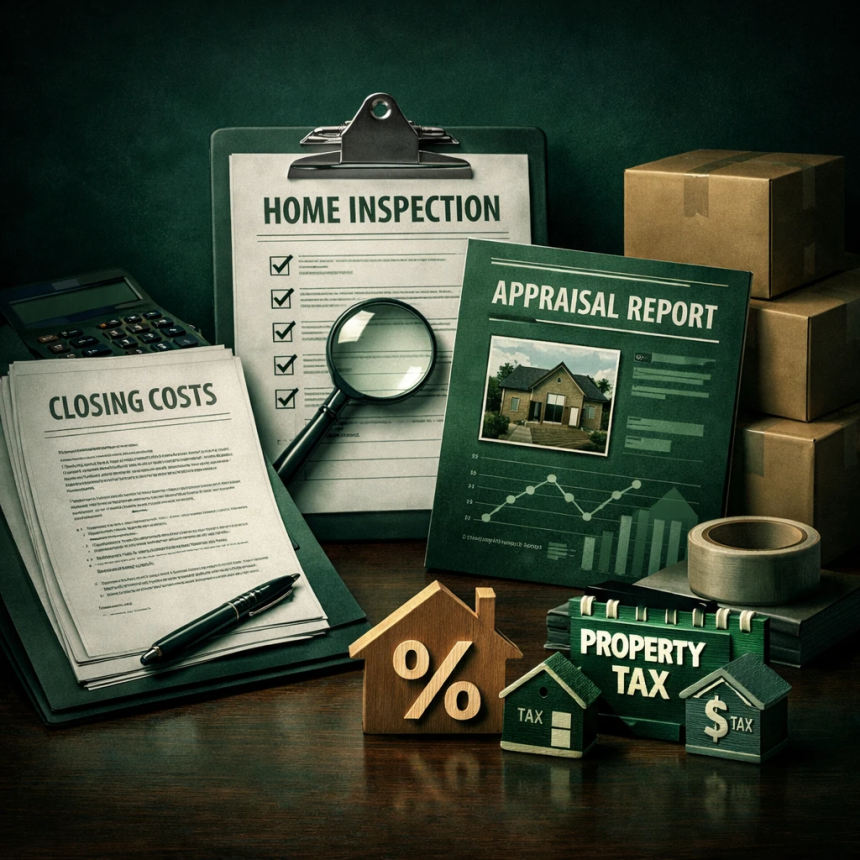
The Ultimate Guide: Costs of Buying a Home Besides the Down Payment (2026)
By Peyman Daneshgar
You’ve been saving for years. You’ve watched your bank account grow, dreaming of the day you’d finally have enough for a 20% down payment. You’re almost there. But here’s the truth that catches most first-time buyers off guard: the down payment is just the beginning.
I was helping a neighbor calculate what she could actually afford for her first home, and when we got to the part about ongoing costs beyond the mortgage, her jaw literally dropped. She’d saved up this amazing down payment, had her mortgage preapproval all ready to go—but had absolutely no idea about the hidden expenses that come with owning a home. And honestly? She’s not alone .
According to the U.S. Census Bureau’s 2024 American Community Survey, median monthly owner costs for homeowners with a mortgage reached $2,035 in 2024, and that doesn’t even tell the whole story . When you factor in all the hidden costs—closing fees, property taxes, insurance, maintenance, and more—the true cost of homeownership can be double what many buyers expect.
This guide is the definitive resource for understanding the costs of buying a home besides the down payment in 2026. We’ll walk you through every single expense, from the moment you make an offer to the ongoing costs that last for as long as you own the home. By the end, you’ll have a complete picture of what it really takes to afford a home—and you won’t be caught off guard.
Table of Contents
- The Down Payment Myth: Why You Need More Cash Than You Think
- Upfront Costs: What You Pay Before You Get the Keys
- Closing Costs: The Big Ticket You Can’t Ignore
- Moving and Immediate Post-Purchase Expenses
- Ongoing Monthly Costs Beyond Your Mortgage
- Maintenance and Repairs: The 1% Rule (And Why It’s Not Enough)
- The First-Year Reality Check: What Real Homeowners Spend
- Regional Variations: Location Changes Everything
- How to Prepare: A Practical Action Plan
- Frequently Asked Questions (FAQs)
- Conclusion: Know the Full Picture Before You Buy
The Down Payment Myth: Why You Need More Cash Than You Think
Think of buying a home like adopting a pet that costs hundreds of thousands of dollars. You’re not just paying for the initial adoption fee (down payment)—you’re signing up for ongoing care that never really stops. And just like nobody warns you how expensive vet bills can get, a lot of first-time buyers don’t realize the true financial commitment they’re making .
When we talk about the costs of buying a home besides the down payment, we’re talking about everything from the moment you make an offer through the decades of ownership that follow. These costs typically fall into three categories:
- Upfront costs before closing: Earnest money, inspections, appraisals
- Closing costs: The fees required to finalize your loan
- Ongoing costs after moving in: Taxes, insurance, utilities, maintenance, HOA fees
For a typical home purchase in 2026, you’ll need far more cash than just your down payment. On a $400,000 home with 5% down, expect to need $47,000 to $55,000 in liquid assets including down payment, closing costs, prepaids, moving expenses, and reserves .
Let’s break down every single one of these expenses.
how to use a balance transfer card wisely
Upfront Costs: What You Pay Before You Get the Keys
Before you even get to the closing table, there are several costs you’ll encounter. These are the first of the costs of buying a home besides the down payment.
Earnest Money: Showing You’re Serious
When you make an offer on a home, the seller wants to know you’re serious. That’s where earnest money comes in—a deposit showing your good faith intention to buy the property .
- How much: Typically 1% to 2% of the purchase price . On a $400,000 home, that’s $4,000 to $8,000.
- How it works: The money is held in an escrow account and credited toward your down payment or closing costs at closing .
- Risk: If you back out without a valid contractual reason (like a failed inspection or financing contingency), you could forfeit this money.
Home Inspection: Know What You’re Buying
A home inspection is a professional evaluation of the property’s condition. It’s one of the most important investments you’ll make.
- Cost: Around $300 to $500 . The Consumer Financial Protection Bureau strongly recommends getting one .
- Why it matters: Inspectors look for major issues with the roof, foundation, HVAC, plumbing, and electrical systems. If they find problems, you can negotiate repairs or a lower price—or walk away entirely.
- Savvy move: Some buyers also opt for specialized inspections (roof, termite, radon, sewer line) that add to the cost but can prevent expensive surprises.
- how to negotiate lower credit card interest rates
Home Appraisal: The Lender’s Stamp of Approval
An appraisal is different from an inspection. While an inspection checks the home’s condition, an appraisal determines its fair market value . Lenders require appraisals to ensure they’re not lending more than the home is worth.
- Cost: Typically $300 to $400, though this varies by location . Rural areas or regions with fewer appraisers may have higher fees .
- Who pays: The buyer pays, usually at closing .
- What happens if it’s low: If the appraisal comes in below the purchase price, you may need to renegotiate with the seller, bring more cash to closing, or walk away.
Closing Costs: The Big Ticket You Can’t Ignore
Closing costs are the fees and expenses required to finalize your mortgage and transfer ownership of the home. They are among the most significant costs of buying a home besides the down payment, and they catch many first-time buyers off guard.
best debt consolidation loans for good credit 2024
What’s Included in Closing Costs?
Closing costs include a wide range of fees from various parties involved in the transaction :
| Cost Category | What It Covers | Typical Range |
|---|---|---|
| Origination Fee | Lender’s fee for processing your loan | 0.5% to 1% of loan amount |
| Discount Points | Prepaid interest to lower your rate | 0% to 3% of loan amount (optional) |
| Appraisal Fee | Property valuation | $300-$400 |
| Credit Report Fee | Checking your credit | $35-$50 |
| Title Search & Insurance | Verifying ownership and protecting against claims | $300-$2,500+ |
| Recording Fees | Government fees to record the sale | $20-$250 |
| Transfer Taxes | State/local taxes on property transfer | Varies by location |
| Prepaid Interest | Interest from closing date to first payment | Varies |
| Escrow Deposits | Prepaid property taxes and insurance | 2-12 months of payments |
How Much Are Closing Costs in 2026?
Closing costs typically run 2% to 5% of the loan amount . On a $400,000 home with 5% down (a $380,000 loan), that’s $7,600 to $19,000 .
The national average for closing costs on a single-family home is around $4,661, but this varies dramatically by location. In Washington, D.C., average closing costs hit $17,545, while in South Dakota they’re just $1,551 .

Who Pays Closing Costs?
Traditionally, buyers pay most closing costs, but sellers often contribute as well—especially in buyer-friendly markets. Seller concessions (where the seller agrees to pay some of your closing costs) can significantly reduce your out-of-pocket cash .
- FHA and VA loans: Allow sellers to contribute up to 6% of the purchase price toward closing costs.
- Conventional loans: Allow 3% to 9% depending on your down payment .
- how to get out of payday loan debt fast
Moving and Immediate Post-Purchase Expenses
Once you’ve closed on the home, you still need to get yourself and your belongings inside. These costs are often overlooked in the excitement of buying.
Moving Costs
- Local moves (under 100 miles): Average $2,300 .
- Long-distance moves: Average $4,600 .
- DIY moves: Cheaper but factor in truck rental, fuel, packing supplies, and your own time and stress.
Immediate Purchases
Many first-time buyers need to buy items their new home doesn’t come with :
- Lawn mower, hose, and yard equipment
- Window treatments and curtains
- New appliances (if not included)
- Basic tools and cleaning supplies
- Furniture for new spaces
The first year of homeownership can easily add thousands of dollars in these “settling in” costs.
does debt settlement hurt your credit score?
Ongoing Monthly Costs Beyond Your Mortgage
Now we get to the expenses that will follow you for as long as you own the home. These ongoing costs of buying a home besides the down payment are often rolled into your monthly housing budget—and they can be substantial.
Property Taxes: The Gift That Keeps on Taking
Property taxes are probably the most underestimated ongoing cost . They’re based on your home’s assessed value and local tax rates, and they can increase over time.
- National average: Around 1% of home value annually, but ranges from 0.27% in Hawaii to 2.23% in New Jersey . On a $400,000 home, that’s $1,080 to $8,920 per year.
- Median tax bill: Hit $3,500 in 2024 .
- The trap: Property taxes aren’t fixed. As home values rise, your tax bill likely will too . Twenty-six percent of first-time homeowners didn’t realize property taxes fluctuate .
Homeowners Insurance: The Price of Protection
Insurance costs have exploded in recent years. Single-family homeowners with mortgages now pay an average of $2,370 annually—a 70% increase since 2021 .
- National average 2025: $2,802 to $3,548 per year .
- 2026 outlook: Projected to hit $3,520 by end of 2025, an 8% jump from 2024 .
- Worst-hit states: Nebraska ($7,920), Oklahoma ($7,426), Florida ($15,460) .
- Why the surge: Climate change is making natural disasters more frequent and severe. Construction costs are up. Materials are expensive. Labor is scarce .
“Homeowners insurance is pushing the budget in 2026 over the edge, not interest rates,” warns Ryann Brier, a licensed real estate agent. “I have been warning my clients that insurance could spike another 8% to 10% this next year, and to build a buffer in their budgets” .
Private Mortgage Insurance (PMI)
If your down payment is less than 20%, you’ll pay PMI (Private Mortgage Insurance). This protects the lender if you default.
- Cost: Typically 0.4% to 1.5% of the original loan amount annually . On a $380,000 loan, that’s $1,600 to $6,000 per year ($133 to $500 monthly).
- How to remove it: PMI automatically cancels when your loan balance reaches 78% of the original value, or you can request cancellation at 80% loan-to-value.
- Strategies to Pay Off $30,000 in Student Loans
HOA Fees: The Neighborhood Tax
If you buy in a community with a homeowners association (common in condos, townhouses, and many planned developments), you’ll pay monthly HOA fees.
- Average: Around $125 monthly, though this varies dramatically . Some HOAs charge $50; others $500+.
- Condo fees: Can run into the thousands in high-rise buildings because they cover building maintenance, insurance, amenities, and sometimes utilities .
- Special assessments: Be aware of these one-time fees for major building repairs. They can add thousands with little notice .
“A low HOA with low dues that leads to deferred maintenance is the worst,” warns mortgage expert Cody Schuiteboer. When long-postponed repairs finally arrive, fees often spike 30% to 50% in a single year .
Utilities: Keeping the Lights On
The average monthly utility cost runs about $430 , though this varies based on home size, climate, energy sources, and local rates. First-time buyers coming from apartments often underestimate utility costs because they’ve never paid for heating and cooling an entire house .
Maintenance and Repairs: The 1% Rule (And Why It’s Not Enough)
This is where the costs really catch people off guard. The standard advice is to budget 1% of your home’s value annually for maintenance . But in 2026, that rule may be outdated.
Real-world data:
- Real Estate Witch’s 2025 data shows homeowners actually pay an average of $24,529 per year in costs beyond their mortgage—including utilities, repairs, maintenance, property taxes, and insurance .
- Thumbtack’s 2024 Home Care Price Index found home maintenance costs averaged $6,543.50 in 2023 .
- Bankrate’s study estimates maintenance at 2% of median home value for their calculations .
“Don’t cut corners and estimate your house to have 1% maintenance issues,” advises Brier. “Budgeting 2% is really on the low end.” In colder climates or older homes, that reserve may need to go even higher—up to 4% of the home’s value annually .
Maintenance isn’t linear. A home may go years with minimal needs, then require $10,000 to $20,000 in urgent repairs. “A roof with 18 of 25 years remaining means a bill of $15,000 to $25,000 in five to seven years,” says Schuiteboer .
how to use a balance transfer card wisely
Common first-year maintenance costs :
- HVAC servicing and seasonal tune-ups
- Minor plumbing or electrical repairs
- Appliance repairs or replacement
- Gutter cleaning and exterior upkeep
- Landscaping or drainage adjustments
The First-Year Reality Check: What Real Homeowners Spend
According to American Home Shield’s 2025 survey of 1,001 homeowners, the first year of homeownership can cost $86,698 when you add up :
- Down payment
- Furnishing costs
- Renovations
- Tools and equipment
The brutal truth :
- 46% of first-time buyers didn’t understand the true cost before purchasing
- Nearly 1 in 4 (24%) didn’t budget for closing fees
- Over 40% had no furnishing budget
- 56% didn’t budget for repairs
- 81% of homeowners say costs are higher than expected
- Nearly half (44%) believe it’s easier to be a renter than a homeowner
Here’s what two real-world examples look like:
Example 1: $300,000 Home (Brier’s analysis)
- Property taxes: $425/month
- Insurance: $142/month
- Maintenance reserve: $500/month
- Utilities: $350/month
- Total non-mortgage monthly: $1,417
Example 2: $625,000 Home (Schuiteboer’s client)
- Property taxes: $625/month
- Insurance: $170/month
- Maintenance reserve: $520/month
- Monthly mortgage: $3,750
- Total monthly housing cost: $5,065
“Those numbers don’t lie,” Brier says. “Unaccounted-for, true costs can really hurt” .

government programs for medical debt relief
Regional Variations: Location Changes Everything
The costs of buying a home besides the down payment vary dramatically by where you live.
| Cost Category | Low-Cost States | High-Cost States |
|---|---|---|
| Property Tax Rate | Hawaii: 0.27% | New Jersey: 2.23% |
| Property Tax Bill | West Virginia: $728 | New Jersey: $9,413 |
| Insurance | National average: $2,802 | Florida: $15,460 |
| Closing Costs | South Dakota: $1,551 | D.C.: $17,545 |
| Home Prices | West Virginia: $170,514 | Hawaii: $977,538 |
Before you buy, research the specific costs in your target area. Talk to local homeowners, review tax records, and get insurance quotes.
How to Prepare: A Practical Action Plan
Now that you understand the costs of buying a home besides the down payment, here’s how to prepare.
Before You Buy
- Get pre-approved to understand your loan amount and monthly payment .
- Research all costs for your target area—taxes, insurance, utilities.
- Build your cash reserves beyond the down payment. For a $400,000 home with 5% down, you realistically need $47,000 to $55,000 liquid .
- Get quotes for homeowners insurance before you commit to a home.
- Review HOA documents if applicable. Check their financial health and planned assessments .
- how to talk to creditors when you can’t pay
After You Buy
- Set up a maintenance fund immediately. Budget 2% of your home’s value annually and automate contributions .
- Separate maintenance from emergencies—have both .
- Perform seasonal maintenance to prevent bigger issues .
- Track all expenses so you know your true cost of ownership and can adjust future budgets .
Frequently Asked Questions (FAQs)
1. How much money do I really need to buy a house beyond the down payment?
For a $400,000 home with 5% down, you’ll need approximately $47,000 to $55,000 in liquid assets including down payment, closing costs, prepaids, moving expenses, and reserves . Closing costs alone run 2% to 5% of the loan amount .
2. What are typical closing costs in 2026?
The national average is around $4,661, but this varies by location from $1,551 in South Dakota to $17,545 in Washington, D.C. . As a percentage, expect 2% to 5% of your loan amount .
first-time home buyer grants and programs 2024
3. How much should I budget for home maintenance?
Most experts now recommend 2% of your home’s value annually, not the old 1% rule . In colder climates or older homes, budget up to 4% . On a $400,000 home, that’s $8,000 to $16,000 per year.
4. Are property taxes fixed or can they increase?
Property taxes can and do increase over time as home values rise . Twenty-six percent of first-time homeowners didn’t realize this . Your tax bill may jump dramatically right after purchase in states with uncapping laws .
5. Why are homeowners insurance premiums so high in 2026?
Insurance premiums have surged nearly 70% since 2021 due to climate change (more frequent natural disasters), rising construction costs, and stricter underwriting practices . They’re projected to climb another 8% to 10% in 2026 .
6. What are HOA fees and what do they cover?
HOA fees are monthly dues paid by residents in communities with homeowners associations. They cover maintenance of common areas, amenities, and sometimes building insurance. Fees average $125 monthly but can be much higher . Watch for special assessments for major repairs .
7. What is earnest money and do I get it back?
Earnest money (typically 1% to 2% of the purchase price) is a deposit showing you’re serious about buying . It’s held in escrow and credited toward your down payment or closing costs . You get it back if the deal falls through for a valid contractual reason .
8. How do utility costs for a house compare to an apartment?
Utility costs for a house are typically significantly higher than for an apartment . You’re now heating and cooling a larger space, paying for water and sewer directly, and maintaining landscaping. Average monthly utilities run about $430 .
9. Can I negotiate closing costs with the seller?
Yes! Seller concessions are common . Sellers can contribute up to 6% of the purchase price on FHA and VA loans, and 3% to 9% on conventional loans depending on your down payment .
10. How do I know if a home will be affordable in the long run?
Look beyond the mortgage payment. Calculate the full monthly cost including taxes, insurance, PMI (if applicable), HOA fees, utilities, and add a maintenance reserve of 2% of the home’s value annually . If that total number fits comfortably in your budget, you’re in good shape.
Conclusion: Know the Full Picture Before You Buy
The dream of homeownership is beautiful and attainable—but only if you go in with your eyes wide open. The down payment is just the first of many costs of buying a home besides the down payment. Closing costs, moving expenses, property taxes, insurance, HOA fees, utilities, and maintenance can easily add thousands to your monthly budget and tens of thousands to your first-year costs.
“I’ve seen buyers obsess over their mortgage payments and get blindsided by postclosing costs,” says Cody Schuiteboer. “And in 2026, those surprises are hitting even harder. Your mortgage payment is a floor, not a ceiling” .
The key to successful homeownership is preparation. Research your target market thoroughly. Build cash reserves well beyond your down payment. Get multiple quotes for insurance and compare lender fees. And most importantly, create a realistic budget that accounts for every single expense—both the predictable and the unexpected.
With the comprehensive understanding you now have, you can shop for a home with confidence, make an offer with clarity, and settle into your new home with the peace of mind that comes from knowing you’re truly prepared. Your dream home is waiting—and now you know exactly what it will cost.