The Ultimate Guide to the Mortgage Pre-Approval Process Step-by-Step (2026)
By Peyman Daneshgar
You’ve finally decided to stop scrolling through Zillow “just for fun” and start actually looking for a home. You’ve found a few listings you love, and you’re ready to make an offer. But before you do, there is one critical step you cannot afford to skip: getting pre-approved for a mortgage.
Walking into a seller’s open house without a pre-approval letter in 2026 is like showing up to a job interview without a resume. It signals that you aren’t prepared. In a competitive market, where the average mortgage approval rate for purchase loans hovers around 85%, sellers want proof that you are a serious, qualified buyer . They want to know that the deal will close, and a pre-approval letter is the single best way to give them that confidence.
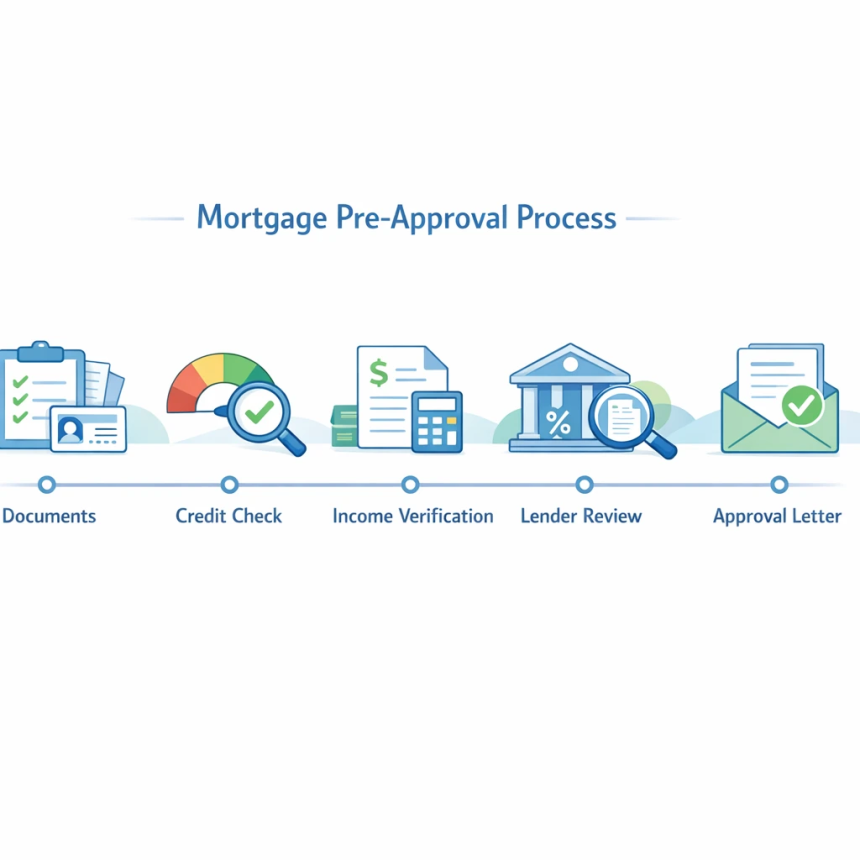
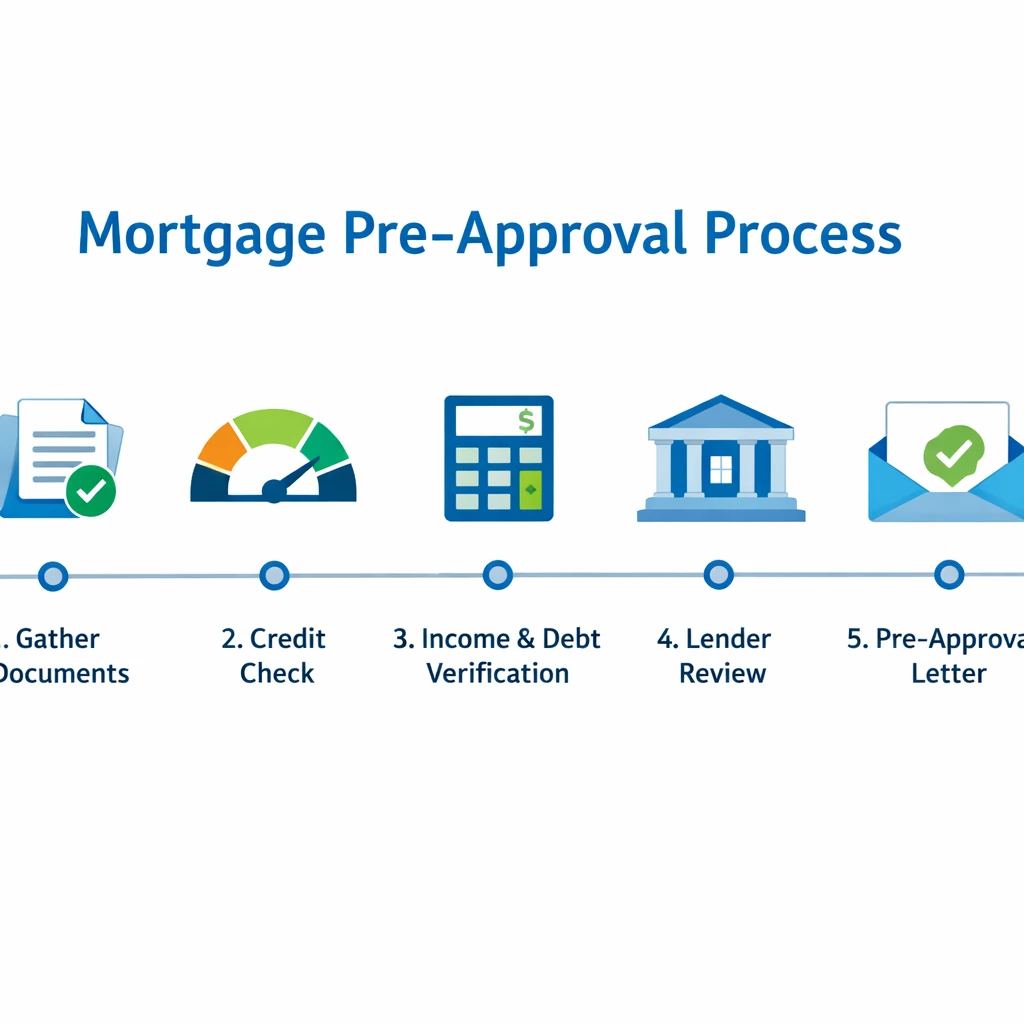
This guide is the definitive resource for navigating the mortgage pre-approval process step-by-step. We will walk you through every stage, from understanding the difference between prequalification and preapproval to gathering the essential documents and finally getting that letter in your hand. By the end, you will have a clear, actionable roadmap to becoming a verified, competitive homebuyer.
Table of Contents
- What is Mortgage Pre-Approval? (And Why It Matters in 2026)
- Pre-Approval vs. Pre-Qualification: The Critical Difference
- Step 1: Check Your Credit and Financial Health
- Step 2: Gather Your Essential Documents (The 2026 Checklist)
- Step 3: Choose Your Lender and Apply
- Step 4: The Lender’s Review Process
- Step 5: Receive and Understand Your Pre-Approval Letter
- What Lenders Evaluate: Credit, Income, Assets, and DTI
- How Long Does Pre-Approval Take?
- How Long is a Pre-Approval Letter Valid?
- Common Mistakes to Avoid During Pre-Approval
- What If Your Pre-Approval is Denied?
- Frequently Asked Questions (FAQs)
- Conclusion: Your Next Steps Toward Homeownership
What is Mortgage Pre-Approval? (And Why It Matters in 2026)
A mortgage pre-approval is a written statement from a lender indicating that they are conditionally willing to lend you a specific amount of money to buy a home . It is based on a thorough review of your financial history, including your credit score, income, assets, and debts . The lender verifies this information using documentation you provide, such as pay stubs, tax returns, and bank statements .
This is not a final loan commitment, but it is a powerful indicator of your borrowing power. Think of it as a financial background check that gives you a conditional “green light” from a lender .
ETF vs index fund: which is better for a beginner?
Why is it so important in 2026?
- It Strengthens Your Offer: Sellers are far more likely to accept an offer from a buyer who has been pre-approved. In competitive markets, some sellers won’t even schedule a showing without one . Buyers with pre-approval are 3-4 times more likely to have their offers accepted compared to those with only a prequalification .
- It Defines Your Budget: Pre-approval gives you a clear, realistic price range. This prevents you from falling in love with homes that are outside of your financial reach and streamlines your home search .
- It Speeds Up the Closing Process: Because much of the financial verification is done upfront, the final underwriting and approval process after you have a contract is often much faster .
- how to open a brokerage account for the first time
Pre-Approval vs. Pre-Qualification: The Critical Difference
These two terms are often used interchangeably, but they are very different stages in the home-buying process. Understanding the distinction is crucial .
| Feature | Pre-Qualification | Pre-Approval |
|---|---|---|
| Information Source | Self-reported by the borrower . | Verified by the lender with documentation . |
| Credit Check | Soft pull or none . | Hard credit inquiry required . |
| Documentation | None required . | Extensive: W-2s, pay stubs, tax returns, bank statements . |
| Time to Complete | Minutes to an hour . | 1 to 10 business days . |
| Accuracy | A rough estimate of what you might afford . | A verified, conditional commitment for a specific loan amount . |
| Seller Perception | Low confidence; the offer may be dismissed . | High confidence; a sign of a serious, qualified buyer . |
| Validity Period | No standard expiration . | Typically 60 to 90 days . |
The Bottom Line: Prequalification is a useful first step to get a general idea of your price range. Pre-approval is what you need before you start making offers .
what is dollar-cost averaging and how to set it up
Step 1: Check Your Credit and Financial Health
Before you formally apply, take stock of your financial situation. This will save you time and prevent surprises.
- Review Your Credit Reports: You are entitled to a free credit report from each of the three major bureaus (Equifax, Experian, TransUnion) annually at AnnualCreditReport.com . Review them for errors, such as incorrect late payments or accounts that aren’t yours, and dispute any inaccuracies you find .
- Know Your Credit Score: Your credit score is a key factor in determining your interest rate and loan options. For a conventional loan, most lenders look for a score of 620 or higher . FHA loans can be more flexible, allowing scores as low as 580 with a 3.5% down payment .
- Calculate Your Debt-to-Income Ratio (DTI): Lenders use your DTI to see how much of your income is already committed to debt. Add up all your monthly debt payments (car loans, student loans, credit card minimums, etc.) and divide by your gross monthly income. A DTI of 36% or less is ideal for most conventional loans, though some programs allow up to 43-50% .
- how to stop impulse buying online
Step 2: Gather Your Essential Documents (The 2026 Checklist)
Having your documents organized before you apply is the single most effective way to speed up the mortgage pre-approval process step-by-step . Here is the complete checklist of what most lenders will require .
Income Verification
- Pay Stubs: Your most recent 30 days of pay stubs, showing year-to-date earnings .
- W-2 Forms: From the past two years for all employers .
- Federal Tax Returns: Your complete federal tax returns (all pages and schedules) for the past two years .
- 1099 Forms: If you have freelance, contract, or investment income .
- Proof of Other Income: Award letters for Social Security, pensions, or alimony .
Asset Verification
- Bank Statements: The last two months of statements for all checking and savings accounts .
- Investment Account Statements: The last two months of statements for 401(k)s, IRAs, brokerage accounts, or other investments .
- Gift Letter: If any part of your down payment is a gift from a family member, you will need a signed letter stating the amount, that it is a gift, and that it does not need to be repaid .
Identity and Other Documents
- Government-Issued Photo ID: Such as a valid driver’s license or passport .
- Social Security Number: You will need to provide your number for the credit check .
- List of Monthly Debts: A complete list of all your recurring debts and obligations .
- Rental History: Contact information for your landlord(s) for the past 12-24 months .
Self-Employed Borrowers
If you are self-employed, be prepared to provide additional documentation, including:
- Business tax returns for the past two years .
- A year-to-date profit-and-loss statement .
- Business bank statements .
- how to save for a house down payment in 2 years
Step 3: Choose Your Lender and Apply
- Shop Around: Do not settle for the first lender you find. Get quotes from two to three different lenders—including banks, credit unions, and online lenders—to compare rates, fees, and loan terms .
- The 14-Day Window: Apply with all your chosen lenders within a 14-day window. Credit scoring models recognize this as rate shopping, and all the hard inquiries will typically count as a single inquiry, minimizing the impact on your credit score .
- Submit Your Application: You will complete a formal application (often online) and upload all the required documentation .
Step 4: The Lender’s Review Process
Once you submit your application, the lender gets to work. They will :
- Pull Your Credit: Perform a hard credit inquiry.
- Verify Your Employment: Contact your employer to confirm your position, salary, and hire date .
- Verify Your Income and Assets: Review your pay stubs, tax returns, and bank statements.
- Calculate Your DTI: Formally calculate your debt-to-income ratio.
- Run Automated Underwriting: Your information is often run through an automated underwriting system (AUS), like Fannie Mae’s Desktop Underwriter, which provides a preliminary approval decision within minutes .
- zero-based budgeting vs. 50/30/20 rule
Step 5: Receive and Understand Your Pre-Approval Letter
If you are approved, the lender will issue a pre-approval letter. This document typically includes :
- Your name.
- The loan amount you are conditionally approved for.
- The loan program (e.g., Conventional, FHA, VA).
- An estimated interest rate.
- The property address (may be left blank).
- The expiration date of the pre-approval.
Important: This is a conditional commitment. The final loan approval is still subject to a satisfactory appraisal of the property you choose and verification that your financial situation has not changed .
best cash envelope system wallets 2024
What Lenders Evaluate: Credit, Income, Assets, and DTI
Lenders assess four primary risk factors to determine your pre-approval :
- Credit Score and History: This shows your past reliability in repaying debts .
- Income and Employment: This demonstrates your ability to make future payments .
- Assets and Reserves: This proves you have the cash for the down payment, closing costs, and a financial cushion after closing. The CFPB recommends having at least two months of reserves .
- Debt-to-Income Ratio (DTI): This calculates how much of your monthly income is already committed to debt, indicating your capacity to take on a new mortgage payment .
How Long Does Pre-Approval Take?
The timeline can vary, but a fully verified pre-approval typically takes three to ten business days . The speed depends on the lender’s workload and how quickly you provide all the required documentation . Submitting a complete and organized application upfront is the best way to expedite the process .
How Long is a Pre-Approval Letter Valid?
A standard pre-approval letter is usually valid for 60 to 90 days . After that period, it expires. If your home search takes longer, you will need to request a renewal from your lender, which will involve providing updated documents (like new pay stubs and bank statements) and may require another credit check .
Common Mistakes to Avoid During Pre-Approval
- Making a Large Purchase: Do not buy a new car, furniture, or anything else on credit. This increases your DTI and can derail your pre-approval .
- Changing Jobs or Quitting: Lenders look for stable income. A job change can raise red flags.
- Moving Money Around: Avoid large, unexplained deposits into your bank accounts. Lenders need to verify the source of all funds .
- Lying on Your Application: Be completely honest. Lenders will verify everything, and inaccuracies can lead to a denial .
- Only Applying with One Lender: You might miss out on a better rate or lower fees. Shopping around is key .
What If Your Pre-Approval is Denied?
A denial can be disappointing, but it is not the end of the road. Here’s what you can do :
- Ask Why: The lender is required to tell you the reason for the denial.
- Improve Your Credit: Work on paying down debts and ensuring all bills are paid on time.
- Pay Down Debt: Lowering your DTI is one of the most effective ways to improve your chances.
- Save for a Larger Down Payment: More money down reduces the lender’s risk.
- Consider a Different Loan Program: If you didn’t qualify for a conventional loan, you might be eligible for an FHA or VA loan .
- Find a Co-Signer: A co-signer with a stronger financial profile can help you qualify .
- sinking funds: what are they and how to set them up
Frequently Asked Questions (FAQs)
1. What is the difference between pre-approval and prequalification?
Prequalification is an informal estimate based on self-reported information. Pre-approval is a verified, conditional commitment from a lender after a thorough review of your financial documents and credit history .
2. Does pre-approval guarantee a loan?
No. Pre-approval is conditional. The final loan approval also depends on the property you choose passing an appraisal and your financial situation remaining the same .
3. Will pre-approval hurt my credit score?
Yes, it will result in a hard inquiry, which can temporarily lower your score by a few points (usually less than 5) . However, if you apply with multiple lenders within a 14-45 day window, it typically counts as a single inquiry .
4. How much does pre-approval cost?
With most lenders, the pre-approval process is free .
money saving challenges for couples
5. What credit score do I need for pre-approval?
For a conventional loan, most lenders require a minimum score of 620 . FHA loans are more flexible, allowing scores as low as 580 with a 3.5% down payment, or 500 with 10% down .
6. How long is a pre-approval letter good for?
A pre-approval letter is typically valid for 60 to 90 days .
7. Can I get pre-approved by multiple lenders?
Yes, and it is highly recommended. It allows you to compare rates and find the best loan for you. Just try to do it within a focused time frame .
8. What documents do I need for mortgage pre-approval?
You will need pay stubs, W-2s and tax returns from the last two years, bank statements from the last two months, a government-issued ID, and your Social Security number .
9. What is a debt-to-income ratio (DTI)?
Your DTI is the percentage of your gross monthly income that goes toward paying debts. Lenders use it to gauge your ability to manage a new mortgage payment .
10. What happens after I get pre-approved?
You can start house hunting with confidence. When you find a home and have an offer accepted, you will then move into the full mortgage application and underwriting process .
Conclusion: Your Next Steps Toward Homeownership
The mortgage pre-approval process step-by-step may seem like a lot of work, but it is the most important foundation you can build for a successful home purchase. It transforms you from a casual browser into a serious, verified buyer who sellers can trust.
how to save money on a tight income
By following the steps in this guide—checking your credit, gathering your documents, and applying with multiple lenders—you are setting yourself up for success. So, take a deep breath, organize your paperwork, and take that first step. Your dream home is waiting, and now you have the roadmap to get there.