The Ultimate Guide to How Much House Can I Afford on a $70,000 Salary? (2026 Edition)
By Peyman Daneshgar
You’ve worked hard, built your career, and now you’re earning a solid $70,000 a year. The dream of homeownership is calling. But as you scroll through listings, a daunting question looms: how much house can I afford on a $70,000 salary?
It’s the most critical question you can ask before falling in love with a property. The answer isn’t just about what a lender will pre-approve you for; it’s about finding a home that fits your lifestyle, your budget, and your long-term financial goals without leaving you “house poor.” In today’s market, with mortgage rates fluctuating and home prices varying wildly by region, understanding your true affordability is more important than ever.
This guide is the definitive resource for anyone earning $70,000 who is ready to buy a home. We will walk you through the rules of thumb, the numbers, the factors that influence your buying power, and the actionable steps you can take to make your dream a reality. By the end, you’ll have a crystal-clear roadmap to finding a home you can comfortably afford.
Table of Contents
- The Short Answer: What’s Your Price Range?
- The Guiding Principle: The 28/36 Rule Explained
- Calculating Your Budget: From $70,000 to a Monthly Payment
- Key Factors That Influence How Much House You Can Afford
- Real-World Scenarios: Affordability on $70,000
- How Much House Can I Afford on a $70,000 Salary? (By Location)
- Beyond the Mortgage: The True Cost of Homeownership
- Tips to Boost Your Home Buying Power on $70,000
- Frequently Asked Questions (FAQs)
- Conclusion: Your Path to Homeownership
The Short Answer: What’s Your Price Range?
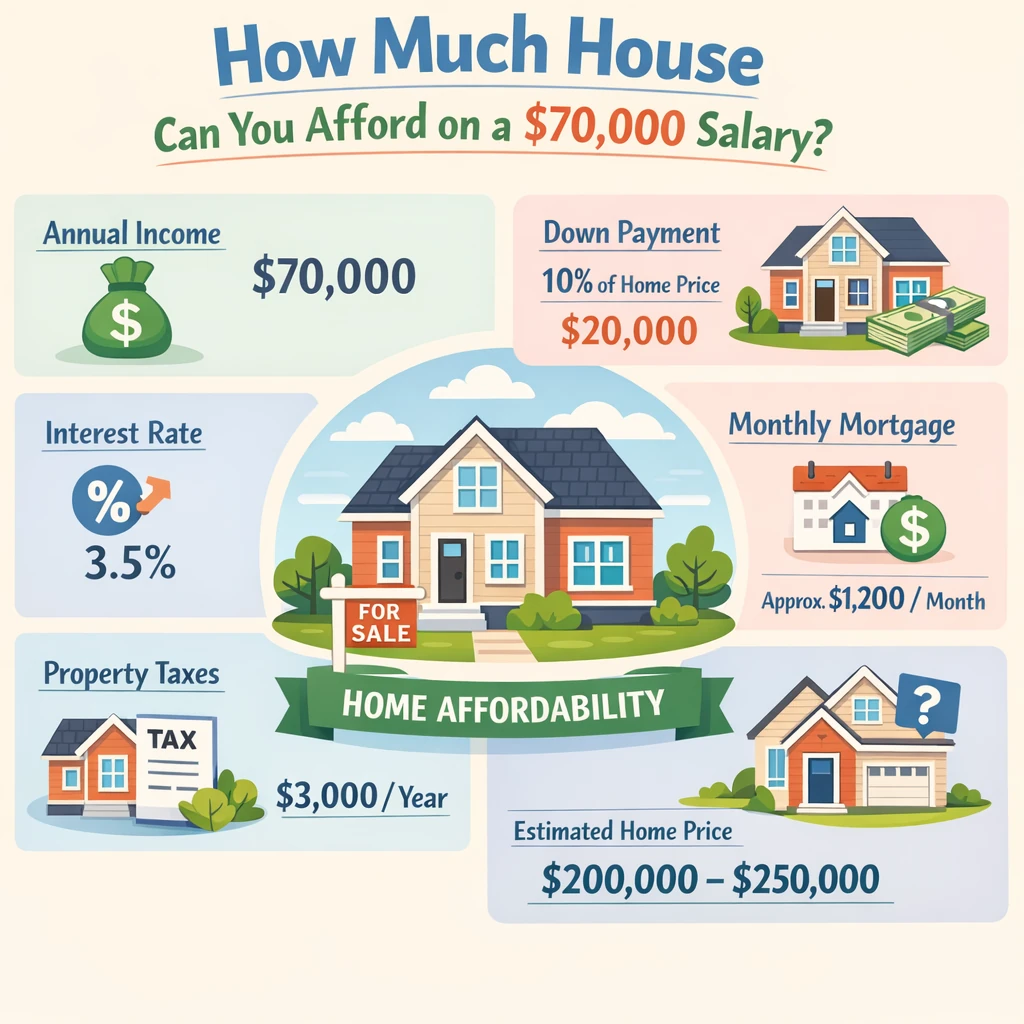
Let’s get straight to the point. For most people earning a $70,000 annual salary, a realistic home purchase price typically falls between $250,000 and $360,000. This translates to a comfortable monthly housing payment in the range of $2,000 to $2,500, which includes your mortgage principal, interest, property taxes, and homeowners insurance .
However, this is just a starting point. Your personal financial situation, the size of your down payment, your existing debts, and even the city you live in will dramatically shift this number up or down. Let’s dive into the details so you can pinpoint your unique budget.
how to negotiate lower credit card interest rates
The Guiding Principle: The 28/36 Rule Explained
The most widely accepted guideline for home affordability is the 28/36 rule. Lenders and financial experts use this rule to determine a safe and manageable level of housing debt .
- The 28% Rule (Front-End Ratio): This rule states that your total monthly housing costs—including principal, interest, property taxes, and homeowners insurance (PITI)—should not exceed 28% of your gross monthly income .
- The 36% Rule (Back-End Ratio): This rule expands the view to include all your debts. It states that your total monthly debt payments, including your new mortgage, car loans, student loans, and credit card minimums, should not exceed 36% of your gross monthly income .
- best debt consolidation loans for good credit 2024
While lenders may sometimes approve loans with higher ratios (up to 43% or even 50% for some programs), sticking to the 28/36 rule ensures you have a financial buffer for savings, emergencies, and the unexpected costs of homeownership .
Calculating Your Budget: From $70,000 to a Monthly Payment
Let’s apply the 28/36 rule to a $70,000 salary.
Step 1: Find Your Gross Monthly Income.
$70,000 / 12 months = $5,833 per month.
Step 2: Calculate Your Maximum Monthly Housing Payment (28%).
$5,833 x 0.28 = $1,633 per month.
This $1,633 is the absolute maximum you should spend on your monthly mortgage payment, including property taxes and homeowners insurance, according to this conservative rule.
Step 3: Calculate Your Maximum Total Debt Payments (36%).
$5,833 x 0.36 = $2,100 per month.
This means that between your mortgage and all your other debts (car loans, student loans, credit cards), your total monthly obligations should not exceed $2,100 .
how to get out of payday loan debt fast
The difference between these two numbers ($2,100 – $1,633 = $467) is the maximum cushion you have for other monthly debts to stay within the 36% limit.
Key Factors That Influence How Much House You Can Afford
While the 28/36 rule provides a solid foundation, the final answer to “how much house can I afford on a $70,000 salary?” depends on several variables.
Your Debt-to-Income Ratio (DTI)
This is arguably the most important factor for lenders. Your DTI is calculated by dividing your total monthly debt payments by your gross monthly income .
- Low Debt, High Buying Power: If you have no car payment and minimal student loans, your DTI is low. This means almost all of your $2,100 total debt allowance can go toward your mortgage, potentially allowing you to afford a home closer to the top of your price range.
- High Debt, Lower Buying Power: If you have a $400 monthly car payment and $300 in student loans ($700 total), that amount is deducted from your $2,100 allowance. This leaves you with only $1,400 for a mortgage, which will significantly lower the home price you can afford .
- does debt settlement hurt your credit score?
Your Down Payment
The amount you put down directly impacts your loan size and monthly payment.
- 3-5% Down (Minimum): With a conventional or FHA loan, you can put down as little as 3% to 3.5% . On a $300,000 home, that’s a down payment of $9,000 to $10,500. However, with less than 20% down, you will have to pay for private mortgage insurance (PMI), which adds $100-$200 or more to your monthly payment and reduces your buying power .
- 20% Down (The Gold Standard): A down payment of $60,000 on a $300,000 home eliminates PMI, lowers your monthly payment, and allows you to afford more house for the same monthly budget.
Your Credit Score and Mortgage Rates
Your credit score directly influences the interest rate you qualify for. A higher score gets you a lower rate. Even a 1% difference in your interest rate can change your buying power by tens of thousands of dollars .
- On a $300,000 loan, a 6.5% rate gives you a monthly principal and interest payment of about $1,896.
- The same loan at 7.5% costs about $2,098 per month—that’s an extra $200 a month, or $72,000 over 30 years.
- Strategies to Pay Off $30,000 in Student Loans
The Type of Mortgage Loan
Different loan programs have different requirements and benefits .
- Conventional Loans: Best for buyers with good credit (620+) and a 5-20% down payment.
- FHA Loans: Popular for first-time buyers. Allows a 3.5% down payment with a credit score of 580 or higher, but requires mortgage insurance for the life of the loan in many cases .
- VA Loans: For eligible veterans and service members. Offers 0% down, no PMI, and competitive rates.
- USDA Loans: For buyers in designated rural and suburban areas. Offers 0% down for low-to-moderate income buyers.
Real-World Scenarios: Affordability on $70,000
To bring this all together, let’s look at three different scenarios for a buyer with a $70,000 salary and an estimated 7% interest rate .
| Scenario | Down Payment | Monthly Debts | Estimated Home Price Range | Details |
|---|---|---|---|---|
| Ideal Buyer | 20% ($50k-$70k) | Low ($0-$200) | $325,000 – $350,000 | No PMI, great loan terms. |
| Average Buyer | 5% (~$15k) | Moderate ($200-$400) | $250,000 – $275,000 | Likely includes PMI. |
| Tight Budget | 3% (~$6k) | High ($400-$700+) | $200,000 – $225,000 | May need low-cost areas. |
How Much House Can I Afford on a $70,000 Salary? (By Location)
The most significant factor in home affordability is location. A $70,000 salary goes much further in the Midwest than on the coasts. Here’s a general idea:
- High-Cost Areas (e.g., San Francisco, New York City, Los Angeles): A $70,000 salary will make it extremely challenging to buy a home without a very large down payment. You may be looking at condos, townhomes, or properties far from city centers, potentially in the $250,000-$350,000 range if they exist.
- Moderate-Cost Areas (e.g., Denver, Austin, Orlando): Your salary can work well here. You can likely find a comfortable single-family home in the $300,000-$375,000 range, especially with a moderate down payment.
- Low-Cost Areas (e.g., Cleveland, Kansas City, Wichita): Your salary has strong purchasing power. You can likely afford a very nice home in the $350,000+ range, possibly even more, allowing you to buy a larger or more updated property.
Use local online real estate marketplaces to get a feel for what your estimated monthly payment will get you in your specific area.
how to use a balance transfer card wisely
Beyond the Mortgage: The True Cost of Homeownership
When asking “how much house can I afford on a $70,000 salary?“, remember that the mortgage is just the beginning. Factor in these ongoing costs to your monthly budget:
- Property Taxes: These vary by location and can add hundreds to your monthly payment.
- Homeowners Insurance: Protects your home and belongings; costs vary based on coverage and location.
- Private Mortgage Insurance (PMI): Required if your down payment is less than 20% on a conventional loan.
- HOA Fees: If you buy a condo or a home in a planned community, you’ll pay monthly or annual fees.
- Maintenance and Repairs: A golden rule is to budget 1-2% of your home’s value annually for upkeep . On a $300,000 home, that’s $3,000 to $6,000 per year.
- Utilities: Expect higher costs for electricity, water, gas, and trash services compared to renting, especially if you’re moving from a smaller apartment.
Tips to Boost Your Home Buying Power on $70,000
If the numbers feel tight, don’t be discouraged. Here are actionable strategies to improve your situation:
- Pay Down Existing Debt: This is the single most effective way to increase your buying power. Eliminating a $200 monthly car payment could boost the home price you can afford by tens of thousands of dollars .
- Improve Your Credit Score: Check your credit report for errors and pay all bills on time. Even a 20-30 point increase can qualify you for a better interest rate .
- Save for a Larger Down Payment: The more you put down, the less you borrow. Aim for 20% to eliminate PMI, which frees up room in your monthly budget.
- Explore First-Time Home Buyer Programs: Your state or local housing authority may offer down payment assistance grants or low-interest loans that can significantly lower your upfront costs .
- Shop Around for Lenders: Don’t accept the first loan offer. Get quotes from multiple lenders (banks, credit unions, online lenders) to find the best rate and terms .
- Consider a Multi-Family Home: Buying a duplex or triplex and renting out the other units can generate income that helps pay your mortgage, effectively increasing what you can afford .
- government programs for medical debt relief
Frequently Asked Questions (FAQs)
1. Is $70,000 a good salary for buying a house?
Yes, $70,000 is a solid income for homeownership in many parts of the country. Your success will depend on your existing debts, your down payment savings, and the cost of living in your target area .
2. What is the monthly payment on a $300,000 house with a $70,000 salary?
With a 7% interest rate and 10% down, your monthly principal and interest would be around $1,796. Adding estimated property taxes and insurance could bring your total monthly payment to roughly $2,200 – $2,400. This is within the affordable range for a $70,000 salary if you have low other debts .
3. How much house can I afford with a $70,000 salary and no debt?
With no debt, you are in a fantastic position. You could likely afford a home in the $325,000 to $350,000 range, and possibly even higher if you have a solid down payment, because all of your “debt allowance” can go toward your mortgage .
first-time home buyer grants and programs 2024
4. Can I afford a $400,000 house on a $70,000 salary?
In most cases, a $400,000 home would be a significant stretch on a $70,000 salary, unless you have a very large down payment (close to 20% or more) and zero other debts. The monthly payment would likely exceed the recommended 28% of your gross income .
5. How does a car payment affect how much house I can afford?
A car payment directly increases your DTI, which reduces the amount a lender will approve you for and shrinks your monthly budget for a mortgage. A $400 car payment can reduce your maximum affordable home price by $50,000 or more .
6. What is the 28/36 rule for a $70,000 salary?
The 28/36 rule means your total monthly housing costs (PITI) should be at most 28% of your gross monthly income (around $1,633), and your total debt payments (including mortgage) should be at most 36% of your income (around $2,100) .
is debt consolidation a good idea?https://daneshgr.com/is-debt-consolidation-a-good-idea/
7. Should I use an FHA or conventional loan on a $70,000 salary?
An FHA loan is great if you have a lower credit score or only a 3.5% down payment. A conventional loan is better if you have good credit and can put at least 5-10% down, as you can eventually cancel PMI. Your loan officer can help you compare .
8. What costs are not included in my mortgage payment?
Your mortgage payment (PITI) does not include utilities, HOA fees, maintenance, repairs, or furnishings. Budgeting an extra 1-2% of the home’s value annually for these costs is wise .
9. How can I calculate my own home affordability?
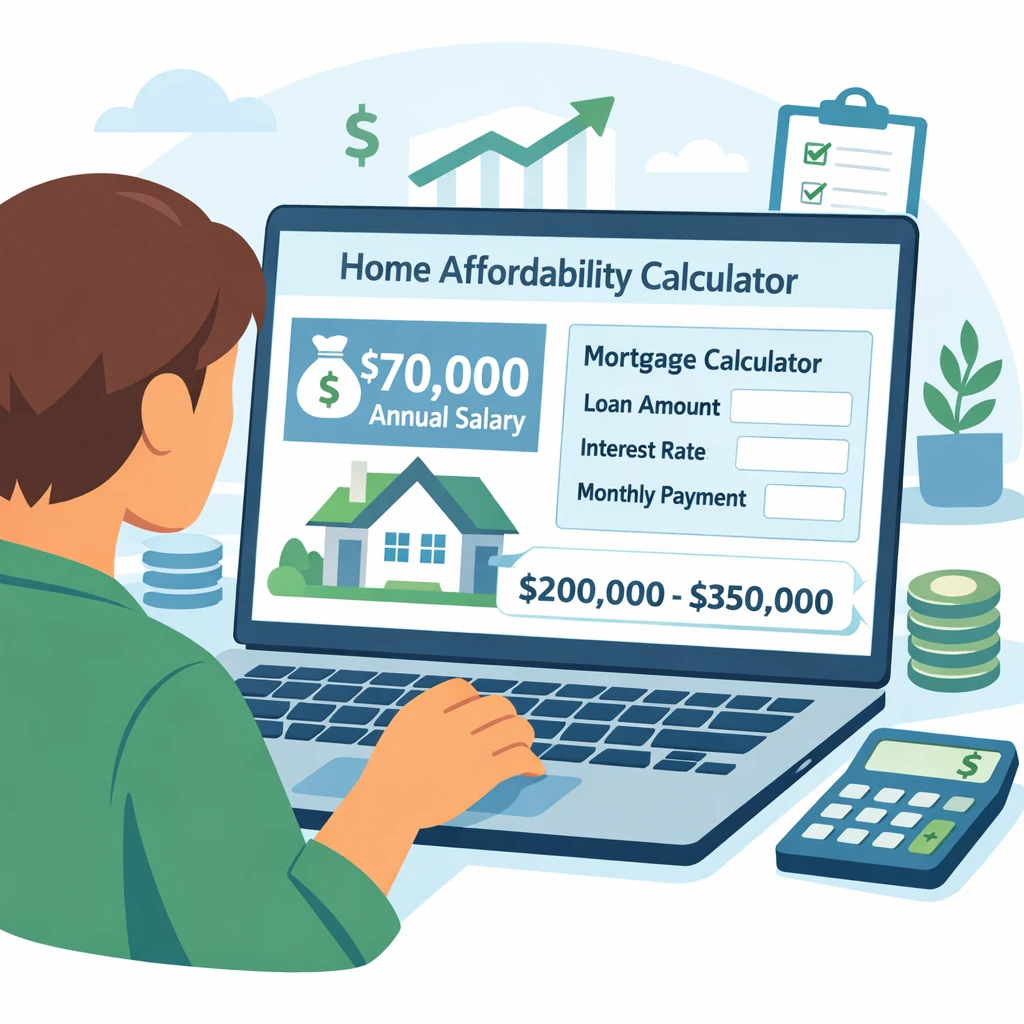
The best way is to use an online affordability calculator that factors in your income, debts, down payment, and estimated interest rate. For the most accurate number, get pre-approved by a mortgage lender .
10. How do I know if I’m “house poor”?
You are “house poor” if so much of your income goes toward your mortgage and home-related expenses that you struggle to afford other things like saving for retirement, traveling, dining out, or handling unexpected emergencies. Following the 28/36 rule helps prevent this .
how to talk to creditors when you can’t pay
Conclusion: Your Path to Homeownership
Determining how much house can I afford on a $70,000 salary is a journey of self-assessment as much as it is a math problem. By understanding the 28/36 rule, honestly evaluating your debts, and factoring in the true costs of ownership, you can arrive at a price range that feels comfortable, not crushing.
The dream of owning a home on a $70,000 salary is not only possible—it’s achievable for millions of Americans. With careful planning, a solid down payment, and a clear understanding of your budget, you can find a place to call your own and build a future in it. Your first step? Talk to a reputable lender, get pre-approved, and start your search with confidence.