The Ultimate Guide: Is It Better to Rent or Buy a Home Right Now? (2026 Deep Dive)
By Peyman Daneshgar
The question is as old as the modern housing market itself: is it better to rent or buy a home right now? For generations, the prevailing wisdom was simple—buying is always the better long-term investment. Renting, the old saying goes, is just “throwing money away.”
But in 2026, that advice feels dangerously outdated. The world has changed. Home prices have soared to record highs, mortgage rates have reset to a “new normal” above 6%, and the gap between what it costs to own versus rent has shifted dramatically depending on where you live . Meanwhile, rents in many markets are actually falling for the first time in years, creating a uniquely “renter-friendly” environment .
So, which path is right for you right now? The answer is no longer a simple rule of thumb. It requires a deep, honest look at your personal finances, your lifestyle goals, and the specific dynamics of your local housing market.
This guide is the definitive resource for navigating the rent vs. buy decision in 2026. We will break down the latest data, walk you through the hidden costs of both options, provide a framework for making the choice, and answer every question you might have. By the end, you will have a clear, personalized roadmap for your next move.
Table of Contents
- The 2026 Housing Market: A Tale of Two Trends
- The Case for Buying a Home in 2026
- The Case for Renting a Home in 2026
- The Financial Face-Off: Renting vs. Buying by the Numbers
- The Hidden Costs: What the Monthly Payment Doesn’t Tell You
- The 5-Year Rule: Why Your Time Horizon Matters Most
- Regional Reality Check: Where You Live Changes Everything
- The “Rent is Dead Money” Myth, Debunked
- How to Decide: A Step-by-Step Framework
- Frequently Asked Questions (FAQs)
- Conclusion: Your Home, Your Choice
The 2026 Housing Market: A Tale of Two Trends
To answer the question “is it better to rent or buy a home right now?”, you must first understand the unique dynamics of the 2026 market. It is a market defined by contradictory forces.
Home Prices: Still Climbing, But Slowing
After years of explosive growth, home price appreciation is moderating but remains positive. The National Association of Realtors (NAR) expects prices to increase by about 2% to 4% in 2026 . Other forecasts, like those from Realtor.com and Zillow, are more conservative, predicting gains of around 1% to 2.2% . The takeaway? Buying a home is likely to continue building equity, just at a slower, more sustainable pace.
Mortgage Rates: The “New Normal”
Gone are the days of 3% mortgages. The average 30-year fixed mortgage rate is projected to hover around 6% to 6.3% in 2026 . While this is a slight improvement from the peaks of recent years, it represents a “new normal” that significantly impacts affordability. For every percentage point increase in the rate, your buying power drops substantially.
how to create a budget for beginners step by step
Rents: A Rare Bright Spot for Renters
Here is where the 2026 market diverges from recent history. After a surge in new apartment construction over the past 18 months, an oversupply in some markets is putting downward pressure on rents . National median rent has fallen to its lowest level since 2022, with some areas experiencing a 6.2% drop from the peak . Realtor.com forecasts rents to decline by another 1% by the end of 2026 . This is shaping up to be one of the most renter-friendly periods in a decade
.best budgeting method for irregular income
The Affordability Paradox
This creates a strange paradox. In many counties (about 58% according to ATTOM data), the monthly cost of owning a home is actually lower than renting a comparable three-bedroom property . However, the upfront barrier to entry—the down payment and closing costs—remains a massive hurdle, as home prices are at record highs .
best budgeting method for irregular income
The Case for Buying a Home in 2026
For the right person in the right situation, buying a home remains a powerful financial move.
1. Building Equity, Not Just Paying a Landlord
Every mortgage payment you make is a form of forced savings. A portion goes toward interest, but a portion goes toward paying down the principal, building your ownership stake in the property. Over time, this equity becomes a powerful financial asset you can tap into for renovations, education, or retirement.
2. Hedge Against Rent Inflation
When you buy a home with a fixed-rate mortgage, your largest monthly expense—your housing payment—is locked in for the next 15 or 30 years. Your property taxes and insurance may rise, but the principal and interest payment is fixed. As a renter, you are subject to the whims of the market. And while rents are softening now, the long-term trend is always upward . In the EU, for example, rents have risen 21.1% since 2015 .
50/30/20 rule calculator excel template free
3. Long-Term Appreciation
Despite short-term fluctuations, real estate has historically been a reliable long-term investment. The very long-term trend for home prices is around 3% annual growth . While 2026 may see gains on the lower end of that spectrum, owning a home allows you to participate in that wealth creation.
how to save money on a tight income
4. Stability and Freedom
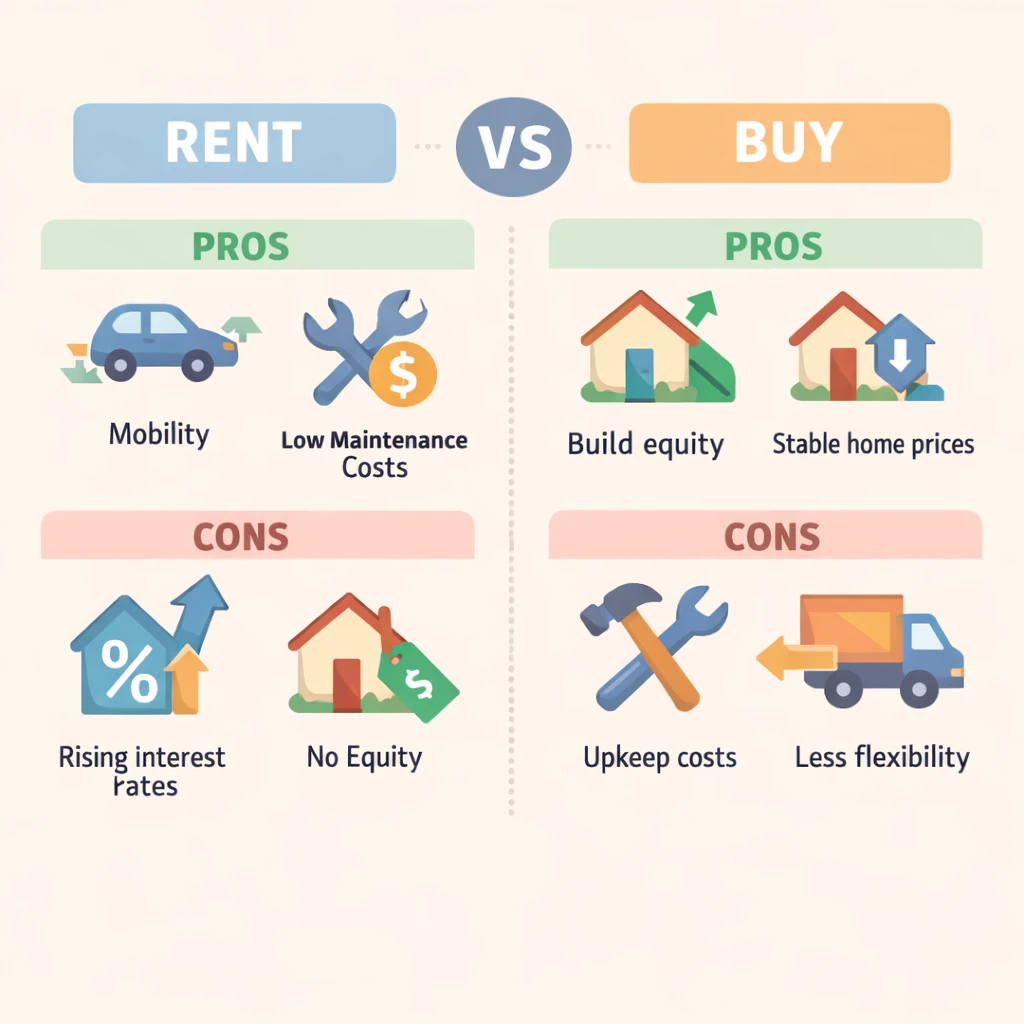
There is an intangible value to owning your own space. You can paint the walls, renovate the kitchen, and get a dog without asking a landlord’s permission. For families looking to put down roots in a community and a school district, this stability is invaluable.
The Case for Renting a Home in 2026
For many, especially in the current market, renting is not just a fallback option—it is a strategically superior choice.
1. Lower Monthly Costs in Many Markets
In 69% of U.S. counties, home prices are rising faster than rents . This means that in many areas, renting is simply cheaper on a month-to-month basis. The cash you save by renting can be redirected into other wealth-building vehicles.
2. Flexibility and Mobility
Renting offers freedom. If your job relocates, you want to move to a new city, or your family situation changes, you can simply give notice and move at the end of your lease. Selling a home is an expensive, time-consuming process. In a world where career paths are less linear than they used to be, this flexibility has real financial value.
3. Freedom from Maintenance and Surprise Costs
When the roof leaks or the boiler breaks, a renter calls the landlord. A homeowner calls a contractor and opens their wallet. Homeowners must budget for maintenance, typically estimated at 1% of the property’s value per year . On a $400,000 home, that’s $4,000 annually. Renting shields you from these unpredictable expenses.
4. The Power of Investing the Difference
This is the most compelling financial argument for renting. Let’s say you have a $45,000 deposit saved. Instead of using it to buy a home, you invest it in a diversified portfolio (like a low-cost index fund) that averages a 6-7% annual return . If your rent is also significantly lower than a mortgage payment would be, you can invest that monthly savings as well. Over time, your investment portfolio could grow larger than the equity you would have built in a home, especially in the first 5-7 years of ownership.
best robo-advisors for beginners 2024 comparison
The Financial Face-Off: Renting vs. Buying by the Numbers
To truly answer “is it better to rent or buy a home right now?”, you need to run the numbers. Here is a framework for comparison.
The Buying Scenario: What to Include
- Purchase Price: The cost of the home.
- Down Payment: The cash you put down (typically 3-20%).
- Mortgage Payment: Principal and interest based on current rates (approx. 6.3%).
- Property Taxes: Vary by location.
- Homeowners Insurance: Required.
- Private Mortgage Insurance (PMI): Required if your down payment is less than 20%.
- Maintenance: Budget 1% of the home’s value annually .
- Closing Costs: One-time upfront costs of 2-5% of the loan amount .
The Renting Scenario: What to Include
- Monthly Rent: Your base rent payment.
- Renter’s Insurance: Cheap but essential.
- Application Fees and Deposits: One-time upfront costs.
- Rent Increases: Factor in an annual increase (e.g., 2-3%) if you plan to stay long-term.
- The “Opportunity Cost”: This is the crucial part. What would your down payment and monthly savings earn if invested?
- ETF vs index fund: which is better for a beginner?
A Worked Example
Let’s look at a hypothetical buyer, Sarah, based on the UK-based calculator model from WeCovr .
- Scenario: Sarah wants to buy a £300,000 flat in Bristol with a £45,000 deposit, a 30-year mortgage at 4.5%, and a £1,400 monthly rent alternative.
- The Result: A rent vs. buy calculator shows that for the first 6 years, Sarah’s net worth would be higher if she rented and invested her deposit. From Year 7 onwards, the equity and appreciation from buying make it the financial winner .
The “crossover point” —the year when buying becomes cheaper than renting—is typically 5 to 7 years after purchase .
The Hidden Costs: What the Monthly Payment Doesn’t Tell You
Many first-time buyers make the mistake of comparing the mortgage payment to the rent payment. This is dangerously incomplete.
Upfront Costs of Buying
- Down Payment: The biggest hurdle.
- Closing Costs: These alone can be a shock. On a $400,000 home with 3-4% closing costs, you need an extra $12,000 to $16,000 in cash on top of your down payment .
- how to open a brokerage account for the first time
Ongoing Costs of Buying
- Maintenance and Repairs: As noted, budget 1% annually. A new roof or HVAC system can cost $10,000+.
- HOA Fees: If you buy a condo or a home in a planned community, these monthly fees can be hundreds of dollars.
- Higher Utilities: Homes are typically larger than apartments and cost more to heat and cool.
The “Hidden” Costs of Renting
- Junk Fees: Some landlords charge application fees, “January fees,” or fees for amenities like mail sorting .
- Rent Increases: While rents are stable now, they will rise over the long term.
- No Equity: This is the big one. At the end of 30 years of renting, you own nothing.
The 5-Year Rule: Why Your Time Horizon Matters Most
Financial experts universally agree on one thing: the length of time you plan to stay in the home is the single most important factor in the rent vs. buy decision.
If you plan to move in less than 5 years, renting is almost always the better financial choice . Why? Because the upfront transaction costs (closing costs, realtor commissions when you sell) are so high that you won’t have time to build enough equity to recoup them.
If you plan to stay 5 to 7 years or more, buying begins to make financial sense . You give the market time to appreciate, you pay down more of your principal, and you spread those upfront costs over a longer period. For those planning to stay 10+ years, buying is typically a strong wealth-building move .
how to stop impulse buying online
Regional Reality Check: Where You Live Changes Everything
The answer to “is it better to rent or buy a home right now?” depends almost entirely on your zip code.
The United States: A Tale of Three Regions
According to ATTOM’s 2026 Rental Affordability Report, the math varies wildly by region :
- The Midwest: The strongest market for buyers. It was more affordable to buy than rent in 81.5% of counties analyzed. Places like Peoria, IL, and Wayne County, MI, are incredibly affordable.
- The South: Still favors buyers, with 66.3% of counties showing ownership as more affordable.
- The Northeast: A mixed bag. It was more affordable to buy in only 48.8% of counties.
- The West: The strongest market for renters. It was more affordable to buy in a mere 16.9% of counties. In coastal California, the numbers are stark. In Orange County, CA, ownership consumes over 104% of typical wages, making it far cheaper to rent .
- how to save for a house down payment in 2 years
Europe: A Continent in Crisis
The picture in Europe is more dire. Across the EU, home prices have risen 63.6% since 2015, while rents are up 21.1% . Wages have not kept pace. In many European capitals, renting a modest flat already consumes more than 40% of the average net salary . For many Europeans, the question isn’t rent vs. buy—it’s whether they can afford either without sacrificing financial stability. This has led to a rise in “forced co-living” and flat-sharing as an economic necessity rather than a lifestyle choice .
The “Rent is Dead Money” Myth, Debunked
This is perhaps the most persistent and damaging myth in personal finance. The idea that rent is “dead money” ignores a fundamental principle: you are paying for a service.
That service is shelter, flexibility, and freedom from risk. When you rent, you are paying for a place to live and transferring the risks of property taxes, maintenance, and market fluctuations to the landlord. That is not “dead”—it’s a transaction.
Furthermore, as the 5-year rule and the power of investing the difference show, renting can be the financially superior choice in the short-to-medium term. The “dead money” argument only holds up over very long time horizons (10+ years) in markets where buying is demonstrably cheaper.
How to Decide: A Step-by-Step Framework
Ready to make your decision? Follow this process.
- Check Your Local Market: Use online tools to compare the median rent for a home you’d want versus the all-in monthly cost of buying a comparable home (use a mortgage calculator that includes taxes and insurance). What is the monthly gap?
- Assess Your Time Horizon: Be honest. Do you see yourself in the same city, in the same job, with the same family situation for the next 5-7+ years?
- Evaluate Your Savings: Do you have enough for a down payment (at least 3-5%) plus another 3-4% for closing costs plus a 3-6 month emergency fund after you buy? If not, you are not ready to buy, regardless of the monthly math.
- Consider Your Stability: Is your income secure? Do you have the temperament to handle a $10,000 unexpected repair bill?
- Run the Numbers (with Opportunity Cost): Use a comprehensive rent vs. buy calculator that factors in investment returns on your deposit and monthly savings. See where your “crossover point” lies .
- Talk to a Professional: Speak with a mortgage lender to get pre-approved (so you know your budget) and a financial advisor to understand how a home purchase fits into your overall wealth plan.
Frequently Asked Questions (FAQs)
1. Is 2026 a good time to buy a house?
It depends on your personal situation. For those with stable jobs, a long time horizon (5-7+ years), and enough savings for a down payment and closing costs, 2026 offers a more balanced market with slower price growth and stabilizing rates . For those with short-term plans or limited savings, renting is likely the better choice.
2. Is renting cheaper than buying in 2026?
In many markets, yes. While buying is more affordable in a slight majority of U.S. counties on a monthly basis, the upfront costs are massive . Furthermore, in high-cost areas like the West Coast, renting is significantly cheaper month-to-month. Nationally, rents are falling while home prices are still rising, favoring renters in the short term .
3. Will mortgage rates go down in 2026?
Forecasts suggest mortgage rates will stabilize or decrease slightly, averaging around 6% to 6.3% for a 30-year fixed loan . This is an improvement from recent peaks but far from the pandemic-era lows.
4. What is the “5-year rule” in real estate?
The 5-year rule is a guideline suggesting that you should plan to live in a home for at least five years to make buying financially worthwhile. This gives you enough time to recoup the upfront closing costs through equity build-up and appreciation .
5. Is renting just throwing money away?
No. Renting is paying for a service: shelter and flexibility. The money you save on a down payment, maintenance, and potentially lower monthly costs can be invested. For many people, especially in the short term, renting is the financially smarter move .
6. What are the hidden costs of buying a home?
The main hidden costs are closing costs (2-5% of the loan amount), ongoing maintenance (budget 1% of the home’s value annually), potential HOA fees, higher utility bills, and private mortgage insurance (PMI) if you put down less than 20% .
7. How much do I need for a down payment?
While 20% is ideal to avoid PMI, it is not required. Many conventional and FHA loans allow down payments as low as 3% to 3.5% . However, a smaller down payment means a higher loan amount, higher monthly payments, and the added cost of PMI .
8. Will home prices drop in 2026?
Most major forecasts do not predict a drop. Instead, they expect a slowdown in price growth, with increases of 1% to 4% . A significant price drop is considered unlikely due to persistent housing shortages.
9. What is the housing market outlook for 2026 in Europe?
The outlook is challenging. Home prices and rents continue to rise faster than wages, making housing unaffordable for many, particularly in major cities. The supply of new housing is insufficient to meet demand, and construction costs are high .
10. Should I wait to buy a home?
Waiting can be a good strategy if you are using the time to save a larger down payment, improve your credit score, or if you are uncertain about your job or location. However, waiting also means risking modest home price increases and potentially facing similar or higher rates in the future. Run the numbers for your specific market.
Conclusion: Your Home, Your Choice
The question “is it better to rent or buy a home right now?” has no single answer. In 2026, the decision is more nuanced than ever. The era of “buying is always better” is over, replaced by a reality where the best choice depends entirely on your personal finances, your timeline, and your local market.
For some, this is the year to take the plunge into homeownership, leveraging stabilizing rates to build long-term equity. For others, the smartest move is to rent, enjoy the flexibility, and invest the difference, waiting for a more favorable entry point.
The key is to make the decision with your eyes wide open. Ignore the myths, crunch the numbers, and be honest with yourself about your goals. Your path to financial freedom is unique—choose the housing option that best supports it.