
By: Peiman Daneshgar | Email: daneshgar781@gmail.com**
Published: February 21, 2026**
Table of Contents
- How to Avoid Taxes on Savings Account Interest (Legally, Obviously)
- Introduction: The $47 Surprise
- What This Article Will Actually Give You
- Part 1: The Problem Nobody Warns You About
- Part 2: United States—The Three-Legged Stool of Tax-Free Savings
- Part 3: United Kingdom—The ISA Is Your Best Friend
- Part 4: Canada—The TFSA Is Your Secret Weapon
- Part 5: South Africa—The TFSA Down Under (Sort Of)
- Part 6: India—Section 80TTA and 80TTB (The Direct Deductions)
- Part 7: The One Strategy That Works Everywhere
- Part 8: What NOT to Do (The Illegal Stuff)
- Frequently Asked Questions
- The Emotional Bottom Line
Introduction: The $47 Surprise
I know that feeling.
You check your bank account in early February, and there it is. A deposit labeled “INTEREST PAID.” You did nothing to earn it. You just left money sitting there, and the bank gave you a little bonus for being responsible.
Feels good, right?
Then tax season comes. You’re filling out your return, and you remember that interest. You dig up the form from your bank. It says you earned $47.37 in interest last year.
No big deal, you think. $47 isn’t going to change my tax bill.
But then you do the math. If you’re in the 22% bracket, that $47 costs you about $10. Not life-changing, sure. But multiply that by 10 years, by multiple accounts, by higher rates when savings accounts actually paid something—and suddenly you’re talking real money.
And if you have a lot saved? If you’re retired and living off interest? The number gets much, much bigger.
government programs for medical debt relief
Sound familiar?
Here’s the thing nobody tells you: The government wants a piece of your savings interest. Not just your investments. Not just your salary. The money you worked hard to save, sitting in a bank account, earning a pittance—they want some of that pittance.
But here’s the good news: In almost every country, there are perfectly legal ways to keep that money. Not loopholes. Not shady offshore accounts. Just smart, boring, legal strategies that millionaires have been using for decades.
🧠 Quick Reality Check:
You’re not trying to cheat the system. You’re just trying to stop the system from nibbling away at your hard-earned savings. And in every developed country, the tax code has provisions for exactly that. You just need to know where to look.
What This Article Will Actually Give You
Here’s the deal. Most tax articles focus on one country or one strategy. This one is different.
By the time you finish reading, you’ll know:
- The specific strategies for the US, UK, Canada, South Africa, and India—because readers come from everywhere .
- How tax-advantaged accounts (ISAs, TFSAs, RRSPs, Roth IRAs) completely eliminate tax on savings interest .
- The exact numbers —contribution limits, tax-free allowances, and income thresholds for 2025-2026 .
- The “municipal bond” loophole that lets high earners avoid tax on interest entirely .
- What NOT to do (so you don’t accidentally commit tax fraud) .
This is the playbook. Let’s run it.
how to use a balance transfer card wisely
Part 1: The Problem Nobody Warns You About
Why Savings Interest Is Taxed (The Annoying Answer)
In most countries, interest from savings accounts is treated as income —just like your salary . It gets added to your total income for the year, and you pay tax on it at your marginal rate .
For example:
- US: Savings interest is taxed as ordinary income (10%–37%) .
- UK: Interest is taxed at your marginal rate (0%–45%), but you get a Personal Savings Allowance .
- Canada: Interest is fully taxable at your marginal rate unless it’s in a registered account .
- India: Interest is taxable under “Income from Other Sources” but eligible for deductions .
- South Africa: Interest is taxable, but with annual exemptions .
The “I Didn’t Get a Form” Trap
Here’s where people mess up: They think if they didn’t get a tax form (1099-INT in the US, for example), they don’t have to report the interest.
Wrong.
Banks are only required to send forms if interest exceeds a certain threshold (usually $10 in the US). But the IRS still expects you to report every penny. And with modern data matching, they know exactly how much you earned .
Strategies to Pay Off $30,000 in Student Loans
🤔 Pause and Think:
If you’ve been ignoring small amounts of interest because “it’s not worth reporting,” you’re technically not compliant. Fix it.
Part 2: United States—The Three-Legged Stool of Tax-Free Savings
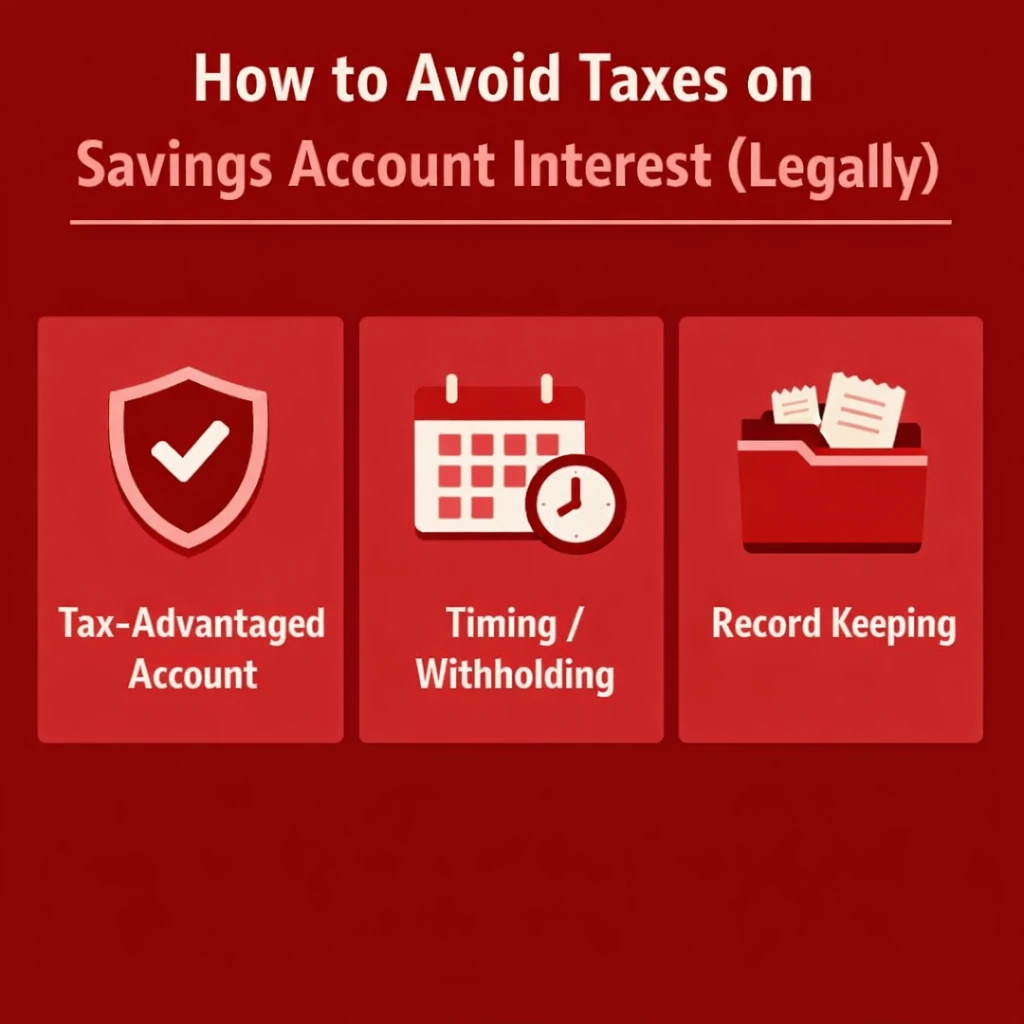
In the US, avoiding tax on savings interest comes down to three strategies: where you put the money, what you put it in, and how you manage it.
Leg 1: Tax-Advantaged Accounts (The Big Guns)
Roth IRA:
- Contributions are after-tax, but all growth and withdrawals are tax-free
- 2025 contribution limit: $7,000 ($8,000 if 50+)
- Income limits apply (phases out at $150,000 for single filers)
- Best for long-term savings you won’t touch until retirement
Traditional IRA:
- Contributions are tax-deductible now; growth is tax-deferred
- Withdrawals in retirement are taxed as ordinary income
- 2025 contribution limit: $7,000 ($8,000 if 50+)
Health Savings Account (HSA):
- The triple tax advantage: contributions tax-deductible, growth tax-free, withdrawals tax-free for qualified medical expenses
- 2025 contribution limit: $4,300 (individual) or $8,550 (family)
- After age 65, you can withdraw for any purpose penalty-free (though non-medical withdrawals are taxed)
529 Plans:
- For education savings
- Growth tax-free, withdrawals tax-free for qualified education expenses
- No federal tax deduction for contributions, but many states offer deductions
- does debt settlement hurt your credit score?
Leg 2: Tax-Free Investment Products (For When Your Accounts Are Maxed)
Municipal Bonds (“Munis”):
- Bonds issued by state and local governments
- Interest is federal tax-free, and often state tax-free if you buy bonds from your home state
- Particularly valuable for high-income investors in high-tax states
- Current yields around 3-4% for high-quality bonds
Treasury Bills (T-Bills):
- Interest is subject to federal tax but exempt from state and local taxes
- Great for investors in high-tax states like California or New York
- Current yields over 4% as of late 2025
Series I Bonds and EE Bonds:
- Interest is free from state and local taxes
- If used for qualified education expenses, interest can be federal tax-free too (subject to income limits)
- I Bonds currently offer a combined rate of 3.98% (fixed rate + inflation adjustment)
- Purchase directly from TreasuryDirect.gov
Tax-Exempt Money Market Funds:
- Funds that invest primarily in municipal bonds
- Interest is federal tax-free (and sometimes state tax-free)
- Examples: Fidelity SAI Municipal Money Market Fund (FMQXX), Vanguard Municipal Money Market Fund (VMSXX)
Leg 3: Tax-Loss Harvesting (Turning Lemons Into Tax Breaks)
This doesn’t directly apply to savings accounts, but it’s worth knowing: If you have investments in taxable accounts, you can sell losing investments to offset gains (including interest income) up to $3,000 per year against ordinary income .
how to get out of payday loan debt fast
Part 3: United Kingdom—The ISA Is Your Best Friend
In the UK, the answer is simple: Individual Savings Accounts (ISAs) .
The Cash ISA (The Simple One)
A Cash ISA is exactly what it sounds like—a savings account where all interest is tax-free .
2025-2026 ISA allowance: £20,000 per tax year .
You can split this between Cash ISAs and Stocks and Shares ISAs however you like. You can open a Cash ISA with as little as £1 .
Withdrawals are allowed anytime, but unlike a flexible ISA, if you withdraw money, you can’t put it back without it counting against your annual allowance .
The £20,000 Allowance
Here’s the math:
- Basic rate taxpayer: Without an ISA, you’d pay 20% tax on interest above your allowance
- Higher rate taxpayer: 40% tax
- Additional rate taxpayer: 45% tax
If you have £20,000 in a Cash ISA earning 4%, that’s £800 tax-free every year. Over 10 years, assuming rates stay similar, that’s £8,000+ in your pocket instead of the government’s.
best debt consolidation loans for good credit 2024
The Personal Savings Allowance (Your Backup Plan)
If you max out your ISA or have savings in regular accounts, the Personal Savings Allowance gives you:
- £1,000 tax-free interest for basic rate taxpayers
- £500 for higher rate taxpayers
- £0 for additional rate taxpayers
The Starting Rate for Savings
If your income is low, you might also qualify for the starting rate for savings—up to £5,000 of interest tax-free if your non-savings income is under £17,570 .

Example: How Much Can You Actually Save?
Let’s say you’re a basic rate taxpayer with £50,000 in savings earning 4% (£2,000 annual interest).
- Without planning: You’d use your £1,000 PSA, then pay 20% tax on the remaining £1,000 = £200 tax
- With a Cash ISA: Put £20,000 in the ISA = £800 tax-free
- Remaining £30,000 in regular account = £1,200 interest
- PSA covers £1,000 = tax on £200 = £40 tax
- Total tax: £40 instead of £200. You save £160 per year .
- how to negotiate lower credit card interest rates
Part 4: Canada—The TFSA Is Your Secret Weapon
How the TFSA Works
The Tax-Free Savings Account (TFSA) is Canada’s gift to savers. Despite the name, it’s actually an investment account where:
- Contributions are after-tax (no deduction upfront)
- All growth is tax-free—forever
- Withdrawals are tax-free—anytime, for any reason
- Withdrawn contribution room is added back the following year
The $109,000 Opportunity
The cumulative TFSA contribution limit since 2009 is $109,000 as of 2026 . For 2025 and 2026, the annual limit is $7,000 .
The key insight: TFSA millionaires don’t keep cash in their TFSAs—they invest in growth assets like stocks and ETFs . But even if you just hold cash, the interest is tax-free.
The TFSA Millionaire Club
As of October 2024, the CRA revealed that 352 Canadians had TFSAs worth at least $1 million . Two account holders had over $40 million .
Their secrets:
- Max out contributions early (many contribute January 1st)
- Invest in growth assets, not cash
- Focus on Canadian dividend stocks (avoid 15% withholding tax on US dividends)
- Buy and hold for the long term
- Avoid frequent trading (which triggers CRA scrutiny)
The FHSA and RRSP (Bonus Options)
First Home Savings Account (FHSA):
- New account type combining RRSP and TFSA benefits
- Contribute up to $8,000/year (max $40,000 lifetime)
- Contributions tax-deductible
- Withdrawals tax-free if used for first home purchase
- snowball vs avalanche method calculator
RRSP:
- Contributions tax-deductible
- Growth tax-deferred
- Withdrawals taxed as income in retirement
The CRA Trap to Avoid
The CRA watches TFSAs closely. If you engage in active or day trading, they may deem your activity “business-like” and tax your gains . TFSA millionaires succeed through long-term buy-and-hold, not frequent trading.
Part 5: South Africa—The TFSA Down Under (Sort Of)
The R500,000 Lifetime Limit
South Africa’s Tax-Free Savings Account (TFSA) launched in 2015 . The rules:
- Annual contribution limit: R36,000
- Lifetime contribution limit: R500,000
- No tax on interest, dividends, or capital gains inside the account
- Withdrawals are tax-free and unrestricted
Critical: Once you hit the R500,000 lifetime limit, you cannot contribute further—but the money continues growing tax-free .
investment mistakes to avoid in your 20s
The Power of Compounding in a TFSA
Here’s the example from 10X Investments :
- Invest R3,000/month (max annual contribution) for 13 years and 11 months until you hit R500,000
- Then let it grow untouched for the remaining years of a 40-year period
- At 6% average annual return, your final balance = R3.5 million
- Withdraw the full amount tax-free
That’s the power of tax-free compounding.
The 40% Penalty (Don’t Overcontribute)
If you exceed the R36,000 annual limit or R500,000 lifetime limit, SARS hits you with a 40% tax penalty on the excess . Track your contributions carefully.
Part 6: India—Section 80TTA and 80TTB (The Direct Deductions)
India takes a different approach: direct deductions on interest income.
Section 80TTA: For the Under-60 Crowd
If you’re below 60 years old, Section 80TTA allows a deduction of up to Rs 10,000 on interest from savings accounts .
Key points:
- Applies to interest from savings accounts in banks, cooperative societies, and post offices
- Does NOT apply to fixed deposits, recurring deposits, or corporate bonds
- Deduction is on total interest from all eligible accounts combined, not per account
- Available to individuals and HUFs
- NRIs can claim on NRO accounts (NRE accounts are already tax-free)
- NOT available under the new tax regime (Section 115BAC)
Section 80TTB: Senior Citizen Privilege
For senior citizens (60+), Section 80TTB is much more generous :
- Deduction up to Rs 50,000 on interest income
- Covers savings accounts, fixed deposits, AND recurring deposits
- Specifically designed for retirement security
- How to Choose Your First Mutual Fund
What’s NOT Covered
Neither section covers:
- Interest from corporate bonds or debentures
- Interest from time deposits (FDs, RDs—except under 80TTB for seniors)
- Any interest under the new tax regime
The New Regime Trap
If you opt for the new tax regime (lower rates, fewer deductions), you cannot claim Section 80TTA or 80TTB . You’ll pay tax on all interest at your slab rate.
Part 7: The One Strategy That Works Everywhere
Muni Bonds and T-Bills (US Specific)
For US high earners who’ve maxed their retirement accounts, municipal bonds and Treasury bills offer tax-advantaged interest . Muni interest is federal tax-free; T-bill interest is state tax-free.
The Universal Truth: Location Matters
Across every country, the principle is the same: Tax-advantaged accounts beat taxable accounts every time .
| Country | Account Type | Key Feature |
|---|---|---|
| US | Roth IRA | Tax-free growth and withdrawals |
| UK | Cash ISA | Up to £20,000/year tax-free |
| Canada | TFSA | Up to $109,000 cumulative tax-free |
| South Africa | TFSA | Up to R500,000 lifetime tax-free |
| India | 80TTA/80TTB | Rs 10,000–50,000 deduction |
If you have savings, put them in these accounts first . It’s not complicated. It’s just moving money from one place to another.
Part 8: What NOT to Do (The Illegal Stuff)
Let’s be clear about what this article is NOT recommending:
- Hiding money offshore to avoid reporting (illegal, and they’ll find it)
- Failing to report interest because “it’s small” (illegal, and banks report it)
- Lying on tax returns about where your money is (illegal, and auditable)
- Using accounts in someone else’s name to stay under limits (illegal, and obvious)
The strategies here are legal because they use provisions the tax code explicitly provides. Use them with confidence.
Frequently Asked Questions
Q: Do I have to pay tax on savings account interest?
A: In most countries, yes—interest is taxable as income. But there are legal ways to avoid or reduce it .
Q: What’s the best way to avoid tax on savings interest in the US?
A: Use tax-advantaged accounts (Roth IRA, Traditional IRA, HSA). If those are maxed, consider municipal bonds or Treasury bills .
Q: What’s the UK ISA allowance for 2025-26?
A: £20,000 per tax year .
Q: What’s the Canadian TFSA limit for 2026?
A: $7,000 annual limit. Cumulative limit since 2009 is $109,000 .
Q: What’s Section 80TTA in India?
A: A deduction of up to Rs 10,000 on savings account interest for individuals under 60 .
Q: Can seniors claim more in India?
A: Yes—Section 80TTB allows up to Rs 50,000 deduction, including on fixed deposits .
Q: What’s the South African TFSA lifetime limit?
A: R500,000 total, with annual limit of R36,000 .
Q: Are municipal bonds really tax-free?
A: Interest is federal tax-free, and often state tax-free if you buy bonds from your home state .
Q: Do I need to report interest if I didn’t get a tax form?
A: Yes. The absence of a form doesn’t exempt you from reporting .
Q: Can I use multiple strategies?
A: Absolutely. Max your tax-advantaged accounts first, then use tax-free products, then harvest losses.
The Emotional Bottom Line
Look, I’m not going to pretend that thinking about taxes on your savings is exciting.
It’s not. It’s boring. It’s administrative. It’s the least sexy part of personal finance.
But here’s the thing: Every dollar (or pound, or rand, or rupee) you save on taxes is a dollar that stays in your pocket. And over a lifetime, those dollars add up to real money—money that could be a vacation, a car, a down payment, or just a buffer against life’s surprises.
The strategies in this article aren’t loopholes. They’re not cheating. They’re just smart, legal ways to keep what’s yours. Governments created these provisions because they want to encourage saving. Use them.
Open that ISA. Max that TFSA. Check if your bank offers municipal bonds. Do the paperwork. It’s not hard—it’s just a few clicks and forms.
And next year, when tax season comes, you won’t be staring at that interest payment wondering where half of it went.
You’ll already know. Because you kept it all.