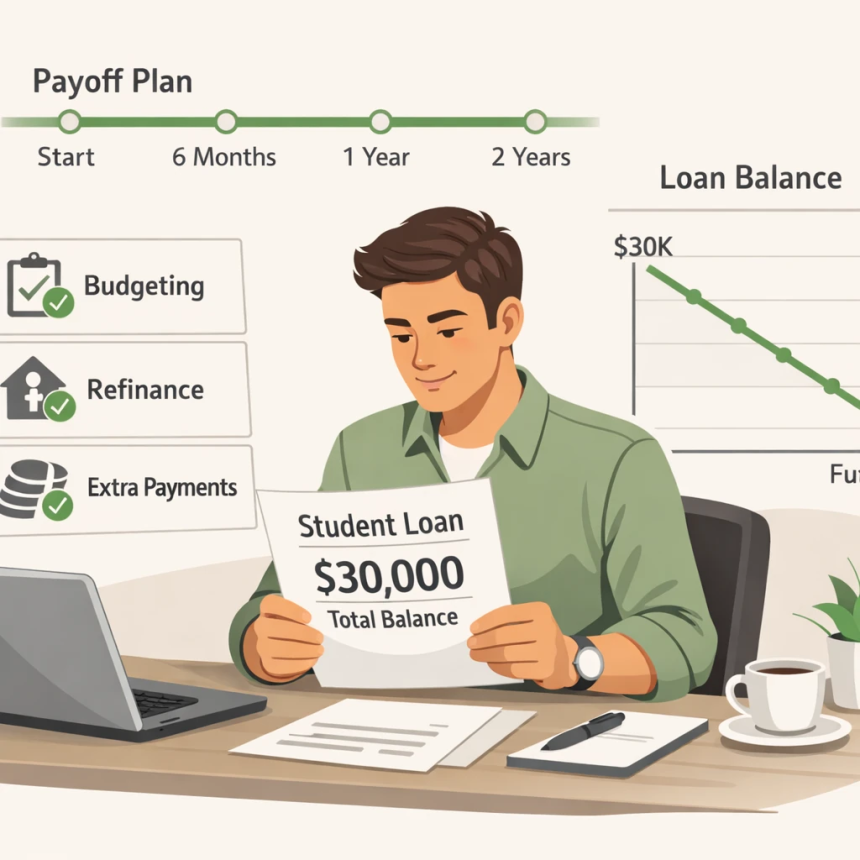
For the 43 million Americans carrying student loan debt, the path to repayment can feel like a marathon with no finish line . The average borrower owes around $39,000, making a balance of $30,000 in student loans a very common and relatable financial challenge . While this amount is substantial, it is also highly manageable with the right plan.
Whether you are a recent graduate just entering repayment or someone who has been chipping away at their balance for years, the feeling of being stuck is real. But here is the good news: with deliberate strategies, you can pay off this debt faster than the standard 10-year plan, save thousands of dollars in interest, and free up your income for other financial goals.
This guide is the definitive resource for anyone looking to eliminate a $30,000 student loan balance. We will cover everything from the mathematical foundations of debt payoff to the latest policy changes affecting borrowers in 2026. You will learn how to choose the right repayment plan, when to refinance, and how to leverage forgiveness programs. By the end, you will have a personalized, actionable roadmap to becoming debt-free.
Table of Contents
- Understanding Your $30,000 Student Loan Debt
- Strategy 1: Master the Avalanche and Snowball Methods
- Strategy 2: Pay More Than the Minimum—And Make It Count
- Strategy 3: The Biweekly Payment Hack
- Strategy 4: Refinance for a Lower Interest Rate
- Strategy 5: Utilize “Found Money” and Side Hustles
- Strategy 6: Explore Loan Forgiveness and Assistance Programs
- Strategy 7: Create a Student Loan-Focused Budget
- Navigating the 2026 Federal Student Loan Changes
- Frequently Asked Questions (FAQs)
- Conclusion: Your Roadmap to Debt Freedom
Understanding Your $30,000 Student Loan Debt
Before diving into payoff strategies, you must understand exactly what you owe. A $30,000 student loan balance is a significant number, but its impact on your life depends heavily on the interest rates and loan types.
The Cost of Waiting
The biggest enemy of debt freedom is not the principal; it is the interest. A $30,000 loan at 6% interest repaid over 10 years will cost you roughly $9,967 in total interest . If you extend that to 25 years, the total interest balloons to over $32,000—more than the original loan amount .
Loan Types Matter
- Federal Loans: These come with borrower protections like income-driven repayment (IDR) plans, deferment, and forgiveness options. However, rates are set by the government and are generally fixed.
- Private Loans: These lack federal protections but may have variable rates. If you have private loans, your primary tools are refinancing and aggressive payment strategies.
- sinking funds: what are they and how to set them up
Strategy 1: Master the Avalanche and Snowball Methods
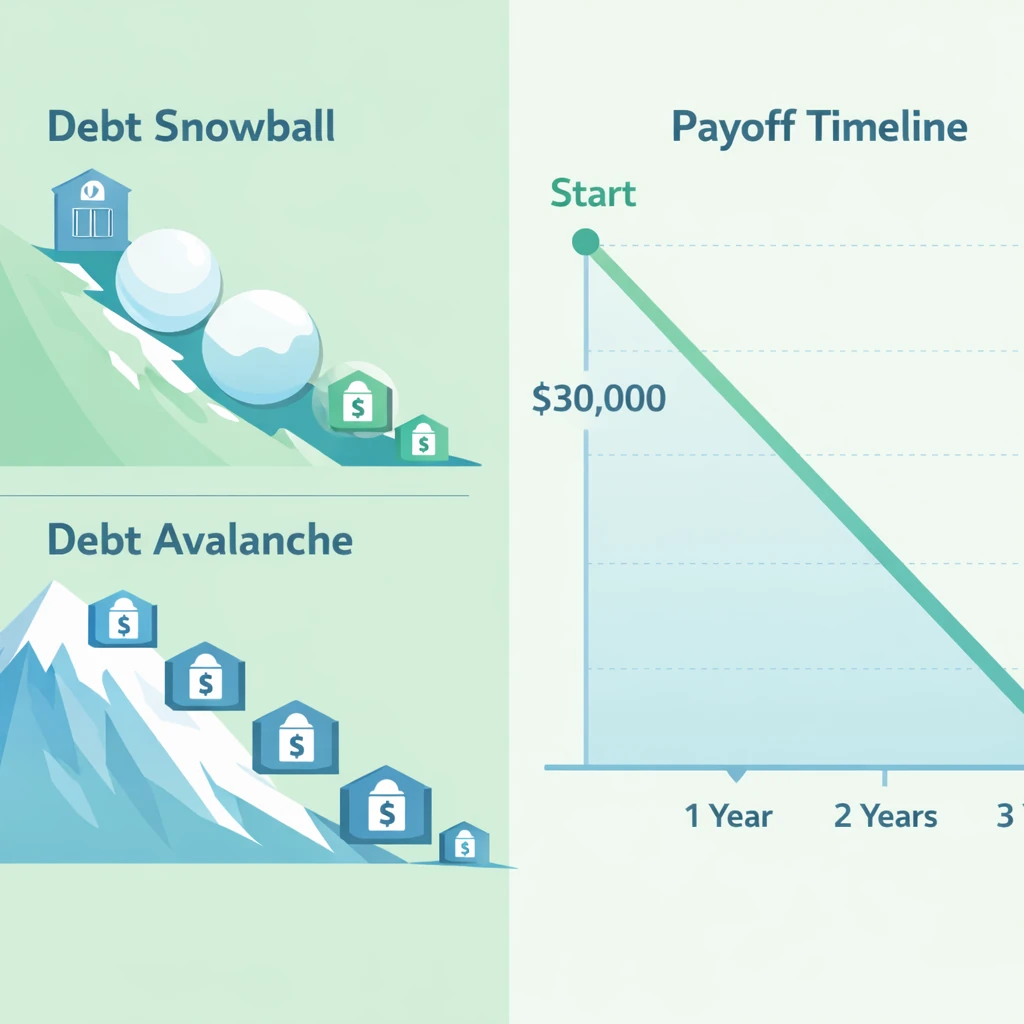
If you have multiple student loans (perhaps a mix of subsidized, unsubsidized, or even private loans), you need a system to prioritize them. Two popular methods dominate the conversation: the Avalanche and the Snowball .
The Avalanche Method (Mathematically Optimal)
- How it works: You make the minimum payment on all your loans. Then, you put every extra dollar toward the loan with the highest interest rate.
- Why it works: It minimizes the total interest you pay over the life of your loans.
- Best for: People who are disciplined and want to save the most money.
The Snowball Method (Behaviorally Optimal)
- How it works: You make the minimum payment on all your loans. Then, you put every extra dollar toward the loan with the smallest balance.
- Why it works: Paying off a small loan quickly gives you a psychological “win,” which builds momentum and motivation to tackle the next one .
- Best for: People who need motivation and quick wins to stay on track.
Which is right for you? If your loans have similar interest rates (e.g., all between 4% and 5.5%), the Snowball method’s psychological boost might be worth the small mathematical cost. If you have a credit card-style loan at 12% and federal loans at 4%, use the Avalanche to kill the high-rate debt first.
best cash envelope system wallets 2024
Strategy 2: Pay More Than the Minimum—And Make It Count
This is the single most effective strategy to pay off $30,000 in student loans faster . The standard 10-year plan is designed to be affordable, not efficient.
The Impact of Extra Payments
Using the example of a $30,000 loan at 6% interest:
- Standard Payment (10 years): $333/month. Total interest: ~$9,967 .
- Add $50/month: Pay $383/month. You pay off the loan in 8 years and 4 months, saving $1,804 in interest .
- Add $100/month: Pay $433/month. You pay off the loan in 7 years and 2 months, saving $3,046 in interest .
The “Principal Only” Trap
When you make an extra payment, you must instruct your servicer to apply it to the principal balance. If you don’t specify, they may apply it to future interest or push your next due date back, which defeats the purpose of saving on interest . Look for a button that says “Apply to principal” or call your servicer to confirm.
zero-based budgeting vs. 50/30/20 rule
Strategy 3: The Biweekly Payment Hack
This is a sneaky but powerful way to make an extra full payment every year without feeling the pinch in your monthly budget .
How Biweekly Payments Work
Instead of making one monthly payment of, say, $333, you divide that amount in half ($166.50) and pay it every two weeks.
- The Math: There are 52 weeks in a year. Paying every two weeks means you make 26 half-payments, which equals 13 full payments per year instead of 12 .
On a $30,000 loan at 5% interest, switching to biweekly payments can shave about 18 months off your repayment timeline and save you hundreds, if not thousands, in interest .
Check with your servicer first: Not all loan servicers automatically apply biweekly payments correctly. You may need to set up a manual transfer from your bank account every two weeks to ensure the extra payment is allocated properly.
how to save for a house down payment in 2 years
Strategy 4: Refinance for a Lower Interest Rate
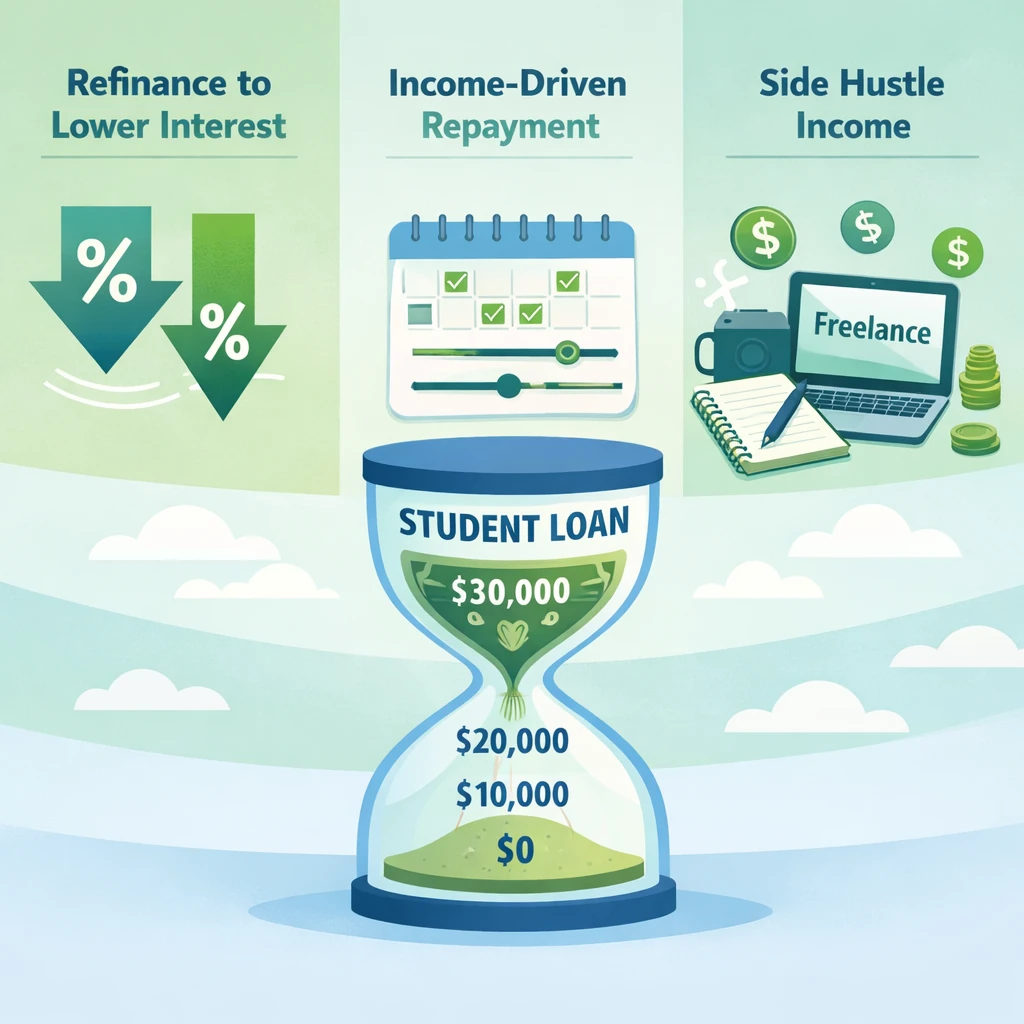
Refinancing is one of the most effective tools for borrowers with good credit and stable income. It involves taking out a new private loan to pay off your existing loans, ideally at a lower interest rate .
The Potential Savings
If you refinance that $30,000 loan from 7% to 4% over 10 years, you could save over $5,000 in interest .
The Big Warning for Federal Borrowers
Never refinance federal loans into private loans unless you are absolutely certain you won’t need federal protections. When you refinance federally, you lose access to:
- Income-Driven Repayment (IDR) plans
- Public Service Loan Forgiveness (PSLF)
- Deferment and forbearance options
- Potential future forgiveness programs
Refinancing is best for borrowers with high-rate private loans or those with federal loans and excellent credit who have a stable job and do not plan to use forgiveness programs.
how to stop impulse buying online
Strategy 5: Utilize “Found Money” and Side Hustles
Paying off debt faster often requires finding money outside of your regular paycheck. This is often called using “found money” .
Where to Find Extra Cash
- Work Bonuses and Raises: When you get a bonus or a raise, commit to putting a significant portion (or all of it) toward your loans. If your salary increases by 3%, increase your loan payment by 2% .
- Tax Refunds: Instead of spending your refund, apply it directly to your principal. A $1,000 refund applied to a 6% loan saves you hundreds in future interest.
- Side Hustles: Use your skills to freelance, tutor, or drive for a ride-share service. Even an extra $200 a month can cut years off your repayment .
- what is dollar-cost averaging and how to set it up
Strategy 6: Explore Loan Forgiveness and Assistance Programs
While you may be focused on paying off your debt yourself, you should not leave money on the table. There are numerous programs designed to help borrowers eliminate their student debt .
Public Service Loan Forgiveness (PSLF)
If you work full-time for a government agency or a non-profit organization, you may qualify for PSLF. After making 120 qualifying monthly payments (10 years) under an income-driven repayment plan, the remainder of your federal loans is forgiven tax-free .
Teacher Loan Forgiveness
Teachers who work for five consecutive years in a low-income school may be eligible for forgiveness of up to $17,500 on their federal loans .
State and Employer Programs
- State Programs: Many states offer loan repayment assistance for professionals in high-demand fields like healthcare, law, and education .
- Employer Assistance: An increasing number of companies offer student loan repayment as an employee benefit. Check with your HR department to see if they contribute to your loans .
- how to open a brokerage account for the first time
Strategy 7: Create a Student Loan-Focused Budget
You can’t out-earn bad spending habits. Creating a budget that prioritizes your student loans is essential .
The “Live Like a Student” Approach
For one to two years after graduation, resist the urge to upgrade your lifestyle. Keep your rent reasonable, avoid a new car payment, and limit eating out . The money you save by living frugally can be funneled directly into your loans.
Automate and Forget
Set up automatic payments from your bank account. Not only does this ensure you never miss a payment, but most federal and private lenders also offer a 0.25% interest rate reduction for enrolling in autopay .
Navigating the 2026 Federal Student Loan Changes
The landscape of federal student loans has changed significantly. The One Big Beautiful Bill Act (OBBBA), passed in 2025, introduced major reforms that affect how borrowers will repay their loans .
The End of SAVE and the Arrival of RAP
The SAVE plan has been officially wound down . Starting July 1, 2026, new borrowers will have two main choices:
- Standard Repayment Plan: Fixed payments over 10 to 25 years, depending on the amount borrowed.
- Repayment Assistance Plan (RAP): A new income-driven plan that sets payments at 1% to 10% of your adjusted gross income. The repayment term extends to 30 years, after which any remaining balance is forgiven .
What This Means for Current Borrowers
If you have existing federal loans, you are not immediately forced into the new plans. You can remain on older plans like PAYE, ICR, and IBR, but these are being phased out.
- Deadline: You must transition to either the new RAP or IBR by July 1, 2028 .
- Action Item: Log into StudentAid.gov to see what plan you are on and calculate your future payments under the new RAP versus the Standard plan .
Frequently Asked Questions (FAQs)
1. What is the fastest way to pay off $30,000 in student loans?
The fastest way combines multiple strategies: pay more than the minimum each month, use the biweekly payment hack, and apply any windfalls (bonuses, tax refunds) directly to the principal. Refinancing to a lower rate can also accelerate payoff if you qualify .
2. Is it better to pay off student loans fast or invest?
This is a personal finance classic. If your loan interest rate is high (say, above 5-6%), paying down debt is a “guaranteed return” on your money. If your rate is low (under 4%), you might come out ahead by investing in the market, but you carry the risk of market volatility. Many experts recommend a balanced approach: invest enough to get your employer’s then aggressively pay down debt.
best robo-advisors for beginners 2024 comparison
3. How does the new Repayment Assistance Plan (RAP) affect me?
If you borrow after July 1, 2026, RAP will be your only income-driven option. It offers lower monthly payments for low-income borrowers but extends the repayment term to 30 years, meaning you will pay more interest overall unless you pay extra each month .
4. Should I refinance my $30,000 student loan?
Yes, if you have private loans or if you have federal loans, a high credit score (690+), stable income, and you are willing to give up federal protections like IDR and PSLF. Run the numbers to ensure the new rate saves you money after fees .
5. Can I get my $30,000 in student loans forgiven?
Yes, but only under specific conditions. The most common paths are Public Service Loan Forgiveness (after 10 years of qualifying work and payments) or the 20-25 year forgiveness under income-driven plans (soon to be 30 years under the new RAP) .
6. What happens if I can’t afford my student loan payments?
Do not ignore the debt. Contact your loan servicer immediately. You can explore income-driven repayment plans (like the new RAP), which can lower your monthly payment to as little as $0 based on your income. You can also request deferment or forbearance, but be aware that interest usually accrues during these periods .
7. How does the Avalanche method save more money than the Snowball?
The Avalanche method targets the highest interest rate first. By eliminating the most expensive debt quickly, you reduce the total amount of interest that accrues over time. The Snowball method might cost slightly more in interest, but it provides psychological wins that help people stick to their plan .
8. Is a $30,000 student loan debt a lot?
While any debt can feel heavy, $30,000 is slightly below the national average . It is a manageable amount with a structured plan. The median salary for a new graduate makes this a realistic goal to tackle within 5-10 years with discipline.
9. What is the monthly payment on a $30,000 student loan?
It depends on the interest rate and term.
- At 5% over 10 years: ~$318/month
- At 6% over 10 years: ~$333/month
- On an income-driven plan, it could be as low as $0 depending on your earnings.
10. Can I negotiate a lower interest rate on my existing student loans?
You cannot negotiate the rate on existing federal loans (they are fixed by law). However, you can refinance them with a private lender to get a new, lower rate. For private loans, you can contact your lender to ask for a rate reduction based on your improved credit history or set up autopay for a small discount .
Conclusion: Your Roadmap to Debt Freedom
Paying off $30,000 in student loans is not just about following a set of rules; it is about changing your mindset. It requires understanding the math (avalanche method, extra payments), taking advantage of the system (forgiveness, autopay discounts), and adapting to the new rules of 2026.
Start by logging into your account and writing down every loan, its balance, and its interest rate. Choose your strategy—whether it’s the mathematical efficiency of the Avalanche or the motivational power of the Snowball. Then, look for ways to increase your income and cut your spending, funneling every extra dollar toward your goal.
The journey to debt freedom is a marathon, not a sprint. But with the comprehensive strategies outlined in this guide, you have the tools to cross the finish line faster than you ever thought possible. Your financial future is waiting—go claim it.