
The Ultimate Guide: Social Security Claiming Strategies for Married Couples
By Peiman Daneshgar
Table of Contents
- Introduction: Why Marriage Changes Everything
- How Social Security Benefits Work for Couples
- 2026 Updates You Must Know
- The Foundation: Full Retirement Age and Benefit Reductions
- Spousal Benefits: The 50% Rule
- Survivor Benefits: Protecting the Longer-Living Spouse
- Excess Spousal Benefits: When Both Spouses Worked
- The “Deemed Filing” Rule: What’s No Longer Possible
- Six Claiming Strategies for Different Couple Profiles
- The Earnings Test in 2026: Working While Claiming
- Tax Considerations: The Often-Overlooked Factor
- Divorced Spouses: You May Still Qualify
- Special Considerations: Age Gaps and Health Differences
- Frequently Asked Questions
- Conclusion
Introduction: Why Marriage Changes Everything
For single retirees, the Social Security claiming decision is relatively straightforward: you choose when to begin collecting based on your own earnings record, health, and financial needs. But for married couples, the decision is fundamentally different—and far more consequential.
When both spouses have worked, when earnings are unequal, when ages differ, and when the reality that one spouse will almost certainly outlive the other is considered, the optimal claiming strategy becomes a complex optimization problem. Get it right, and you can add tens of thousands of dollars to your lifetime benefits. Get it wrong, and you could permanently lock in a lower income for the rest of your lives—especially for the surviving spouse .
This comprehensive guide to Social Security claiming strategies for married couples will walk you through every aspect of the decision, from the basic rules to advanced strategies tailored to your specific situation. We incorporate the latest 2026 updates, including new earnings limits, cost-of-living adjustments, and tax provisions that every couple should know before filing .
How Social Security Benefits Work for Couples
Before diving into strategies, it’s essential to understand the three types of benefits that may be available to a married couple.
1. Retirement Benefits (Based on Your Own Work Record)
Every worker who has paid into Social Security for at least 10 years earns a retirement benefit. The amount you’re entitled to at your Full Retirement Age (FRA) is called your Primary Insurance Amount (PIA) . This is the baseline number from which all other calculations flow.
2. Spousal Benefits (Based on Your Partner’s Record)
Even if you never worked or have a low earnings record, you may be eligible for a spousal benefit of up to 50% of your spouse’s PIA . This does not reduce the benefit your spouse receives.
Key rule: You cannot claim a spousal benefit until your spouse has filed for their own retirement benefit .
how to talk to creditors when you can’t pay
3. Survivor Benefits (For the Widow(er))
When one spouse dies, the surviving spouse is entitled to receive the higher of the two benefits they were receiving (or were entitled to receive). This can be up to 100% of what the deceased spouse was receiving at the time of death .
This is perhaps the most critical feature of the system for married couples: the survivor’s income will be based on the higher-earning spouse’s benefit, adjusted for when that spouse claimed.
2026 Updates You Must Know
The Social Security landscape changes annually, and 2026 brings several important updates that affect claiming decisions .
Cost-of-Living Adjustment (COLA)
Benefits increased by 2.8% for 2026, helping retirees keep pace with inflation .
Earnings Test Limits
If you claim benefits before your Full Retirement Age and continue working:
- Under FRA: $1 in benefits is withheld for every $2 you earn above $24,480 (up from $23,400 in 2025)
- Year you reach FRA: $1 is withheld for every $3 you earn above $65,160 (up from $62,160 in 2025), but only for months before you reach FRA
- government programs for medical debt relief
New Senior Tax Deduction
Starting in 2025 (and continuing through 2028), individuals age 65 and older can claim a $6,000 deduction from adjusted gross income. For married couples filing jointly where both are 65+, the deduction is $12,000. This deduction phases out for individuals earning $75,000+ and couples earning $150,000+ .
Proposed Changes Affecting Spousal and Survivor Benefits
Note that several provisions affecting family member benefits are under consideration by the Social Security Administration, including potential reductions in spousal benefit percentages and alternative survivor benefit calculations . While not yet enacted, couples planning long-term should be aware that the system’s financial challenges may lead to future modifications.
The Foundation: Full Retirement Age and Benefit Reductions
Your claiming age determines the size of your monthly check—for life.
Full Retirement Age by Birth Year
| Birth Year | Full Retirement Age (FRA) |
|---|---|
| 1943-1954 | 66 |
| 1955 | 66 and 2 months |
| 1956 | 66 and 4 months |
| 1957 | 66 and 6 months |
| 1958 | 66 and 8 months |
| 1959 | 66 and 10 months |
| 1960 or later | 67 |
Impact of Claiming Age
For those with FRA of 67 :
| Claiming Age | Retirement Benefit (% of PIA) | Spousal Benefit (% of spouse’s PIA) |
|---|---|---|
| 62 | 70% | 32.5% |
| 63 | 75% | 35% |
| 64 | 80% | 37.5% |
| 65 | 86.7% | 41.7% |
| 66 | 93.3% | 45.8% |
| 67 (FRA) | 100% | 50% |
| 68 | 108% | 50% (no increase) |
| 69 | 116% | 50% (no increase) |
| 70 | 124% | 50% (no increase) |
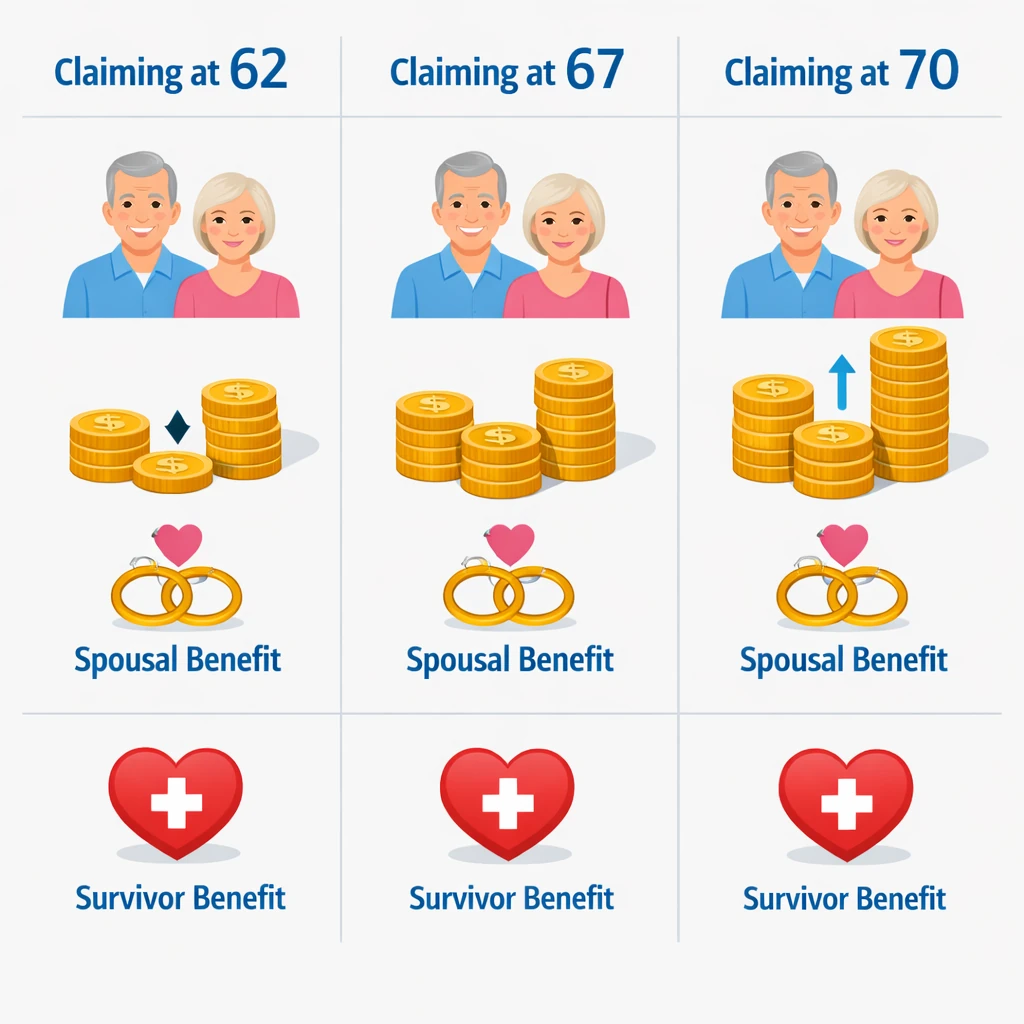
Critical distinction: Retirement benefits increase by 8% per year when delayed past FRA, up to age 70. Spousal benefits do NOT increase beyond FRA . This single fact drives many optimal claiming strategies.
how to use a balance transfer card wisely
Spousal Benefits: The 50% Rule
Who Qualifies for Spousal Benefits?
You may be eligible for spousal benefits if :
- You are at least age 62, OR
- You are caring for a child who is under age 16 or disabled and entitled to benefits on your spouse’s record
- Your spouse has already filed for their own retirement benefit
- Your own retirement benefit (if any) is less than 50% of your spouse’s PIA
How Spousal Benefits Are Calculated
The maximum spousal benefit is 50% of your spouse’s PIA (their benefit at FRA). If you claim spousal benefits before your own FRA, your spousal benefit is permanently reduced .
Strategies to Pay Off $30,000 in Student Loans
Example:
- John’s PIA at his FRA (67) = $3,000
- Maximum spousal benefit for Mary = $1,500 (50%)
- If Mary claims spousal at 62, she receives only 32.5% of John’s PIA = $975/month
If You Have Your Own Work Record
If you have your own retirement benefit, Social Security pays you the higher of:
- Your own retirement benefit, OR
- Your spousal benefit (which may be an “excess spousal” top-up—explained below)
You cannot claim a spousal benefit first and then switch to your own later (the “deemed filing” rule prevents this—see below) .
does debt settlement hurt your credit score?
Survivor Benefits: Protecting the Longer-Living Spouse
The survivor benefit is often the most overlooked yet most important aspect of Social Security claiming strategies for married couples. Why? Because the surviving spouse—typically the wife, given longer life expectancies—will have to live on a single check for the rest of their life .

How Survivor Benefits Work
When one spouse dies, the survivor can receive up to 100% of the deceased spouse’s benefit (the amount they were receiving at death), or their own benefit—whichever is higher. They cannot receive both .
Crucial implication: The benefit the surviving spouse receives for the rest of their life will be based on the higher-earning spouse’s claiming decision.
Why Delaying Matters for Survivors
If the higher-earning spouse claims early at 62, their benefit is permanently reduced by about 30%. That reduced amount is what the survivor will receive for potentially decades. If the higher earner delays until 70, the survivor receives that maximum amount .
Example:
- Higher earner’s PIA at 67 = $3,000
- If claimed at 62: monthly benefit = $2,100
- Survivor receives: $2,100/month for life
- If claimed at 70: monthly benefit = $3,720
- Survivor receives: $3,720/month for life
- Difference: $1,620/month, $19,440/year
This is why financial experts consistently advise that for most couples, the higher earner should delay benefits until age 70 .
Survivor Benefit Rules
- Survivor benefits can begin as early as age 60 (50 if disabled)
- If you claim survivor benefits before your own FRA, they are permanently reduced
- You can switch from your own benefit to a survivor benefit later (or vice versa), allowing for strategic claiming
- how to get out of payday loan debt fast
Excess Spousal Benefits: When Both Spouses Worked
When both spouses have their own work records, spousal benefits come into play as an “excess spousal” top-up.
How It Works
Social Security calculates:
- Your own retirement benefit (based on your earnings)
- The spousal benefit you’re entitled to (50% of your spouse’s PIA)
You receive the higher amount. If your spousal benefit is larger, you get your own benefit plus an “excess spousal” amount to bring you up to the spousal level .
Important Nuance
The excess spousal calculation uses your PIA (your benefit at FRA), not your reduced early claiming amount .
Example from Forbes :
- Devon’s PIA = $1,000, files at 62, receives $700/month
- Scottie’s PIA = $4,000
- Maximum spousal benefit for Devon = $2,000 (50% of Scottie’s PIA)
- Devon’s excess spousal = $1,000 ($2,000 – Devon’s $1,000 PIA)
- Devon’s total = his $700 + $1,000 = $1,700/month
If Devon had waited until FRA, his total would be: his $1,000 + $1,000 excess = $2,000/month.
The key takeaway: Filing early for your own benefit permanently reduces that portion of your income, even if you later add an excess spousal benefit.
The “Deemed Filing” Rule: What’s No Longer Possible
Before 2016, couples could use sophisticated strategies like “file and suspend” or “restricted application” to claim spousal benefits while letting their own benefits grow. Those strategies are gone for everyone except those born before January 2, 1954 .
best debt consolidation loans for good credit 2024
The Current Rule: Deemed Filing
If you file for Social Security at any age between 62 and FRA, you are “deemed” to be filing for both your own retirement benefit and any spousal benefit you’re eligible for. You receive the higher amount, but you cannot take one first and switch later .
Exception: This rule does not apply to survivor benefits. You can still claim one benefit (e.g., your own) and switch to a survivor benefit later.
Six Claiming Strategies for Different Couple Profiles
Every couple is different. Here are six strategies tailored to common situations.
Strategy 1: The Classic “Higher Earner Delays, Lower Earner Files Early”
Best for: Couples with a significant earnings gap, where one spouse’s benefit is much larger.
The strategy:
- Lower-earning spouse files at 62 (or FRA) to provide some income
- Higher-earning spouse delays until 70 to maximize their benefit
- If the lower earner filed early, they can switch to an excess spousal benefit when the higher earner files
Why it works: Provides income in early retirement while ensuring the survivor gets the maximum possible benefit. The breakeven analysis often favors this approach, especially if the higher earner has average or better longevity .
Strategy 2: Both Delay to 70
Best for: Couples with substantial savings who don’t need immediate income, and where both have good health/longevity.
The strategy: Both spouses wait until 70 to claim.
Why it works: Maximizes both benefits and provides the largest possible survivor benefit. The trade-off is drawing down savings for 5-8 years to bridge the gap. The “bridge strategy” involves using retirement accounts to fund living expenses while benefits grow .
Strategy 3: Both Claim Early
Best for: Couples in poor health, or those who need the income immediately and have no other resources.
The strategy: Both file at 62.
Why it works: You get income when you need it. But understand that you’re permanently locking in reduced benefits for life, and the survivor will receive a reduced amount. This should only be considered if health or financial necessity dictates .
Strategy 4: Lower Earner Claims at FRA, Higher Earner Delays
Best for: Couples where the lower earner’s spousal benefit will exceed their own, and they want to maximize that spousal benefit.
The strategy:
- Lower earner waits until their FRA to claim either their own benefit or spousal
- Higher earner delays to 70
Why it works: By waiting until FRA, the lower earner ensures their spousal benefit (if they switch to it later) isn’t reduced. If they have their own benefit, they can claim that at FRA and then add excess spousal when the higher earner files.
how to negotiate lower credit card interest rates
Strategy 5: The “Start-Stop-Start” (for Survivor Benefits)
Best for: Widows/widowers who are eligible for both their own benefit and a survivor benefit.
The strategy:
- Claim the smaller benefit first (e.g., your own at 62)
- Switch to the larger survivor benefit at FRA or later
Why it works: Survivor benefits are not subject to deemed filing. This allows you to let the larger benefit grow while receiving some income .
Strategy 6: File Early, Then Suspend (Limited Use)
Note: This is only possible after FRA. You cannot suspend before FRA.
If you filed early and regret it, once you reach FRA you can voluntarily suspend benefits. This stops your payments but allows your benefit to earn delayed retirement credits (8% per year) up to age 70. Your spouse can still claim spousal benefits based on your record while your benefit is suspended.
The Earnings Test in 2026: Working While Claiming
If you plan to work while receiving Social Security before your FRA, the earnings test applies .
2026 Limits
| Situation | Earnings Limit | Withholding Rate |
|---|---|---|
| Under FRA all year | $24,480 | $1 for every $2 above limit |
| Year you reach FRA | $65,160 | $1 for every $3 above limit (pre-FRA months only) |
What Counts as Earnings?
Only wages from work or net self-employment income count. Pensions, annuities, investment income, IRA distributions, and capital gains do not count toward the earnings limit .
The Good News: Withheld Benefits Come Back
Benefits withheld due to the earnings test are not lost forever. Once you reach FRA, Social Security recalculates your benefit to give you credit for the months benefits were withheld, resulting in a higher ongoing payment .
Example
Maria, age 63 in 2026, claims Social Security but continues working and earns $50,000.
- Excess over $24,480 = $25,520
- Withholding = $12,760 (half of excess)
- Maria receives reduced benefits now, but her future benefit will be adjusted upward at FRA
- snowball vs avalanche method calculator
Tax Considerations: The Often-Overlooked Factor
Many couples don’t realize that Social Security benefits can be taxable .
How Benefits Become Taxable
The IRS uses “combined income” = your adjusted gross income + non-taxable interest + ½ of your Social Security benefits.
| Combined Income (Single) | Combined Income (Married Joint) | Taxable Portion |
|---|---|---|
| Below $25,000 | Below $32,000 | 0% |
| $25,000 – $34,000 | $32,000 – $44,000 | Up to 50% |
| Above $34,000 | Above $44,000 | Up to 85% |
Tax Planning Strategies
- The bridge strategy: Draw from traditional IRAs/401(k)s before claiming Social Security. This can reduce future RMDs and keep combined income below tax thresholds .
- Roth conversions: Convert traditional IRA funds to Roth in your 60s (before claiming). This creates tax-free income later and reduces future RMDs .
- Consider state taxes: Some states tax Social Security; others don’t. Factor this into retirement location decisions.
The New Senior Tax Deduction (2025-2028)
For 2026, individuals 65+ can deduct $6,000 from AGI (couples 65+ filing jointly: $12,000). This deduction phases out above $75,000 AGI (singles) or $150,000 (couples). This can help keep more of your benefits out of taxable territory .
Divorced Spouses: You May Still Qualify
If you’re divorced but were married for at least 10 years, you may be eligible for benefits based on your ex-spouse’s record .
Key Rules for Divorced Spouse Benefits
- You must be unmarried
- You must be at least 62
- Your ex-spouse must be entitled to Social Security benefits (they don’t need to have claimed yet)
- The benefit you receive based on your ex’s record does not affect their benefit or their current spouse’s benefit
- If you remarried, you generally cannot claim on an ex’s record unless the later marriage ended
Survivor Benefits for Divorced Spouses
If your ex-spouse dies, you may be eligible for survivor benefits if:
- The marriage lasted 10 years or more
- You are currently unmarried (or remarried after age 60)
- You are at least 60 (50 if disabled)
Special Considerations: Age Gaps and Health Differences
Age Gaps of 5-10+ Years
When spouses are significantly different ages, the analysis changes :
- The younger spouse may benefit from claiming at 62 to start receiving some income
- The older spouse (especially if the higher earner) should strongly consider delaying to 70
- Survivor benefits become even more critical—the younger spouse may need that income for decades
Health and Life Expectancy
Use the Social Security Administration’s life expectancy tables and consider:
- Personal and family health history
- Current health status
- Lifestyle factors
The breakeven age—the point at which delaying benefits results in more lifetime income—is typically around 80-82 . If you have health concerns suggesting a shorter lifespan, claiming earlier may make sense.
investment mistakes to avoid in your 20s
Actuarial Realities
According to the Society of Actuaries :
- A 60-year-old woman in average health has a 66% chance of living to 85
- A 60-year-old man has a 55% chance of living to 85
- 84% probability that at least one spouse in a 60-year-old couple will live to 85
- 64% probability that at least one will live to 90
These statistics underscore why protecting the survivor—by maximizing the higher earner’s benefit—is so important.
Frequently Asked Questions
Q1: What is the best age for a married couple to claim Social Security?
There’s no single “best” age—it depends on your earnings records, ages, health, and finances. However, a common optimal strategy is for the lower earner to claim at 62 or FRA and the higher earner to delay until 70 .
Q2: If my spouse dies, do I get their Social Security in addition to mine?
No. As a survivor, you receive the higher of the two benefits—yours or your deceased spouse’s—but not both .
Q3: What is the spousal benefit amount?
The maximum spousal benefit is 50% of your spouse’s Primary Insurance Amount (their benefit at Full Retirement Age). If you claim spousal benefits before your own FRA, the amount is permanently reduced .
Q4: Can I collect spousal benefits while my own benefits grow?
Not anymore. Due to the “deemed filing” rule, if you file for benefits before FRA, you’re deemed to be filing for both your own and any spousal benefit. You cannot take one first and switch later, except for survivor benefits .
Q5: What are the 2026 Social Security changes I need to know?
Key 2026 updates include: a 2.8% COLA, higher earnings test limits ($24,480 under FRA; $65,160 in FRA year), and a $6,000/$12,000 senior tax deduction for those 65+ .
Q6: How does the earnings test work in 2026?
If you’re under FRA and earn above $24,480, $1 is withheld for every $2 over the limit. In the year you reach FRA, $1 is withheld for every $3 above $65,160 (pre-FRA months only). Withheld benefits are credited back as higher payments later .
Q7: I’m divorced. Can I claim on my ex-spouse’s record?
Yes, if you were married for at least 10 years, are currently unmarried, and are at least 62. Your ex-spouse doesn’t need to have claimed yet, and your claim won’t affect their benefits .
Q8: What is the “bridge strategy”?
The bridge strategy involves using retirement savings (IRAs, 401(k)s) to cover living expenses in your 60s while delaying Social Security to age 70. This allows your benefit to grow by 8% per year and can reduce taxes and future RMDs .
Q9: Should I factor taxes into my claiming decision?
Absolutely. Up to 85% of your benefits can be taxable if your combined income exceeds certain thresholds. Coordinating withdrawals from retirement accounts with your claiming age can minimize taxes .
Q10: What if my spouse and I are different ages?
Age gaps make survivor protection even more critical. The younger spouse may want to claim early to provide income, while the older (especially higher-earning) spouse delays to maximize the survivor benefit the younger spouse will eventually receive .
Q11: How do I find my Full Retirement Age?
Use the Social Security Administration’s online calculator or refer to the table in this article. For those born in 1960 or later, FRA is 67 .
Q12: Can I change my mind after claiming?
You have 12 months from the date you filed to withdraw your application and repay all benefits received. After that, you cannot undo your claim unless you suspend at FRA. Suspension stops payments but allows your benefit to grow until 70 .
Conclusion
Deciding when and how to claim Social Security is one of the most consequential financial decisions you’ll make as a couple. The difference between an optimal strategy and a suboptimal one can amount to hundreds of thousands of dollars over your lifetimes .
The key principles to remember:
- Think as a team, not as individuals. Your combined lifetime benefits matter more than either spouse’s individual benefit .
- Protect the survivor. The higher earner delaying until 70 is the single most powerful strategy for most couples .
- Consider the full picture—your savings, health, life expectancy, taxes, and earnings from work .
- Run the numbers. Use online calculators or consult a fee-only financial planner to model different claiming ages and scenarios.
- Stay informed. Social Security rules evolve. The 2026 updates—higher earnings limits, the new senior tax deduction, and the 2.8% COLA—all affect your planning .
For married couples, Social Security is not just a retirement program—it’s a longevity insurance policy for the spouse who will likely live alone for many years. By claiming strategically, you ensure that policy provides the maximum possible protection.