The Ultimate Guide: Retirement Planning for Self-Employed Individuals
By Peiman Daneshgar
Table of Contents
- Introduction
- Why Retirement Planning is Critical for the Self-Employed
- US Retirement Plans for the Self-Employed
- European Retirement Options for the Self-Employed
- How Much Should You Save?
- Step-by-Step Guide to Getting Started
- Tax Strategies for Self-Employed Retirement Savings
- Investment Strategies for Your Retirement Account
- Common Mistakes and How to Avoid Them
- 2026 Key Deadlines and Limits at a Glance
- Frequently Asked Questions
- Conclusion
Introduction
For the millions of Americans and Europeans who work for themselves—freelancers, gig workers, consultants, and small business owners—retirement planning presents a unique challenge. Without an employer-sponsored 401(k) or automatic payroll deductions, the responsibility of saving for the future falls entirely on your shoulders. Yet, this challenge also brings opportunity: the self-employed have access to some of the most powerful, tax-advantaged retirement savings vehicles available.
Retirement planning for self-employed individuals is not just about putting money aside; it’s about strategically reducing your current tax burden while building long-term wealth. In the 2026 tax landscape, with updated contribution limits and new rules from the SECURE 2.0 Act, understanding your options is more critical than ever.
This comprehensive guide will walk you through everything you need to know about retirement planning for self-employed individuals. We will explore US-based plans like the Solo 401(k), SEP IRA, and SIMPLE IRA, as well as European options such as SIPPs and Lifetime ISAs. By the end, you will have a clear roadmap to secure your financial future, no matter how many clients you have or how variable your income may be.
Why Retirement Planning is Critical for the Self-Employed
The Absence of Auto-Enrollment
Unlike traditional employees, who are often automatically enrolled in workplace pension schemes, self-employed workers must proactively choose to save. In the UK, for example, automatic enrolment has successfully brought millions into pension saving—but it only benefits employees. The UK’s army of self-employed workers do not have a similar arrangement in place, largely because there isn’t an employer who can match contributions or set up a scheme on their behalf .
The Power of Tax Advantages
One of the biggest advantages of retirement planning for self-employed individuals is the ability to significantly reduce your taxable income. Contributions to qualified retirement plans are often tax-deductible, lowering your current year’s tax bill while your money grows tax-deferred or tax-free .
money saving challenges for couples
Catching Up is Harder
Starting late is more expensive for the self-employed. Without the discipline of automatic payroll deductions, many put off saving. The good news is that the IRS and HMRC offer generous catch-up contributions for those over 50, allowing you to accelerate savings in your peak earning years .
US Retirement Plans for the Self-Employed
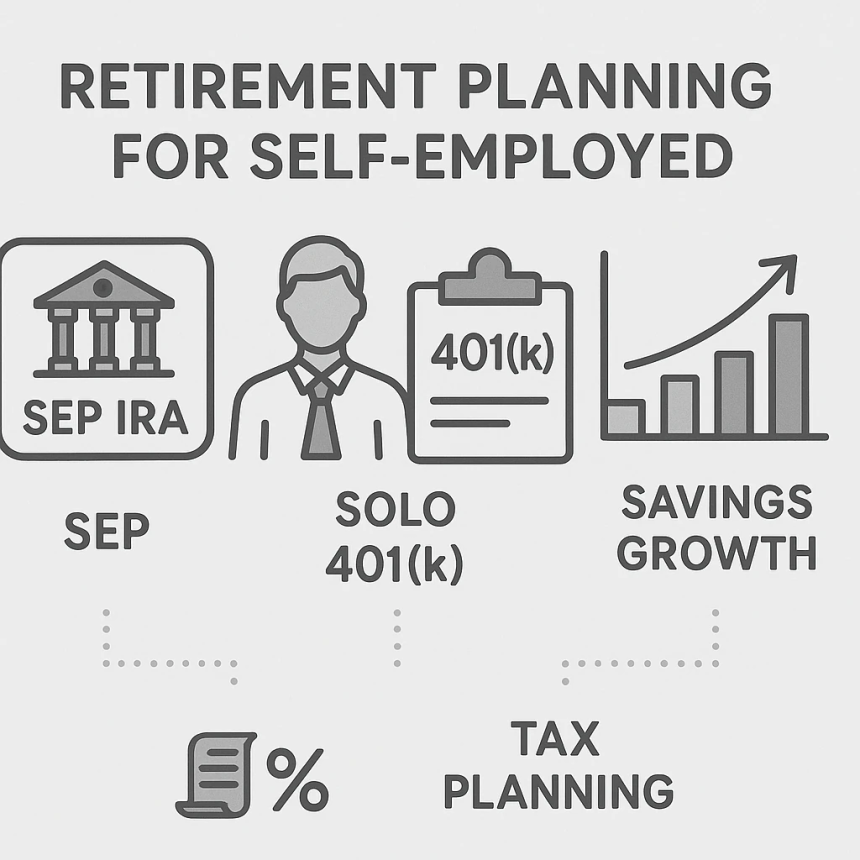
If you are a US-based freelancer, contractor, or small business owner, you have four primary options for retirement planning for self-employed individuals. The right choice depends on your income, whether you have employees, and how much you want to save.
Option 1: Solo 401(k) (Individual 401(k))
The Solo 401(k) is often considered the gold standard for self-employed individuals with no employees other than a spouse. It offers the highest contribution limits and the most flexibility .
How It Works:
You wear two hats: employee and employer. You can make contributions in both capacities, allowing you to save significantly more than with other plans .
2026 Contribution Limits :
- Employee Deferral: Up to $24,500 (pre-tax or Roth)
- Employer Profit-Sharing: Up to 25% of compensation
- Total Contribution (Under 50): $72,000
- Catch-Up Contribution (50+): +$8,000 (total $80,000)
- Super Catch-Up (Ages 60-63): +$11,250 (total $83,750)
Key Features:
- Roth Option: You can make Roth deferrals, allowing for tax-free withdrawals in retirement .
- Loan Feature: You can borrow up to $50,000 or 50% of your account balance .
- Spouse Participation: Your spouse can participate if they earn bona fide W-2 wages from the business, increasing total contribution room .
- Deadline: Employee deferrals must be elected by December 31. Employer contributions can be made by your tax filing deadline (including extensions) .
- sinking funds: what are they and how to set them up
Best For: Solo entrepreneurs, freelancers, and consultants with high income who want to maximize savings.
Option 2: SEP IRA (Simplified Employee Pension IRA)
The SEP IRA is a simple, easy-to-establish plan that allows for high contributions but is funded entirely by the employer (you) .
How It Works:
You contribute a percentage of your net self-employment income to your own SEP IRA and, if applicable, to the accounts of your employees .
2026 Contribution Limits :
- Maximum Contribution: The lesser of 25% of compensation or $72,000
- No Catch-Up Contributions: Because the employer makes all contributions, there are no catch-up provisions based on age .
Key Features:
- Extremely Easy Setup: Fill out IRS Form 5305-SEP .
- Flexible Contributions: You can decide how much to contribute each year based on your profits. In lean years, you can contribute nothing .
- No Reporting Requirements: Unlike a 401(k), there are no annual IRS reporting requirements (Form 5500) .
- NEW: SEP Roth IRA: Thanks to SECURE Act 2.0, you can now elect to have your SEP contributions treated as Roth contributions, allowing for tax-free growth .
- Deadline: You can set up and fund a SEP IRA as late as your tax filing deadline, including extensions .
Best For: Self-employed individuals who want simplicity and flexibility, and who may have a few employees.
best cash envelope system wallets 2024
Option 3: SIMPLE IRA (Savings Incentive Match Plan for Employees)
The SIMPLE IRA is designed for businesses with 100 or fewer employees. It allows for both employee salary deferrals and mandatory employer contributions .
How It Works:
Employees (including you) can make salary deferral contributions. The employer must either match employee contributions (up to 3% of compensation) or make a fixed 2% contribution for all eligible employees .
2026 Contribution Limits :
- Employee Deferral: Up to $17,000 (for businesses with 26+ employees)
- Increased Deferral (if match is 4%): Up to $18,100 (for businesses with 25 or fewer employees)
- Catch-Up Contribution (50+): +$4,000
- Super Catch-Up (Ages 60-63): +$5,250
Key Features:
- Easy Administration: Less paperwork than a 401(k) .
- Mandatory Employer Contributions: You must contribute each year you have the plan, even if the business has low profits .
- High Penalties for Early Withdrawal: Withdrawals within the first two years can incur a 25% penalty .
- Deadline: You must set up the plan by October 1. Salary deferrals are deducted from payroll throughout the year .
Best For: Self-employed individuals with a small number of employees who want to offer a retirement benefit at a lower cost than a 401(k).
zero-based budgeting vs. 50/30/20 rule
Option 4: Traditional and Roth IRAs
Even with a business retirement plan, IRAs can supplement your savings. For those just starting out, an IRA is an excellent first step .
2026 Contribution Limits :
- Standard Limit: $7,500
- Catch-Up (50+): +$1,100 (total $8,600)
Key Features:
- Traditional IRA: Contributions may be tax-deductible (depending on income). Growth is tax-deferred .
- Roth IRA: Contributions are after-tax, but qualified withdrawals are tax-free. Income limits apply .
- Deadline: You can contribute for the prior year until the tax filing deadline (usually April 15) .
European Retirement Options for the Self-Employed
For European readers, particularly in the UK, retirement planning for self-employed individuals involves different products. Here are the primary options.
UK: Self-Invested Personal Pension (SIPP)
A SIPP is a “do-it-yourself” pension that gives you control over where your money is invested .
How It Works:
You contribute money, the government adds tax relief, and you invest in a wide range of assets (stocks, bonds, ETFs, etc.) .
2025/2026 Contribution Limits :
- Annual Allowance: Up to £60,000 (or 100% of your earnings, whichever is lower)
- Tax Relief: Basic rate relief is added automatically (20%). Higher and additional rate taxpayers can claim extra relief through self-assessment .
- Carry Forward: You can carry forward unused allowance from the previous three tax years .
- how to save for a house down payment in 2 years
Key Features:
- Tax-Free Growth: Investments grow free from UK capital gains and income tax.
- Access Age: Currently 55, rising to 57 in 2028 .
- Tax-Free Lump Sum: You can typically withdraw 25% of your pot tax-free .
Best For: Self-employed individuals who want control over investments and high contribution limits.
UK: Lifetime ISA (LISA)
A Lifetime ISA can be used to save for your first home or for retirement .
How It Works:
You contribute up to £4,000 per year, and the government adds a 25% bonus .
2025/2026 Limits:
- Contribution Limit: £4,000 (within the overall £20,000 ISA allowance)
- Government Bonus: Up to £1,000 per year
Key Features:
- Tax-Free Withdrawals: Money can be withdrawn tax-free from age 60 for retirement .
- Early Withdrawal Penalty: Withdrawing for any other reason incurs a 25% charge .
- Comparison to Pension: For basic-rate taxpayers, the bonus is the same as pension tax relief, but the withdrawal is tax-free (unlike a pension, where only the first 25% is tax-free). For higher-rate taxpayers, a pension is usually more efficient .
Best For: Basic-rate taxpayers who want a simple, tax-free retirement savings vehicle.
how to stop impulse buying online
UK: Standard ISAs
While not specifically a retirement account, an ISA offers flexibility .
2025/2026 Limits:
- Contribution Limit: £20,000 per year
Features:
- Tax-free growth and withdrawals
- No age restrictions on access
- No upfront government bonus
How Much Should You Save?
One of the hardest parts of retirement planning for self-employed individuals is knowing how much to save. The answer depends on your income, age, and retirement goals.
The Percentage Rule of Thumb
Most financial professionals recommend saving 15-20% of your net self-employment income for retirement . This includes all contributions—both your “employee” and “employer” shares.
The Retirement Living Standards (UK)
For UK readers, the Pension and Lifetime Savings Association provides useful benchmarks :
- Minimum Retirement: £14,400 per year (single)
- Moderate Retirement: £31,300 per year (single)
- Comfortable Retirement: £43,100 per year (single) / £60,600 (couple)
- what is dollar-cost averaging and how to set it up
Using Cashflow Modelling
Because self-employed income can be variable, a financial planner can use cashflow modelling software to map out different scenarios and help you decide the optimal amount to contribute each year .
Step-by-Step Guide to Getting Started
If you’re ready to begin retirement planning for self-employed individuals, follow these steps.
Step 1: Assess Your Business Structure
- Sole Proprietor/Single Member LLC: Your contributions are based on your net profit from Schedule C .
- S-Corporation: You must pay yourself a reasonable salary. Contributions are based on your W-2 wages .
- Limited Company (UK): You can make contributions as both an employee and an employer, potentially reducing corporation tax .
Step 2: Choose the Right Plan
Use this decision matrix:
| Scenario | Recommended Plan |
|---|---|
| No employees, want to save the most | Solo 401(k) |
| No employees, want simplicity | SEP IRA |
| Have a few employees, low cost desired | SIMPLE IRA |
| Just starting, low income | Traditional or Roth IRA |
| UK resident, higher-rate taxpayer | SIPP |
| UK resident, basic-rate taxpayer | LISA or SIPP |
Step 3: Open the Account
Open an account with a provider like Fidelity, Vanguard, or a self-directed IRA custodian. For a Solo 401(k), ensure the provider supports the features you want (Roth, loans, etc.) .
Step 4: Set Up a Contribution System
- Consistent Income: Set up automatic monthly transfers .
- Variable Income: Commit to making a lump-sum contribution at year-end after calculating your profits.
Step 5: Invest the Money
Don’t let your contributions sit in cash. Choose a diversified portfolio of low-cost index funds or target-date funds that align with your risk tolerance and time horizon .
how to open a brokerage account for the first time
Tax Strategies for Self-Employed Retirement Savings
Strategy 1: Time Your Contributions
For SEP IRAs and Solo 401(k) employer contributions, you have until your tax filing deadline (including extensions) to contribute for the prior year . This allows you to maximize your deduction after you know your exact income.
Strategy 2: Use Roth Accounts for Tax Diversification
Having both pre-tax (Traditional) and after-tax (Roth) money gives you flexibility in retirement to manage your tax bracket. With a Solo 401(k), you can make Roth deferrals . With a SEP IRA, you can now opt for a SEP Roth IRA .
Strategy 3: Understand the 2026 Roth Catch-Up Rule
For 2026, if you are age 50 or older and had prior-year W-2 compensation of $150,000 or greater, any catch-up contributions to your 401(k) must be made on a Roth (after-tax) basis . This is a critical change from SECURE 2.0.
Strategy 4: Claim All Tax Relief (UK)
If you are a higher or additional-rate taxpayer in the UK, you must claim the extra tax relief through your self-assessment tax return. Failing to do so means your pension is not as tax-efficient as it could be .
Strategy 5: Consider Employer Contributions from Your Limited Company (UK)
If you are a director of a limited company, making employer contributions to your pension can reduce your company’s corporation tax bill, as it is treated as a business expense .
Investment Strategies for Your Retirement Account
Once you’ve chosen the right plan for your retirement planning for self-employed individuals, you need to invest the money.
Asset Allocation by Age
A common rule of thumb is the “110 minus your age” method: subtract your age from 110 to determine the percentage of your portfolio that should be in stocks. At 40, you might keep roughly 70% in stocks and 30% in bonds and lower-risk investments .
ETF vs index fund: which is better for a beginner?
Low-Cost Index Funds and ETFs
For most self-employed savers, a portfolio of low-cost total market index funds or target-date funds is the most effective way to build wealth .
Avoid “Shiny Object” Syndrome
With a self-directed account, you may be tempted by alternative investments like real estate or crypto. While these can be part of a portfolio, be cautious. Speaking with a financial planner could help you select the right suite of investments within your account .
Consolidation Consideration
If you have multiple old pensions from previous employment, consider consolidating them into your current SIPP or Solo 401(k) to reduce fees and simplify management—but only if you won’t lose valuable guaranteed benefits .
Common Mistakes and How to Avoid Them
Mistake 1: Waiting Until Tax Day
Many self-employed people scramble to set up a plan in April. However, for a Solo 401(k), the employee deferral election must be made by December 31 . Missing this deadline means losing the ability to make that $24,500 deferral for the year.
Mistake 2: Forgetting to Invest
You open the account, make the contribution, and then… nothing. The money sits in cash. As soon as funds hit your account, log in and choose your investments .
Mistake 3: Not Planning for Employees
If you have employees and choose a SEP IRA, you must contribute the same percentage for them as you do for yourself . This can become very expensive. Factor this into your plan choice.
Mistake 4: Overlooking Catch-Up Contributions
If you are 50 or older, you have the ability to save significantly more. Use it .
Mistake 5: DIY Without a Plan
70% of SIPP investors operate on a non-advised basis . While DIY can work, a financial planner can help with cashflow modelling, tax efficiency, and avoiding scams .
best robo-advisors for beginners 2024 comparison
Mistake 6: Failing to File Form 5500-EZ
If your Solo 401(k) balance exceeds $250,000 at the end of the plan year, you must file Form 5500-EZ with the IRS. Failure to do so can result in significant penalties .
2026 Key Deadlines and Limits at a Glance
| Plan Type | 2026 Contribution Limit | Key Deadline |
|---|---|---|
| Solo 401(k) – Employee Deferral | $24,500 ($32,500 with catch-up) | December 31, 2026 |
| Solo 401(k) – Employer Contribution | Up to $72,000 total | Tax filing deadline + extensions |
| SEP IRA | Lesser of 25% or $72,000 | Tax filing deadline + extensions |
| SIMPLE IRA | $17,000 ($21,000 with catch-up) | Within 7 days of payroll |
| Traditional/Roth IRA | $7,500 ($8,600 with catch-up) | April 15, 2027 |
| UK SIPP | Up to £60,000 | Tax filing deadline (can carry forward) |
| UK LISA | £4,000 | April 5, 2027 |
Frequently Asked Questions
Q1: Can I have both a SEP IRA and a Roth IRA?
Yes. You can contribute to a SEP IRA based on your self-employment income and also make a separate contribution to a Roth IRA, subject to Roth IRA income limits .
Q2: What is the best retirement plan for a solo founder with no employees?
For 2026, the Solo 401(k) is generally the best choice because it allows you to make both an employee deferral ($24,500) and an employer profit-sharing contribution, for a total of up to $72,000. It also offers a Roth option and a loan feature .
Q3: Can I do both a Solo 401(k) and a SEP IRA?
No, they are alternatives. You cannot maintain both for the same business, as the Solo 401(k) is itself a type of profit-sharing plan .
Q4: What happens if I contribute too much to my Solo 401(k)?
Excess deferrals must generally be removed by April 15 of the year following the contribution. If you don’t correct the error in time, the excess could be double-taxed .
Q5: I’m self-employed in the UK. Should I use a SIPP or a LISA for retirement?
If you are a basic-rate taxpayer, the LISA is attractive because the withdrawal is tax-free. If you are a higher or additional-rate taxpayer, a SIPP is usually better because of the higher upfront tax relief . You can also use both.
Q6: When can I access my money?
- US Plans: Generally age 59½ without penalty. Exceptions apply for disability, first-time home purchase (IRA), and separation from service at age 55 (401(k)) .
- UK Plans: Currently age 55, rising to 57 in 2028 .
Q7: Do I have to include my spouse in my retirement plan?
- Solo 401(k): Your spouse can participate if they are a bona fide employee and receive W-2 wages .
- SEP IRA: Your spouse is treated like any other employee. If they meet the eligibility requirements, you must contribute the same percentage for them as you do for yourself .
Q8: What are the income limits for a Roth IRA in 2026?
For single filers, the phase-out range is $153,000 to $168,000 MAGI. For married couples filing jointly, it is $242,000 to $252,000 .
Q9: Can I roll over an old 401(k) from a previous job into my Solo 401(k)?
Yes, most Solo 401(k) plans accept rollovers from other 401(k)s and IRAs, provided the plan documents allow it .
Q10: Do I need to file a Form 5500-EZ for my Solo 401(k)?
Yes, if your plan assets exceed $250,000 at the end of the plan year. This is an often-overlooked requirement that carries heavy penalties for non-compliance .
Conclusion
Retirement planning for self-employed individuals may require more initiative than saving through an employer, but it also offers greater flexibility and control. In the 2026 landscape of higher contribution limits and new Roth options, the opportunity to build a substantial, tax-advantaged nest egg has never been better.
The key is to start now. Choose the plan that fits your business structure and savings goals. Set up automatic contributions. Invest wisely. And review your plan annually.
Whether you’re a freelancer in New York, a consultant in London, or a small business owner in Berlin, the principles are the same: pay yourself first, harness the power of tax deferral, and let compound interest work its magic over time. Your future self will thank you.