By: Peiman Daneshgar | Email: daneshgar781@gmail.com**
Published: February 22, 2026**
Table of Contents
- Understanding Your Home Insurance Deductible (The $2,500 Mistake You Don’t Want to Make)
- Introduction: The Day After the Storm
- What This Article Will Actually Give You
- Part 1: The One Sentence You Need to Remember
- Part 2: The Two Types of Deductibles (This Is Where People Get Screwed)
- Part 3: The $500 vs. $1,000 vs. $2,500 Debate (Real Math)
- Part 4: The Percentage Deductible Trap (Read This Before You Buy in Florida)
- Part 5: When You Pay vs. When You Don’t (The 7-Year Rule)
- Part 6: Real Examples (So You Can See How This Works)
- Part 7: The Wind/Hail and Hurricane Exceptions
- Part 8: How to Choose the Right Deductible for YOU
- Frequently Asked Questions
- The Emotional Bottom Line
Introduction: The Day After the Storm
I know that feeling.
A tree branch crashed through your roof last night. Or a pipe burst in the basement. Or maybe it’s something smaller—a broken window, a stolen bike, water damage from the washing machine that decided to die.
You’re standing in the mess, already stressed, already tired, already calculating how much this is going to cost.
Then you remember: you have home insurance. You pay for it every month. This is exactly what it’s for.
You call your insurance company, feeling almost relieved. They’ll handle it. That’s what they’re there for.
Then the agent asks: “What’s your deductible?”
And you freeze.
You know you have one. You saw it on the paperwork somewhere. $500? $1,000? More? You have no idea. And suddenly that relief turns back into anxiety.
Sound familiar?
You’re not alone. Most homeowners have no idea what their deductible is, how it works, or when they actually have to pay it. They just know it’s “something” they pay before insurance kicks in.
But here’s the thing: Your deductible isn’t just a number on a page. It’s one of the most important decisions you make about your coverage. Choose wrong, and you could be paying thousands you don’t need to—or worse, find out you can’t afford to file a claim at all.
how to catch up on retirement savings in your 50s
🧠 Quick Reality Check:
The average home insurance claim is about $13,000 . Your deductible could be $500, $1,000, $2,500, or even a percentage of your home’s value. If you don’t know which one you have, you’re gambling with your finances.
What This Article Will Actually Give You
Here’s the deal. Most insurance articles are either sales pitches or so full of jargon you need a translator.
This one is different.
By the time you finish reading, you’ll know:
- The two types of deductibles—flat dollar vs. percentage, and why the difference matters .
- The $500 vs. $1,000 math—how much you actually save, and whether it’s worth it .
- The percentage deductible trap—why your Florida friend might pay $15,000 before insurance kicks in .
- When to file a claim (and when NOT to) .
- How to choose the right deductible for YOUR situation .
This is the playbook. Let’s run it.
how to invest in REITs for passive income

Part 1: The One Sentence You Need to Remember
Let’s start with the simplest definition possible:
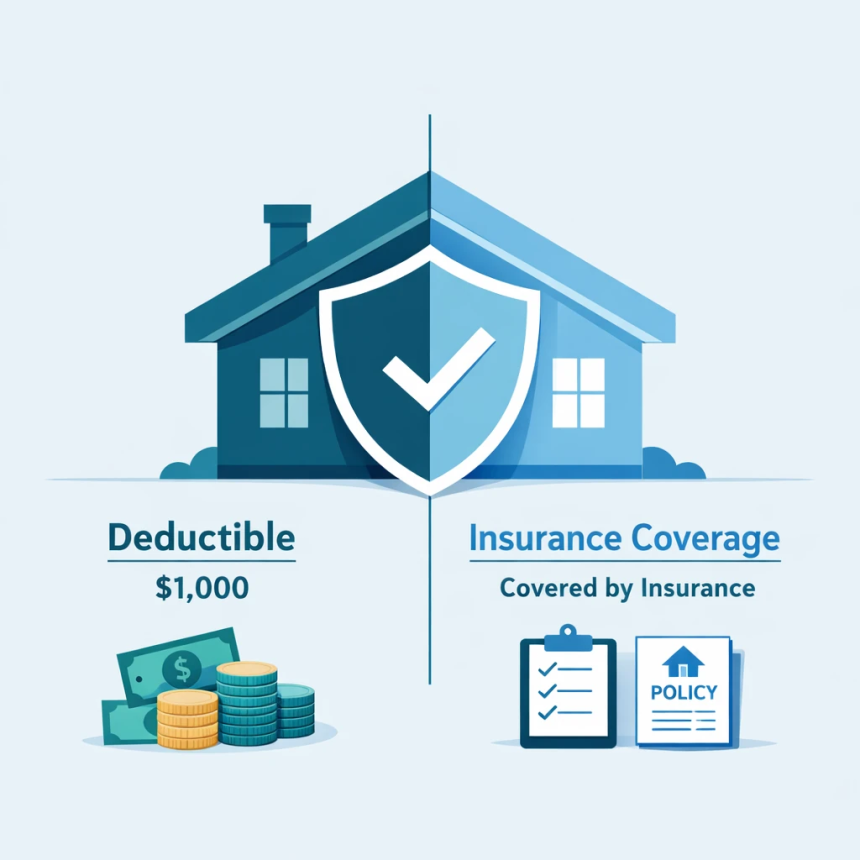
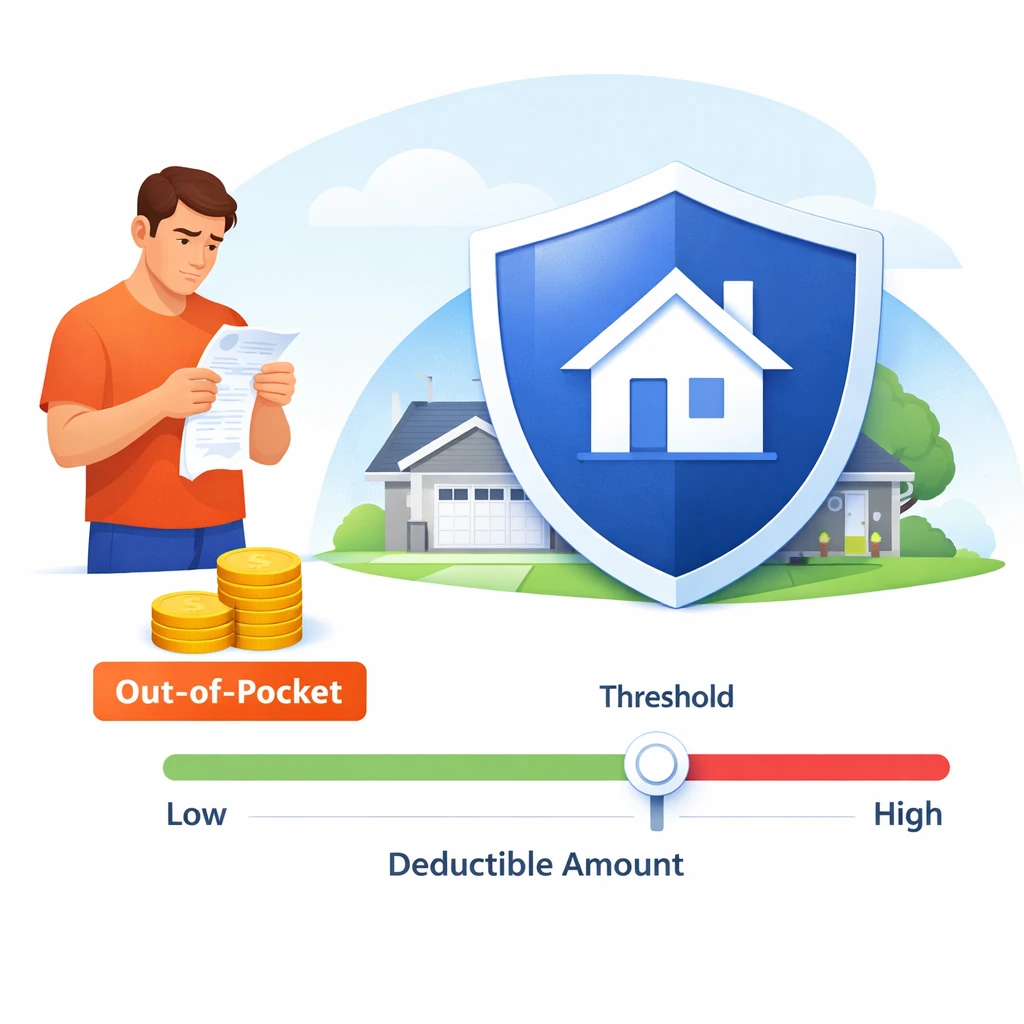
Your deductible is the amount you pay out of pocket before your insurance company pays anything on a claim.
That’s it. If your deductible is $1,000 and you have $5,000 in damage, you pay $1,000 and insurance pays $4,000 (minus any depreciation—more on that in a different article).
If the damage is less than your deductible? You pay the whole thing. Insurance pays nothing.
costs of buying a home besides the down payment
Part 2: The Two Types of Deductibles (This Is Where People Get Screwed)
Not all deductibles are created equal. There are two main types, and picking the wrong one can cost you thousands.
The Flat Dollar Deductible
This is the simple one. Your deductible is a fixed dollar amount—usually $500, $1,000, $2,500, or $5,000 .
Example: You have a $1,000 deductible. A storm causes $8,000 in damage. You pay $1,000, insurance pays $7,000.
Most policies use flat dollar deductibles for standard perils like fire, theft, vandalism, and water damage from plumbing issues.
The Percentage Deductible (The Hurricane Surprise)
This is where people get blindsided. Some policies—especially in areas prone to hurricanes, windstorms, or hail—use a percentage deductible instead of a flat dollar amount .
Instead of paying a fixed number, you pay a percentage of your home’s insured value (the dwelling coverage amount, not the market value).
Example: Your home is insured for $300,000. Your policy has a 2% hurricane deductible. A hurricane causes $20,000 in damage.
Your deductible is 2% × $300,000 = $6,000.
You pay $6,000. Insurance pays $14,000.
what to look for in a fixed-rate mortgage
If you thought you had a $1,000 deductible, you’re in for a very nasty surprise.
Which One Do You Have?
| Type | Typical For | Calculation | Common Amounts |
|---|---|---|---|
| Flat Dollar | Most claims (fire, theft, water) | Fixed amount | $500, $1,000, $2,500, $5,000 |
| Percentage | Hurricanes, wind, hail, earthquakes | % of dwelling coverage | 1%, 2%, 5%, 10% |
The Split Deductible Trick
Here’s where it gets even more confusing: Many policies have split deductibles .
You might have a flat $1,000 deductible for fire and theft, but a 2% deductible for hurricanes . Or a 1% deductible for wind and hail in certain months.
Always read your policy. The “deductible” section will list multiple numbers for different perils.
how to improve credit score before applying for a mortgage
Part 3: The $500 vs. $1,000 vs. $2,500 Debate (Real Math)
If you have a flat dollar deductible, you usually have choices. Here’s how to decide.
The Trade-Off
| Deductible | Annual Premium Savings | What You Pay If Something Happens |
|---|---|---|
| $500 | Base premium | You pay $500 |
| $1,000 | Save ~$100-200/year | You pay $1,000 |
| $2,500 | Save more | You pay $2,500 |
The Break-Even Calculation
Let’s say you’re considering moving from $500 to $1,000. You’d save about $150 per year in premiums .
The math: If you don’t have a claim for 3-4 years, you come out ahead. If you have a claim sooner, the lower deductible wins.
The Allstate Rule of Thumb
Allstate suggests : “If you have enough money set aside to cover a higher deductible and you rarely file claims, raising your deductible can be an easy way to save money on your premiums.”
But if you don’t have that cash, a lower deductible is safer.
When to Choose a Higher Deductible
- You have a healthy emergency fund (enough to cover the deductible)
- You rarely file claims
- You want lower monthly premiums
- You’re comfortable with some risk
When to Stick with Lower
- You don’t have $1,000+ in savings
- You live in an area with frequent claims (hail, storms, etc.)
- You’d struggle to pay a large bill unexpectedly
- is it better to rent or buy a home right now?
Part 4: The Percentage Deductible Trap (Read This Before You Buy in Florida)
How Percentage Deductibles Work
In hurricane-prone states (Florida, Texas, Louisiana, etc.), percentage deductibles are standard . Here’s what that looks like:
| Home Value | Deductible % | You Pay Before Insurance Kicks In |
|---|---|---|
| $300,000 | 2% | $6,000 |
| $300,000 | 5% | $15,000 |
| $500,000 | 2% | $10,000 |
| $500,000 | 5% | $25,000 |
The Percentage Deductible Matrix
Florida law requires insurers to offer hurricane deductibles of $500, 2%, 5%, and 10% . Some companies may offer other options, but these are the standards.
Why Insurance Companies Do This
Percentage deductibles protect insurers from catastrophic losses. If a hurricane hits an entire region, they’d be flooded with claims. A percentage deductible means homeowners share more of the risk.
What You Can Do About It
You usually can’t avoid a percentage deductible in high-risk areas. But you can:
- Choose the lowest percentage available (even if premiums are higher)
- Shop around—different insurers use different percentages
- Ask about separate wind/hail deductibles (sometimes different from hurricane)
Part 5: When You Pay vs. When You Don’t (The 7-Year Rule)
When You Pay
You pay your deductible for any covered claim that exceeds your deductible amount .
When You DON’T Pay
- Damage below your deductible —you pay the whole thing, insurance pays nothing
- Liability claims (someone injured on your property)—these usually have no deductible
- Some medical payments coverage —often pays small amounts without deductible
The “Should I File?” Decision Tree
Here’s the question every homeowner faces: If I have $2,000 in damage and a $1,000 deductible, should I file a claim?
Consider:
- Is it above your deductible? If damage is $900, you pay it all. No claim.
- How much will you actually get? $2,000 damage – $1,000 deductible = $1,000 payout.
- Will your rates go up? Probably. Filing a claim often increases premiums.
- How many claims have you filed recently? Multiple claims can get you dropped.
- mortgage pre-approval process step-by-step
The 7-Year Math
Insurance companies track your claims history. One small claim might raise your rates for 3-7 years . If the payout is small, it’s often not worth filing.
The rule of thumb: Only file claims that are significantly above your deductible and truly necessary .
🤔 Pause and Think:
Before you file any claim, ask yourself: “Is this worth potentially paying higher premiums for the next 5 years?” Sometimes paying out of pocket is cheaper in the long run.
Part 6: Real Examples (So You Can See How This Works)
Example 1: The Flat Deductible
Maria has a $1,000 deductible. A pipe bursts, causing $8,000 in water damage.
- Maria pays: $1,000
- Insurance pays: $7,000
- Total cost to Maria: $1,000
Example 2: The Percentage Surprise
Carlos lives in Florida. His home is insured for $400,000 with a 2% hurricane deductible. A hurricane tears off part of his roof—$15,000 in damage.
Carlos thinks: “My deductible is $1,000, so insurance will cover $14,000.”
Wrong. His hurricane deductible is 2% of $400,000 = $8,000.
- Carlos pays: $8,000
- Insurance pays: $7,000
- Carlos is shocked and angry. (But he read this article, so he’s prepared.)
Example 3: The “Should I File?” Decision
Jenna has a $1,000 deductible. A storm causes $1,800 in damage to her fence.
- Claim payout if filed: $800
- Premium increase: ~$200/year for 5 years = $1,000 in extra costs
- FHA loan vs Conventional loan requirements
Result: Filing this claim costs Jenna more in the long run than paying out of pocket. She pays the $1,800 herself and keeps her claims-free discount.
Part 7: The Wind/Hail and Hurricane Exceptions
Named Storm Deductibles
Many policies have named storm deductibles that only apply when a storm is officially named by weather authorities . If the storm isn’t named, the regular deductible applies.
The Hurricane Deductible Calendar
In some states, hurricane deductibles only apply during hurricane season (usually June 1 to November 30). A storm in May uses the regular deductible .
Wind/Hail Deductibles (Different Again)
Some policies have separate wind and hail deductibles , especially in tornado-prone areas . These can be flat dollar or percentage, and they apply year-round.
Part 8: How to Choose the Right Deductible for YOU
Step 1: Check Your Emergency Fund
Look at your savings. How much could you pay tomorrow without going into debt?
- If you have $10,000 saved, a $2,500 deductible is fine.
- If you have $500 saved, you need the lowest deductible you can get.
Step 2: Know Your Risk
- Live in hurricane country? Percentage deductible is unavoidable—choose the lowest %.
- Live in a low-risk area? Flat deductible is likely, and you can choose higher to save money.
- how much house can I afford on a $70,000 salary?
Step 3: Run the Numbers
Call your insurer and ask:
- “What’s the premium difference between $500 and $1,000?”
- “What’s the premium difference between $1,000 and $2,500?”
- “Do I have percentage deductibles for any perils?”
Do the break-even math: savings ÷ premium difference = years to break even.
Step 4: Read Your Policy (Seriously)
Look for the “Deductible” section. It will list:
- Flat dollar amounts for standard perils
- Any percentage deductibles and what they apply to
- Any seasonal or named storm rules
If you don’t understand it, call your agent and ask. It’s their job to explain.
Frequently Asked Questions
Q: What is a home insurance deductible?
A: The amount you pay out of pocket before insurance pays on a claim .
Q: What’s the difference between flat and percentage deductibles?
A: Flat is a fixed dollar amount. Percentage is a percent of your home’s insured value .
Q: How do percentage deductibles work?
A: You pay a percentage of your dwelling coverage. If your home is insured for $300,000 with a 2% deductible, you pay $6,000 .
Q: What’s a typical deductible?
A: Flat deductibles are often $500, $1,000, or $2,500. Percentage deductibles are 1%, 2%, or 5% .
Q: Should I choose a higher deductible?
A: It depends. Higher deductible = lower premium, but you pay more if something happens. Choose based on your savings and risk tolerance .
Q: When should I NOT file a claim?
A: When damage is just above your deductible, or when filing could raise your rates more than the payout .
Q: Do I pay a deductible for liability claims?
A: No. Liability coverage (if someone sues you) usually has no deductible .
Q: Do I pay a deductible for medical payments to others?
A: Usually no. Medical payments coverage often pays small amounts without deductible .
Q: What’s a split deductible?
A: When different perils have different deductibles—e.g., $1,000 for fire, 2% for hurricanes .
Q: Do all states allow percentage deductibles?
A: Percentage deductibles are most common in hurricane- and hail-prone states. Check your policy .
Q: Can I change my deductible?
A: Yes, usually at renewal. Contact your insurer to adjust .
first-time home buyer grants and programs 2024
The Emotional Bottom Line
Look, I’m not going to pretend that understanding your deductible is fun.
It’s not. It’s reading insurance documents. It’s doing math. It’s thinking about bad things that might happen to your home.
But here’s the thing: The time to understand your deductible is NOT when you’re standing in a puddle of water looking at a broken roof.
The time is now. Today. Before anything happens.
Because when something does happen—and statistically, it will—you’ll have enough to deal with. You don’t need the added stress of discovering that your “affordable” premium comes with a $15,000 hurricane deductible you never knew existed.
So pull out your policy. Look at the deductible section. Call your agent with questions. Run the numbers on $500 vs. $1,000. Check if you have percentage deductibles for storms.
An hour of work now could save you thousands later.
You’ve got this.