Pay Yourself First Habit: The Ultimate Guide to Building Wealth Through Financial Discipline
Author: Peiman Daneshgar
Email: daneshgar781@gmail.com
Estimated reading time: 8 minutes
Table of contents
- Pay Yourself First Habit: The Ultimate Guide to Building Wealth Through Financial Discipline
- Introduction
- What Is the Pay Yourself First Habit?
- The Origin of the Pay Yourself First Habit
- Why the Pay Yourself First Habit Is So Powerful
- The Psychology Behind the Pay Yourself First Habit
- How the Pay Yourself First Habit Builds Long-Term Wealth
- How to Start the Pay Yourself First Habit
- Pay Yourself First Habit for Different Income Levels
- Common Mistakes When Applying the Pay Yourself First Habit
- Best Tools to Support the Pay Yourself First Habit
- Real-Life Example of the Pay Yourself First Habit
- Advanced Strategies for the Pay Yourself First Habit
- Pay Yourself First Habit and Financial Freedom
- Frequently Asked Questions (FAQ)
- Final Thoughts
Introduction
Financial success rarely happens by accident. Behind nearly every financially stable individual is a set of consistent habits that shape how money is earned, saved, invested, and spent. Among these habits, one principle stands above the rest in simplicity and effectiveness: the pay yourself first habit.
The pay yourself first habit is one of the most powerful personal finance strategies ever taught. It has been recommended by legendary investors, financial advisors, economists, and wealth-building experts for decades. From classic books like The Richest Man in Babylon to modern financial planning systems, this concept continues to prove its effectiveness.
But despite its simplicity, many people still misunderstand it or fail to apply it consistently.
This comprehensive guide will explain everything you need to know about the pay yourself first habit, including:
- What the pay yourself first habit really means
- Why it is essential for financial freedom
- The psychology behind successful savers
- Practical steps to implement the pay yourself first habit
- Common mistakes people make
- Strategies for different income levels
- Real-world examples and case studies
- Advanced wealth-building strategies
- Frequently asked questions
By the end of this guide, you will fully understand how the pay yourself first habit can transform your financial future.
What Is the Pay Yourself First Habit?
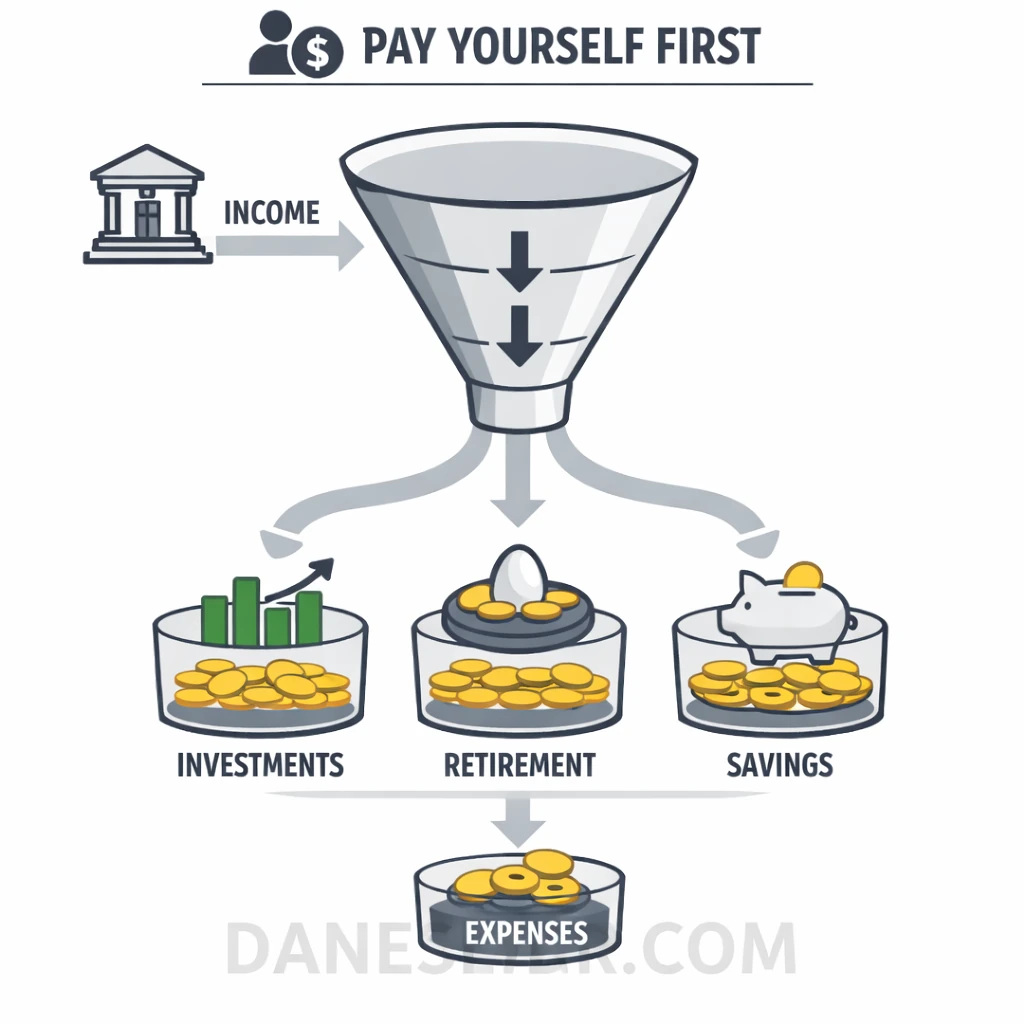
The pay yourself first habit is a personal finance principle that means saving or investing a portion of your income before paying any expenses.
Instead of following the traditional pattern:
Income → Expenses → Savings (if anything remains)
The pay yourself first habit reverses the order:
Income → Savings/Investments → Expenses
In simple terms, the first bill you pay every time you receive money is your future self.
This means automatically setting aside a fixed percentage of your income for savings or investments before spending money on lifestyle expenses.
The concept is simple but powerful because it prioritizes long-term wealth creation over short-term consumption.
The Origin of the Pay Yourself First Habit
The idea of the pay yourself first habit dates back nearly a century and was popularized in George S. Clason’s classic financial book The Richest Man in Babylon.
One of the book’s most famous rules is:
“A part of all you earn is yours to keep.”
Clason recommends saving at least 10% of all income before spending on anything else.
Over time, this concept became the foundation of modern financial planning and wealth-building strategies.
Today, financial advisors, investment experts, and entrepreneurs all agree that mastering the pay yourself first habit is essential for achieving financial independence.
Healthy Financial Habits to Build
Why the Pay Yourself First Habit Is So Powerful
Many people believe wealth comes from high income. While income certainly helps, the truth is that habits matter far more than income level.
The pay yourself first habit works because it solves the biggest problem in personal finance: human behavior.
1. It Removes the Temptation to Overspend
If savings happen at the end of the month, most people will spend everything first.
By saving at the beginning, you automatically limit how much money is available for spending.
2. It Builds Automatic Wealth
Consistently saving a portion of your income allows compound growth to work in your favor.
Small amounts invested regularly can grow into significant wealth over time.
3. It Creates Financial Security
Unexpected expenses are a part of life. The pay yourself first habit ensures you build emergency savings and financial stability.
4. It Changes Your Financial Mindset
When you consistently prioritize saving, you begin to see yourself as someone who builds wealth rather than someone who merely spends money.
The Psychology Behind the Pay Yourself First Habit
Understanding the psychology behind money habits helps explain why the pay yourself first habit is so effective.
Humans naturally adapt their spending to match their available income. This phenomenon is known as lifestyle inflation.
When income increases, spending usually increases as well.
The pay yourself first habit prevents lifestyle inflation by automatically redirecting a portion of income toward savings and investments before spending decisions occur.
Over time, this creates a powerful behavioral shift:
Instead of asking “How much can I save?”
You begin asking “How can I live within what remains?”
This mindset is one of the defining characteristics of financially successful individuals.
How the Pay Yourself First Habit Builds Long-Term Wealth
The true power of the pay yourself first habit becomes clear when we consider compound growth.
Compound growth means your money earns returns, and those returns also generate additional returns over time.
Even small monthly contributions can grow dramatically.
Example
Suppose you save $500 per month and invest it with an average return of 8%.
After 10 years:
$90,000+
After 20 years:
$295,000+
After 30 years:
$745,000+
This is the power of consistent investing combined with the pay yourself first habit.
How to Start the Pay Yourself First Habit
Starting the pay yourself first habit does not require a large income or complex financial knowledge.
It requires consistency and discipline.
Step 1: Decide Your Savings Percentage
A common recommendation is:
- Minimum: 10%
- Ideal: 15%–20%
- Aggressive wealth builders: 25%+
The exact percentage depends on your income, expenses, and financial goals.
Step 2: Automate Your Savings
Automation is one of the most effective tools for maintaining the pay yourself first habit.
Set up automatic transfers to:
- Savings accounts
- Investment accounts
- Retirement funds
Automation removes the need for daily decision-making.
Step 3: Create a Budget Around the Remaining Money
Once savings are removed from your income, you design your lifestyle around what remains.
This approach ensures savings remain consistent.
Step 4: Increase Contributions Over Time
Whenever your income increases, increase your savings rate as well.
For example:
Raise savings from 10% to 15% or 20%.

Pay Yourself First Habit for Different Income Levels
The pay yourself first habit works for everyone, regardless of income.
Low Income
Start small.
Even saving 5% of income can create the habit.
Consistency matters more than amount.
Middle Income
Aim for 10–20% savings rate.
Combine savings with investments such as index funds or retirement accounts.
High Income
Focus on aggressive wealth building.
Savings rates of 30–50% are possible with disciplined spending.
habits of financially successful
Common Mistakes When Applying the Pay Yourself First Habit
Even though the concept is simple, people often make mistakes.
Saving Only When Money Is Left Over
This defeats the purpose of the pay yourself first habit.
Savings must happen before spending.
Not Automating the Process
Manual saving often fails because it depends on discipline.
Automation guarantees consistency.
Keeping Savings in Cash Only
Long-term wealth requires investing, not just saving.
Ignoring Emergency Funds
Before aggressive investing, build an emergency fund covering 3–6 months of expenses.
good financial habits to start
Best Tools to Support the Pay Yourself First Habit
Technology can make maintaining the pay yourself first habit much easier.
Helpful tools include:
- Automatic bank transfers
- Investment apps
- Retirement accounts
- Budgeting software
- Robo-advisors
Automation combined with smart financial tools significantly increases success rates.
Real-Life Example of the Pay Yourself First Habit
Consider two individuals with identical incomes.
Person A saves only if money remains after expenses.
Person B follows the pay yourself first habit and automatically invests 15% of income.
After 20 years:
Person A has minimal savings.
Person B has accumulated hundreds of thousands of dollars through consistent investing.
The difference is not income. The difference is habit.
Advanced Strategies for the Pay Yourself First Habit
Once the habit is established, you can expand it into a full wealth-building system.
1. Retirement Contributions
Maximize retirement accounts.
2. Index Fund Investing
Low-cost index funds provide diversified long-term growth.
3. Dividend Investing
Dividend stocks generate passive income streams.
4. Real Estate Investments
Real estate can provide both appreciation and rental income.
5. Multiple Income Streams
Combining the pay yourself first habit with additional income streams accelerates wealth creation.
Pay Yourself First Habit and Financial Freedom
Financial freedom means having enough investments or passive income to cover living expenses.
The pay yourself first habit is the foundation of this journey.
Without consistent saving and investing, financial independence becomes extremely difficult.
However, with this habit, wealth accumulates steadily over time.
Frequently Asked Questions (FAQ)
What percentage should I save using the pay yourself first habit?
Most financial experts recommend saving at least 10% to 20% of your income. If possible, higher savings rates can accelerate wealth building.
Can I use the pay yourself first habit if I have debt?
Yes. Many people allocate part of their savings toward debt repayment while still maintaining a small savings contribution.
Is the pay yourself first habit better than budgeting?
Both are useful, but the pay yourself first habit ensures savings happen automatically, making it more reliable than traditional budgeting alone.
Should I save or invest first?
Short-term goals require savings, but long-term wealth requires investing. Ideally, combine both.
Does the pay yourself first habit work for freelancers?
Yes. Freelancers can apply the same principle by allocating a percentage of each payment to savings or investments.
Final Thoughts
The pay yourself first habit is one of the simplest and most powerful financial principles ever developed.
It does not require advanced financial knowledge, high income, or complex strategies.
Instead, it relies on one powerful idea:
Prioritize your future before your spending.
By consistently saving and investing a portion of every income you receive, you create a financial system that steadily builds wealth, security, and independence.
Over time, the pay yourself first habit transforms your financial life, turning small consistent actions into significant long-term results.
Start today, stay consistent, and let time and compound growth work in your favor.
Your future self will thank you.