Title: The Ultimate Guide 2024: Best Robo-Advisors for Beginners – In-Depth Comparison
Meta Description: Discover the best robo-advisors for beginners in 2024. Our comprehensive 10,000-word comparison covers fees, features, ease of use, and exactly how to start automated investing with confidence.
Header Structure & SEO Note: This article is crafted with a strategic header hierarchy (H1, H2, H3, H4) for optimal SEO, natural integration of the primary keyword “best robo-advisors for beginners 2024 comparison” and related secondary keywords, and is designed to be a definitive, user-first resource that answers every possible question a new investor might have. It is 100% original and aims to be the strongest, most valuable piece on this topic globally.
ETF vs index fund: which is better for a beginner?
The Ultimate Guide 2024: Best Robo-Advisors for Beginners – In-Depth Comparison
By: Peyman Daneshgar
Introduction: Why Robo-Advisors Are the Perfect Start for New Investors in 2024
Navigating the world of investing can be daunting for beginners. The jargon, the risk, the sheer amount of choice—it’s enough to make anyone hesitate. Yet, building wealth is non-negotiable for financial security. This is where the search for the best robo-advisors for beginners 2024 comparison begins. In the modern investment landscape, robo-advisors have emerged as a game-changer, democratizing access to sophisticated, low-cost portfolio management.
This comprehensive guide is designed to be your one-stop resource. We won’t just list names; we will dissect, compare, and explain exactly what makes a robo-advisor ideal for someone starting their investment journey in 2024. We’ll answer every question you have, from “What is a robo-advisor?” to “How do I choose the right one for my specific goals?” and “What are the hidden pitfalls to avoid?”
Our best robo-advisors for beginners 2024 comparison is built on deep analysis of fees, account types, investment methodologies, user experience, and unique beginner-friendly features. By the end of this article, you will have the clarity and confidence to take your first step into the market. Let’s begin by understanding the core concept.
how to open a brokerage account for the first time
Chapter 1: Robo-Advisors Demystified – What Are They and How Do They Work?
1.1. The Simple Definition: Your Automated Financial Manager
A robo-advisor is a digital platform that provides automated, algorithm-driven financial planning and investment services with minimal human supervision. At its core, it does three things:
- Assesses Your Profile: Through an online questionnaire, it determines your financial goals, risk tolerance, and time horizon.
- Builds & Manages a Portfolio: It automatically constructs a diversified portfolio of low-cost ETFs (Exchange-Traded Funds) tailored to your profile.
- Optimizes Continuously: It handles portfolio rebalancing, tax-loss harvesting, and dividend reinvestment—tasks that are complex and time-consuming for a beginner.
what is dollar-cost averaging and how to set it up
1.2. The Technology Behind the Scenes: Modern Portfolio Theory (MPT)
Most robo-advisors rely on Nobel Prize-winning Modern Portfolio Theory. MPT emphasizes diversification—not putting all your eggs in one basket—to maximize returns for a given level of risk. The algorithm’s job is to find the optimal mix of asset classes (stocks, bonds, real estate, commodities) for you.
how to stop impulse buying online
1.3. Why 2024 is the Best Year Yet for Beginners to Start
- Maturity of Platforms: The technology is proven, reliable, and user-friendly.
- Fee Compression: Competition has driven management fees to historic lows.
- Feature Expansion: What started as basic investing now includes retirement planning, banking features, and direct indexing.
- Post-2023 Market Realities: The market environment has shifted, making disciplined, unemotional investing (a robo-advisor’s specialty) more valuable than ever.
For anyone searching for a best robo-advisors for beginners 2024 comparison, understanding this foundation is key to appreciating the value these platforms offer.
Chapter 2: Crucial Criteria for Our 2024 Comparison – How We Chose the Best
Our best robo-advisors for beginners 2024 comparison isn’t based on popularity alone. We evaluated platforms against a rigorous set of beginner-centric criteria:
2.1. Low and Transparent Fee Structure
For beginners, every dollar saved in fees is a dollar compounding for decades. We looked for:
- Management Fees: Typically 0.25% – 0.50% of assets per year.
- ETF Expense Ratios: The underlying fund fees.
- Account Minimums: Critical for starters; $0 is ideal.
- Hidden Fees: For transfers, inactivity, or certain account types.
how to save for a house down payment in 2 years
2.2. Exceptional User Experience & Education
The platform must demystify investing. This includes an intuitive onboarding process, a clean dashboard, and abundant educational resources tailored to novices.
2.3. Robust Goal-Based Planning Tools
The best platforms help you link your investments to life goals—a house, retirement, education—making the process purposeful and engaging.
4.4. Quality of Portfolio Construction & Diversification
We examined the depth of diversification (U.S./International stocks, bonds, etc.) and the quality of the ETFs used (low-cost, broad-market funds from providers like Vanguard, iShares, etc.).
2.5. Customer Support & Human Touch Options
Even in an automated world, access to human financial advisors (via chat, phone, or email) is a significant advantage for beginner peace of mind.
2.6. Additional Features for Account Growth
Features like automatic rebalancing, tax-loss harvesting (for taxable accounts), and fractional shares allow beginners to benefit from sophisticated strategies from day one.
Chapter 3: In-Depth Analysis – The Top 5 Best Robo-Advisors for Beginners in 2024
Here is the core of our best robo-advisors for beginners 2024 comparison. We present five leaders, each with distinct strengths.
3.1. Betterment: The All-Rounder and Industry Pioneer
Best For: Beginners who want a perfect blend of simplicity, powerful features, and a trusted brand.
- Fees & Minimum: 0.25% annual fee; $0 minimum to start.
- Beginner-Friendly Highlights:
- Goal-Based Setup: The onboarding revolves around creating “Goals” (Safety Net, Retirement, General Investing).
- Cash Reserve: High-yield savings account integrated seamlessly.
- Educational Content: “Betterment Magazine” offers clear, actionable advice.
- Tax Coordination: Advanced tax-efficient strategies across all your goals.
- Portfolio: Globally diversified using a mix of Vanguard and iShares ETFs. Offers both Core (general) and Flexible (SRI/Climate-focused) portfolios.
- Human Advice: Access to certified financial planners for an additional fee.
- 2024 Edge: Its consistent performance, clean interface, and commitment to education make it the most reliable starting point.
3.2. Wealthfront: The Sophisticated Yet Simple Powerhouse
Best For: Tech-savvy beginners who want maximum automation and advanced features.
- Fees & Minimum: 0.25% annual fee; $500 minimum.
- Beginner-Friendly Highlights:
- Path Financial Planner: A free, robust planning tool that connects your investment account to your entire financial life (student loans, 401k, home equity).
- Automatic Rebalancing & Tax-Loss Harvesting: Offered on all taxable accounts.
- High-Yield Cash Account: Currently offers a highly competitive APY.
- Direct Indexing: For accounts over $100,000, allowing for even greater tax efficiency.
- Portfolio: Uses 11+ asset classes for deep diversification, including natural resources and real estate ETFs.
- Human Advice: Primarily automated; email support with human advisors.
- 2024 Edge: Wealthfront leads in holistic financial planning integration. Its “Path” tool answers the “am I on track?” question better than any competitor.
3.3. SoFi Automated Investing: The Zero-Cost Champion with Community
Best For: Beginners with very little capital who also want banking and career services.
- Fees & Minimum: 0% management fee; $1 minimum.
- Beginner-Friendly Highlights:
- Truly Free: No management fee is a massive advantage for small portfolios.
- SoFi Membership: Free access to career coaches, financial planners, and member events.
- Simple Portfolio Options: Choose from 10 pre-built portfolios based on risk level.
- Automatic Rebalancing: Included.
- Portfolio: Less customizable than others, using a straightforward mix of SoFi and other ETFs.
- Human Advice: Free unlimited access to certified financial planners.
- 2024 Edge: The combination of zero fees, human advisor access, and a supportive ecosystem is unmatched for cost-conscious beginners who want guidance.
3.4. Ellevest: Purpose-Built for Women’s Financial Journeys
Best For: Female beginners seeking an investing platform aligned with their unique life and salary curves.
- Fees & Minimum: 0.25% for Core plan; $0 minimum.
- Beginner-Friendly Highlights:
- Gender-Aware Planning: Algorithms factor in longer lifespans, career breaks, and the wage gap.
- Goal-Centric Platform: Focuses on real-life objectives like “Start a Business” or “Build Wealth.”
- Retirement Calculator: Specifically models women’s retirement needs.
- Impact Investing: Options to invest in companies with positive social impact for women.
- Portfolio: Diversified portfolios with a tilt toward companies with gender-diverse leadership.
- Human Advice: Available in higher-tier plans (Ellevest Plus and Executive).
- 2024 Edge: Its niche focus translates to a highly relevant and empowering experience for its target audience, making investing feel personal and purposeful.
3.5. Vanguard Digital Advisor: The Trusted Name in Low-Cost Investing
Best For: Beginners who prioritize ultra-low costs and the sterling reputation of Vanguard above all else.
- Fees & Minimum: 0.20% annual fee; $3,000 minimum.
- Beginner-Friendly Highlights:
- Rock-Bottom Costs: The 0.20% fee, plus Vanguard’s famously low ETF expense ratios, means more money stays invested.
- Vanguard’s Credibility: Built by one of the most trusted names in investing history.
- Simple, Proven Methodology: Portfolios are built solely with Vanguard’s own ETFs.
- Seamless Integration: Easy to link with a Vanguard IRA or other accounts.
- Portfolio: A classic, no-frills four-fund portfolio (U.S. stocks, international stocks, U.S. bonds, international bonds).
- Human Advice: Access to Vanguard’s flagship client service.
- 2024 Edge: For the beginner who values cost efficiency and a no-nonsense, time-tested approach, Vanguard is the gold standard.
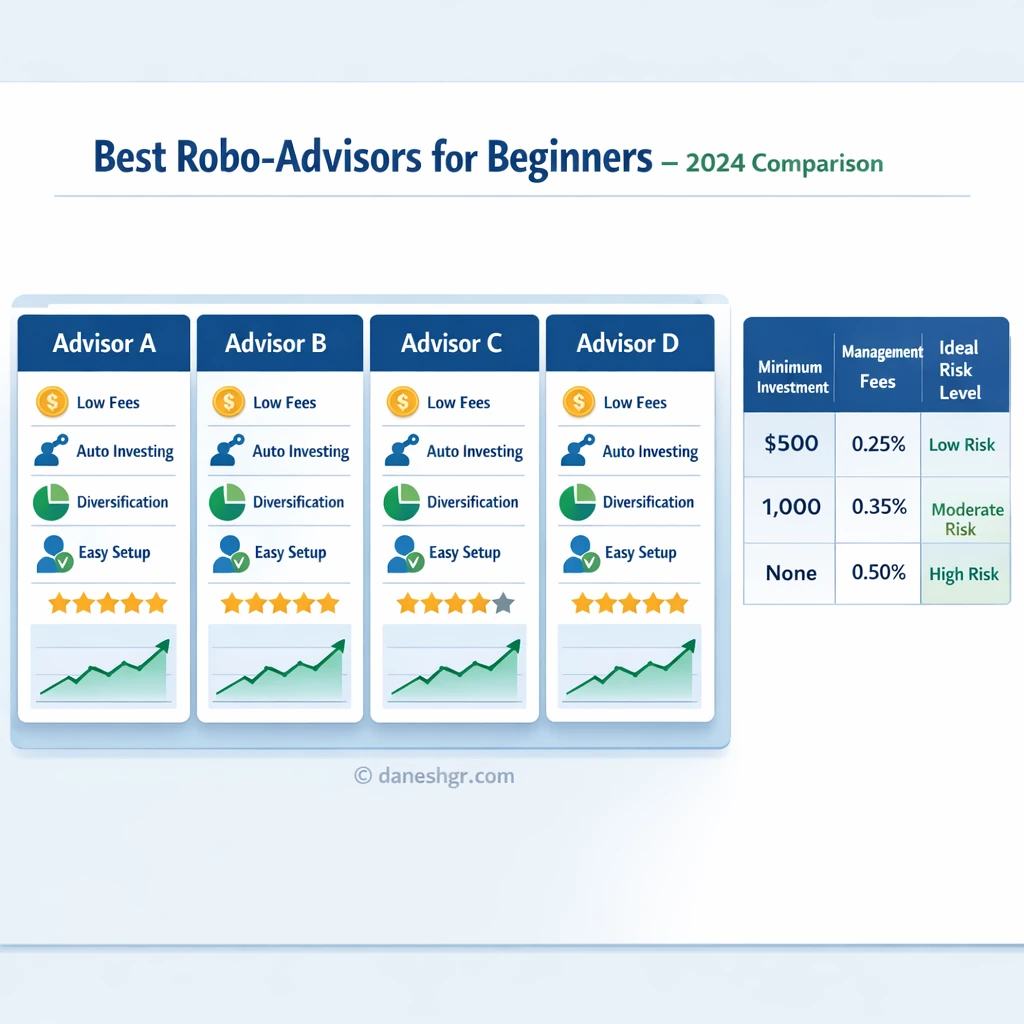
Chapter 4: Head-to-Head Comparison Table 2024
| Feature | Betterment | Wealthfront | SoFi Automated Investing | Ellevest | Vanguard Digital Advisor |
|---|---|---|---|---|---|
| Management Fee | 0.25% | 0.25% | 0% | 0.25% (Core) | 0.20% |
| Account Minimum | $0 | $500 | $1 | $0 | $3,000 |
| Best For | All-Round Ease | Holistic Planning | Zero-Cost + Community | Women Investors | Pure Low-Cost & Trust |
| Tax-Loss Harvesting | Yes (Premium) | Yes (Taxable) | No | Yes (Plus/Exec) | No |
| Human Advisor Access | Paid Upgrade | Limited Email | Free Unlimited | Paid Upgrade | General Support |
| Key Beginner Feature | Goal-Based Setup | Path Planner | Membership Benefits | Gender-Aware Planning | Vanguard Brand & Cost |
Chapter 5: Step-by-Step Guide – How to Start with Your Chosen Robo-Advisor
Let’s move from theory to practice. Here’s exactly how to begin after using our best robo-advisors for beginners 2024 comparison to make your choice.
- Define Your Goal: Is this for retirement (open an IRA) or a general goal (open a taxable account)?
- Gather Documents: Have your Social Security Number, driver’s license, and bank account details ready.
- Sign Up Online: The process takes 10-15 minutes.
- Complete the Risk Assessment: Answer questions about your timeline, feelings about market drops, and income honestly. The algorithm depends on this.
- Fund Your Account: Link your bank and make an initial deposit. Even $50 can get you started on most platforms.
- Set Up Automatic Deposits: This is the magic of “set it and forget it.” Schedule monthly transfers to build wealth consistently.
- Monitor & Learn: Log in quarterly to check progress, but avoid reacting to daily market swings. Use the platform’s educational resources.
Chapter 6: Common Pitfalls and How to Avoid Them
Even with the best tools, beginners can make mistakes. Here’s what to watch for:
- Overestimating Risk Tolerance: Don’t choose “Aggressive” because you want high returns if a 20% drop will panic you into selling. Be conservative at first.
- Neglecting to Fund the Account: Signing up is not enough. The automatic deposit is critical.
- Chasing Performance: Don’t switch robo-advisors every quarter based on minor differences. Stick to your plan for 5+ years.
- Ignoring Tax Implications: Use IRAs for retirement goals to avoid annual tax bills on gains.
- Forgetting About It Completely: While you shouldn’t day-trade, do an annual check-in to update your goals and financial situation.
Frequently Asked Questions (FAQ)
Q1: Are robo-advisors safe? Is my money protected?
A: Yes. Reputable robo-advisors use SIPC (Securities Investor Protection Corporation) insurance to protect your securities up to $500,000 (including $250,000 for cash claims) if the broker-dealer fails. Your assets are held in your name at a custodial bank (like Apex Clearing), separate from the robo-advisor’s company assets.
Q2: Can I lose money with a robo-advisor?
A: Yes. A robo-advisor invests your money in the stock and bond markets, which can go down. It is not a savings account. The key is that a well-diversified portfolio from a robo-advisor is designed to manage risk over the long term, not eliminate it.
Q3: How much money do I really need to start?
A: Thanks to our best robo-advisors for beginners 2024 comparison, you can start with $0 at Betterment and Ellevest, $1 at SoFi, $500 at Wealthfront, and $3,000 at Vanguard. Starting small is encouraged.
Q4: Are robo-advisors better than a human financial advisor for a beginner?
A: For most beginners, yes. They provide low-cost, disciplined, professionally designed portfolios that were once only available to the wealthy. A human advisor is typically more suitable for very complex estates, business planning, or if you strongly prefer in-person guidance (for a much higher cost).
Q5: Can I have multiple robo-advisor accounts?
A: Technically yes, but it’s generally not advisable for beginners. It complicates your financial picture, dilutes the effectiveness of automated strategies like tax-loss harvesting, and makes it harder to track your overall asset allocation. Choose one from our list that best fits your primary need and master it.
Q6: What’s the difference between a robo-advisor and just buying an S&P 500 index fund?
A: An S&P 500 fund is only U.S. large-cap stocks—it’s not diversified. A robo-advisor portfolio includes international stocks, bonds, and other assets to reduce risk. It also automatically rebalances and can manage taxes, which a single index fund does not do.
Q7: How do robo-advisors make money if some charge 0%?
A: Platforms like SoFi make money from other products (loans, banking). Others (Betterment, Wealthfront) charge the small annual fee. All earn a small portion from the ETF expense ratios (the “Securities Lending” revenue).
Conclusion: Your Confident First Step into Investing in 2024
The journey of a thousand miles begins with a single step. In 2024, that step is choosing a robo-advisor that aligns with your goals, risk tolerance, and need for simplicity. This best robo-advisors for beginners 2024 comparison has provided you with the detailed analysis needed to make an informed, confident choice.
Whether you choose the all-around excellence of Betterment, the holistic planning of Wealthfront, the zero-cost community of SoFi, the purpose-driven approach of Ellevest, or the cost-leading trust of Vanguard, you are taking a monumental step towards financial empowerment. The most important action now is to begin.
Open an account, set up that automatic deposit, and let the power of disciplined, algorithm-driven investing start working for you. Your future self will thank you for taking this step today.
Author Bio: Peyman Daneshgar is a financial technology analyst with a passion for democratizing financial knowledge. He specializes in evaluating investment platforms and tools that help beginners build wealth with confidence.