ETF vs Index Fund: Which Is Better for a Beginner? The Ultimate 2024 Guide
Author: Peyman Daneshgar
Email: daneshgar781@gmail.com
Executive Summary
For a beginner investor, choosing between ETFs and index funds can be a daunting decision. This comprehensive guide breaks down both investment vehicles in exhaustive detail, providing clarity, actionable insights, and a definitive framework for making your first investment choice. By the end of this guide, you will understand the nuanced differences, costs, accessibility, and strategic implications of investing in ETFs versus index funds, empowering you to make an informed decision tailored to your financial goals.
how to open a brokerage account for the first time
Table of Contents
- Introduction: The Foundation of Passive Investing
- Chapter 1: What Are Index Funds? The Original Passive Giant
- Chapter 2: What Are ETFs? The Modern Market Disruptor
- Chapter 3: Head-to-Head Comparison: ETF vs Index Fund
- Chapter 4: Which Is Better for Beginners? A Detailed Analysis
- Chapter 5: Step-by-Step Guide to Getting Started
- Chapter 6: Common Beginner Mistakes and How to Avoid Them
- Chapter 7: Advanced Strategies for Future Growth
- Frequently Asked Questions (FAQ)
- Conclusion: Your Personalized Path Forward
Introduction: The Foundation of Passive Investing
The debate of ETF vs index fund is central to modern investing philosophy. For a beginner, this choice represents the first critical step in building long-term wealth. Both instruments are pillars of passive investing, designed to track market indices like the S&P 500, offering diversification, lower costs, and a hands-off approach compared to individual stock picking. But their structural differences can significantly impact your investment experience, costs, and outcomes. This guide dives deeper than any existing resource to dissect every facet of the ETF vs index fund dilemma, providing you with the knowledge to invest with confidence.
what is dollar-cost averaging and how to set it up
Chapter 1: What Are Index Funds? The Original Passive Giant
1.1 Definition and Mechanics
An index fund is a type of mutual fund constructed to match or track the components of a financial market index. It operates on a “buy and hold” strategy, mirroring the index’s performance. When you buy shares of an index fund, you are pooling your money with other investors, and a professional fund manager ensures the fund’s portfolio reflects the target index.
1.2 Key Characteristics of Index Funds
- Pricing and Trading: Index funds are priced once per day after the market closes at the Net Asset Value (NAV). All buy and sell orders are executed at this single price.
- Investment Minimums: Many traditional index funds, particularly those from companies like Vanguard and Fidelity, have initial minimum investments, which can range from $1,000 to $3,000.
- Fractional Shares: Typically, index funds do not allow the purchase of fractional shares. You must buy whole shares based on the NAV.
- Automation: They are perfect for automatic investment plans. You can set up recurring purchases of a fixed dollar amount.
1.3 Pros and Cons for Beginners
Pros:
- Simplicity of Dollar-Cost Averaging: Easy to automate recurring investments.
- No Brokerage Account Required: Can often be bought directly from the fund provider.
- Unemotional Trading: Single daily price prevents reactive, intraday trading.
Cons:
- Higher Minimums: Can be a barrier to entry for absolute beginners.
- Less Intraday Flexibility: Cannot place limit orders or trade during market hours.
how to stop impulse buying online
Chapter 2: What Are ETFs? The Modern Market Disruptor
2.1 Definition and Mechanics
An Exchange-Traded Fund (ETF) is a marketable security that tracks an index, commodity, or basket of assets. Unlike an index fund, an ETF trades like a common stock on an exchange. Its price fluctuates throughout the trading day as it is bought and sold. Most ETFs are index-based, making the ETF vs index fund comparison so relevant.
2.2 Key Characteristics of ETFs
- Pricing and Trading: ETFs trade intraday on stock exchanges. Their price can deviate slightly from the underlying NAV due to supply and demand.
- Investment Minimums: The minimum investment is the price of one share. With the rise of commission-free trading and fractional shares on platforms like Robinhood, M1 Finance, and Fidelity, this barrier is virtually zero.
- Fractional Shares: Many modern brokerages now allow fractional share purchases of ETFs.
- Tax Efficiency: Due to an in-kind creation/redemption process, ETFs typically generate fewer capital gains distributions than traditional index funds.
2.3 Pros and Cons for Beginners
Pros:
- Low Barrier to Entry: Start investing with the price of a single share.
- Trading Flexibility: Place limit orders, stop-loss orders, and trade anytime.
- High Liquidity: Can be bought and sold instantly during market hours.
- Slightly Better Tax Efficiency: Generally more tax-efficient in taxable brokerage accounts.
Cons:
- Potential for Behavioral Errors: Intraday trading can tempt beginners to time the market.
- Commission Risk: While most are commission-free, some brokerages may charge fees for certain ETFs.
- Bid-Ask Spreads: Can add a small, hidden cost to trading.
how to save for a house down payment in 2 years
Chapter 3: Head-to-Head Comparison: ETF vs Index Fund
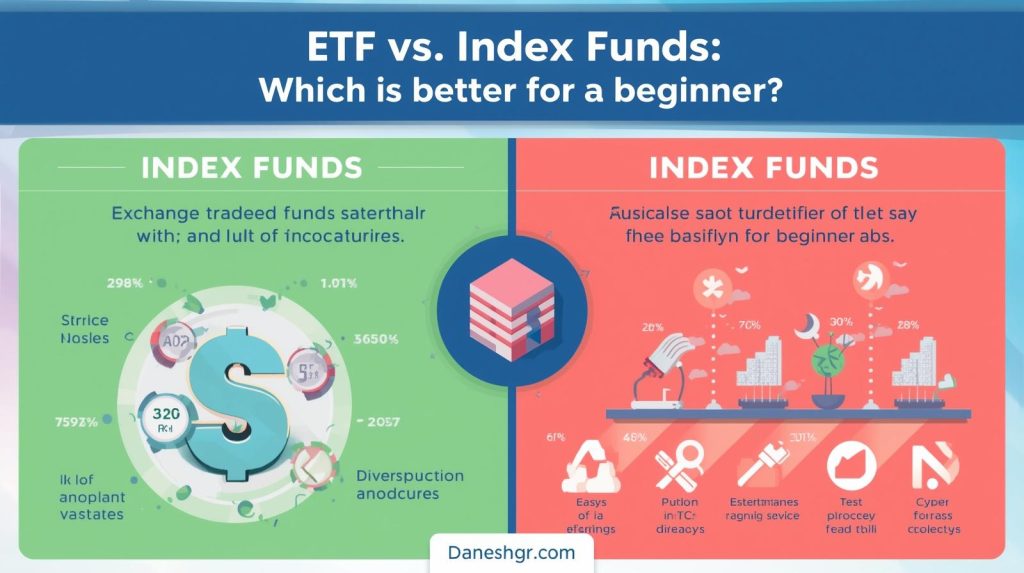
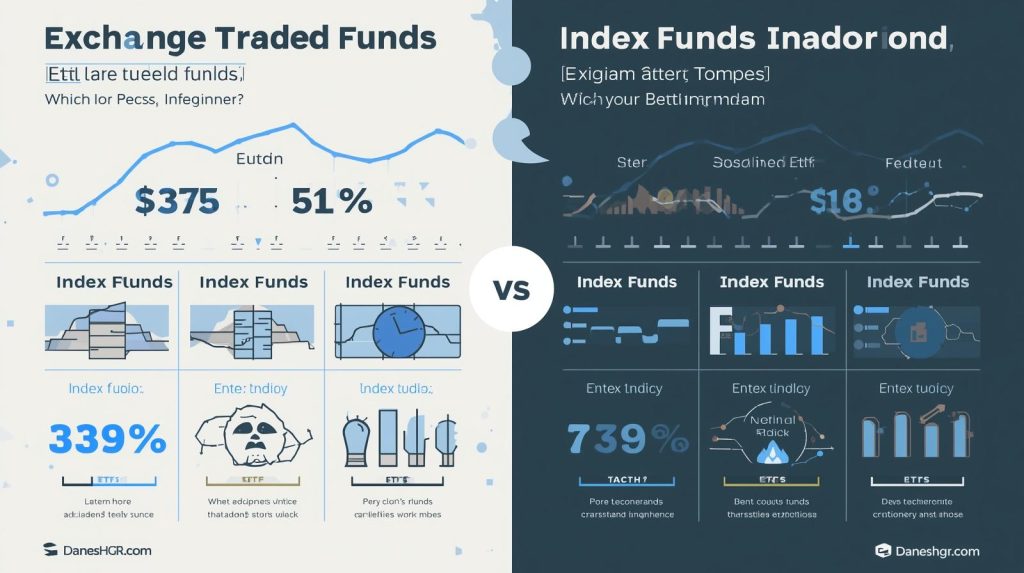
To truly answer ETF vs index fund: which is better for a beginner?, we must compare them across critical dimensions.
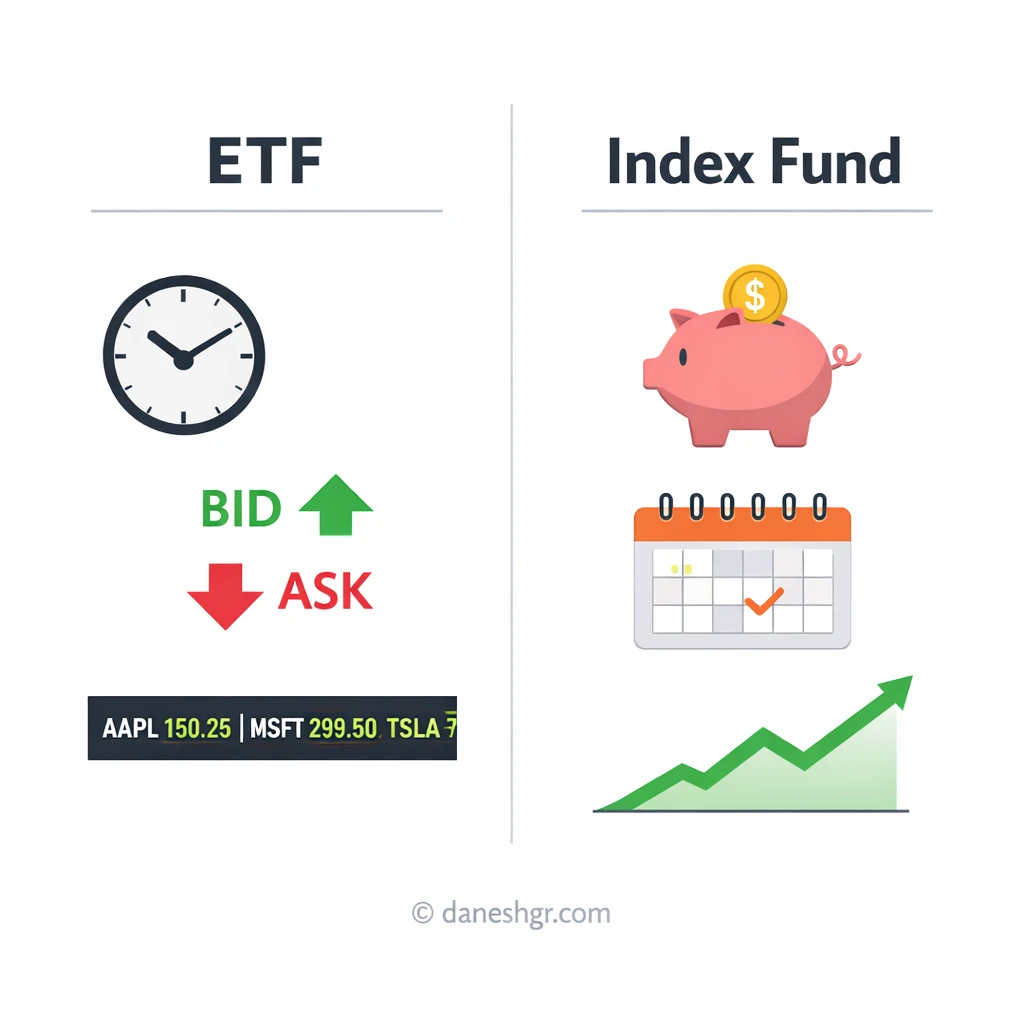
| Feature | ETF (Exchange-Traded Fund) | Index Fund (Mutual Fund) | Winner for Beginners? |
|---|---|---|---|
| Minimum Investment | One share (often $50-$500) | Often $1,000-$3,000 initial minimum | ETF (Lower barrier) |
| Pricing | Fluctuates intraday; market price | Once per day at Net Asset Value (NAV) | Index Fund (Simplicity) |
| Trading | Anytime during market hours | Once per day after market close | Tie (Depends on style) |
| Expense Ratios | Very low (e.g., 0.03% for VOO) | Very low (e.g., 0.04% for VFIAX) | Near Tie (Often identical) |
| Commission/Trading Fee | Typically $0 on major platforms | Typically $0 if buying from fund family | Tie |
| Automatic Investing | Possible with some new brokers | Excellent, easy to set up recurring buys | Index Fund |
| Fractional Shares | Available on select platforms | Not typically available | ETF (on modern platforms) |
| Tax Efficiency | Generally more efficient | Slightly less efficient due to capital gains | ETF (for taxable accounts) |
| Behavioral Influence | Can encourage overtrading | Encourages set-and-forget mentality | Index Fund |
Chapter 4: Which Is Better for Beginners? A Detailed Analysis
The answer to ETF vs index fund: which is better for a beginner? is not universal. It depends on your psychology, goals, and starting capital.
Scenario 1: The Beginner with Less Than $1,000
- Verdict: Start with an ETF.
- Reasoning: The ability to buy a single share of a broad-market ETF (like ITOT or VTI) with no minimum makes the ETF the undisputed winner. You can begin your journey immediately.
Scenario 2: The Beginner Who Wants Full Automation
- Verdict: Choose an Index Fund.
- Reasoning: If your primary goal is to “set it and forget it” with automated monthly contributions from your bank account, the traditional index fund structure is seamless for this purpose.
Scenario 3: The Beginner in a Taxable Brokerage Account
- Verdict: Lean towards an ETF.
- Reasoning: The structural tax advantages of ETFs, while small, are a definite benefit in a taxable account over a decades-long horizon.
Scenario 4: The Beginner Prone to Emotional Trading
- Verdict: Choose an Index Fund.
- Reasoning: The single daily pricing of an index fund acts as a behavioral guardrail, preventing you from making rash decisions based on midday market swings.
Overall Beginner Recommendation: For the typical absolute beginner today, a broad-market ETF offers the best combination of ultra-low cost, zero minimums, and accessibility through modern brokerages. It provides the most frictionless entry point into the world of investing.
zero-based budgeting vs. 50/30/20 rule
Chapter 5: Step-by-Step Guide to Getting Started
Step 1: Define Your Goal
Is this for retirement (30+ years), a house down payment (5-10 years), or general wealth building?
Step 2: Choose Your Account Type
- Retirement: Open an IRA (Roth or Traditional). Both ETFs and index funds are excellent here.
- General Investing: Open a taxable brokerage account. ETFs have a slight edge.
Step 3: Select a Brokerage Platform
- For ETFs: Consider Fidelity, Charles Schwab, Vanguard, or M1 Finance for fractional shares and automation.
- For Index Funds: Vanguard, Fidelity, and Charles Schwab are the industry leaders.
Step 4: Pick Your Specific Investment
- ETF Examples: VTI (US Total Stock Market), VXUS (International Stocks), BND (Total Bond Market).
- Index Fund Examples: VTSAX (US Total Stock Market), VFIAX (S&P 500), VTIAX (International Stocks).
Step 5: Execute Your First Trade
- For an ETF: Search for the ticker (e.g., VTI), select “Buy,” choose “Shares” or “Dollars” (if fractional), and place a “Market Order” for simplicity.
- For an Index Fund: Navigate to the fund’s page (e.g., VTSAX), click “Invest,” and enter the dollar amount.
Step 6: Set Up Recurring Investments (Crucial for Success)
Automate your contributions immediately to build discipline, regardless of whether you choose an ETF or index fund
best cash envelope system wallets 2024
Chapter 6: Common Beginner Mistakes and How to Avoid Them
- Chasing Performance: Don’t buy last year’s top-performing ETF or index fund. Stick to broad, total-market funds.
- Overlooking Costs: Even small differences in expense ratios matter. Always choose the lowest-cost option for a given index.
- Letting Taxes Drive Decisions in IRAs: In retirement accounts, the ETF vs index fund tax difference is irrelevant. Choose based on other factors.
- Failing to Diversify: One S&P 500 fund is not a complete portfolio. Consider adding international and bond exposure over time.
- Abandoning the Plan During Volatility: The number one rule is to keep investing consistently through market ups and downs.
sinking funds: what are they and how to set them up
Chapter 7: Advanced Strategies for Future Growth
Once you’ve mastered the basics of the ETF vs index fund decision, consider these strategies:
- The Three-Fund Portfolio: A simple, powerful portfolio using one domestic stock fund, one international stock fund, and one bond fund (available as both ETFs and index funds).
- Tax-Loss Harvesting: Easier to implement with ETFs in a taxable account due to their precise intraday trading.
- Asset Location: Placing less tax-efficient assets (like bonds) in tax-advantaged accounts and more efficient assets (like stock ETFs) in taxable accounts.
Frequently Asked Questions (FAQ)
Q1: Can I lose all my money in an ETF or index fund?
A: While extremely unlikely with a broad-market fund, your investment value will fluctuate with the market. A total loss would require the entire index (e.g., the entire US stock market) to go to zero, which is practically impossible in a functioning economy.
Q2: Which is more profitable, an ETF or index fund?
A: When tracking the same index, their performance will be virtually identical before costs. After accounting for minimal expense ratio differences and potential tax impacts, the variance is negligible for a long-term buy-and-hold investor. The ETF vs index fund choice is about structure, not superior returns.
Q3: Do I need a broker for both?
A: For ETFs, yes, you need a brokerage account. For index funds, you can often buy directly from the fund company (like Vanguard) without a traditional broker, though many also hold them in brokerage accounts.
Q4: How do I choose between Vanguard, Fidelity, and Schwab?
A: All three are excellent. Vanguard pioneered index investing. Fidelity and Schwab now offer equally low-cost funds and ETFs, sometimes with lower minimums. Choose based on user interface, customer service, and your specific needs.
Q5: Should I invest in both an ETF and an index fund?
A: For a beginner, this is unnecessary complexity. Choose one structure for a given asset class to keep your portfolio simple and clean.
Q6: How much should I start investing as a beginner?
A: Start with an amount you won’t need for 5+ years, even if it’s just $50 or $100. Consistency over time is far more important than the initial sum.
money saving challenges for couples
Conclusion: Your Personalized Path Forward
The ETF vs index fund debate ultimately resolves to personal preference and circumstances. For the modern beginner, ETFs often provide the most accessible and flexible on-ramp to investing, with their share-based pricing and zero minimums. However, if you have a larger initial sum and prize automated, hands-off simplicity above all else, a traditional index fund remains a phenomenal choice.
Final Recommendation: Open a brokerage account with a provider like Fidelity or Schwab that offers fractional ETFs and automatic investing. Purchase a single, low-cost, total stock market ETF like ITOT or VTI. Set up a small, recurring weekly or monthly investment. This approach combines the best of both worlds: the low barrier of an ETF with the automated discipline of an index fund strategy.
Remember, the most important decision is to start. The difference between choosing a perfect ETF and a perfect index fund is dwarfed by the difference between investing and not investing at all. Begin your journey today, stay consistent, and let the power of the markets work for you over the long term.