
: Build Wealth Faster Without Earning More
Author: Peiman Daneshgar
Email: daneshgar781@gmail.com
Table of contents
- 1. What Are High Yield Savings Habits?
- 2. Why Most People Save the Wrong Way
- 3. Habit #1: Automate First, Decide Later
- 4. Habit #2: Use a High‑Yield Savings Account (HYSA)
- 5. Habit #3: Save in Percentages, Not Leftovers
- 6. Habit #4: Increase Savings With Every Raise
- 7. Habit #5: Separate Savings by Purpose
- 8. Habit #6: Create Friction for Spending
- 9. Habit #7: Track Net Worth, Not Just Expenses
- 10. Habit #8: Build a “Boring” Emergency Fund
- 11. Habit #9: Turn Windfalls Into Wealth
- 12. Habit #10: Protect Your Momentum
- 13. Frequently Asked Questions
- 14. Final Thoughts
1. What Are High Yield Savings Habits?
When people hear “high yield,” they often think of investments or risky strategies.
But high yield savings habits are not about gambling your money.
They are about building systems that multiply the impact of every dollar you save.
It’s the difference between:
- Saving occasionally
- And saving automatically
- Saving what’s left
- And paying yourself first
High yield savings habits turn saving from a decision into a default.
That shift changes everything.
52 Week Savings Challenge Rules
2. Why Most People Save the Wrong Way
Most people try to save like this:
Spend → Pay bills → See what’s left → Save the leftovers
The problem?
There are rarely leftovers.
Expenses expand to fill income. Small lifestyle upgrades slowly eat away at potential savings.
Without structure, good intentions disappear by the end of the month.
High yield savings habits reverse the order:
Earn → Save → Spend what remains
That simple reversal increases savings dramatically over time.
3. Habit #1: Automate First, Decide Later
Automation removes emotion from money decisions.
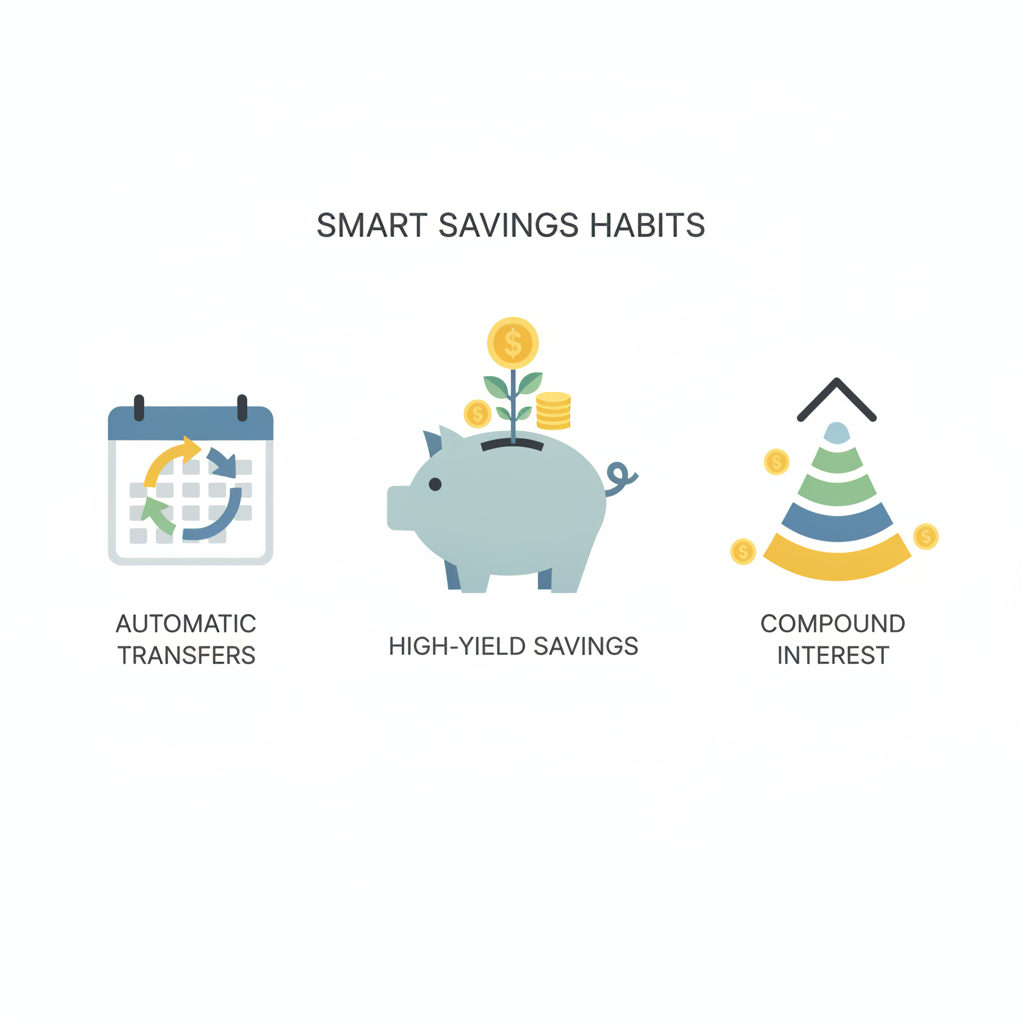
Set up automatic transfers from your checking account to your savings account the day after payday.
Even small automatic transfers build serious progress over time.
For example:
Saving $200 per month at 4% annual interest:
[
Future\ Value \approx 200 \times \frac{(1+0.04/12)^{120}-1}{0.04/12}
]
After 10 years, that’s over $29,000.
Automation works because it eliminates willpower from the equation.

4. Habit #2: Use a High‑Yield Savings Account (HYSA)
Keeping money in a traditional savings account with 0.01% interest barely grows your money.
A high‑yield savings account (HYSA) typically offers significantly higher interest rates.
Even a few percentage points make a meaningful difference over time.
For example:
- $10,000 at 0.01% earns almost nothing.
- $10,000 at 4% earns $400 per year.
The habit here is simple:
Always make sure your savings are working for you.
Review your interest rate at least once per year.
5. Habit #3: Save in Percentages, Not Leftovers
Instead of deciding on a fixed dollar amount, commit to saving a percentage of your income.
Examples:
- 10% minimum savings rate
- 20% aggressive savings rate
- 30% wealth-building phase
When income increases, savings automatically increase.
Percentages scale with your life.
This prevents lifestyle inflation from consuming raises.
6. Habit #4: Increase Savings With Every Raise
When you receive a raise, avoid upgrading your lifestyle immediately.
Instead:
Increase your savings rate before increasing spending.
If you get a $300 monthly raise:
- Save $200
- Spend $100
This keeps your lifestyle stable while accelerating financial growth.
Small adjustments after raises compound into major long-term results.
Better Money Habits vs Khan Academy
7. Habit #5: Separate Savings by Purpose
One big savings account can feel vague and easy to spend.
Instead, divide savings into categories:
- Emergency fund
- Travel fund
- Home fund
- Investment fund
- Freedom fund
Clear labels increase motivation and reduce temptation.
When money has a purpose, you’re less likely to misuse it.
8. Habit #6: Create Friction for Spending
Spending should not be easier than saving.
Some ways to create friction:
- Remove saved credit card details from online stores
- Wait 24 hours before large purchases
- Keep savings in a separate bank
- Turn off one‑click checkout
Friction protects long-term goals from short-term impulses.
Convenience fuels spending. Intentional delay protects savings.
9. Habit #7: Track Net Worth, Not Just Expenses
Tracking expenses helps control spending.
Tracking net worth builds motivation.
Net worth formula:
[
Net\ Worth = Assets – Liabilities
]
When you track your total financial progress monthly, saving becomes more meaningful.
You see growth.
And visible growth encourages consistency.
10. Habit #8: Build a “Boring” Emergency Fund
High yield savings habits begin with stability.
Before aggressive investing, build an emergency fund covering 3–6 months of essential expenses.
Keep this money in a liquid, safe account like a HYSA.
It may not feel exciting.
But it protects you from debt, stress, and financial setbacks.
Stability creates freedom.
11. Habit #9: Turn Windfalls Into Wealth
Tax refunds, bonuses, gifts, or side income often disappear quickly.
High yield savers follow a simple rule:
Save at least 50% of unexpected money.
Windfalls are powerful because they don’t affect your regular lifestyle.
Redirecting them to savings accelerates progress dramatically.
12. Habit #10: Protect Your Momentum
The biggest risk to savings is not low income.
It’s inconsistency.
Life will present emergencies, temptations, and unexpected costs.
High yield savings habits survive because they are systems, not moods.
Even if you reduce contributions temporarily, never stop completely.
Consistency beats intensity.
13. Frequently Asked Questions
What is considered a good savings rate?
Most financial experts recommend saving at least 15–20% of income. Higher rates accelerate financial independence.
Are high‑yield savings accounts safe?
If insured by government-backed deposit insurance (like FDIC in the US), they are generally considered safe for cash savings.
Should I invest instead of using a savings account?
Savings accounts are best for short-term goals and emergency funds. Investing is better suited for long-term growth.
How quickly can I see results?
Within a few months, you’ll notice momentum. Within a year, the difference becomes significant.
14. Final Thoughts
High yield savings habits are not about extreme sacrifice.
They are about structure, automation, and consistency.
When you:
- Automate savings
- Use high-yield accounts
- Save in percentages
- Increase savings with raises
- Protect your momentum
You transform saving from effort into identity.
And when saving becomes part of who you are, wealth follows naturally.