Author: Peiman Daneshgar
Email: daneshgar781@gmail.com
Table of contents
- Introduction: The Age-Old Question That Keeps You Up at Night
- The Anatomy of Happiness: What Are We Actually Searching For?
- The Turning Point: What Science Says About the “Happiness Threshold”
- The Hedonic Treadmill: Why More Money Often Feels Like Zero Money
- Financial Security vs. Materialistic Excess: The Real Happiness Split
- Time Affluence: The Ultimate Privilege Money Can Buy
- The Psychology of Justifying Lifestyle Inflation
- How to Spend Money to Maximize Emotional Returns
- 1. Buy Experiences, Not Things
- 2. Buy Many Small Pleasures Instead of a Few Large Ones
- 3. Pay Now, Consume Later
- 4. Spend on Other People
- Why High Income Won’t Fix Your Internal Chemistry
- The Comparison Trap: Social Media and the Illusion of Relative Wealth
- A Practical Guide to Building a Healthy Relationship with Money
- Frequently Asked Questions (FAQ)
- Final Thoughts: The True Value of a Dollar to Your Soul
Introduction: The Age-Old Question That Keeps You Up at Night
Let’s be completely honest for a moment.
You’ve probably looked at your bank account, your credit card balance, or your monthly bills, let out a deep sigh, and thought to yourself:
“If I just had another $10,000, $50,000, or a million dollars right now… all my problems would disappear, and I would finally be happy.”
It is a thought that crosses the mind of almost every human being living in the modern world. We are constantly bombarded with stories of overnight crypto millionaires, tech founders, and social media influencers who seem to live lives of endless joy, luxury, and peace—all funded by their massive wealth.
So you tell yourself that you need to work harder, run faster on the corporate treadmill, and sacrifice your sleep, your weekends, and your relationships today so that you can buy your happiness tomorrow. You might have tried budgeting apps, side hustles, changing careers, or obsessing over financial freedom checklists.
But deep down, a nagging question remains: Would money make me happy?
Or are we chasing a beautiful illusion that will leave us just as anxious and empty, only with a nicer car in the driveway?
Here is the honest truth that most personal finance experts and wellness gurus won’t tell you: Most discussions about money and happiness fail because they treat wealth as a simple math equation rather than a complex emotional system.
In this comprehensive, deep-dive guide, we are going to look beyond the surface clichés. We aren’t going to give you cheap platitudes like “money can’t buy love” or “wealth is evil.” Instead, we will explore the cutting-edge behavioral psychology, the neuroscience of dopamine, and the hard economic data behind how money affects the human brain.
By the end of this guide, you will understand:
- The exact income thresholds where money stops buying happiness.
- The psychological traps that make rich people feel poor.
- How to structure your spending to get the absolute highest emotional return on investment (ROI).
- A hidden psychological framework that behavioral scientists call the “Hedonic Treadmill” and how to escape it.
There is a specific mental shift near the end of this article that completely changes how you view your paycheck. But before we get to that, we need to address the burning question you came here for.
Let’s look at the actual science.
How “Revenge Spending” Is Destroying Your Savings
Quick Self-Reflection
Think back to the last time you received a raise, a tax refund, or a cash gift.
How long did that warm, secure feeling of “having more money” actually last? A day? A week? A month?
If that feeling faded faster than you expected, you’ve already experienced the core paradox of wealth. Let’s find out why.
The “Loud Budgeting” Trend Explained: Why Gen Z Is Doing It
The Anatomy of Happiness: What Are We Actually Searching For?
To answer if would money make me happy, we first have to understand what “happiness” actually is. Psychologists generally divide happiness into two distinct categories:
- Emotional Well-being (Daily Mood): This is the quality of your everyday life. How often do you feel joy, stress, anger, affection, and sadness? It is the immediate emotional texture of your day-to-day existence.
- Life Evaluation (Cognitive Satisfaction): This is how you feel about your life as a whole when you step back and reflect on it. It is your assessment of your achievements, status, and overall trajectory.
                           ┌───────────────────────────┐
                           │      HUMAN HAPPINESS      │
                           └─────────────┬─────────────┘
                                         │
                   ┌─────────────────────┴─────────────────────┐
                   ▼                                           ▼
      ┌─────────────────────────┐                 ┌─────────────────────────┐
      │   Daily Emotional Mood  │                 │     Life Evaluation     │
      │   (Stress, Joy, Anger)  │                 │ (Status, Goals, Pride)  │
      └─────────────────────────┘                 └─────────────────────────┘
Here is the fascinating part: money affects these two types of happiness in completely different ways.
If you are living in constant financial precarity, your daily emotional mood is heavily damaged. The stress of not knowing if you can pay rent next month acts like a toxic background noise in your brain. It floods your system with cortisol, ruins your sleep, and makes it incredibly difficult to feel joy, no matter how beautiful the sunset is.
However, once you cross the threshold of basic financial safety, adding more money does not automatically improve your daily mood. Instead, it primarily boosts your life evaluation. You feel more successful when you compare yourself to others, but your actual day-to-day emotional state—how happy you feel eating lunch or talking to a friend—remains relatively unchanged.
This means that if you are asking would money make me happy, you have to ask yourself: Are you trying to cure daily stress, or are you trying to feel successful in the eyes of society?
“Girl Math” vs. “Boy Math”: The Psychology of Justifying Purchases
The Turning Point: What Science Says About the “Happiness Threshold”
For over a decade, a famous 2010 study by Nobel laureates Daniel Kahneman and Angus Deaton dominated the conversation about money and happiness. They concluded that emotional well-being plateaus at an annual household income of approximately $75,000 (roughly equivalent to $90,000–$100,000 today when adjusted for inflation). Beyond this point, they argued, earning more money did not make people feel any happier on a daily basis.
However, in 2021, researcher Matthew Killingsworth published a study using real-time tracking of people’s emotions via an app called “Track Your Happiness.” His findings challenged the old plateau theory.
Killingsworth found that happiness continues to rise with income, even far beyond $75,000.
Happiness Level
   ▲
   │                                     * (Killingsworth: Linear growth continues)
   │                                   *
   │                                 *
   │                               *
   │          * * * * * * * * * * * (Kahneman: Plateau around $75k-100k)
   │        *
   │      *
   │    *
   │  *
   └──────────────────────────────────────────────► Income ($)
But there is a massive catch that people often overlook: the relationship is logarithmic, not linear.
What does this mean in plain English?
It means that as you earn more, you need larger and larger increases in income to experience the same emotional boost.
- If you make $20,000 a year, doubling your income to $40,000 will radically transform your life. It is a massive leap in security and happiness.
- If you make $100,000 a year, doubling your income to $200,000 will certainly make life easier, but it will not double your daily happiness.
- If you make $500,000 a year, you would need to jump to $1,000,000 to feel even a minor shift in your emotional baseline.
So, would money make me happy? Yes, but the price tag for each additional drop of happiness gets exponentially higher the richer you become.
What Is “Doom Spending” and How to Stop It Today
A Mind-Bending Mind Game
Imagine a stranger walks up to you today and hands you a check for $5,000. Write down the first three things you would do with that money.
Now, imagine that same stranger hands you $5,000, but you are already a multi-millionaire. Would those same three things bring you the same level of excitement?
Probably not. The value of money is not absolute; it is entirely relative to your current state of mind.
The Hedonic Treadmill: Why More Money Often Feels Like Zero Money
Have you ever wondered why celebrities, politicians, and CEOs who earn millions of dollars still seem highly stressed, angry, and unsatisfied?
The answer lies in a psychological phenomenon called the Hedonic Treadmill (or hedonic adaptation).
Humans are incredibly adaptable creatures. When something good happens to us—whether it’s getting a promotion, buying a luxury sports car, or winning the lottery—our happiness levels spike. But this spike is temporary. Within weeks or months, our brains adapt to our new circumstances, and we return to our baseline level of happiness.
Happiness
   ▲       [SPIKE] Promotion / Luxury Buy
   │         ▲
   │        / \
   │       /   \
   │      /     \
   ├─────/───────\─────────────────────────── Base Level of Happiness (Set Point)
   │              \     /
   │               \   /
   │                ▼ [ADAPTATION] Back to normal
   └────────────────────────────────────────► Time
Here is how the Hedonic Treadmill works in real life:
- The Desire: You drive an old, noisy car and dream of buying a quiet luxury sedan. You believe it will make you happy forever.
- The Purchase: You work hard, save money, and buy the luxury sedan. For the first month, you feel like royalty every time you start the engine.
- The Adaptation: By month three, the quiet ride becomes your new normal. You no longer notice the soft leather seats or the smooth suspension. It’s just “your car.”
- The New Desire: You see someone driving an even more expensive SUV. Suddenly, your luxury sedan feels average, and the cycle starts over.
If you don’t understand this cycle, asking would money make me happy will lead you into a lifelong trap. You will spend your entire life running faster and faster, earning more and more, only to stay in the exact same emotional place.
Financial Security vs. Materialistic Excess: The Real Happiness Split
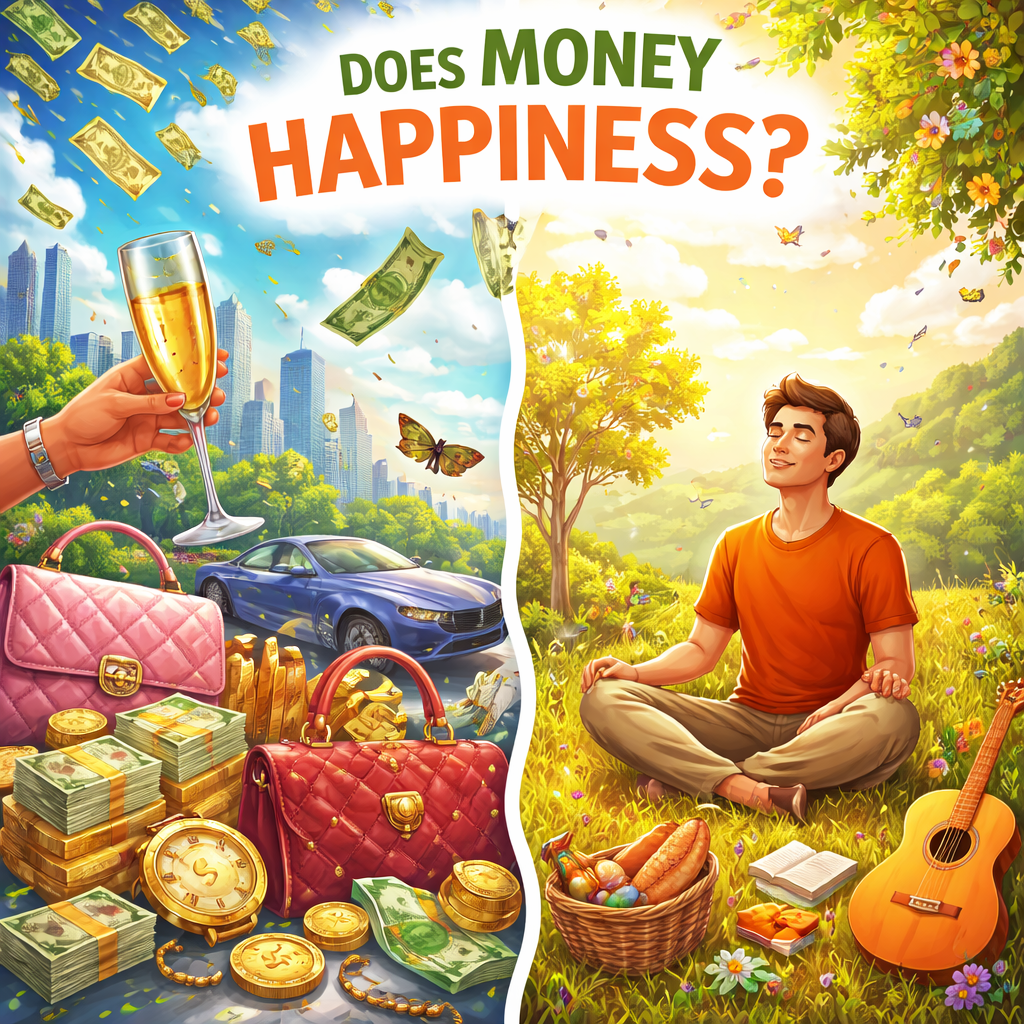
To truly understand the connection between wealth and well-being, we must divide spending into two categories: buying security and buying status.
┌─────────────────────────────────────────────────────────────────────────┐
│                           THE SPENDING DIVIDE                           │
├────────────────────────────────────────┬────────────────────────────────┤
│            BUYING SECURITY             │         BUYING STATUS          │
├────────────────────────────────────────┼────────────────────────────────┤
│ • Emergency fund (peace of mind)       │ • Designer clothes             │
│ • High-quality healthcare              │ • Luxury sports cars           │
│ • Living in a safe neighborhood        │ • Oversized mansions           │
│ • Paying off toxic high-interest debt  │ • Keeping up with the neighbors│
└────────────────────────────────────────┴────────────────────────────────┘
When you use money to buy security, you are building a protective shield around your life. You are preventing bad things—like a sudden medical bill, a car breakdown, or a job loss—from ruining your emotional stability. Research shows that this type of spending has a massive, lasting positive effect on happiness.
However, when you use money to buy status, you are entering an endless social war. There is always someone with a bigger house, a faster car, or a more expensive watch. Buying status is like drinking salt water: the more you consume, the thirstier you get.
Time Affluence: The Ultimate Privilege Money Can Buy
If there is one thing that money can buy that directly increases daily happiness, it is time.
Psychologists use the term Time Affluence to describe the feeling of having enough time to do the things you love—like spending time with family, pursuing hobbies, exercising, and resting. The opposite of this is Time Poverty, which is the constant, stressful feeling of being rushed, overworked, and exhausted.
       TIME POVERTY                             TIME AFFLUENCE
 ┌──────────────────────┐                  ┌──────────────────────┐
 │ • Constant stress    │                  │ • Low daily anxiety  │
 │ • No time for health │   VS.            │ • Meaningful hobbies │
 │ • Strained relations │                  │ • Quality time       │
 │ • Burnout            │                  │ • Rest and recovery  │
 └──────────────────────┘                  └──────────────────────┘
A study published in the Proceedings of the National Academy of Sciences (PNAS) found that people who spent money to buy themselves out of time-consuming tasks (e.g., hiring a cleaning service, ordering healthy prepared meals, or paying more to live closer to work) reported significantly higher life satisfaction than those who spent their money on material goods.
Think about it this way:
If you earn $150,000 a year but have to work 80 hours a week, commute two hours a day, and check your emails during dinner, you are cash-rich but time-poor. Your wealth is actually making you miserable because it is stealing your life away.
But if you earn $70,000 a year, work a stable 35 hours a week, have a short commute, and can spend your evenings cooking with your family or reading a book, you are time-affluent.
So, would money make me happy? Yes—if you use it to buy your time back, rather than using your time to buy more money.
best money habits for beginners
The Commute Calculation
Let’s play a quick game of trade-offs.
Would you rather take a job that pays $100,000 a year with a stressful 1-hour commute each way, or a job that pays $85,000 a year with a 10-minute walk to work?
Most people choose the higher salary. But behavioral science shows that the daily misery of a long, traffic-filled commute has a worse long-term impact on your happiness than a 15% salary cut.
The Psychology of Justifying Lifestyle Inflation
Why is it so hard to save money and buy time? Why do we constantly inflate our lifestyle as our income grows?
It comes down to a psychological concept called lifestyle inflation (or lifestyle creep).
When you start earning more, your expectations shift. What used to be a luxury quickly becomes a necessity.
- When you are a college student, living with roommates and eating instant noodles feels normal.
- When you get your first job, you feel you must have your own apartment.
- When you get a raise, you feel you must shop at organic grocery stores and buy designer coffee daily.
Your brain is incredibly creative at justifying these upgrades. It tells you: “I work hard, so I deserve to live in this neighborhood,” or “I need this subscription to stay productive.”
But lifestyle inflation is a trap. It binds your happiness to a high level of monthly spending. If you ever want to change careers, work less, or take a creative risk, you can’t—because you are locked into paying for your inflated life.
How to Spend Money to Maximize Emotional Returns
If you want your money to buy you happiness, you have to stop spending it randomly. You need to follow research-backed strategies that maximize your Emotional ROI.
Here are four rules for happy spending:
1. Buy Experiences, Not Things
Material items decay, get dirty, and become outdated. But memories grow sweeter over time. A family vacation, a concert ticket, or learning a new skill stays with you forever. Your brain naturally filters out the minor annoyances of an experience (like a delayed flight) and remembers the joy, whereas it quickly gets bored of physical objects.
       MATERIAL GOODS                          EXPERIENCES
┌───────────────────────────┐         ┌───────────────────────────┐
│ • Lose value instantly    │         │ • Gain emotional value    │
│ • Easily compared to news │   VS.   │ • Unique to you           │
│ • Cause buyer's remorse   │         │ • Cultivate social bonds  │
│ • Turn into clutter       │         │ • Create lifelong memories│
└───────────────────────────┘         └───────────────────────────┘
2. Buy Many Small Pleasures Instead of a Few Large Ones
Because of hedonic adaptation, a single massive purchase (like a $10,000 watch) only gives you one temporary spike in happiness. But spending that same money on frequent, small delights—like a weekly massage, a nice dinner with friends, or fresh flowers for your desk—provides constant, fresh bursts of joy throughout the year.
3. Pay Now, Consume Later
Online shopping has made it easy to “consume now, pay later.” But this creates anxiety. The opposite approach—paying for a vacation months in advance—creates a wonderful psychological state called anticipation. The joy of looking forward to something is often greater than the event itself.
4. Spend on Other People
Humans are deeply social creatures. Neuroscientists have found that spending money on others (prosocial spending) activates the reward centers of the brain far more than spending money on ourselves. Whether it’s buying a cup of coffee for a coworker or donating to a cause you believe in, giving makes us feel connected and meaningful.
Healthy Financial Habits to Build
Why High Income Won’t Fix Your Internal Chemistry
Here is a hard truth that is difficult for many to accept: Your money cannot fix your brain’s baseline neurochemistry.
Psychologists have found that about 50% of our happiness baseline is determined by our genetics. Some people are naturally born with a more cheerful, resilient temperament, while others are naturally more anxious or prone to melancholy.
                  ┌─────────────────────────────────────┐
                  │    WHAT DETERMINES OUR HAPPINESS?   │
                  └──────────────────┬──────────────────┘
                                     │
         ┌───────────────────────────┼───────────────────────────┐
         ▼                           ▼                           ▼
  ┌─────────────┐             ┌─────────────┐             ┌─────────────┐
  │  Genetics   │             │ Circumstances│            │ Daily Habits│
  │    (50%)    │             │ (Money, Job)│             │  (Actions)  │
  │             │             │    (10%)    │             │    (40%)    │
  └─────────────┘             └─────────────┘             └─────────────┘
Only about 10% of our happiness is determined by our external circumstances—which includes our income, our house, and the city we live in. The remaining 40% is determined by our daily habits, thoughts, and actions.
This means that if you are naturally anxious, insecure, or lonely, moving to a beachside mansion will not solve your problems. You will simply be a wealthy person dealing with anxiety, insecurity, and loneliness. Money is a tool that can amplify who you already are, but it cannot change your inner self.
The Comparison Trap: Social Media and the Illusion of Relative Wealth
In the past, we only compared ourselves to our immediate neighbors. If our house was similar in size to the houses on our street, we felt successful and content.
But today, social media has turned the entire world into our neighborhood.
When you log onto Instagram or TikTok, you are not comparing yourself to your coworkers or classmates. You are comparing your average life to the highly curated highlights of the top 0.1% of the wealthiest people on the planet.
This constant exposure creates a feeling of relative deprivation. You feel poor not because you lack resources, but because you are constantly looking at people who have more.
[Your Reality] ───► [Comparison with Friends] ───► [Social Media Feed] ───► [Feeling Poor]
 (Warm home,         (Everyone is doing          (Private jets, luxury       (Despite safety,
  good food)          relatively okay)            hotels, yachts)             you feel behind)
If you want to protect your happiness, you must limit this comparison loop. Realize that what you see online is a performance, not a reality.
A Practical Guide to Building a Healthy Relationship with Money
How do we take this information and apply it today? Here is a step-by-step roadmap to make sure your money supports your happiness rather than destroying it.
Step 1: Define Your “Enough Number”
Sit down and calculate exactly how much money you need each month to cover your essentials, feel safe, and enjoy moderate comfort. Once you hit this number, realize that any extra income should be treated as a resource to buy freedom and security, not a license to buy more status symbols.
Step 2: Ruthlessly Cut Status Spending
Look at your bank statements from the last three months. Highlight any purchases you made to impress other people or to fit into a certain social circle. Eliminate them. They are draining your savings and giving you nothing in return.
Step 3: Invest in Your Health and Relationships
The longest-running study on human happiness (the Harvard Study of Adult Development) has tracked individuals for over 80 years. The clear conclusion? Good relationships keep us happier and healthier. Period. Use your money to nurture these connections—buy dinner for friends, travel to see family, or pay for therapy to improve your mental health.
Frequently Asked Questions (FAQ)
Would money make me happy if I hate my job?
Only temporarily. While a high salary can make a bad job bearable for a short time, the daily mental toll of doing work you dislike eventually overrides the pleasure of your paycheck. True happiness comes from aligning your work with your skills and values.
What is the ideal salary for happiness?
While it varies depending on where you live and your family size, research suggests that the sweet spot for maximum daily emotional well-being is around $90,000 to $100,000 per year. Beyond this, additional income has a diminishing effect on daily joy.
Why do some millionaires feel poor?
Because of lifestyle creep and relative comparison. If a millionaire lives in a neighborhood surrounded by billionaires, they will compare themselves upward and feel financially insecure.
Does spending money on others really make us happier?
Yes. Multiple studies in neuroscience show that donating money or buying gifts for loved ones activates the brain’s reward networks, creating a “warm glow” effect that lasts far longer than spending money on ourselves.
Is it wrong to want to be rich?
No, desiring wealth is natural because wealth represents safety, comfort, and opportunities. However, wanting to be rich simply for the sake of accumulation or social status usually leads to frustration.
Final Thoughts: The True Value of a Dollar to Your Soul
If you read this far, you are now ahead of most people who chase money blindly.
Most of the world is trapped in a cycle: working long hours to buy things they don’t need, to impress people they don’t like, using money they don’t have.
But you now know the secret.
Money is not the goal. It is simply a vehicle.
If you use it to buy:
- Peace of mind
- Time with your loved ones
- Health and growth
- Experiences that feed your soul
Then yes, money will make you incredibly happy.
But if you use it to run on the hedonic treadmill, chasing status and trying to fill an emotional void, you will remain empty, no matter how large your net worth becomes.
The next time you look at your wallet or think about your career goals, ask yourself:
“Am I using my life to get money, or am I using money to get my life?”
That single question can change your financial journey forever.