Author: Peiman Daneshgar
Email: daneshgar781@gmail.com
Table of contents
- Introduction: That Little Voice That Says “This Is Actually a Good Deal”
- What Is “Girl Math”?
- What Is “Boy Math”?
- Why Humans Justify Purchases
- Social Media and the Rise of “Math Logic” Spending
- Real‑Life Examples of Girl Math and Boy Math
- Is This Behavior Harmful?
- How Brands Use the Same Psychology
- How to Avoid Self‑Deception When Spending
- A Smarter Way to Think About Purchases
- Frequently Asked Questions (FAQ)
- Final Thoughts: Understanding the Mind Behind Spending
Introduction: That Little Voice That Says “This Is Actually a Good Deal”
Let’s be honest for a second.
You probably didn’t plan to buy that thing.
Maybe it was a pair of shoes.
Maybe a gaming accessory.
Maybe a jacket you technically already had a version of.
But then your brain started doing… math.
Not real math.
The kind of math that magically turns spending money into “saving money.”
Something like:
- “If I wear this jacket 40 times, it’s basically $2 per use.”
- “This game costs $70, but I’ll play it for 100 hours.”
- “I returned something last week, so technically this is free.”
And suddenly the purchase feels logical.
If this sounds familiar, congratulations.
You’ve experienced what the internet now calls “Girl Math” or “Boy Math.”
These viral concepts exploded on TikTok and social media because they capture something deeply human:
Our brain is incredibly good at justifying what we already want.
In this article you’ll learn:
- What Girl Math and Boy Math actually mean
- Why the brain invents these mental calculations
- How social media amplified this behavior
- And how to recognize when your brain is bending logic to justify spending
But first, let’s understand what people actually mean by Girl Math.
Because despite the name, it’s less about gender and more about psychology.
What Is “Doom Spending” and How to Stop It Today
What Is “Girl Math”?
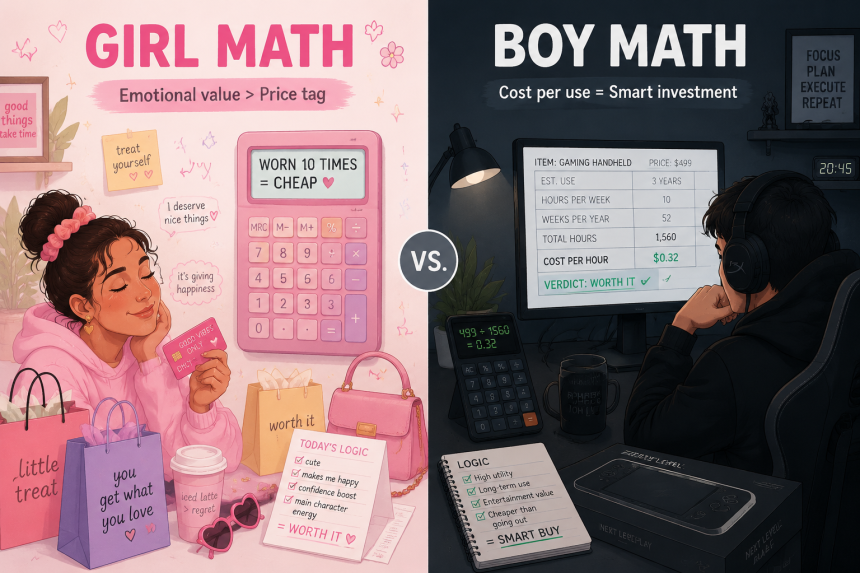
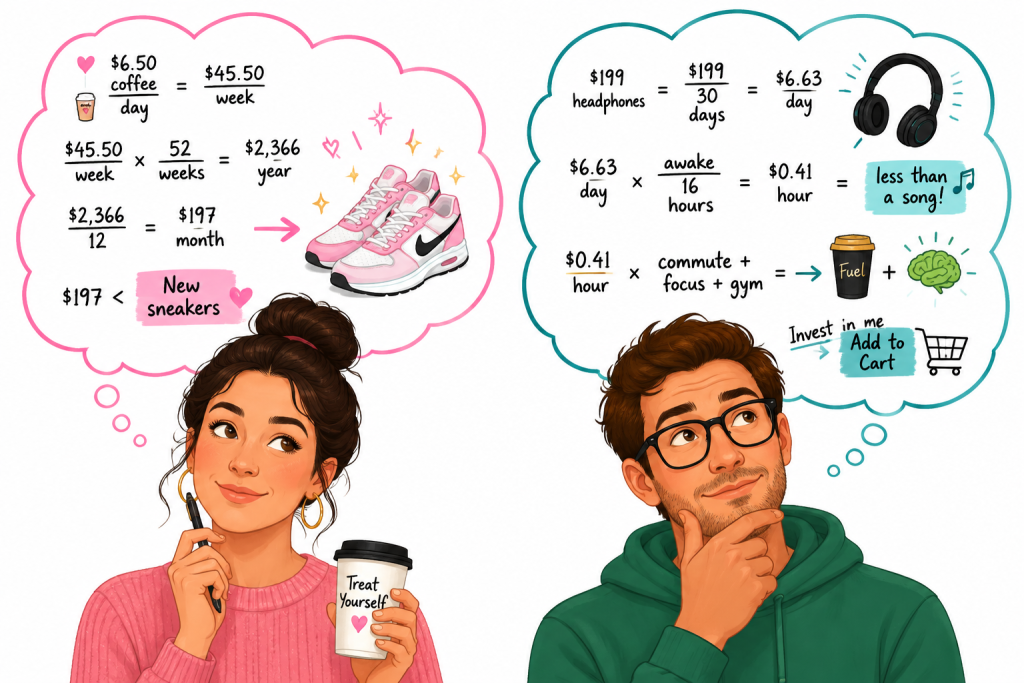
“Girl Math” is a humorous internet trend describing how someone mentally justifies spending money by reframing the cost.
The logic often works like this:
If the cost can be mentally reduced, divided, or reframed, the purchase suddenly feels reasonable.
Common examples include:
- If you return something, the refund can be used on something new “for free.”
- If an item is on sale, you’re “saving money” by buying it.
- If something is worn often, the price per use becomes tiny.
Here’s a classic example.
You see a $120 jacket.
Using Girl Math, your brain might say:
- You’ll wear it 60 times this winter.
- $120 ÷ 60 = $2 per wear.
Suddenly the jacket becomes “basically $2.”
Which sounds very reasonable.
The humor of Girl Math comes from the fact that everyone knows the logic is a bit… stretched.
But it also reveals something fascinating about human behavior.
Because the brain doesn’t naturally think in strict financial terms.
It thinks in emotional value.
Before we look at Boy Math, ask yourself something.
Quick Question
Have you ever justified a purchase by calculating “price per use”?
If yes, you’ve already done a form of Girl Math.
But there’s another version of this phenomenon.
And the internet calls it Boy Math.
What Is “Boy Math”?
Boy Math follows the same psychological pattern but uses slightly different logic patterns.
Instead of dividing cost into smaller emotional chunks, Boy Math often justifies purchases based on utility, longevity, or performance value.
Examples include:
- “This $1,000 gaming PC will last 5 years.”
- “If I play 500 hours of games, that’s only $2 per hour.”
- “Buying expensive tools saves money long‑term.”
- “This car upgrade improves performance, so it’s worth it.”
The logic usually focuses on long-term justification.
Instead of reducing the price emotionally, Boy Math reframes the purchase as an investment.
For example:
Someone buys a $300 mechanical keyboard.
Boy Math explanation:
“If I use it every day for 4 years, it’s basically pennies per day.”
Technically, the math checks out.
But the brain still skipped an important question:
Did you actually need it?
And that’s where psychology becomes interesting.
Because both Girl Math and Boy Math are examples of the same cognitive behavior.
Our brain rationalizes decisions after we emotionally make them.
But why does the brain do this?
Why Humans Justify Purchases
Humans rarely make purely logical spending decisions.
Instead, decisions usually follow this order:
- Emotion decides
- Logic explains
You see something you like.
Your brain generates a desire.
Then logic appears afterward to defend the decision.
Psychologists call this:
Post‑purchase rationalization
Or more broadly:
Cognitive justification.
The brain dislikes feeling inconsistent.
If you spend money impulsively, the brain tries to reduce discomfort by creating logical explanations.
That’s where “math logic” appears.
Examples include:
- dividing the cost
- comparing with worse alternatives
- focusing on long-term benefits
- redefining the purchase as an investment
The brain isn’t trying to deceive you.
It’s trying to protect your self-image as a rational person.
But social media made this phenomenon explode.
Let’s talk about that.
Social Media and the Rise of “Math Logic” Spending
The concepts of Girl Math and Boy Math became viral trends on platforms like TikTok and Instagram.
Short videos showed people humorously explaining their spending logic.
For example:
“If I bought concert tickets six months ago, they’re basically free today.”
Or:
“If shipping is free over $100, then buying more actually saves money.”
Millions of viewers related instantly.
Why?
Because people recognized their own thinking patterns.
But there’s a deeper effect here.
Social media normalizes these behaviors.
When people see others joking about spending logic, it makes the behavior feel acceptable and universal.
Which can subtly encourage more impulsive purchases.
But not all purchase justification is bad.
Sometimes it can actually be helpful.
Let’s look at some real‑world examples.
best money habits for beginners
Real‑Life Examples of Girl Math and Boy Math
Here are some situations many people recognize.
Example 1: The Gym Membership
Someone pays $60 per month.
They justify it like this:
“If I go 20 times this month, that’s only $3 per visit.”
The logic encourages them to use the gym more.
In this case, the justification helps reinforce a good habit.
Example 2: The Expensive Jacket
Someone buys a $200 winter coat.
Their reasoning:
“I’ll wear this every winter for years.”
If the coat lasts five winters, the cost feels much smaller.
Healthy Financial Habits to Build

Example 3: Gaming Purchases
Gamers often justify purchases using cost per hour of entertainment.
For example:
A $70 game played for 120 hours equals roughly $0.58 per hour.
Compared to movies or concerts, it seems cheap.
And that reasoning is not entirely wrong.
But it still ignores the original question:
Was the purchase necessary?
Is This Behavior Harmful?
Not always.
In fact, purchase justification is a normal part of human psychology.
Problems appear when it becomes a default spending habit.
If every purchase requires creative math to feel acceptable, that’s a warning sign.
Common risks include:
- overspending
- ignoring long‑term financial goals
- emotional impulse purchases
- accumulating unused items
But the solution isn’t eliminating justification.
The goal is recognizing when your brain is doing it.
Awareness alone can dramatically change spending behavior.
How Brands Use the Same Psychology
Interestingly, companies intentionally design pricing strategies around these mental calculations.
Examples include:
Subscription Pricing
Instead of $120 per year, a service costs:
$9.99 per month
The smaller number feels easier to justify.
“Cost Per Use” Marketing
Many brands advertise durability or long-term value.
Examples:
- premium shoes
- luxury watches
- high-end electronics
They encourage consumers to think in per‑use terms.
Bundles and Discounts
“Buy two, get one free.”
This encourages Girl Math logic:
“I’m saving money by buying more.”
In reality, the total spending increases.
Understanding these tactics helps you recognize when your brain is being nudged.
How to Avoid Self‑Deception When Spending
You don’t need to eliminate fun spending.
But a few simple questions can stop irrational justification.
Before buying something, ask:
- Would I still buy this if it were not on sale?
- Am I dividing the price to make it feel cheaper?
- Would I recommend this purchase to a friend honestly?
- If I wait 24 hours, will I still want it?
These questions interrupt automatic rationalization.
And that small pause can save a surprising amount of money.
A Smarter Way to Think About Purchases
Instead of asking:
“Can I justify this purchase?”
Ask something simpler.
“Will this meaningfully improve my life?”
That question cuts through mental math tricks.
Some purchases absolutely do improve life.
Others are just temporary dopamine.
And recognizing the difference is the key to healthier spending.
Frequently Asked Questions (FAQ)
What is Girl Math?
Girl Math is a humorous way people justify purchases by reframing the cost, such as dividing the price by number of uses.
What is Boy Math?
Boy Math usually justifies spending based on long‑term value, performance, or utility rather than emotional reasoning.
Is Girl Math actually logical?
Sometimes. Cost‑per‑use calculations can be reasonable, but they can also hide unnecessary spending.
Why do people justify purchases?
The brain wants to maintain the feeling of being rational, so it creates explanations for decisions already made emotionally.
Are these behaviors gender specific?
Not really. The names are playful internet labels, but both patterns appear in everyone.
Final Thoughts: Understanding the Mind Behind Spending
The internet jokes about Girl Math vs. Boy Math because it’s funny.
But underneath the humor is something important.
Humans are incredibly creative when it comes to justifying what we want.
We divide costs.
We stretch timelines.
We reframe purchases as investments.
Sometimes the logic works.
Sometimes it’s just our brain protecting us from buyer’s guilt.
The key isn’t avoiding every impulse purchase.
It’s understanding when your mind is doing math to justify emotion.
Once you recognize that pattern, spending decisions become clearer.
And strangely enough…
You may find yourself buying fewer things—but enjoying them much more.