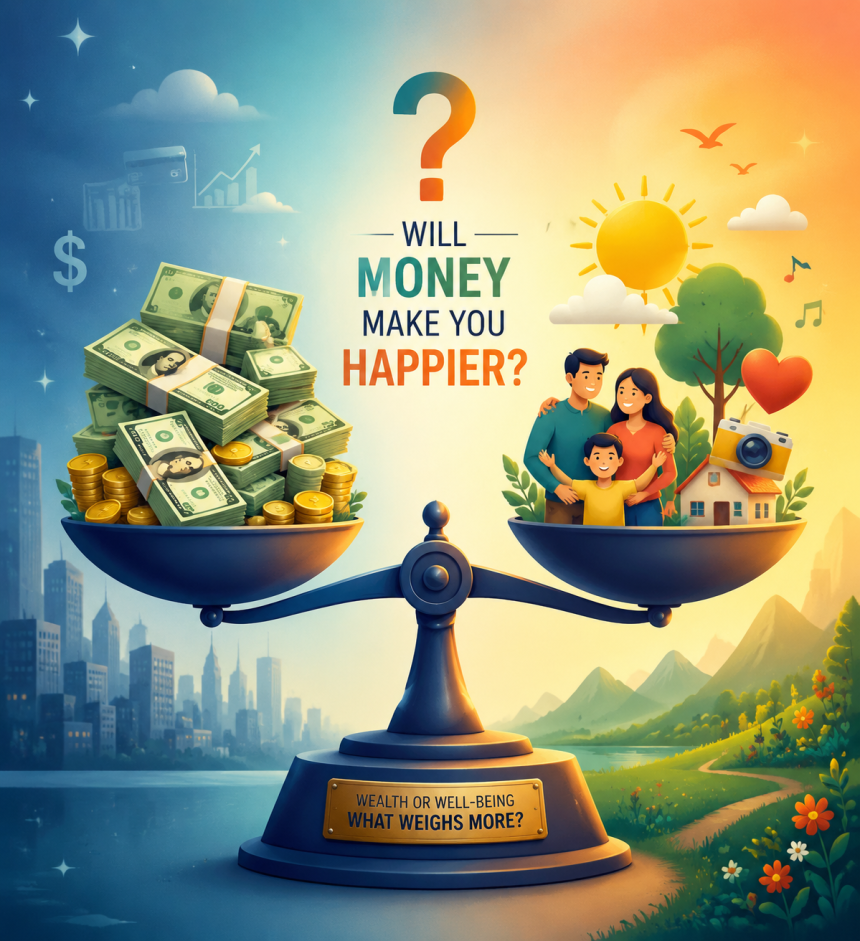
Will Money Make You Happier? The Real Relationship Between Wealth and Happiness
Author: Peiman Daneshgar
Email: daneshgar781@gmail.com
Table of contents
- Will Money Make You Happier? The Real Relationship Between Wealth and Happiness
- Introduction: The Question Everyone Quietly Asks
- Understanding Happiness: Two Different Meanings
- 1. Emotional Well‑Being
- 2. Life Satisfaction
- When Money Truly Improves Happiness
- Financial Stability Reduces Stress
- Access to Better Living Conditions
- Greater Sense of Control
- The Point Where Money Stops Helping as Much
- The Hedonic Adaptation Effect
- Why Wealth Doesn’t Always Lead to Happiness
- Social Comparison
- Lifestyle Inflation
- Lack of Purpose
- The Role of Time in Happiness
- How to Use Money to Increase Happiness
- Spend on Experiences
- Invest in Relationships
- Reduce Stressful Obligations
- Support Personal Growth
- What Money Cannot Buy
- A Balanced Perspective on Wealth and Happiness
- Conclusion
Introduction: The Question Everyone Quietly Asks
Almost everyone, at some point in life, asks the same question:
“Will money make me happier?”
It’s a simple question, yet it touches one of the deepest human concerns: the search for a better life.
We live in a world where wealth is constantly associated with happiness. Social media shows luxurious vacations, designer clothes, beautiful homes, and seemingly perfect lifestyles. Advertisements promise that the next purchase will make life more enjoyable. Career culture pushes people to work harder, earn more, and climb higher.
So naturally, many people believe that if they could just earn more money, their lives would improve dramatically.
But the reality is more complicated.
Money can certainly improve happiness under certain conditions. At the same time, many wealthy people still struggle with stress, dissatisfaction, or even depression. This contradiction has fascinated psychologists and economists for decades.
To truly answer the question “Will money make you happier?”, we need to understand how money interacts with human psychology, security, expectations, and lifestyle.
Understanding Happiness: Two Different Meanings
One of the biggest reasons people misunderstand the relationship between money and happiness is because “happiness” actually has two different meanings in psychology.
Researchers often divide happiness into two categories.
1. Emotional Well‑Being
Emotional well‑being refers to your daily emotional experience.
It includes feelings such as:
- joy
- calmness
- stress
- frustration
- anxiety
- satisfaction
This type of happiness is about how you feel during your everyday life.
2. Life Satisfaction
Life satisfaction is different. It refers to how you evaluate your life as a whole.
People think about questions like:
- Am I successful?
- Am I doing well compared to others?
- Am I satisfied with where my life is going?
Interestingly, money affects these two forms of happiness differently.
Money strongly influences life satisfaction, because income often represents status and achievement.
However, its effect on daily emotional well‑being becomes weaker after a certain level of financial comfort.
How “Revenge Spending” Is Destroying Your Savings
When Money Truly Improves Happiness
Money has the greatest impact on happiness when it removes financial insecurity.
People who struggle with basic expenses often experience constant mental pressure. Worrying about rent, bills, or debt creates chronic stress that affects both mental and physical health.
When income increases enough to cover basic needs, several powerful psychological benefits appear.
The “Loud Budgeting” Trend Explained: Why Gen Z Is Doing It
Financial Stability Reduces Stress
Financial security removes one of the most persistent forms of anxiety: uncertainty about survival.
People with stable finances can:
- pay bills on time
- handle emergencies
- plan for the future
This stability allows the brain to relax and focus on more meaningful aspects of life.
“Girl Math” vs. “Boy Math”: The Psychology of Justifying Purchases
Access to Better Living Conditions
Higher income often improves quality of life by allowing access to:
- safer neighborhoods
- better healthcare
- healthier food
- improved education
These factors contribute to long‑term well‑being.
What Is “Doom Spending” and How to Stop It Today
Greater Sense of Control
Another important psychological factor is control.
People feel happier when they believe they have control over their circumstances. Money can increase this feeling by giving individuals more choices about where they live, how they work, and what opportunities they pursue.
The Point Where Money Stops Helping as Much
While money improves happiness at lower income levels, research shows that its effect gradually slows down as income increases.
Economists call this phenomenon diminishing returns.
In simple terms, the first increase in income has the strongest effect on happiness, while later increases bring smaller improvements.
For example:
- Going from financial struggle to financial stability can dramatically change someone’s life.
- Going from comfortable to extremely wealthy usually has a smaller impact on emotional well‑being.
Once people feel secure, additional income mainly increases comfort and status, rather than daily happiness.

The Hedonic Adaptation Effect
Another important psychological concept is hedonic adaptation.
Humans quickly adapt to new circumstances.
When something positive happens—such as a raise, a new car, or a larger home—people initially feel a surge of happiness. But over time, that new situation becomes normal.
The excitement fades.
Eventually, the person returns to roughly the same baseline level of happiness as before.
This process explains why major financial improvements often feel less impactful than expected.
A luxury item that once felt exciting may become ordinary after a few months.
Why Wealth Doesn’t Always Lead to Happiness
If money can improve life, why do many wealthy individuals still report feeling unhappy?
There are several reasons.
Social Comparison
Humans constantly compare themselves with others.
Someone earning a comfortable salary may feel successful in one environment but inadequate in another. If surrounded by people who earn far more, a person may feel poor even when they are objectively wealthy.
Social media has intensified this effect by exposing people to curated images of luxury and success.
Lifestyle Inflation
When income rises, spending habits often rise as well.
This phenomenon is called lifestyle inflation.
People upgrade their homes, cars, vacations, and daily habits as their earnings grow. As a result, their expenses increase alongside their income, leaving them feeling just as financially pressured as before.
Lack of Purpose
Money cannot replace deeper psychological needs.
People also require:
- meaningful relationships
- a sense of purpose
- personal growth
- community and belonging
Without these elements, financial success alone may feel empty.
The Role of Time in Happiness
One of the most powerful benefits money can provide is time freedom.
Many people assume money brings happiness because it allows them to buy luxury items. But research suggests the real advantage of wealth is the ability to control how you spend your time.
People who have greater control over their schedules tend to report higher life satisfaction.
Money can help by allowing people to:
- work fewer hours
- live closer to work
- outsource stressful tasks
- take breaks or vacations
These changes reduce daily stress and create more opportunities for meaningful experiences.
How to Use Money to Increase Happiness
Since money alone does not guarantee happiness, the key question becomes how to use money wisely.
Psychological research suggests several spending patterns that tend to increase happiness.
Spend on Experiences
Experiences often produce longer-lasting happiness than material goods.
Travel, learning opportunities, and shared activities create memories that remain meaningful long after the event.
Invest in Relationships
Strong social connections are one of the most reliable predictors of happiness.
Using money to spend time with friends and family—such as shared meals, trips, or celebrations—can strengthen these bonds.
Reduce Stressful Obligations
Money can improve well‑being when it reduces daily stress.
Examples include:
- paying off high-interest debt
- improving living conditions
- reducing long commutes
These changes improve everyday quality of life.
Support Personal Growth
Education, hobbies, and skill development can create a sense of progress and purpose. Spending money on learning often leads to deeper satisfaction than purchasing material items.
What Money Cannot Buy
Despite its advantages, money cannot provide several essential elements of human happiness.
It cannot directly create:
- genuine friendships
- self-esteem
- love
- emotional resilience
- meaning in life
These qualities develop through relationships, experiences, and personal development rather than financial resources.
Money may support these areas by creating opportunities, but it cannot replace them.
best money habits for beginners
A Balanced Perspective on Wealth and Happiness
The relationship between money and happiness is not simple.
Money can dramatically improve life when it solves fundamental problems such as poverty, insecurity, and lack of opportunity.
However, once basic comfort and stability are achieved, additional income plays a smaller role in emotional well‑being.
At that stage, happiness depends more on:
- meaningful relationships
- personal growth
- health
- purpose
- and how individuals spend their time.
Conclusion
So, will money make you happier?
The honest answer is sometimes, but not always.
Money can increase happiness by reducing stress, improving security, and providing greater freedom of choice. These benefits are especially powerful for people who face financial uncertainty.
However, after basic needs and reasonable comfort are met, the impact of additional wealth becomes limited. Happiness then depends less on income and more on relationships, purpose, and lifestyle choices.
In the end, money is best viewed as a tool rather than a source of happiness itself.
Used wisely, it can create the conditions for a fulfilling life. But true happiness ultimately depends on how people live, connect with others, and find meaning in their daily experiences.