Author: Peiman Daneshgar
Email: daneshgar781@gmail.com
Table of contents
- Introduction: The Feeling You Probably Know Too Well
- What Is Doom Spending?
- Why Doom Spending Happens
- Signs You Might Be Doom Spending
- The Real Consequences of Doom Spending
- How to Stop Doom Spending Today
- The 10‑Minute Rule That Breaks Impulse Spending
- Build a “Calm Spending System”
- A Real-Life Scenario
- Frequently Asked Questions (FAQ)
- Final Thoughts: You’re Already Ahead of Most People
Introduction: The Feeling You Probably Know Too Well
Let me guess something.
You open your phone…
Scroll through the news…
See another headline about inflation, layoffs, climate disasters, or global uncertainty.
And suddenly you think:
“You know what? I deserve something nice today.”
So you buy something.
Maybe it’s a $40 gadget from Amazon.
Maybe clothes you didn’t really need.
Maybe another food delivery when there’s food in the fridge.
For a few minutes, it feels good.
Then the feeling fades.
And later you wonder:
“Why did I even buy that?”
If this sounds familiar, you’re not alone.
Millions of people today are trapped in a cycle called doom spending.
And the frustrating part?
Most people don’t even realize they’re doing it.
You might have already tried things like:
- Budget apps
- No‑spend challenges
- Watching personal finance videos
- Making strict monthly budgets
But somehow… the impulse spending keeps happening.
Here’s the honest truth:
Most financial advice fails because it ignores the emotional reason behind spending.
In this article, you’ll learn:
- What doom spending really is
- Why smart, responsible people fall into it
- The psychological triggers behind it
- And most importantly: how to stop doom spending today without extreme budgeting
There’s one small technique near the end that behavioral economists use themselves. Hardly anyone talks about it.
But before we get there, we need to understand something surprising.
Because doom spending is not really about money.
And once you see why, everything changes.
best money habits for beginners
What Is Doom Spending?
In simple terms:
Doom spending is when people spend money as a way to cope with stress, anxiety, or uncertainty about the future.
It usually happens when the world feels unstable.
Examples include:
- Buying things impulsively after reading bad news
- Spending money because “the future feels uncertain anyway”
- Treating yourself constantly because everything feels overwhelming
- Spending as a way to escape anxiety or burnout
The term became popular during the early 2020s when economists noticed a strange pattern.
Even during economic uncertainty, consumer spending remained extremely high.
People were worried about money…
But they were still spending it.
Why?
Because psychologically, spending can feel like control in a chaotic world.
Healthy Financial Habits to Build
Quick Reality Check
Ask yourself something honestly:
Have you ever bought something mainly because you felt stressed or emotionally drained?
If the answer is yes, congratulations.
You’re human.
But here’s where things get interesting.
Because doom spending isn’t random.
It follows very specific psychological triggers.
Let’s look at them.

Why Doom Spending Happens
Doom spending is deeply connected to how our brains handle stress.
When people feel uncertain about the future, the brain shifts into short‑term reward mode.
Instead of thinking about:
- retirement
- savings
- long‑term goals
The brain focuses on immediate comfort.
This happens for three main reasons.
1. The “Why Save Anyway?” Effect
When the future feels uncertain, saving money can feel pointless.
People subconsciously think:
“If everything is getting worse… why not enjoy something today?”
This mindset quietly drives spending.
2. Micro-Dopamine Hits
Every purchase gives a small dopamine reward.
Not huge.
But enough to temporarily improve mood.
Online shopping is especially powerful because it combines:
- anticipation
- novelty
- reward
Which is basically a perfect dopamine cocktail.
3. Emotional Exhaustion
Modern life is mentally draining.
Constant information.
Constant decisions.
Constant pressure.
When the brain is exhausted, it chooses easy pleasure over disciplined decisions.
Which means clicking “Buy Now”.
Strange But True
Research shows people are more likely to impulsively shop after reading negative news headlines.
Yes, seriously.
Your brain tries to balance negative emotions with quick rewards.
And shopping becomes the shortcut.
But here’s the real problem.
Most people don’t realize when they’ve crossed the line from normal spending into doom spending.
Let’s talk about the warning signs.
Signs You Might Be Doom Spending
Doom spending doesn’t always look extreme.
Often it hides inside normal purchases.
Here are some subtle signs.
You Shop When You Feel Emotionally Drained
Bad day at work?
You suddenly feel the urge to buy something.
Not because you need it.
But because you want to feel better.
Packages Arrive and You Barely Remember Ordering Them
This happens more than people admit.
You see a delivery and think:
“Wait… when did I buy that?”
You Justify Purchases With “Life Is Short”
This mindset can quietly normalize unnecessary spending.
Your Cart Is Always Full
Amazon.
Clothing stores.
Random gadgets.
You constantly add things “just in case”.
Quick Reflection
Think about your last three impulse purchases.
Were they planned?
Or were they emotional?
Be honest.
Because awareness is where everything starts.
And now we need to talk about something uncomfortable.
The hidden cost of doom spending.
The Real Consequences of Doom Spending
Doom spending doesn’t destroy finances overnight.
It works slowly.
Quietly.
Almost invisibly.
Small purchases stack up.
A $25 purchase here.
$40 there.
$15 subscriptions.
Over months, it becomes thousands.
But the financial cost isn’t the worst part.
The real damage is psychological.
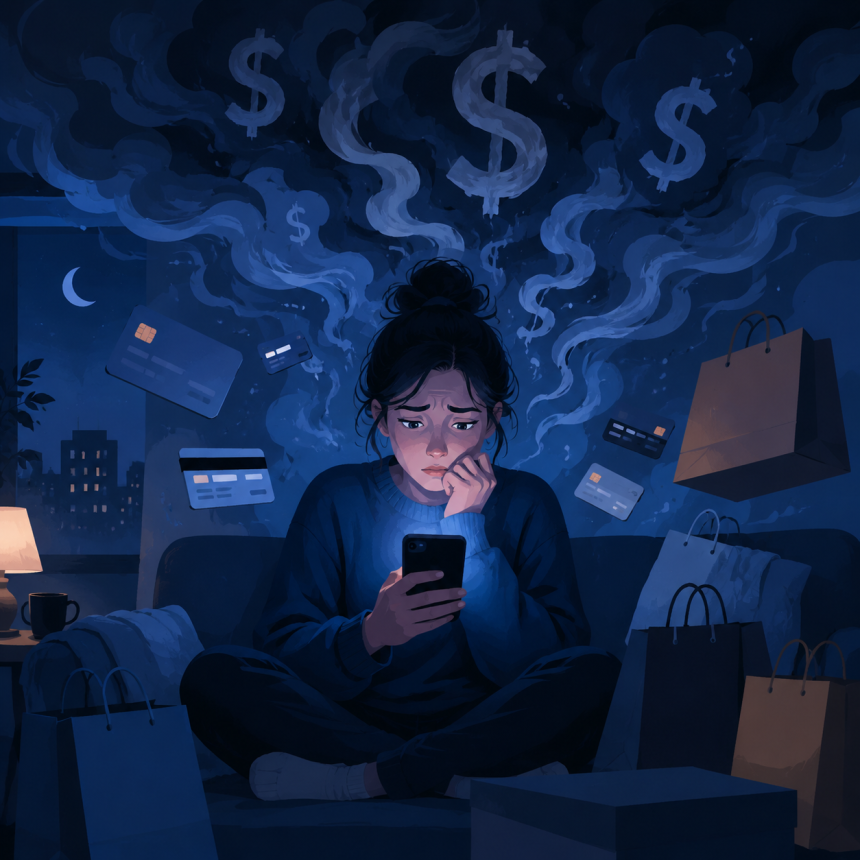
The Doom Spending Cycle
- You feel anxious or stressed
- You buy something
- Temporary relief
- Later guilt
- More anxiety
- Repeat
This cycle slowly erodes your sense of financial control.
And when people feel out of control with money, they often spend even more.
But here’s the good news.
Breaking this cycle doesn’t require extreme discipline.
You just need a few smart systems.
Let’s start with the simplest one.
How to Stop Doom Spending Today
Instead of trying to eliminate spending, the goal is interrupting the impulse loop.
Here are some strategies that work surprisingly well.
1. The 24‑Hour Pause Rule
Before buying anything non‑essential, wait 24 hours.
This sounds simple.
But it works because impulse decisions fade quickly.
Many purchases lose their appeal after a short delay.
2. Remove One‑Click Purchases
One‑click checkout is designed to bypass thinking.
Disable saved payment methods.
Yes, it adds friction.
That’s the point.
3. Create a “Fun Spending” Budget
Completely restricting spending backfires.
Instead, give yourself a monthly guilt‑free spending amount.
This prevents emotional binge spending.
Quick Experiment
Next time you feel the urge to impulse buy:
Open your phone notes and write:
“Why do I want this right now?”
You’ll be surprised how often the answer is emotional.
But there’s an even more powerful technique most people have never heard of.
It takes only ten minutes.
The 10‑Minute Rule That Breaks Impulse Spending
Here’s a trick used in behavioral psychology.
When you want to buy something impulsively:
Wait 10 minutes.
But do one thing during those ten minutes.
Imagine the purchase after the excitement fades.
Ask yourself:
- Where will this item be in 6 months?
- Will it actually improve my life?
- Would I still buy it tomorrow?
This tiny pause activates the rational part of the brain.
And surprisingly often, the impulse disappears.
Build a “Calm Spending System”
Instead of reacting emotionally, create a system.
Three rules make a huge difference.
Rule 1: Track Only Three Categories
Tracking every expense is exhausting.
Focus only on:
- Essentials
- Joy purchases
- Impulse buys
That’s it.
Rule 2: Use the “One‑In, One‑Out” Rule
If you buy something new, remove something old.
This slows down accumulation.
Rule 3: Define Your “Enough Number”
Ask yourself:
“How much money do I need monthly to feel comfortable?”
Once you know this number, spending decisions become clearer.
A Real-Life Scenario
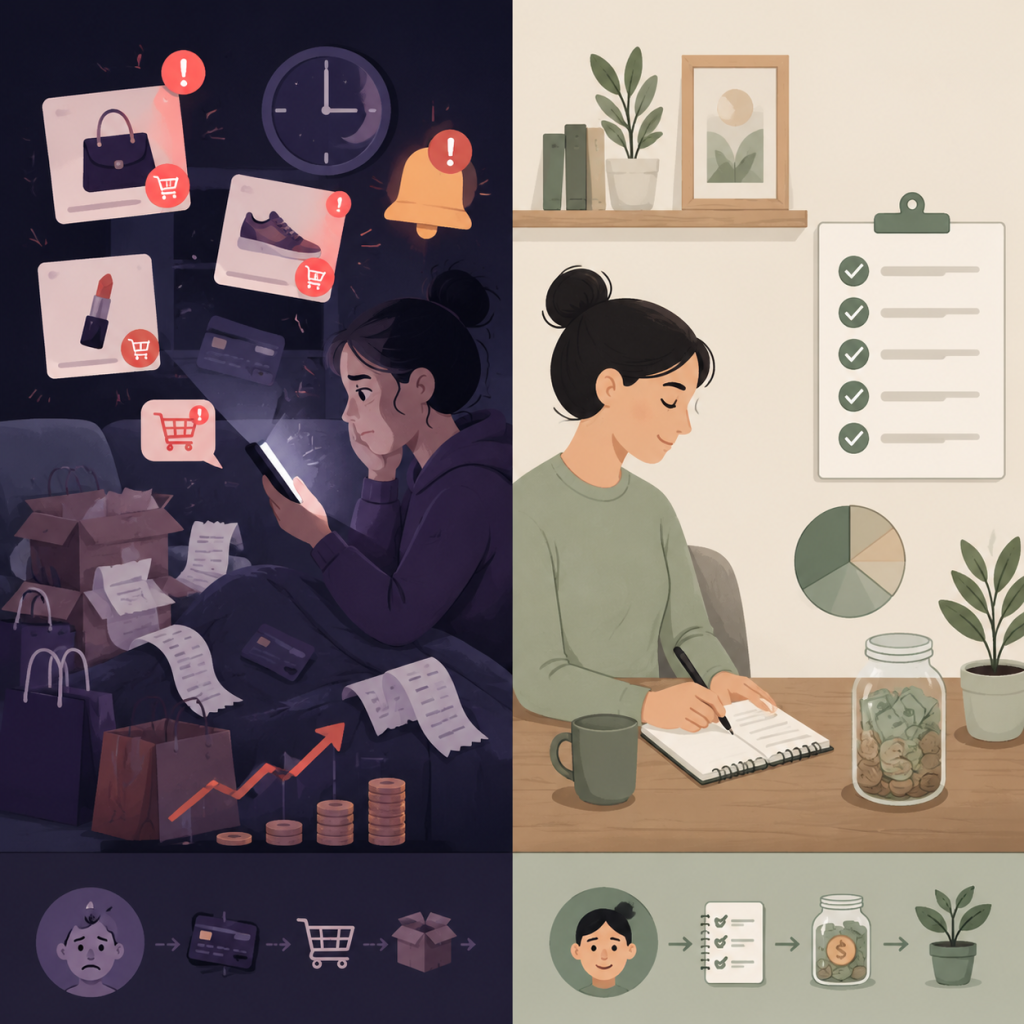
Let’s imagine two people.
Both feel stressed about the economy.
Person A doom spends:
- random gadgets
- frequent delivery food
- constant online shopping
Person B recognizes the pattern.
They create a small rule:
Every impulse purchase waits 24 hours.
After a few months, something interesting happens.
Person A feels increasingly financially stressed.
Person B feels calmer and more in control.
The difference wasn’t income.
It was awareness.
Frequently Asked Questions (FAQ)
Is doom spending the same as impulse buying?
Not exactly.
Impulse buying is spontaneous.
Doom spending is driven by stress, anxiety, and uncertainty about the future.
Why has doom spending become so common?
Modern life exposes people to constant negative information through news and social media.
This increases stress and emotional spending behavior.
Is doom spending always bad?
Occasional emotional spending is normal.
It becomes a problem when it becomes a primary coping mechanism.
Can budgeting alone stop doom spending?
Usually not.
Because doom spending is emotional, not mathematical.
Behavioral strategies work better.
What is the fastest way to stop doom spending?
The simplest effective strategy is combining:
- the 24‑hour pause rule
- removing one‑click purchasing
- awareness of emotional triggers
Final Thoughts: You’re Already Ahead of Most People
Most people never realize they’re doom spending.
They assume they simply “lack discipline”.
But now you know something important.
Doom spending isn’t about weakness.
It’s about how humans react to uncertainty.
And once you recognize the pattern, you can interrupt it.
You don’t need perfect budgeting.
You don’t need extreme frugality.
You just need awareness and a few simple systems.
And honestly?
The moment you recognize doom spending for what it is…
You’re already ahead of millions of people still stuck in the cycle.
The next time you feel the urge to buy something after a stressful day, pause for a moment.
Ask yourself:
“Is this something I truly want… or just a reaction to the chaos around me?”
That small question can quietly change your financial future.