
Author: Peiman Daneshgar
Email: daneshgar781@gmail.com
Table of contents
- 1. Is Saving $1,000 in a Month Realistic?
- 2. The Math Behind the Sprint
- 3. Step 1: The Radical Financial Audit
- 4. Step 2: The “Essentials Only” Month
- 5. Step 3: Generating Quick Cash (The Income Injection)
- 6. Step 4: Removing Friction from Spending
- 7. Step 5: Managing the Psychological Struggle
- 8. Avoiding the “Bounce Back” Trap
- 9. Frequently Asked Questions
- 10. Final Thoughts
1. Is Saving $1,000 in a Month Realistic?
Saving $1,000 in 30 days is a significant challenge, but for many households, it is entirely possible with a dedicated “sprint” mindset.
It is important to distinguish this from long-term financial planning. A one-month savings sprint is not about sustainable lifestyle changes; it is about extreme focus, short-term sacrifice, and a massive behavioral reset.
If your budget is already stretched to the limit, this goal may require increasing income rather than just cutting expenses. However, for those with “hidden” spending habits, this 30-day challenge acts as a powerful wake-up call.
2. The Math Behind the Sprint
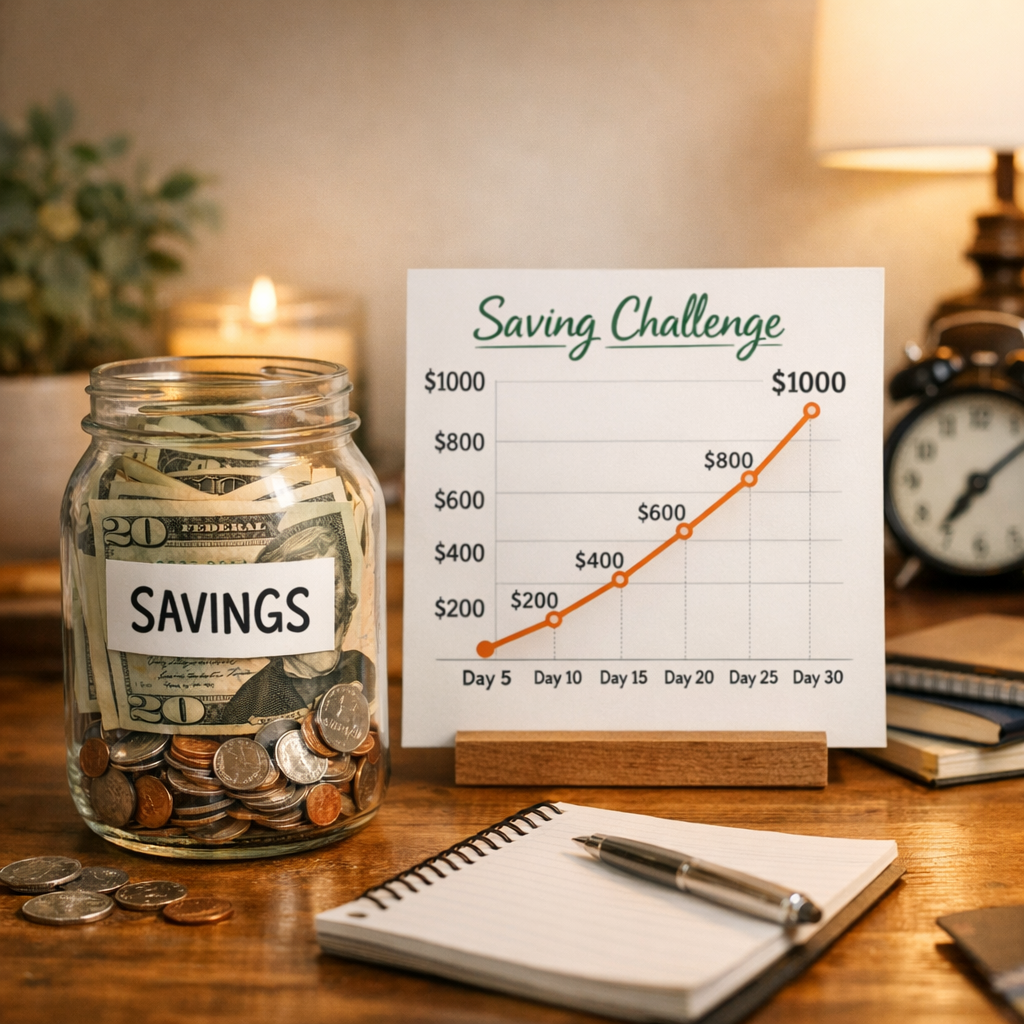
Breaking a large goal into daily targets makes it feel manageable.
To reach $1,000 in 30 days, you need to save:
$$\frac{\$1,000}{30 \text{ days}} \approx \$33.33 \text{ per day}$$
This is the target. Every dollar you cut from your spending or earn in extra income brings you closer to that ~$33 daily milestone. By tracking this daily, you create a feedback loop that encourages persistence.

3. Step 1: The Radical Financial Audit
Before you can save, you must see exactly where your money is flowing.
- Print or Export Your Bank Statements: Go through the last 30 days line by line.
- Categorize “Need” vs. “Want”: Be brutally honest. If you didn’t need it to survive or maintain your job, it’s a “want.”
- Identify the “Vampire Expenses”: These are recurring subscriptions (streaming services, gym memberships you don’t use, unused apps) that silently drain your account. Cancel them immediately for the next 30 days.
- Saving Loose Change Habit
4. Step 2: The “Essentials Only” Month
To hit your $1,000 goal, you need to enter “survival mode” for one month. This involves aggressive cost-cutting in non-essential areas:
- Dining Out: This is usually the easiest place to find $200–$400 in savings. Prepare every meal at home for 30 days.
- Groceries: Shop with a strict list. Stick to generic brands and avoid high-cost, pre-packaged foods.
- Entertainment: Pause all premium subscriptions. Utilize free local activities, libraries, or free streaming options.
- Utility Usage: Lower the thermostat, be mindful of electricity use, and skip “extra” convenience services.
- No Spend Month Rules
5. Step 3: Generating Quick Cash (The Income Injection)
If cutting expenses isn’t enough to reach $1,000, you must generate income. This is the fastest way to bridge the gap.
- Sell Underutilized Assets: Look through your closet, garage, or storage. Electronics, old clothing, furniture, or books can often be sold on platforms like Facebook Marketplace, eBay, or Poshmark. You can often make $200–$500 in a weekend.
- Gig Work: Use apps like TaskRabbit, Uber, DoorDash, or local freelance platforms. A few hours of extra work per week can comfortably cover your daily $33 requirement.
- Overtime: If your job allows, request extra hours. This is often the most efficient way to generate “guaranteed” extra income.
- Digital Envelope Saving System
6. Step 4: Removing Friction from Spending
The easier it is to spend money, the more you will spend. During this 30-day sprint, you need to make spending difficult.
- Delete Saved Cards: Remove credit card information from Amazon, food delivery apps, and any browser autofill settings. The act of having to manually type in a card number creates a “pause” that allows you to reconsider the purchase.
- The 72-Hour Rule: If you see something you want to buy, force yourself to wait 72 hours. In almost every case, the initial urge to buy will fade.
- Unsubscribe from Marketing Emails: Retailers use “flash sales” to trigger impulsive buying. Unsubscribing removes the temptation from your inbox.
- Round‑Up Savings Apps
7. Step 5: Managing the Psychological Struggle
A 30-day sprint is mentally exhausting. You will feel “deprivation” or “FOMO” (Fear Of Missing Out).
- Visualize the Goal: Keep a physical tracker visible in your home. Coloring in a progress chart provides visual reinforcement.
- Focus on the “Why”: Remind yourself that this is only for 30 days. This isn’t your life forever; it is a temporary, high-intensity exercise.
- Find Free Rewards: Celebrate milestones with things that don’t cost money, like a long hike, visiting a friend, or an evening of movies at home.
- Emergency Fund Habit Guide
8. Avoiding the “Bounce Back” Trap
The biggest danger after a successful month is the “rebound effect.” Once you hit your $1,000 goal, you might feel entitled to splurge as a reward.
Do not do this.
- Treat the Money as Sacred: Move the $1,000 into a separate savings account (like an Emergency Fund or Debt Pay-off account) the moment you accumulate it.
- Analyze Your Learnings: Which cuts were actually easy? Keep those changes permanent. Which ones made you miserable? Find a middle ground.
- Build the Habit: Use the momentum of this month to set up permanent automation for your savings.
- Pay Yourself First Method
9. Frequently Asked Questions
What if I don’t hit exactly $1,000?
That is perfectly fine. The goal is the habit and the progress. If you save $700, you are still $700 ahead of where you were before.
Is this sustainable long-term?
Generally, no. Trying to live in “sprint” mode indefinitely can lead to burnout. Use this to jumpstart savings, then transition to a sustainable, long-term budget.
What is the most common reason people fail?
Lack of preparation. If you don’t have a plan for your meals or a way to handle temptation, you will default to old, expensive habits.
10. Final Thoughts
Saving $1,000 in a month is not just about the money; it is about proving to yourself that you have control over your finances. By auditing your expenses, trimming the fat, and finding ways to boost your income, you demonstrate that your bank balance is a result of your choices—not just your income.
Use this month as a testing ground to see how much “room” actually exists in your budget. Once you realize how much you can save in 30 days, you will never look at your finances the same way again.