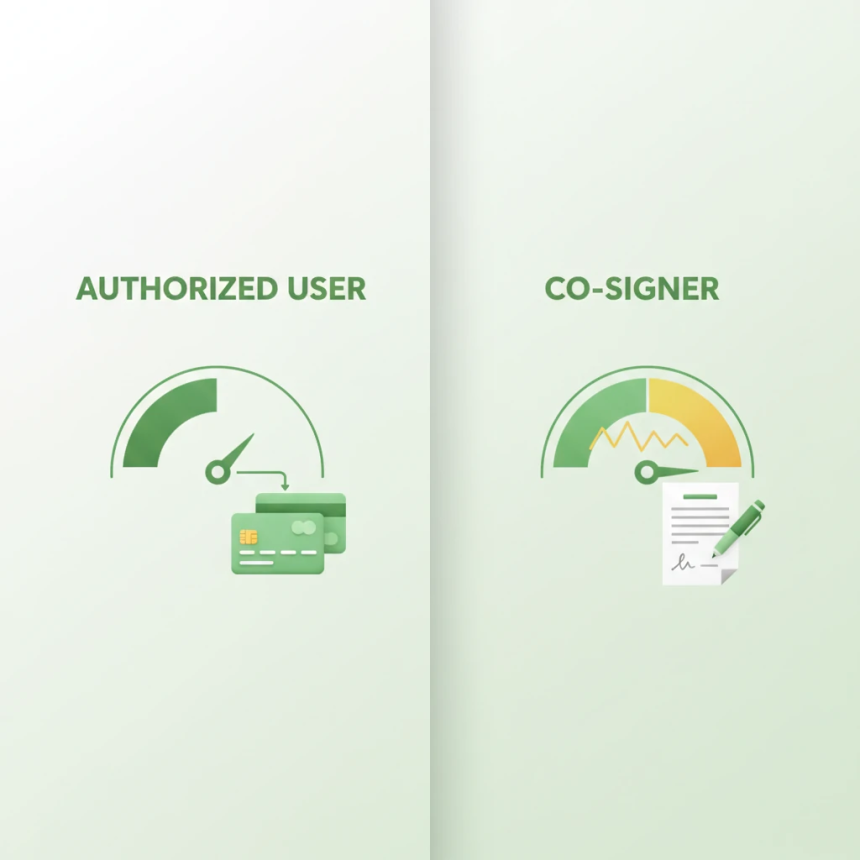
By: Peiman Daneshgar | Email: daneshgar781@gmail.com**
Published: February 19, 2026**
Table of Contents
- Authorized User vs Co-Signer: Which Helps Credit More? (The Surprising Answer)
- Introduction: The Awkward Conversation You’re About to Have
- What This Article Will Actually Give You
- Part 1: The Short Answer—It’s Complicated, But One Is Usually Better
- Part 2: What Is a Co-Signer? (The Legal Promise)
- Part 3: What Is an Authorized User? (The Piggyback Ride)
- Part 4: The Side-by-Side Comparison (Who’s Responsible for What)
- Part 5: Which One Actually Helps Credit More?
- Part 6: The Problem—Hardly Anyone Allows Co-Signers Anymore
- Part 7: The Risks Nobody Talks About
- Part 8: How to Make Either Strategy Work
- Part 9: Alternatives to Both (When You Can’t Find Help)
- Frequently Asked Questions
- The Emotional Bottom Line
Introduction: The Awkward Conversation You’re About to Have
I know that feeling.
You’re sitting across from someone you love—maybe your parent, your sibling, your best friend—and you’re about to ask them for help. Not just any help. Financial help. The kind that involves their credit score, their reputation, their money.
You’ve been rehearsing this conversation in your head for days. You’ve tried to figure out a way to do it yourself. You’ve applied for cards and gotten denied. You’ve tried to build credit on your own, but without a history, nobody will give you a chance.
So here you are, about to ask: “Will you co-sign for me?” Or maybe: “Can you add me as an authorized user?”
And you’re not even sure which one to ask for. You’ve heard both terms thrown around. You know they both involve someone else helping you with credit. But what’s the difference? Which one is better? Which one is safer for them? Which one will actually help your credit more?
Sound familiar?
You’re not alone. Millions of people have been exactly where you are right now—stuck between needing help and not knowing how to ask for it the right way.
how to talk to creditors when you can’t pay
🧠 Quick Reality Check:
Before you have that conversation, you need to know the facts. Because here’s the thing: one of these options barely exists anymore. And the other one can either rocket your credit into the stratosphere or crash it into the ground—depending entirely on who you’re connected to.
What This Article Will Actually Give You
Here’s the deal. Most articles will give you a basic definition of each term and leave you to figure it out.
This one is different.
By the time you finish reading, you’ll know:
- The exact difference between a co-signer and an authorized user—who’s responsible for what, who gets the card, who’s on the hook .
- Which one helps your credit more (with real data from a LendingTree study of 5,000 people) .
- The shocking truth that most major banks don’t even allow co-signers anymore .
- The “utilization trap” that can actually lower your score if you pick the wrong person to help you .
- How to ask for help without destroying your relationship or your credit .
This is the playbook. Let’s run it.
government programs for medical debt relief
Part 1: The Short Answer—It’s Complicated, But One Is Usually Better
If you’re in a hurry, here’s the short version:
For most people trying to build credit, becoming an authorized user is the better option—if you choose the right person.
Here’s why:
- Authorized users get the benefit of the primary account holder’s credit history without being legally responsible for the debt .
- Most credit card issuers allow authorized users, while very few allow traditional co-signers anymore .
- A LendingTree study found that being an authorized user can backfire badly if the primary account holder has high credit utilization .
- how to use a balance transfer card wisely
Co-signing is a different beast. It’s a legal promise to repay a debt if the primary borrower doesn’t . It appears on the co-signer’s credit report and affects their score just as much as the borrower’s . But here’s the kicker: you can barely find a credit card that allows co-signers anymore.
So practically speaking? Authorized user is usually the way to go. But you need to do it right.
Part 2: What Is a Co-Signer? (The Legal Promise)
Let’s start with the term that sounds scarier—because it is.
The Co-Signer’s Role
A co-signer is someone who agrees to be legally responsible for repaying a debt if the primary borrower doesn’t pay . Think of them as a financial guarantor. They’re saying to the lender: “If this person defaults, I’ll cover it.”
Here’s what makes co-signing unique:
- The co-signer typically does not get a physical card or access to the account .
- The co-signer cannot make purchases or manage the account .
- But the co-signer’s credit is fully on the line .
When you apply for a credit card with a co-signer, the lender checks both applicants’ credit. The co-signer’s good credit helps offset the primary borrower’s bad or nonexistent credit .
When You Need a Co-Signer
People typically seek co-signers when :
- They have no credit history (young adults, recent immigrants)
- They have bad credit from past mistakes
- They have low income that doesn’t meet lender requirements
- They’re applying for a large loan that requires stronger backing
The Brutal Truth About Co-Signing
Here’s what nobody tells you: Co-signing is a terrible deal for the co-signer .
Debt and bankruptcy lawyer Ashley Morgan puts it bluntly: “When you co-sign a debt, you are responsible for all the payments in the beginning. This means if the account is charged or in collections, a creditor can collect the full amount from you” .
And if the primary borrower files for bankruptcy? “You’re still responsible for the debt,” Morgan warns. “The original borrower can discharge their obligation on the debt, but yours remains unless you also file for bankruptcy” .
Oh, and removing yourself as a co-signer later? “It typically requires refinancing the full debt” . So you’re stuck until the loan is paid off or refinanced.
Strategies to Pay Off $30,000 in Student Loans

🤔 Pause and Think:
If you’re thinking about asking someone to co-sign for you, ask yourself: Would you take on this much risk for them? Because that’s what you’re asking them to do.
Part 3: What Is an Authorized User? (The Piggyback Ride)
Now let’s look at the other option.
The Authorized User’s Role
An authorized user is someone who gets added to an existing credit card account by the primary cardholder . They get their own physical card with their name on it, and they can make purchases .
But here’s the key difference: Authorized users are NOT legally responsible for paying back the debt . The primary account holder agrees to repay every dollar charged by the authorized user, including interest and fees .
This is the “piggyback ride.” The authorized user gets to use the card and build credit, but the primary holder carries all the legal weight.
When Authorized User Makes Sense
People become authorized users for several reasons :
- Parents adding children to help them build credit from a young age
- Spouses sharing accounts to streamline finances and earn rewards together
- Someone with no credit trying to establish a history without taking on debt
- Someone rebuilding credit after past mistakes
- does debt settlement hurt your credit score?
The Fine Print
Most credit card issuers report authorized user activity to the credit bureaus . That means the entire account history—including how responsibly the primary holder manages it—can appear on the authorized user’s credit report .
But not all issuers report the same way. Experian, for example, says it does not report late payments on authorized users’ reports, while Equifax and TransUnion may report both positive and negative items .
And here’s something important: The primary cardholder can remove an authorized user at any time . So if things go sideways, the plug can be pulled.
Part 4: The Side-by-Side Comparison (Who’s Responsible for What)
Let’s put these side by side so you can see the difference clearly.
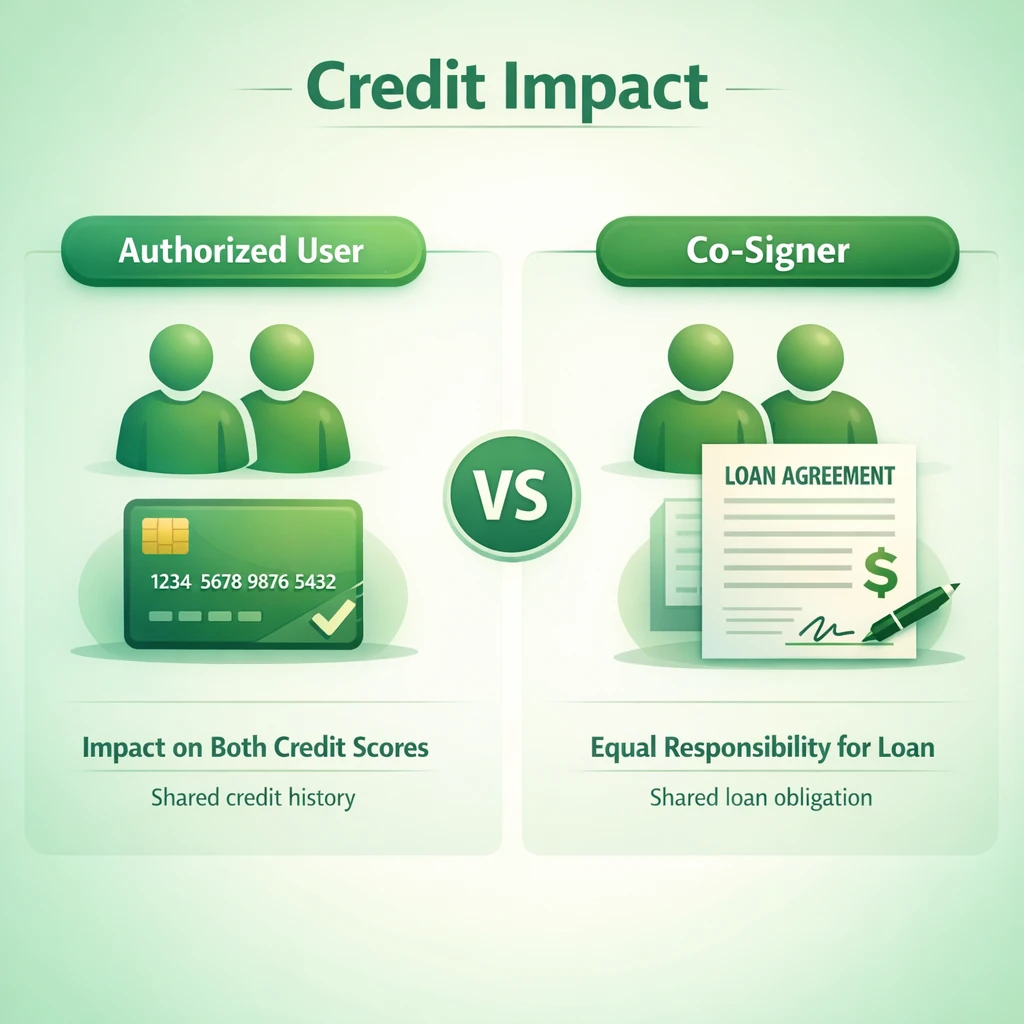
| Factor | Co-Signer | Authorized User |
|---|---|---|
| Who’s responsible for repayment? | The co-signer is legally responsible if the primary borrower doesn’t pay | The primary cardholder is 100% responsible. Authorized user has NO legal obligation |
| Do they get a physical card? | Generally no. Co-signers usually don’t get cards or account access | Yes. Authorized users get their own card with their name on it |
| Can they make purchases? | No. Co-signers typically cannot use the account | Yes. That’s the whole point—they can spend |
| Does it affect their credit? | Yes. The account appears on the co-signer’s report and affects their score | Yes. Most issuers report authorized user activity to credit bureaus |
| Can they be removed? | Not easily. Usually requires refinancing or paying off the debt | Yes. Primary holder can remove them anytime |
| Do most card issuers allow this? | Very few. Co-signers are rare in credit cards now | Yes. Most major issuers allow authorized users |
| Best for… | Helping someone qualify for a loan when they can’t get approved alone | Helping someone build credit while giving them spending access |
Part 5: Which One Actually Helps Credit More?
Now for the million-dollar question.
The Case for Authorized User
Becoming an authorized user can be incredibly powerful for building credit. Why? Because you get the benefit of the primary account holder’s entire credit history .
If your mom has a credit card she’s paid perfectly for 20 years, and she adds you as an authorized user, that 20-year history can appear on your credit report . You go from having no credit to having two decades of perfect payment history. That’s the “rocket fuel” effect.
Matt Schulz, LendingTree’s chief credit analyst, saw this firsthand: “My son had a VantageScore of 774 about two months after his 18th birthday, primarily because he was added as an authorized user on one of my wife’s credit cards when he was younger” .
That’s a score most adults would kill for, achieved by a teenager who never made a single payment.
how to get out of payday loan debt fast
The Case for Co-Signer
Co-signing can also help build credit—for the primary borrower. When you’re the one making payments on a co-signed loan or card, those on-time payments get reported to the credit bureaus . Over time, that builds your own credit history.
The difference is that you’re actually responsible for the payments. You’re not just riding someone else’s history—you’re creating your own.
For someone with bad credit who needs a loan (not just a credit card), a co-signer might be the only way to get approved . And successfully repaying that loan can be a powerful step toward rebuilding.
The LendingTree Study That Changes Everything
Here’s where it gets complicated.
LendingTree analyzed about 5,000 people with “near-prime” credit scores (620-659) who were added as authorized users . What they found should make you pause:
Three months after being added, the average authorized user’s score dropped 18 points—from 639 to 621 .
Wait, what? How can something that’s supposed to help actually hurt?
best debt consolidation loans for good credit 2024
The Utilization Trap
The answer is utilization—how much of the available credit is being used .
Among authorized users whose score dropped, the average utilization on the card they were added to was a whopping 52.6% —way above the recommended 30% .
Among those whose score improved, the average utilization was just 29.2% .
The difference was dramatic:
- Those whose utilization went up after three months saw their score plunge 34 points on average .
- Those whose utilization went down saw their score rise slightly—about 3 points .
The takeaway? Whom you align yourself with matters massively . If the primary account holder carries high balances, their bad habits become your bad habits on paper.
how to negotiate lower credit card interest rates
The Rocket Fuel Effect
But if you choose wisely? Being an authorized user can be “rocket fuel” . Schulz’s son hit a 774 score at 18 because his mom had an 800+ score and perfect payment history .
So the answer to “which helps more” depends entirely on who’s helping you.
Part 6: The Problem—Hardly Anyone Allows Co-Signers Anymore
Here’s the practical reality that might make this whole debate irrelevant.
The Co-Signer Extinction Event
Most major credit card issuers no longer allow co-signers .
Bankrate notes that “few cards and card issuers actually allow this option” . SoFi agrees: “Many credit cards have changed policies and no longer allow you to apply with a cosigner” .
If you’re trying to get a credit card with a co-signer, you’re going to have a hard time finding one that says yes.
The Apple Card Exception
There are a few exceptions. The Apple Card offers “Apple Card Family,” which allows joint accounts . Some Bank of America and U.S. Bank cards may allow co-signers or co-applicants, but you usually have to call and ask—it’s not a standard online option .
For most people, though, the co-signer route for credit cards is essentially closed.
snowball vs avalanche method calculator
Alternatives That Actually Exist
If you can’t find a co-signer, what are your options?
- Become an authorized user (the option that actually exists)
- Get a secured credit card (put down a deposit, get a card, build credit)
- Get a student credit card (if you’re in school)
- Apply for a joint credit card (rare, but some issuers offer it)
For loans—mortgages, auto loans, personal loans—co-signers are still very much a thing . So if you’re trying to borrow money, not just get a credit card, co-signers are still relevant.
Part 7: The Risks Nobody Talks About
Both options come with risks. Let’s be real about them.
Risks for the Co-Signer
If you’re thinking about co-signing for someone, understand what you’re getting into :
- You’re responsible for the entire debt. If the borrower stops paying, the lender comes after you—immediately, not just as a last resort .
- Your credit takes the hit. Late payments, defaults, collections—all of it goes on your report .
- Your debt-to-income ratio increases. That can affect your ability to get your own loans for houses, cars, etc. .
- Bankruptcy won’t save you. If the borrower files bankruptcy, you’re still on the hook .
- You can’t easily remove yourself. You’re stuck until the debt is paid or refinanced .
Risks for the Authorized User
Being an authorized user seems safer—and financially, it is, because you’re not liable for the debt. But there are still risks :
- The primary holder’s bad habits hurt you. If they carry high balances or miss payments, your score can drop .
- You can be removed anytime. If the relationship sours, you lose that credit history .
- You might not build as much credit as you think. Some issuers report differently, and not all positive history transfers perfectly.
- investment mistakes to avoid in your 20s
Risks for the Primary Account Holder
If you’re adding someone as an authorized user, you’re taking a risk too :
- You’re responsible for their spending. Every dollar they charge is your debt .
- They can wreck your utilization. A few big purchases can spike your balance and hurt your score .
- You might damage the relationship. Money problems strain even the closest bonds .
Real Stories: When It All Goes Wrong
Bankrate shared stories that illustrate these risks perfectly :
Jasmine Charbonier added her cousin during COVID to help him out. Three months in, she started seeing charges at bars and gaming stores. Six months later, her credit score had dropped 85 points, and her cousin had maxed out the card twice. The final straw: a $1,000 charge at GameStop without asking. She removed him, but she was stuck with nearly $5,000 in debt .
Dean Rotchin added his college-aged sister as an authorized user to help her build credit. Two years later, he found a $3,200 Nordstrom spree on his statement—completely outside their agreement. When he removed her, her score dropped 30 points .
These aren’t rare horror stories. They’re what happens when boundaries aren’t set.
📊 The Numbers Don’t Lie
Scenario Score Impact Authorized user on card with low utilization (29%) Slight increase (+3 pts avg) Authorized user on card with high utilization (53%) Major decrease (-34 pts avg) Co-signer when borrower pays late Significant drop (varies) Co-signer when borrower defaults Severe damage, possible collections
Part 8: How to Make Either Strategy Work
If you’re going to do this—and millions of people do successfully—here’s how to set it up for success.
If You’re the Helper (Co-Signer or Primary Account Holder)
For co-signers:
- Only co-sign if you can afford to pay the debt yourself . Because you might have to.
- Get all agreements in writing. Even with family, write down expectations .
- Monitor the account. Don’t just trust—verify that payments are being made .
- Have an exit plan. Know how and when you can get off the loan .
For primary holders adding authorized users:
- Set clear boundaries before adding them . What can they use the card for? What’s the spending limit? Who pays the bill?
- Use issuer tools. Many cards let you set spending limits for authorized users and get alerts for each purchase .
- Check statements monthly. Don’t wait for surprises .
- Have a “three strikes” rule or clear consequences for misuse .
- Know you can remove them anytime—and be willing to do it if necessary .
If You’re the Person Getting Help
For authorized users:
- Choose wisely. Look for someone with excellent credit (750+), low utilization (under 30%), and perfect payment history .
- Ask about their habits. Before they add you, ask: Do you carry balances? Have you ever missed a payment?
- Understand the card’s utilization. The LendingTree study shows that cards with utilization under 30% tend to help; over 50% tend to hurt .
- Don’t abuse the privilege. This person is trusting you with their credit. Treat it like gold .
- Monitor your own credit. Make sure the account is being reported and that it’s helping, not hurting .
For co-signers (the borrower):
- Understand what you’re asking. This person is putting their financial future on the line for you .
- Make every payment on time. Their credit is at stake, not just yours .
- Communicate if you’re struggling. Don’t let them find out when the bank calls .
- Refinance to remove them as soon as you can. That should be the goal .
Part 9: Alternatives to Both (When You Can’t Find Help)
What if you don’t have someone who can co-sign or add you as an authorized user? You’re not out of options.
Secured credit cards: Put down a deposit (usually $200-$500), get a card with that limit, use it responsibly, and graduate to an unsecured card in 6-12 months . This is the most reliable way to build credit on your own.
Credit-builder loans: Services like Self offer loans where you make payments first, then get the money later. The payments are reported to credit bureaus, building your history .
Student credit cards: If you’re in school, these are designed for people with limited history .
Store credit cards: Often easier to get than major bank cards, though they have higher interest rates and lower limits.
Experian Boost: Get credit for utility and phone bills you’re already paying .
Frequently Asked Questions
Q: Does being an authorized user build credit?
A: Yes, if the primary cardholder uses the card responsibly—pays on time, keeps balances low. But it can hurt your credit if they don’t .
Q: Can a co-signer be removed from a credit card?
A: It’s difficult. Usually requires refinancing the debt or paying it off. The primary borrower would need to qualify on their own .
Q: Which is safer for the person helping—co-signer or authorized user?
A: Authorized user is safer because they’re not legally liable for the debt. A co-signer can be sued and have their credit destroyed if the borrower defaults .
Q: Do most credit cards allow co-signers?
A: No. Very few major issuers allow traditional co-signers anymore .
Q: How much can being an authorized user raise your credit score?
A: It varies wildly. Some people see jumps of 50-100 points. Others see drops. It depends entirely on the primary account holder’s habits .
Q: Will removing an authorized user hurt their credit?
A: Yes, typically. When the account is removed from their report, they lose that credit history, which can drop their score .
Q: Can I be an authorized user without the card?
A: Yes. Some people add authorized users just for credit-building purposes and never give them the physical card .
Q: What credit score do you need to be a co-signer?
A: Lenders typically look for scores of 620-680 at minimum, with higher being better .
Q: Does adding an authorized user hurt the primary holder’s credit?
A: No. Simply adding someone doesn’t affect your score. What affects it is their spending if they run up balances .
Q: Can an authorized user be removed for bad behavior?
A: Yes. The primary cardholder can remove them at any time .
The Emotional Bottom Line
Look, I’m not going to pretend that asking for financial help is easy.
It’s vulnerable. It’s scary. And it puts relationships on the line in ways that money always does.
But here’s the truth: Most of us got help from someone. A parent who co-signed a first apartment. A spouse who added us to their card. A friend who vouched for us when we had nothing.
The key is to go into it with your eyes open.
If you’re the one asking: Be honest about your situation. Be clear about what you need. And respect the risk that person is taking for you.
If you’re the one helping: Set boundaries. Monitor the account. And be willing to say no if it doesn’t feel right.
And if you’re trying to decide which path to take? Authorized user is usually the better bet—if you can find someone with excellent credit and low balances. Co-signing still exists for loans, but for credit cards, it’s practically a ghost.
Choose wisely. Communicate clearly. And remember that credit is just a tool—not a measure of your worth.
You’ve got this.