
By: Peiman Daneshgar | Email: daneshgar781@gmail.com**
Published: February 19, 2026**
Table of Contents
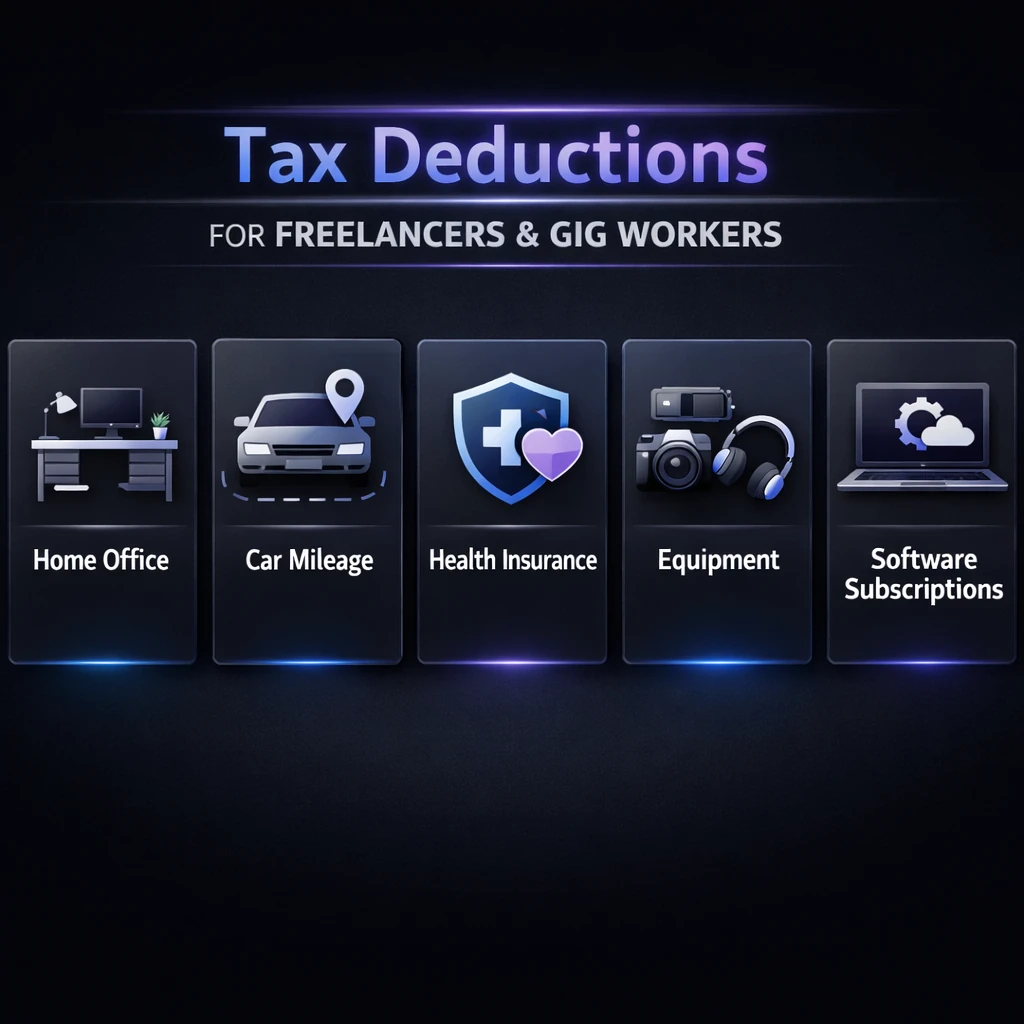
- Tax Deductions for Freelancers and Gig Workers (The Money You’re Leaving on the Table)
- Introduction: The April Nightmare
- What This Article Will Actually Give You
- Part 1: The Freelancer Tax Problem in One Sentence
- Part 2: The Big New Change for 2026 (That Could Save You Thousands)
- Part 3: The “No Tax on Tips” Windfall (If You’re in the Right Gig)
- Part 4: The Home Office Deduction—Your Biggest Friend (and Potential Audit Flag)
- Part 5: Vehicle Expenses—Mileage vs. Actual Costs
- Part 6: The Stuff You’re Probably Forgetting
- Part 7: The Quarterly Tax Trap (And How Not to Get Crushed)
- Part 8: Tax Credits Nobody Tells You About
- Part 9: The “Separate Accounts” Rule That Could Save Your Audit
- Frequently Asked Questions
- The Emotional Bottom Line
Introduction: The April Nightmare
I know that feeling.
It’s mid-April. You’ve been putting it off for weeks, maybe months. Every time you think about doing your taxes, your brain just… nopes out. You open a folder. You see a pile of receipts. You see random PayPal statements. You see that one Venmo payment from a client that you’re not even sure counts as income.
And somewhere in the back of your mind, a voice whispers: “You’re probably paying way too much.”
You’re a freelancer. A gig worker. An independent contractor. You’re not an accountant. You didn’t sign up for this. You just wanted to do your work—write, design, drive, deliver, create—and get paid for it.
But now it’s tax time, and you’re staring at Schedule C like it’s written in ancient Greek. You know there are deductions out there. You know other freelancers pay less than you. But you don’t know what you don’t know.
Sound familiar?
You’re not alone. Millions of freelancers and gig workers overpay their taxes every year simply because they don’t know what they’re allowed to deduct. The tax code is 6,871 pages long. Nobody expects you to read it.
investment mistakes to avoid in your 20s
But here’s the thing: The IRS isn’t going to tell you what you’re missing.
🧠 Quick Reality Check:
The difference between a freelancer who does their taxes scared and a freelancer who does them smart can be thousands of dollars. That’s not an exaggeration. That’s real money that could be in your pocket instead of the government’s.
What This Article Will Actually Give You
Here’s the deal. Most tax articles are written by CPAs for other CPAs. They’re full of jargon, caveats, and footnotes that make your eyes glaze over.
This one is different.
By the time you finish reading, you’ll know:
- The huge new tax break that just kicked in for 2026 (the QBI deduction just got better) .
- Whether you qualify for the “no tax on tips” windfall (and how to claim it) .
- Exactly how to calculate your home office deduction without triggering an audit .
- The 12 deductions freelancers forget most often (including the one that saves me thousands every year) .
- How to pay quarterly taxes without messing up the math or missing deadlines .
- What records you actually need to keep (and what you can throw away) .
This is the playbook. Let’s run it.
How to Choose Your First Mutual Fund
Part 1: The Freelancer Tax Problem in One Sentence
Let me sum up your tax situation in one sentence:
You pay both the employee AND employer side of Social Security and Medicare taxes, which means your effective tax rate is higher than someone with a regular job.
That’s it. That’s the whole problem.
When you’re a W-2 employee, your employer pays half of your FICA taxes (Social Security and Medicare) and you pay the other half. It’s split 50-50.
When you’re self-employed, you pay both halves. That’s the self-employment tax, and it’s currently 15.3% on your net earnings up to the Social Security wage base .
That’s on top of your regular income tax.
So if you make $60,000 as a freelancer, you’re paying about $9,180 in self-employment tax alone before you even touch income tax. That stings.
The only way to fight back is deductions. Every dollar you deduct is a dollar you don’t pay 15.3% self-employment tax on, plus whatever your income tax bracket is.
Deductions aren’t just “nice to have.” They’re survival.
Is Investing in Cryptocurrency Safe for Beginners?
Part 2: The Big New Change for 2026 (That Could Save You Thousands)
Let’s start with the biggest news for this tax year.
What Is the QBI Deduction?
The Qualified Business Income (QBI) deduction (also called Section 199A) has been around since 2017. It lets eligible self-employed people deduct up to 20% of their business income from their taxes .
Think about that. If you make $50,000 from your freelance work, you could deduct $10,000 of it before calculating your tax. That’s not a deduction for expenses—that’s just a straight-up discount on your business income.
The 23% Bump
Here’s what’s new for 2026: The QBI deduction just increased from 20% to 23% .
The One Big Beautiful Bill Act made this change permanent starting in 2026 . So instead of deducting 20% of your business income, you can now deduct 23%.
For a freelancer making $60,000, that’s an extra $1,800 in deductions compared to last year .
Who Actually Benefits? (The Honest Answer)
Now for the reality check.
The QBI deduction is great, but it mostly benefits higher-income freelancers . Why? Because it’s a deduction, and deductions are worth more when you’re in a higher tax bracket.
A $1,000 deduction saves someone in the 37% bracket $370. It saves someone in the 12% bracket only $120 .
Also, the deduction phases out for certain “specified service trades or businesses” (SSTBs) like lawyers, doctors, and consultants once your income hits certain thresholds .
For 2026, the phase-out begins at:
- Single filers: $197,300 taxable income
- Married filing jointly: $394,600 taxable income
If you’re above those numbers, your deduction starts to shrink. If you’re below them, you’re in the clear.
🤔 Pause and Think:
If you made under $150,000 last year, you’re almost certainly getting the full 23% QBI deduction. That’s free money. Don’t leave it on the table.
Part 3: The “No Tax on Tips” Windfall (If You’re in the Right Gig)
Here’s another new one for 2026 that’s flown under the radar.
The One Big Beautiful Bill created a new deduction for tips . Yes, you read that right. Qualified tips received in 2025 and beyond can be deducted from your taxable income .
Who Qualifies? (The List Is Longer Than You Think)
The IRS has released a preliminary list of eligible occupations , and it’s not just restaurant workers:
Beverage & Food Service:
- Bartenders, wait staff, chefs, dishwashers, bakers, hosts
Entertainment & Events:
- Musicians, dancers, DJs, performers, digital content creators (streamers, influencers, podcasters)
Hospitality & Guest Services:
- Hotel clerks, concierges, maids, bellhops
Home Services:
- Electricians, plumbers, HVAC installers, landscapers, home cleaners
Personal Services:
- Tutors, nannies, pet caretakers, photographers, event planners
- best stocks for dividend income for beginners
Appearance & Wellness:
- Hairdressers, massage therapists, makeup artists, tattoo artists, fitness instructors
Recreation & Instruction:
- Golf caddies, tour guides, sports instructors
Transportation & Delivery:
- Uber and Lyft drivers, taxi drivers, valet attendants, delivery workers
Yes, gig economy workers like rideshare drivers and content creators are explicitly included .
The Fine Print
- Maximum annual deduction: $25,000
- The deduction phases out for single filers with modified AGI over $150,000 ($300,000 for joint filers)
- Tips must be reported on Form W-2, Form 1099, or Form 4137
- For self-employed workers, the deduction can’t exceed your net income from the business where you earned the tips
So if you’re a rideshare driver getting cash tips, a hairstylist with tip income, or a Twitch streamer with donations, this deduction is for you.
how to start investing with $100 or less
Part 4: The Home Office Deduction—Your Biggest Friend (and Potential Audit Flag)
The home office deduction is the heavyweight champion of freelancer tax breaks. But it’s also the most misunderstood and most feared.
The “Exclusive Use” Rule (No Cheating)
To qualify for the home office deduction, you need to use a portion of your home regularly and exclusively for business .
“Exclusively” means that space is ONLY for business. If you have a desk in your bedroom and you also use that room for sleeping, watching TV, and folding laundry, it doesn’t qualify—unless you can document specific times when it’s used exclusively .
“Regularly” means you use it consistently, not just occasionally .
Two Ways to Calculate It
Simplified Method :
- Deduct $5.50 per square foot of home office space
- Maximum 300 square feet
- Maximum deduction: $1,650
- No depreciation recapture when you sell your home
- No complex calculations
- best robo-advisors for beginners 2024 comparison
Actual Expense Method :
- Calculate what percentage of your home is used for business (office square footage ÷ total home square footage)
- Deduct that percentage of actual expenses: rent/mortgage interest, utilities, insurance, repairs, depreciation
- Requires detailed records and Form 8829
- Often yields a larger deduction, especially if you have high housing costs
What’s New for 2026
The standard rate increased from $5 to $5.50 per square foot for 2026 .
Also, the IRS is piloting a new digital receipt upload option for documentation, though it’s still in beta .
What You Can Actually Deduct
Under the actual expense method, you can deduct a percentage of :
- Rent (if you rent your home)
- Mortgage interest (if you own—principal payments aren’t deductible)
- Real estate taxes
- Utilities (electricity, gas, water, trash)
- Homeowners or renters insurance
- Repairs and maintenance (direct repairs to the office are 100% deductible; general home repairs are prorated)
- Depreciation (for homeowners—this gets complicated and affects your basis when you sell)
Form 8829: The Scary Form Explained
If you use the actual expense method, you’ll file Form 8829 with your Schedule C . It has four parts :
- Part I: Calculate your business use percentage
- Part II: Figure your allowable deduction (subject to income limits)
- Part III: Depreciation calculation
- Part IV: Carryover of unused expenses to future years
It’s not as scary as it looks. Tax software walks you through it.
ETF vs index fund: which is better for a beginner?
📊 Simplified vs. Actual Method
Factor Simplified Actual Expense Calculation $5.50/sq ft, max 300 sq ft Percentage of actual costs Paperwork Minimal Extensive (receipts, measurements) Form needed None (just enter on Schedule C) Form 8829 Best for Small spaces, renters Large spaces, high expenses Depreciation No Yes (but complicates future sale)
Part 5: Vehicle Expenses—Mileage vs. Actual Costs
If you use your car for business—deliveries, client meetings, supplies pickup—you have two ways to deduct it.
The Standard Mileage Rate (Easy Mode)
For 2025, the standard mileage rate was 70 cents per mile . For 2026, it will be adjusted (check IRS.gov in January).
You track every business mile you drive and multiply by the rate. That’s your deduction.
You need a log. Date, destination, business purpose, miles. Every trip. The IRS is strict about this.
The Actual Expense Method (Maximizer Mode)
You track all your car expenses for the year:
- Gas
- Oil changes
- Repairs
- Insurance
- Registration fees
- Tires
- Lease payments (if leased)
- Depreciation (if owned)
Then you calculate what percentage of your total miles were for business. That percentage of your expenses is deductible.
Example: You drove 10,000 total miles, 7,000 for business (70%). Your total car expenses were $5,000. You deduct $3,500.
The Rule You Cannot Break
You generally cannot switch methods for the same vehicle . Once you choose a method in the first year you use the car for business, you’re generally stuck with it. Pick wisely .
For most freelancers, the standard mileage rate is simpler and often more beneficial unless you have a very expensive car with high costs.
🚗 Pro Tip:
Apps like MileIQ, Stride, or Everlance can track your mileage automatically. The IRS accepts digital logs. Use one. Handwritten logs get lost.
Part 6: The Stuff You’re Probably Forgetting
Here’s where the real savings live—the deductions freelancers miss all the time.
Equipment and Software
- Section 179 deduction: You can deduct the full cost of qualifying equipment (computers, monitors, cameras, furniture) in the year you buy it, up to certain limits (over $1 million for 2025) .
- Bonus depreciation: For 2025, 40% bonus depreciation is available for qualifying property .
- Software subscriptions: Adobe Creative Cloud, Canva, QuickBooks, Zoom, Calendly—all deductible .
- Cell phone: If you use it for business, deduct the percentage of your bill that’s business-related .
Health Insurance Premiums
Self-employed health insurance premiums are deductible above-the-line (on Schedule 1, not Schedule C) . That means you don’t need to itemize to claim them.
You can deduct premiums for yourself, your spouse, and your dependents. The deduction is limited to your net self-employment income .
Retirement Contributions
This is the most powerful deduction most freelancers ignore.
- SEP IRA: Contribute up to 25% of your net self-employment income, max $69,000 for 2025
- Solo 401(k): Higher limits, allows both employee and employer contributions
- SIMPLE IRA: Good if you have employees
Every dollar you contribute reduces your taxable income and builds your retirement.
Education and Training
Courses, certifications, conferences, and workshops that maintain or improve skills in your current business are deductible .
The key: It has to relate to your current business, not a new career you’re pursuing on the side.
Meals (The 50% Rule)
Business meals with clients or prospects are 50% deductible .
Keep records: who you met with, the business purpose, where, when, and the amount.
Phone and Internet
If you have a dedicated business phone line, it’s 100% deductible. If you use your personal phone for business, deduct the percentage of usage that’s business-related .
Same for internet.
how to open a brokerage account for the first time
Bank and Payment Processing Fees
Monthly bank fees, credit card processing fees (Stripe, PayPal), and wire transfer fees are all deductible .
Startup Costs
If you’re just starting out, you can deduct up to $5,000 in startup costs (market research, legal fees, advertising) in your first year . The rest is amortized over 15 years .
The $5,000 deduction phases out if your total startup costs exceed $50,000 .

Part 7: The Quarterly Tax Trap (And How Not to Get Crushed)
Here’s the thing nobody tells you when you start freelancing: The IRS expects to be paid as you go.
Who Has to Pay?
You must make quarterly estimated tax payments if:
- You expect to owe at least $1,000 in taxes for the year
- And you didn’t have enough withheld from other income (like a W-2 job) to cover it
The Safe Harbor Rule (Your Get-Out-of-Penalty-Free Card)
You can avoid underpayment penalties if you pay either :
- 90% of your current year’s tax liability, OR
- 100% of your prior year’s tax liability (110% if your prior year AGI was over $150,000)
This is huge. If you’re not sure what you’ll make this year, just pay 100% of last year’s tax bill (split into four payments). You might overpay slightly, but you won’t get penalized.
what is dollar-cost averaging and how to set it up
2026 Quarterly Deadlines
| Quarter | Period | Due Date |
|---|---|---|
| Q1 | Jan 1 – March 31 | April 15, 2026 |
| Q2 | April 1 – May 31 | June 15, 2026 |
| Q3 | June 1 – Aug 31 | Sept 15, 2026 |
| Q4 | Sept 1 – Dec 31 | Jan 15, 2027 |
How to Pay
- IRS Direct Pay: Free from your bank account
- EFTPS: Electronic Federal Tax Payment System
- Credit/debit card: Through authorized processors (fees apply)
- Mail: With Form 1040-ES vouchers
Part 8: Tax Credits Nobody Tells You About
Deductions reduce your taxable income. Credits reduce your tax bill dollar-for-dollar. They’re better.
Retirement Plan Startup Credit
If you set up a new retirement plan (SEP, SIMPLE, 401(k)), you can claim a credit for startup costs . The SECURE Act enhanced this credit to potentially cover most of your administrative costs for the first few years.
Research and Development Credit (Yes, Really)
If you develop new products, processes, or software, you might qualify for the R&D credit . This includes sole proprietors. Use Form 6765.
Clean Energy and EV Credits
If you buy electric vehicles or charging equipment for your business, you may qualify for credits under Section 45W or Form 8911 .
Disabled Access Credit
If you make your business more accessible to disabled individuals (ramps, interpreters, adaptive equipment), you can claim a credit on Form 8826 .
Part 9: The “Separate Accounts” Rule That Could Save Your Audit
The IRS FAQ is crystal clear on this: Personal expenses paid from a business account are NOT deductible .
But here’s the real point: Mixing business and personal money is a disaster waiting to happen.
If you use the same bank account for everything, you’re making your life exponentially harder at tax time. You’ll spend hours (days?) sorting through transactions trying to figure out what’s business and what’s personal.
The fix: Get a separate bank account and credit card for your business. Run all business income and expenses through them. Never mix.
The IRS says: “It’s a good idea to keep separate business and personal accounts as this makes it easier to keep records” .
Do it. Today.
Frequently Asked Questions
Q: What’s the QBI deduction for 2026?
A: 23% of your qualified business income, up from 20% in previous years .
Q: Can I deduct my home office if I rent?
A: Yes. Rent is deductible under the actual expense method .
Q: What’s the mileage rate for 2026?
A: Not yet announced. 2025 was 70 cents per mile .
Q: Do I have to pay quarterly taxes in my first year?
A: Generally no, because you have no prior year tax liability to base safe harbor payments on. But you’ll owe when you file .
Q: What records do I need for the home office deduction?
A: Square footage measurements, photos of the space, and records of expenses (rent, utilities, etc.) .
Q: Can I deduct my health insurance premiums?
A: Yes, above-the-line on Schedule 1 .
Q: What’s the “no tax on tips” deduction?
A: A new deduction for qualified tip income, up to $25,000, available to many service and gig workers .
Q: Do gig workers qualify for the tip deduction?
A: Yes. Rideshare drivers, delivery workers, and digital content creators are explicitly included .
Q: Can I deduct my cell phone?
A: Yes, the business-use percentage .
Q: What’s the deadline for Q1 estimated taxes?
A: April 15, 2026 .
Q: Can I switch from standard mileage to actual expenses?
A: Generally not for the same vehicle. Choose wisely in year one .
The Emotional Bottom Line
Look, I’m not going to pretend that doing your taxes as a freelancer is fun.
It’s not. It’s stressful. It’s confusing. And it feels deeply unfair that you have to work harder than W-2 employees just to figure out what you owe.
But here’s the thing: The tax code is full of gifts for people like you. The QBI deduction. The home office deduction. The vehicle expenses. The retirement contributions. The IRS literally wrote rules that let you keep more of your money—if you know they exist.
The difference between a freelancer who pays an accountant $300 to do their taxes and a freelancer who does them scared is often thousands of dollars. Not because the accountant is magic. Because they know what to look for.
Now you know too.
Print this article. Bookmark it. Use it as your checklist when tax time comes. And if you’re not sure about something, pay a professional for an hour of their time. It’ll be the best money you spend all year.
You earned that money. Keep as much of it as the law allows.