
By: Peiman Daneshgar | Email: daneshgar781@gmail.com**
Published: February 21, 2026**
Table of Contents
- What to Do If You Can’t Pay Your Taxes on Time (Breathe—You Have Options)
- Introduction: The Envelope You’ve Been Dreading
- What This Article Will Actually Give You
- Part 1: The Worst Thing You Can Do Right Now (And What to Do Instead)
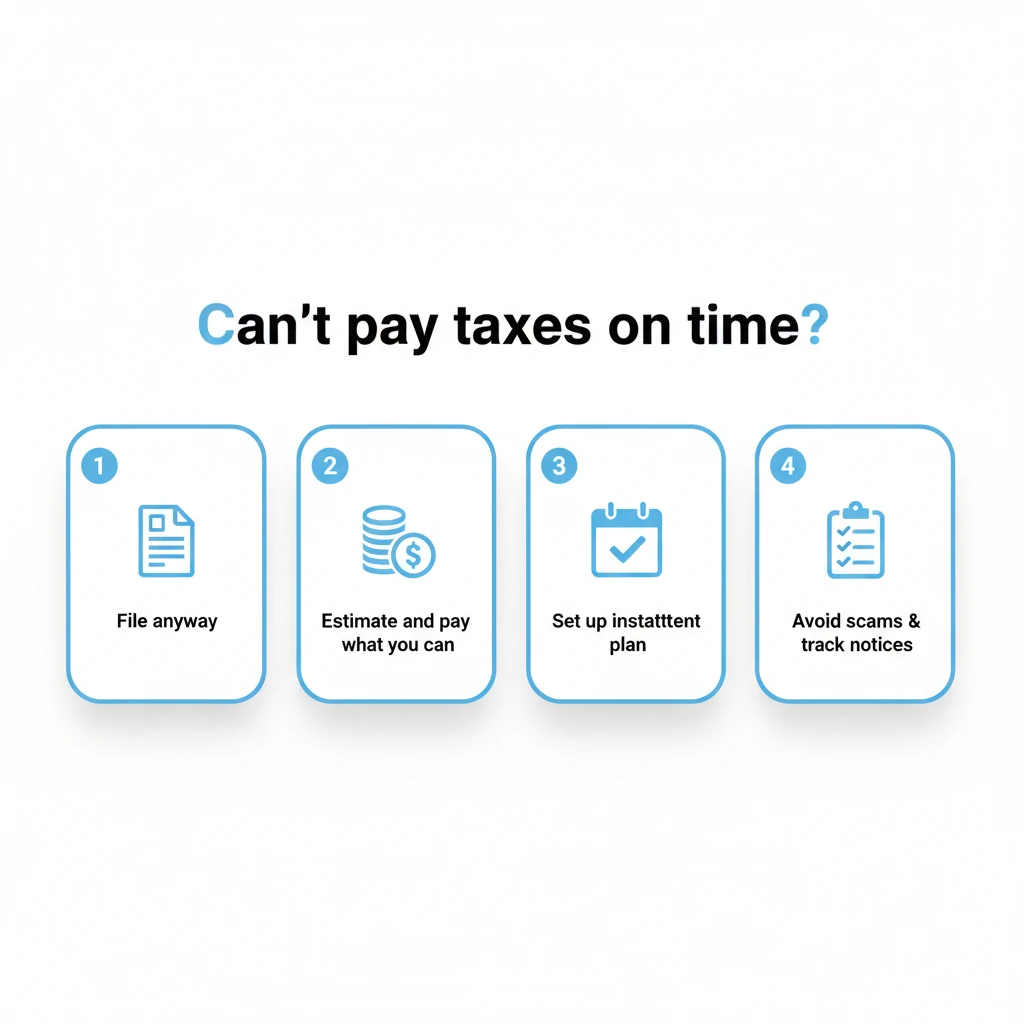
- Part 2: Step 1—File Anyway (Seriously, Just File)
- Part 3: Step 2—Pay Something, Anything
- Part 4: Step 3—The Payment Plan (Your New Best Friend)
- Part 5: Step 4—When Things Are Really Bad
- Part 6: Step 5—Can You Get the Penalties Removed?
- Part 7: What If You Just… Don’t Pay? (The Consequences)
- Part 8: How to Fix This So It Never Happens Again
- Frequently Asked Questions
- The Emotional Bottom Line
Introduction: The Envelope You’ve Been Dreading
I know that feeling.
You’re sorting through the mail—bills, junk, more bills—and then you see it. An envelope from the IRS. Or maybe from your state’s Department of Revenue. Your stomach drops. Your heart races. You’ve been avoiding this, hoping it would just… go away.
Or maybe it’s worse. Maybe you already know you owe. You did your taxes, saw the number, and just closed the browser. You couldn’t face it. You told yourself you’d deal with it later. But later is now, and Tax Day is approaching—or has already passed—and you have no idea what to do.
You’ve heard horror stories. Wage garnishment. Bank levies. Liens on your house. People going to prison (they don’t, but the fear is real). You’re paralyzed. You don’t know who to call or what to say. And every day you don’t act, the problem feels bigger.
Sound familiar?
You’re not alone. Millions of Americans find themselves in this exact spot every year. The tax code is complicated. Life happens. Jobs are lost. Businesses have bad years. Medical bills pile up. And suddenly, that tax bill feels impossible.
Here’s the thing the IRS doesn’t advertise: They have options for people exactly like you. Not “pay up or else.” Actual, real options designed to help you get back on your feet .
🧠 Quick Reality Check:
The IRS is not the mob. They’re not going to break your kneecaps. They’re a giant bureaucracy that wants its money, yes, but they also have programs for people who genuinely can’t pay. The key is to not ignore them. Ignoring is what gets you into real trouble.
What This Article Will Actually Give You
Here’s the deal. Most tax articles are written by CPAs for other CPAs. They’re full of jargon and forms numbers that make your eyes glaze over.
This one is different.
By the time you finish reading, you’ll know:
- The #1 thing you must do even if you can’t pay a dime (and why it’s non-negotiable) .
- Exactly how much it costs to pay late (the real math, with real numbers) .
- The four official IRS options for people who can’t pay—and which one fits your situation .
- How to get penalties removed (yes, it’s possible, and yes, you might qualify) .
- What happens if you do nothing (so you know what you’re avoiding) .
- Where to find help without getting scammed .
This is the playbook. Let’s run it.
can I deduct home office expenses in 2024?
Part 1: The Worst Thing You Can Do Right Now (And What to Do Instead)
Let’s start with the most important advice in this entire article:
DO NOT IGNORE THE IRS.
I know it’s tempting. I know it feels like if you just don’t think about it, maybe it’ll go away. It won’t. The IRS has a very long memory, and they have more resources than you do.
The Pile-Up Problem
Here’s what happens when you ignore a tax bill:
- Interest starts immediately. The rate for the first quarter of 2026 is 7% (federal short-term rate plus 3%), compounded daily .
- Penalties start immediately. The failure-to-pay penalty is 0.5% per month, up to 25% of your tax bill .
- Letters start arriving. First, a friendly reminder. Then a less friendly one. Then very unfriendly ones .
- Eventually, they take action. Wage garnishment, bank levies, property seizure .
The longer you wait, the worse it gets. But if you act now, you can stop the bleeding.
tax deductions for freelancers and gig workers
The IRS Timeline (So You Know What’s Coming)
| Timeframe | What Happens |
|---|---|
| Day after Tax Day | Interest and penalties begin accruing |
| 1-3 months | IRS sends notices (CP14, then more stern letters) |
| 3-6 months | Field calls begin; Notice of Federal Tax Lien may be filed |
| 6+ months | Final Notice of Intent to Levy; wage garnishment, bank levies possible |
🤔 Pause and Think:
If you’re reading this and you’ve already missed the deadline, you’re not doomed. You’re just in the “notices” phase. That’s still early. Act now.
Part 2: Step 1—File Anyway (Seriously, Just File)
This is the most critical step, and the one people mess up most often.
File your tax return by the deadline, even if you can’t pay what you owe .
The Filing Penalty vs. The Payment Penalty
Here’s why this matters:
- Failure-to-file penalty: 5% of your unpaid taxes per month, up to 25% .
- Failure-to-pay penalty: 0.5% of your unpaid taxes per month, up to 25% .
The filing penalty is 10 times higher than the payment penalty. If you don’t file, you’re making a bad situation dramatically worse.
So file. Even if you owe $10,000 and have $0 to pay it. File the return. You can deal with the payment later.
Extensions Don’t Help (Sorry)
An extension to file (Form 4868) gives you six more months to submit your paperwork. It does NOT give you more time to pay . Interest and penalties still start on Tax Day.
authorized user vs co-signer: which helps credit more?
📊 Penalty Comparison
Action Penalty Rate File on time, pay late 0.5% per month File late, pay late 5% per month + 0.5% per month The math is simple: file on time.
Part 3: Step 2—Pay Something, Anything
If you can’t pay the full amount, pay whatever you can by the deadline .
The Math of Paying Late
Let’s say you owe $5,000. If you pay $1,000 by Tax Day, you’re only accruing interest and penalties on the remaining $4,000. Every dollar you pay now saves you money in the long run.
The IRS doesn’t have a minimum payment requirement for this initial payment . If you can only afford $50, pay $50. It’s better than $0.
Where to Find the Money
- Sell stuff. Look around your house. What can you part with?
- Cut expenses temporarily. No restaurants, no subscriptions, no extras until this is handled.
- Pick up extra work. Gig jobs, overtime, side hustles.
- Borrow carefully. From family, from friends, from a low-interest credit card if you must. But be careful not to trade one debt problem for another.
Ramsey Solutions tells the story of David, who got hit with a $14,000 tax bill right before his first child was due. He sold his second car—which was paid off—and used the money to pay his taxes. Not fun, but better than years of debt .
how to get a free FICO score from your bank
Part 4: Step 3—The Payment Plan (Your New Best Friend)
If you can’t pay in full, the IRS wants to set up a payment plan. Seriously. They’d rather get their money over time than chase you forever.
Option A: Short-Term Payment Plan (120-180 Days)
Best for: People who can pay off the balance within a few months .
- Balance must be under $100,000 (tax, penalties, and interest combined)
- Up to 180 days to pay
- No setup fee
- No formal application required—just request it online or by phone
- Interest and penalties continue, but no further enforcement action
This is the easiest option. If you have a bonus coming, a tax refund from a previous year, or just need a few months to scrape together the cash, this is your move.
Option B: Long-Term Installment Agreement
Best for: People who need more than 6 months to pay .
Two flavors:
Streamlined Installment Agreement:
- Balance under $50,000 (for individuals)
- Pay in monthly installments over up to 72 months
- Setup fee: $22–$69 (lower if you use direct debit)
- No financial disclosure required (no Form 433-A)
- Can apply online; instant approval in most cases
- impact of credit card applications on your score
Non-Streamlined Agreement:
- Balance over $50,000 or special circumstances
- Requires Form 433-A (financial statement)
- More negotiation involved
Pro tip: Set up direct debit payments. It lowers your setup fee, reduces the chance of missed payments, and may help avoid a tax lien .
How to Apply
The fastest way is through the IRS’s Online Payment Agreement tool at IRS.gov . You’ll know immediately if you’re approved. No paperwork, no phone calls, no waiting.
You can also file Form 9465, Installment Agreement Request, with your tax return or by mail . But online is faster.
What About State Taxes?
Most states offer similar payment plans. Check with your state’s Department of Revenue website . The process is usually similar to the IRS.
💡 Pro Tip:
Even on a payment plan, interest and penalties keep accruing. So if you can pay extra each month, do it. The faster you pay, the less it costs you.
Part 5: Step 4—When Things Are Really Bad
If you genuinely cannot pay anything—not now, not in monthly installments—you have two more options.
Option C: Currently Not Collectible (CNC) Status
Best for: People with no disposable income after basic living expenses .
If you can prove to the IRS that paying would cause you to fall below basic living standards (food, rent, utilities, transportation), they may place your account in Currently Not Collectible status.
What it means:
- The IRS temporarily suspends collection activity
- No payments required
- No levies or garnishments
- Interest and penalties continue to accrue
- The 10-year collection statute keeps running
How to qualify:
- File Form 433-A, Collection Information Statement
- Document all income and expenses
- Show that your necessary living expenses leave nothing left for taxes
This isn’t forgiveness. The debt doesn’t go away. But it buys you time. If the collection statute expires while you’re in CNC status, you may never have to pay .
Option D: Offer in Compromise (The Long Shot)
Best for: People who can prove the IRS will never collect the full amount .
An Offer in Compromise (OIC) lets you settle your tax debt for less than you owe. It sounds amazing. It’s also incredibly hard to get.
The reality:
- Only about 24-33% of offers are accepted .
- The IRS looks at your income, expenses, and asset equity
- You must be current on all filings and payments
- There’s a $205 application fee (waived for low-income)
- You must submit a detailed financial statement (Form 433-A)
The formula: The IRS calculates your “reasonable collection potential” = (net equity in assets) + (disposable income × 12 or 24 months). If your offer is less than that, it will likely be rejected .
Who qualifies: People with very low income, few assets, and no realistic prospect of ever paying the full amount. If you have a house with equity or a decent job, you probably won’t qualify.
Before applying, use the IRS’s Offer in Compromise Pre-Qualifier tool online . It’ll tell you if you have a shot.
🧠 Reality Check:
Tax resolution companies love to advertise OICs. They make them sound easy. They’re not. If you’re considering this, talk to a real tax professional first.
Part 6: Step 5—Can You Get the Penalties Removed?
Here’s something the IRS doesn’t advertise: You might be able to get penalties removed .
First-Time Penalty Abatement (FTA)
This is the easiest path. If you have a clean record, you can get penalties waived for one tax year .
Requirements:
- You filed all required returns
- You paid (or arranged to pay) all taxes due
- You had no penalties in the prior three years
That’s it. No explanation needed. You don’t have to prove hardship. Just a clean history.
FTA covers:
- Failure-to-file penalty
- Failure-to-pay penalty
- Failure-to-deposit penalty (for businesses)
How to request: Call the IRS number on your notice and ask for First-Time Penalty Abatement. Or file Form 843. Most requests are approved quickly over the phone .
Reasonable Cause
If you don’t qualify for FTA, you can argue “reasonable cause”—meaning you had a good reason for not filing or paying on time .
Valid reasons:
- Serious illness or death in the immediate family
- Natural disaster destroying records
- Unavoidable absence (military deployment, etc.)
- Inability to obtain records despite good-faith effort
- Reliance on incorrect professional advice (tricky, but possible)
Documentation is everything. Hospital records, death certificates, insurance claims, emails to your accountant—prove your story.
Invalid reasons:
- Forgot the deadline
- Didn’t understand the law
- Didn’t have the money (alone—but can support other reasons)
If the penalty is abated, the associated interest is also removed .
what is a good credit score to buy a car?
What Doesn’t Work
The IRS hears every excuse. The ones that never work: “I forgot,” “I was busy,” “I didn’t know,” “My dog ate my return.” Don’t waste your time.
Part 7: What If You Just… Don’t Pay? (The Consequences)
Let’s talk about what happens if you do nothing. So you know what you’re avoiding.
The Notice Flood
First, the letters. CP14, CP501, CP503, CP504. Each one gets less friendly. Each one warns you of impending action .
The Lien
After a few months, the IRS may file a Notice of Federal Tax Lien. This is a public claim against your property—your house, your car, your bank accounts. It shows up on your credit report. It makes getting loans or even new jobs difficult .
The Levy
Then comes the levy. The IRS can:
- Garnish your wages (take money directly from your paycheck)
- Freeze and seize your bank accounts
- Seize and sell your property (car, house, etc.)
Before this happens, you’ll get a Final Notice of Intent to Levy and have 30 days to request a hearing .
No, You Won’t Go to Jail
Tax evasion (intentionally hiding income or lying on returns) can lead to criminal charges. Tax non-payment (not having the money to pay) almost never does . The IRS wants their money, not to lock you up.
does checking your credit score lower it?
Part 8: How to Fix This So It Never Happens Again
Once you’ve dealt with the current crisis, figure out why it happened.
If you’re a W-2 employee:
- Adjust your withholding using the IRS W-4 calculator
- Aim for a small refund or small balance due—not a huge surprise
If you’re self-employed:
- Pay quarterly estimated taxes (Form 1040-ES)
- Set aside 25-30% of every payment you receive
- Open a separate savings account just for taxes
If you had a one-time issue:
- Build an emergency fund so next year’s surprise doesn’t sink you
- Work with a tax professional to plan ahead
Frequently Asked Questions
Q: What happens if I can’t pay my taxes on time?
A: Interest and penalties start immediately. But you have options: payment plans, temporary delay, or in rare cases, settling for less .
Q: Can I go to jail for not paying taxes?
A: Almost never. Tax evasion (lying) is a crime. Not having the money to pay is not .
Q: How do I set up a payment plan with the IRS?
A: Go to IRS.gov and use the Online Payment Agreement tool. It’s fast and free for short-term plans .
Q: What is the failure-to-file penalty?
A: 5% per month on unpaid taxes, up to 25%. That’s why you should always file on time, even if you can’t pay .
Q: Can the IRS take my house?
A: In extreme cases, yes, if you ignore them for a long time. But they’d much rather set up a payment plan .
Q: What is an Offer in Compromise?
A: Settling your tax debt for less than you owe. Hard to qualify for, but worth exploring if you’re truly unable to pay .
Q: How long do I have to pay my taxes?
A: The IRS has 10 years from the date of assessment to collect. After that, the debt expires .
Q: What if I can’t afford anything right now?
A: Request Currently Not Collectible (CNC) status. You’ll need to prove financial hardship .
Q: Can I get penalties removed?
A: Yes. First-Time Penalty Abatement for clean records, or Reasonable Cause for emergencies .
Q: Do state taxes work the same way?
A: Mostly yes. States offer payment plans and sometimes hardship programs. Check your state’s website .
best secured credit cards to build credit 2024
The Emotional Bottom Line
Look, I’m not going to pretend that owing the IRS money is fun.
It’s scary. It’s stressful. It feels like you’re drowning in a system that’s designed to crush you. And every day you don’t act, the weight gets heavier.
But here’s the thing: The IRS has programs for people exactly like you. They’ve seen it all. They’re not surprised by your situation. They have a process. And if you engage with that process—honestly, proactively, and with a plan—you can get through this.
The worst thing you can do is hide. The best thing you can do is pick up the phone, file your return, pay what you can, and set up a plan for the rest.
how long do late payments stay on your credit report?
Millions of people have done exactly that. And millions have come out the other side, tax debt paid, lessons learned, ready to move on.
You can too.
Now go file that return.