
By: Peiman Daneshgar
Email: daneshgar781@gmail.com
Table of Contents
- You’re Asking the Wrong Question (And I Did Too)
- The 10-Second Answer for Impatient People
- Why This Question Confuses Everyone
- Checking Accounts: Built for the “Right Now”
- Savings Accounts: Built for the “Later”
- The Side-by-Side: Everyday Use Compared
- What Happens When You Use Savings for Everyday? (Spoiler: It’s Bad)
- What Happens When You Use Checking for Everything? (Also Bad)
- The “Two-Account System” That Actually Works
- Real Money Example: Sarah vs. Mike
- The Psychology of Separate Accounts (Why It Changes Everything)
- How to Structure Your Accounts for Daily Life
- The “Bills Account” Trick That Saves Sanity
- What About Debit Cards? Which Account Should They Link To?
- Can You Use a Savings Account for Direct Deposit?
- ATM Access: Which Account Wins?
- Online Payments and Bill Pay: The Checking Advantage
- The Emergency Fund Question (Where Does It Live?)
- What the “Gurus” Don’t Tell You About Multiple Accounts
- Setting Up Your Perfect Everyday System (Step by Step)
- Common Everyday Scenarios and What to Do
- When You Might Break the Rules
- The One Tool That Makes Everything Easier
- Frequently Asked Questions About Everyday Use
- Your 5-Minute Action Plan
1. You’re Asking the Wrong Question (And I Did Too)
Okay, let’s be honest for a second.
You’re standing in line at the grocery store, debit card in hand, and a thought pops into your head: “Wait… should I be using my savings account for this instead? Which one is better for everyday stuff?”
Or maybe you’re sitting on your couch, scrolling through your banking app, staring at two accounts and thinking, “Why do I even have both? Can’t I just put all my money in one and be done with it?”
I’ve been there. We’ve all been there.
Here’s what happened to me: When I got my first job, I opened a checking account because my boss said I needed one for direct deposit. Then my mom said I should open a savings account “for emergencies.” So I did. And then for years, I just… had both. I used my checking for everything because that’s what the debit card was linked to. My savings just sat there, growing slowly, doing nothing.
And I always wondered: Am I doing this right? Should I be using my savings for everyday stuff? Is one better than the other?
I tried Googling it. You know what I found? A bunch of bank websites saying things like “a checking account is a transactional deposit account while a savings account is designed for accumulation of funds.” Cool. That means nothing to me. I just want to know where to put my money so I don’t mess up.
Here’s the truth they don’t tell you:
You’re asking the wrong question. It’s not “which one is better for everyday use?” It’s “how do I use BOTH for everyday life in the way they’re designed?”
And that’s what this article is going to give you—the real system that works for actual humans, not banking robots.
By the time you finish reading (and I promise to make it interesting enough that you’ll actually make it to the end), you’ll know exactly where every dollar should live, when to use each account, and how to set up a system that runs itself.
high-deductible health plan with HSA pros and cons
No jargon. No “financial institution” nonsense. Just real talk about real money.
Ready? Let’s dive in.
2. The 10-Second Answer for Impatient People
If you just want the bottom line right now:
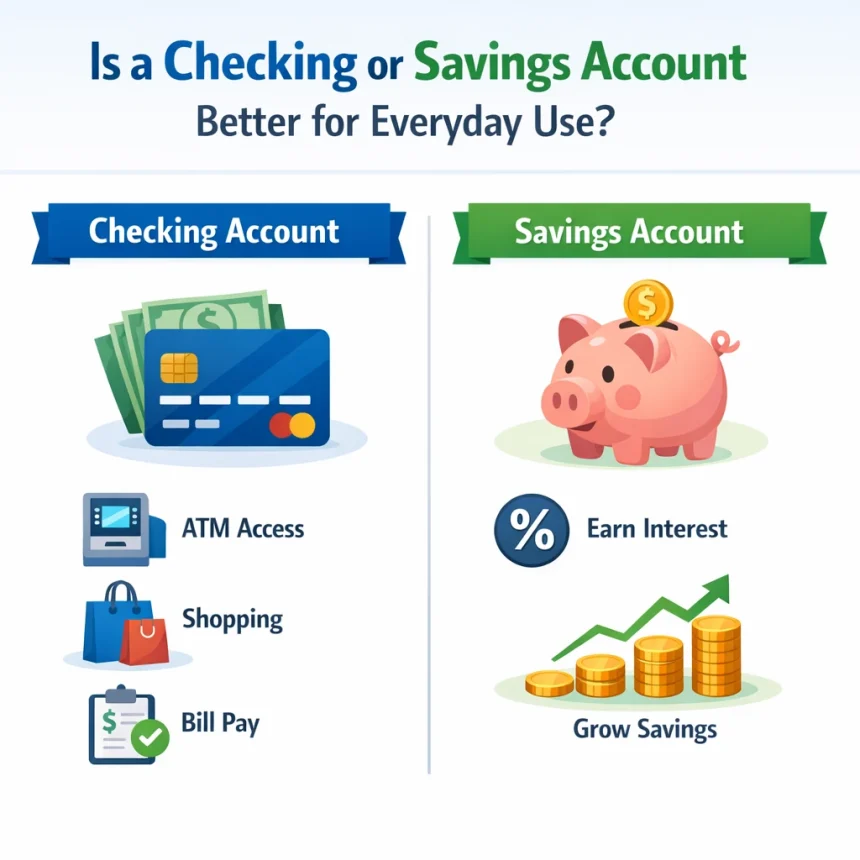
For everyday use—buying coffee, paying bills, grocery shopping, grabbing dinner—use your checking account. That’s literally what it’s designed for.
Do NOT use your savings account for everyday stuff. It’s not built for that. You’ll run into withdrawal limits, possible fees, and you’ll miss out on the interest your savings should be earning.
But here’s the catch: You actually need BOTH accounts working together. Your checking handles the daily spending. Your savings holds the money you’re NOT spending today (emergency fund, future goals). And you move money between them on purpose, not by accident.
what does renters insurance actually cover?
That’s the simple answer. But if you want to understand WHY (and set up a system that actually works), keep reading. The good stuff is coming.
3. Why This Question Confuses Everyone
Before we solve the problem, let’s understand why it’s a problem in the first place.
Reason 1: Banks make it confusing on purpose
Think about it. When you walk into a bank, they offer you 47 different account options. Checking. Savings. Money market. CDs. IRAs. Student accounts. Senior accounts. Premium accounts. It’s overwhelming.
And when things are overwhelming, most people just pick whatever the bank teller suggests (usually whatever pays the bank the most fees) and never think about it again.
Reason 2: The names don’t help
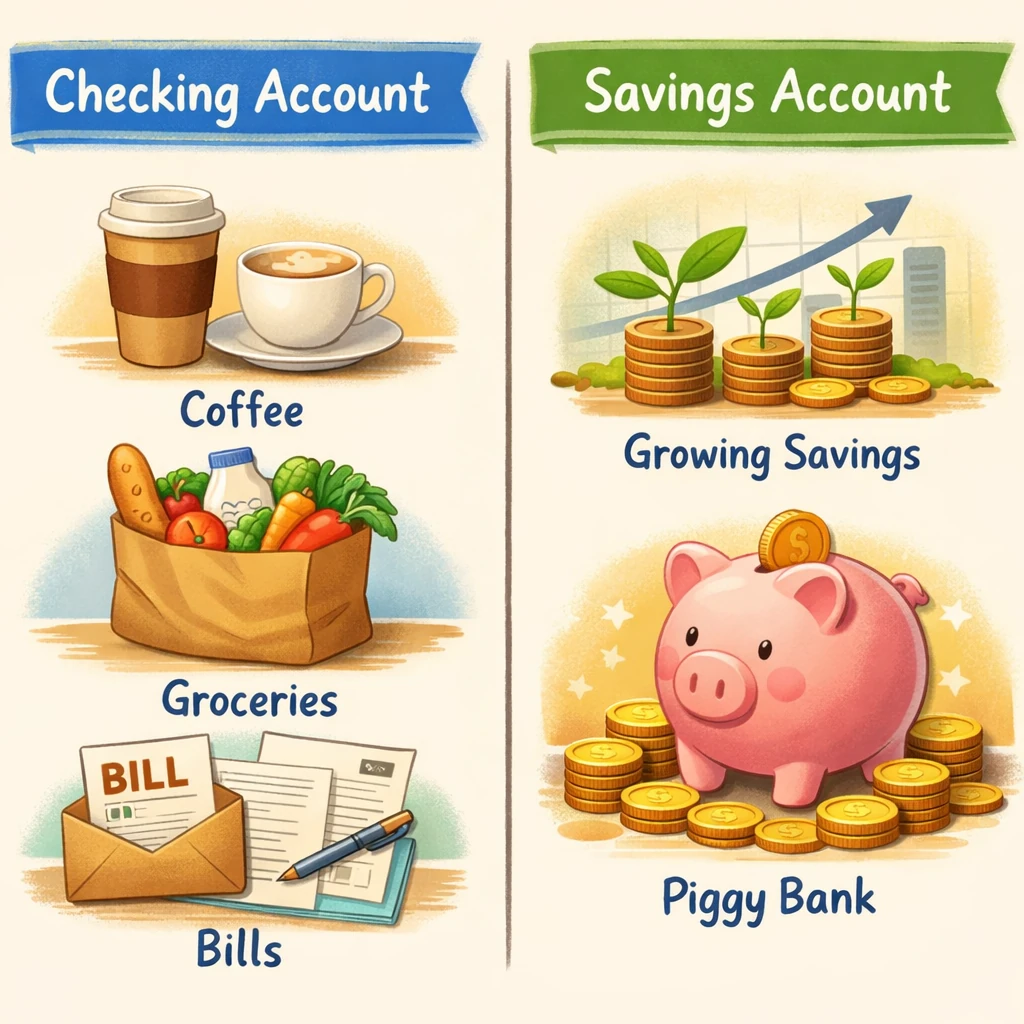
“Checking” sounds like something you do with a list. “Savings” sounds like something you do with money. The names don’t actually tell you how to use them day-to-day.
best health insurance plans for young adults
Reason 3: Your money doesn’t have labels
When you have $1,000 in your bank account, your brain doesn’t automatically sort it into “spending money” and “saving money.” It’s just… money. One big pile. And when all your money is in one pile, it’s hard to know what’s for what.
Reason 4: Bad advice from well-meaning people
Someone probably told you to “just use your checking for everything.” Or maybe someone said “always use savings so you earn interest.” Both are wrong, and both came from people who meant well but didn’t really understand.
Here’s what’s actually happening:
Your money has different jobs. Some of it needs to be ready to spend at a moment’s notice. Some of it needs to be tucked away for later. And the biggest mistake you can make is treating all your money the same way.
🤔 Quick question: Right now, without checking your app, do you know exactly how much of your money is for bills, how much is for fun, and how much is for emergencies? If the answer is no, this article is exactly what you need.
4. Checking Accounts: Built for the “Right Now”
Let’s start with checking accounts because this is where most of your everyday money probably lives.
What a Checking Account Is Actually Designed For
A checking account is what bankers call a “transactional account.” Fancy term, simple meaning: it’s built for transactions. For money moving in and money moving out. Constantly. Every day. Sometimes dozens of times a day.
Think of it like the front door of your house. Stuff comes in (your paycheck), stuff goes out (your rent, your groceries, your Netflix subscription). It’s the entry point and exit point for almost all your money.
Why Checking Is Perfect for Everyday Use
1. Unlimited transactions
You can use your checking account 100 times a day if you want. Buy coffee at 8 AM, lunch at noon, groceries at 6 PM, dinner at 8 PM, and Amazon at 11 PM. The bank doesn’t care. They expect this.
2. Debit card access
Every checking account comes with a debit card. Swipe it, tap it, insert it, use it online. The money comes out instantly. It’s the most convenient way to spend money ever invented.
3. Bill pay built in
Need to pay rent? Electric bill? Credit card? Checking accounts have online bill pay. Set it up once, and it happens automatically forever.
4. Check writing
Yes, people still use these. Your landlord might want one. That random vendor at the farmer’s market might prefer one. Checking accounts give you this option.
5. ATM access
Need cash? Your debit card gets it from any ATM. Some banks even reimburse fees from other banks’ ATMs.
6. Direct deposit
Your paycheck lands here automatically. No more paper checks, no more trips to the bank.
7. App integration
Checking accounts connect to everything—Venmo, Cash App, PayPal, Zelle. Send money to friends instantly.
The One Thing Checking Does Poorly
Interest. Most checking accounts pay ZERO interest. Some pay 0.01%, which means $1,000 earns you 10 cents a year. It’s basically nothing.
So while checking is PERFECT for money that’s coming and going, it’s terrible for money that’s supposed to sit still and grow.
how much life insurance coverage do I really need?
The Bottom Line on Checking
If you’re spending money today or this week, it belongs in checking. That’s what it’s for. Use it freely, use it often, don’t feel guilty.
5. Savings Accounts: Built for the “Later”
Now let’s talk about the other half of the equation. The quiet one. The one that doesn’t get as much attention but is secretly the hero of your financial life.
What a Savings Account Is Actually Designed For
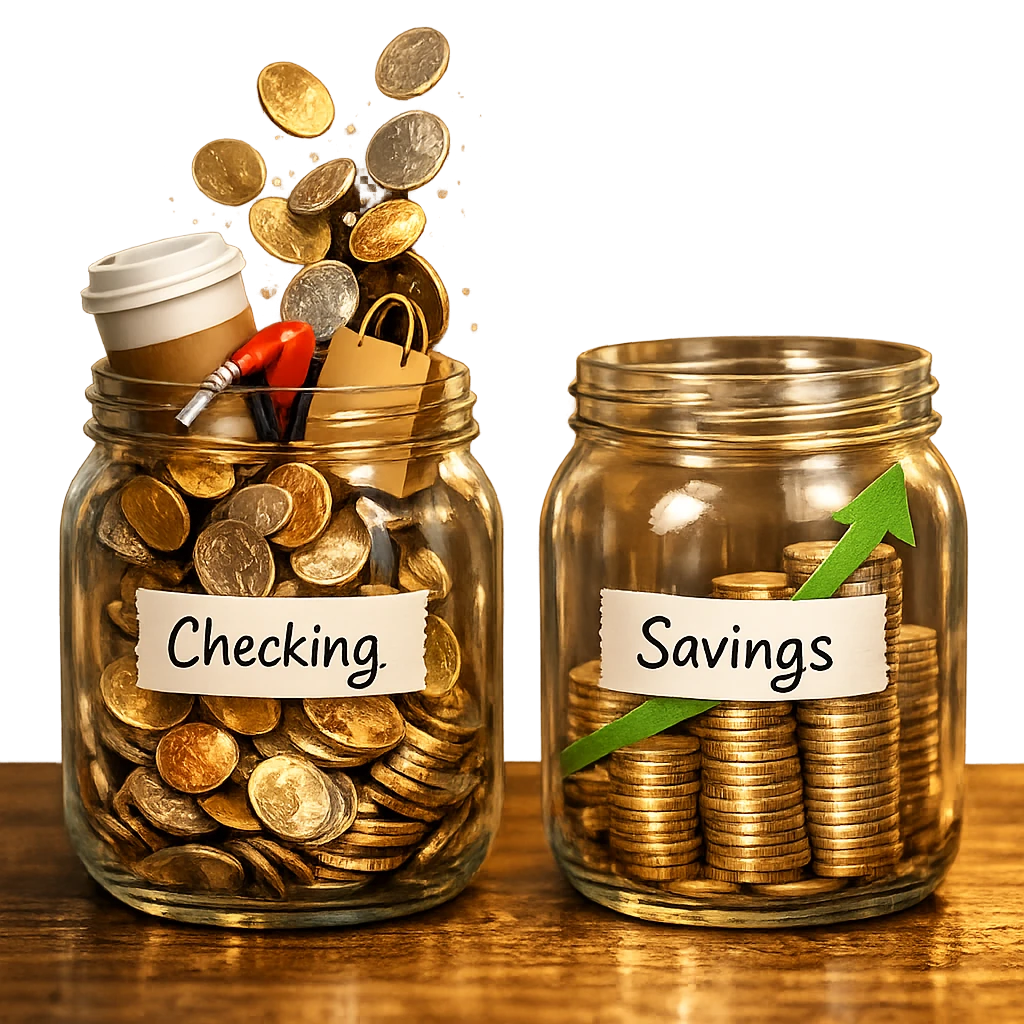
A savings account is designed for one thing: holding money you don’t plan to spend right now.
That’s it. That’s the whole job.
While your checking account is running around doing errands all day, your savings account is at home, relaxing, maybe growing a little bit. It’s not flashy. It’s not exciting. But it’s essential.
Why Savings Is TERRIBLE for Everyday Use
1. Withdrawal limits
Most savings accounts limit you to 6 withdrawals per month. This used to be a federal rule (Regulation D). That rule was relaxed in 2020, but many banks still enforce it. Go over 6 transactions, and you’ll pay a fee (usually $5-15 each time).
If you’re using savings for daily coffee runs, you’ll hit that limit by the 6th of the month. Then you’re paying fees. Not good.
2. No debit card (usually)
Most savings accounts don’t come with a debit card for purchases. Some give you an ATM card (for cash withdrawals only), but you can’t swipe it at stores. So how would you even use it for everyday stuff?
3. Harder to access
To spend money from savings, you usually have to transfer it to checking first. That takes time (seconds online, but still an extra step). That friction is BY DESIGN—it makes you think twice before spending.
4. Missing the point
Here’s the biggest reason not to use savings for everyday: you’d be missing the whole point of having savings. Savings is for money that’s supposed to STAY. If you’re constantly dipping into it, it’s not savings anymore—it’s just a second checking account with extra steps and possible fees.
What Savings Is ACTUALLY For
Savings accounts excel at three things:
1. Earning interest
This is the magic part. A good high-yield savings account pays 4% or more right now. On $5,000, that’s $200 a year for doing nothing. Your checking pays $0.50.
2. Protecting your future money
When your savings is separate from checking, your brain treats it differently. You don’t see that $5,000 every day and think “I could buy something nice.” You see it as off-limits—money for later, not for now.
3. Building toward goals
Emergency fund? That goes in savings. Vacation next year? Savings. New car in 2 years? Savings. Down payment on a house? Savings.
term life vs whole life insurance: which do I need?
The Bottom Line on Savings
If you’re not spending money today—if it’s for next month, next year, or “just in case”—it belongs in savings. That’s what it’s for. Let it sit there, earn interest, and stay out of sight until you actually need it.
6. The Side-by-Side: Everyday Use Compared
Let’s put them head-to-head on the things that matter for daily life.
| Everyday Activity | Checking Account | Savings Account | Winner |
|---|---|---|---|
| Buying coffee with card | ✅ Perfect | ❌ Usually no debit card | Checking |
| Paying rent online | ✅ Built-in bill pay | ❌ Have to transfer first | Checking |
| Getting cash from ATM | ✅ Yes, with debit card | ⚠️ Maybe (ATM card, but limited) | Checking |
| Sending money on Venmo | ✅ Connects easily | ❌ Rarely connects | Checking |
| Automatic bill payment | ✅ Set it and forget it | ❌ Not designed for this | Checking |
| Emergency fund storage | ❌ No interest, too easy to spend | ✅ Perfect, earns interest | Savings |
| Saving for vacation | ❌ Too tempting to spend | ✅ Safe, separate, earns interest | Savings |
| Earning interest | ❌ 0% basically | ✅ 4%+ at good banks | Savings |
| Multiple daily transactions | ✅ Unlimited | ❌ Limited to 6/month usually | Checking |
| Keeping money safe from yourself | ❌ Too easy to spend | ✅ Harder to access | Savings |
The verdict is clear:
For actual everyday spending—buying things, paying bills, moving money around—checking wins, no contest.
IRS audit red flags for individuals
For money you’re NOT spending today—emergencies, goals, future stuff—savings wins, no contest.
7. What Happens When You Use Savings for Everyday? (Spoiler: It’s Bad)
Let me paint you a picture of what goes wrong when you try to use your savings account for daily spending.
Meet Dave.
Dave has one account—a savings account. He gets his paycheck deposited there (yes, you can do direct deposit to savings). He has an ATM card for it. He uses it for everything.
Week 1:
- Monday: Buys lunch ($15)
- Tuesday: Groceries ($65)
- Wednesday: Coffee ($4.50), dinner ($32)
- Thursday: Gas ($40)
- Friday: Drinks with friends ($28)
- Saturday: Movie tickets ($24)
- Sunday: Takeout ($22)
That’s 8 transactions in one week.
What happens next:
Dave’s bank has a 6-transaction monthly limit on savings accounts. He’s already at 8 in the first week. On the 7th transaction, the bank charges him $10. On the 8th, another $10. That’s $20 in fees for one week.
End of month: Dave does this every week. About 32 transactions total. 26 of them are over the limit. At $10 each, that’s $260 in fees.
For the privilege of using his own money.
But wait, it gets worse:
Dave’s savings account earns 0.01% interest (typical for big banks). His $2,000 balance earns him 20 cents for the entire year. Meanwhile, he’s paid $260 in fees in one month.
how to avoid taxes on savings account interest (legally)
The final insult:
Dave tries to apply for a credit card. The bank sees his savings account activity—constant withdrawals, fees, low balance—and thinks he’s bad with money. His application gets denied.
This is what happens when you use the wrong tool for the job.
Savings accounts aren’t built for daily use. They’re built to be quiet, still, and rarely touched. Using them for everyday spending is like using a hammer to cut a tomato—technically possible, but messy and you’ll probably regret it.
8. What Happens When You Use Checking for Everything? (Also Bad)
Okay, so savings is bad for everyday. But what about using checking for everything? That’s fine, right?
Meet Sarah.
Sarah has one account—a checking account. Her paycheck goes there. She pays all her bills from there. She uses her debit card for everything. All her money is in one place.
What Sarah does right:
- No withdrawal limits
- Easy access to her money
- Debit card works everywhere
- Bill pay is set up
What Sarah does wrong:
Sarah keeps her emergency fund in her checking account. All $5,000 of it. Right next to her spending money.
One day, she’s browsing online and sees a TV on sale. “I have $5,000 in my account,” she thinks. “I can afford this $800 TV.”
She buys it.
Then she sees shoes on sale. “Still have plenty,” she thinks. Buys them.
Then a weekend trip with friends. “Why not?”
By the end of the month, her “emergency fund” is down to $3,200. She didn’t even notice it happening because it was all in the same pot.
is cryptocurrency taxable in the US/UK/EU?
The interest she lost:
If Sarah had kept her $5,000 emergency fund in a high-yield savings account at 4%, she’d have earned $200 in interest over the year. Instead, she earned $0 in her checking account.
The real problem:
Sarah isn’t bad with money. She’s actually pretty responsible. But human brains aren’t designed to separate money into mental buckets when it’s all in one place. When you see $5,000, your brain thinks “I have $5,000 to spend.” It doesn’t automatically subtract the $3,000 you need for rent and the $1,000 emergency fund.
This is why “just use checking for everything” fails.
Checking is perfect for the money you’re spending. It’s terrible for the money you’re saving. When you mix them together, the saving money inevitably becomes spending money.
💡 The big insight: The best system isn’t choosing one account. It’s using both accounts the way they’re designed to be used. Checking for spending, savings for saving. Separated on purpose.
9. The “Two-Account System” That Actually Works
Now we get to the good stuff. Here’s the system that actually works for real people.
The Basic Setup
Account 1: Checking
- Where your paycheck goes
- Where you pay bills from
- Where your debit card is linked
- For money you’ll spend this week/month
- Target balance: 1-2 months of expenses
Account 2: Savings
- Where your emergency fund lives
- Where you save for goals
- Earning interest (4%+ ideally)
- For money you won’t touch unless really needed
- Target balance: 3-6 months of expenses (emergency fund) + goal money
How It Works in Practice
Payday:
- Your paycheck lands in checking
- Immediately (or automatically), move money to savings
- What’s left in checking is what you can spend
Everyday spending:
- Use your checking account debit card for everything
- Never use savings for daily purchases
- Check your checking balance before spending (not your total net worth)
When you need savings:
- Real emergency happens (job loss, car repair, medical bill)
- Transfer money from savings to checking
- Use it from checking
- Rebuild savings when you can
Why This Works
Separation = clarity
When your spending money and saving money are in different accounts, your brain treats them differently. You look at checking and think “I have $1,500 for bills and spending this month.” You look at savings and think “I have $5,000 that I’m not touching.”
Friction = protection
Moving money from savings to checking takes an extra step. That 30-second delay is enough to make you think: “Do I REALLY need this? Is this an emergency or just a want?”
Interest = free money
Your savings earns interest while it sits. Your checking doesn’t. By keeping them separate, your savings actually grows instead of just sitting there.
capital gains tax on stocks for beginners
No more mental math
You don’t have to remember that $3,000 of your $5,000 is for rent. All your bill money is in checking. All your long-term money is in savings. Simple.
10. Real Money Example: Sarah vs. Mike
Let’s see this system in action with two real people.
Sarah: The “One Account” Person
Sarah has one checking account. She keeps $8,000 in it because she’s afraid of not having enough.
Her setup:
- $8,000 in checking (0% interest)
- $0 in savings
What happens:
- She sees $8,000 and feels rich
- She spends more than she should because “I have money”
- Her emergency fund isn’t really an emergency fund—it’s just part of her spending money
- She earns $0 in interest
- When an emergency happens, she might not even notice she spent her safety net
Mike: The “Two-Account” Person
Mike uses the checking + savings system.
His setup:
- $2,000 in checking (for monthly bills and spending)
- $6,000 in high-yield savings at 4% (emergency fund)
What happens:
- He sees $2,000 in checking and budgets carefully
- His $6,000 in savings earns $240/year in interest
- When he looks at his savings, he thinks “emergencies only”
- His money is working for him, not just sitting there
- best tax software for small business owners
The Same Money, Different Results
Both Sarah and Mike have $8,000 total.
But Mike:
- Earns $240/year more than Sarah
- Is less likely to accidentally spend his emergency fund
- Has clearer visibility into his finances
- Feels more in control
That’s the power of using both accounts correctly.
11. The Psychology of Separate Accounts (Why It Changes Everything)
This isn’t just about organization. It’s about psychology.
The “Mental Accounting” Problem
Your brain does something called “mental accounting.” It naturally wants to put money into different buckets: “rent money,” “fun money,” “savings money,” etc.
But when all your money is in one account, your brain can’t do that easily. You just see one big number. And one big number triggers one big thought: “I have that much to spend.”
Studies show that people with separate accounts save more money than people with one account. Why? Because the separation creates mental barriers that your brain respects.
The “Out of Sight, Out of Mind” Effect
When your savings is in a different account—especially at a different bank—you don’t see it every day. You don’t check that balance as often. You forget about it a little bit.
And that’s GOOD.
Money you forget about is money you don’t spend. It just sits there, growing, waiting for when you actually need it.
The “Pain of Transfer”
There’s a tiny psychological friction when you have to move money from savings to checking. It’s not much—just a few clicks. But that friction is enough to make you pause and ask: “Do I really need to take this money out?”
That pause is valuable. It’s the difference between impulse spending and intentional spending.
The “Goal Visibility” Effect
When you have separate savings accounts for separate goals (emergency fund, vacation fund, house fund), you can see progress toward each one. That $500 in your vacation fund feels different from the $500 in your emergency fund.
You can watch your vacation fund grow and get excited. You can watch your emergency fund grow and feel secure. You can’t do that when it’s all mixed together.
🧠 Brain hack: Open a separate savings account for each major goal. Name them in your app: “Emergency Fund,” “Hawaii Trip,” “New Car.” Studies show you’ll save more when you can see progress toward specific goals.
12. How to Structure Your Accounts for Daily Life
Let’s get practical. Here’s exactly how to set up your accounts for everyday use.
The Minimalist Setup (2 Accounts)
Checking Account
- Receives your paycheck
- Pays all your bills
- Linked to your debit card
- For everyday spending
- Keep 1 month of expenses here
Savings Account
- Emergency fund (3-6 months expenses)
- Short-term goals (vacation, new phone, etc.)
- Ideally at an online bank earning 4%+
- Transfer money here automatically each payday
The Advanced Setup (3+ Accounts)
Checking #1: Bills Account
- Fixed monthly expenses only (rent, utilities, subscriptions)
- Set up automatic payments from here
- Transfer exactly what you need each month
- Never use the debit card for this account
Checking #2: Spending Account
- Your “fun money” account
- Linked to your debit card
- For groceries, dining out, shopping, gas
- Transfer a fixed amount each week/month
Savings #1: Emergency Fund
- 3-6 months of essential expenses
- At a different bank than your checking
- High-yield (4%+)
Savings #2: Goal Fund
- For specific goals (vacation, car, house)
- Same bank as emergency fund or separate
Why Multiple Accounts Work
When your bills money is separate from your spending money, you never accidentally spend the rent money on dinner. When your emergency fund is at a different bank, you never accidentally dip into it for a sale.
The key: Make it automatic. Set up transfers so money moves without you thinking about it. Then your system runs itself.
13. The “Bills Account” Trick That Saves Sanity
Here’s a specific strategy that changes everything.
The Problem
You get paid on the 1st. Your rent is due on the 1st (perfect). But your car insurance is due on the 15th, your credit card on the 20th, and your phone bill on the 25th.
Throughout the month, money slowly drains from your account. By the 20th, you’re doing mental math: “Okay, I have $800 left, but $300 is for the credit card, and $100 is for the phone…” It’s exhausting. And it’s easy to mess up.
The Solution: The Bills Account
Step 1: Open a second checking account (free, no fees).
Step 2: Calculate all your monthly bills that are the same every month:
- Rent/mortgage
- Car payment
- Insurance
- Subscriptions (Netflix, Spotify, gym)
- Phone bill
- Internet
- Minimum debt payments
Step 3: Add them up. Let’s say it’s $2,000.
Step 4: On payday, immediately transfer $2,000 to your “bills account.”
Step 5: Set up ALL your bills to auto-pay from this account.
Step 6: Forget this account exists. Don’t check it. Don’t carry the debit card. It’s just for bills.
What This Does for You
- Your main checking account now shows only what’s available for spending
- No more mental math about “this $800 includes the $300 for the credit card”
- Bills always get paid because the money is already there
- You can’t accidentally spend bill money because it’s in a different account
This one trick eliminates bill-related anxiety forever.
14. What About Debit Cards? Which Account Should They Link To?
This is a practical question: your debit card has to link to ONE account. Which one should it be?
The Answer: Your Spending Account
Your primary debit card should link to the account you use for everyday purchases—your main checking account (or your “spending” checking if you have the two-checking setup).
Why:
- You’ll use it multiple times daily
- Transactions need to process instantly
- You need to see your available balance in real-time
- Savings accounts don’t support debit card purchases anyway
What About ATM Cards?
Some savings accounts come with ATM cards. These let you withdraw cash from ATMs, but they don’t work for purchases at stores.
Use case: If you need cash from your emergency fund (for a real emergency), you can use the ATM card directly from savings. But for daily cash needs, use your checking account debit card.
The “Don’t Carry It” Strategy
For your savings account, don’t carry the card. Don’t even save it in your phone. Keep it in a safe place at home. If you need emergency cash, you’ll have to go home and get it—which gives you time to think about whether it’s really an emergency.
15. Can You Use a Savings Account for Direct Deposit?
Short answer: Yes, you can.
Most employers will let you direct deposit your paycheck into any account—checking or savings. The money will land there just fine.
Long answer: You probably shouldn’t.
Here’s why:
Reason 1: If your paycheck goes directly to savings, you have to transfer money to checking every time you want to spend. That’s extra steps, and you might hit withdrawal limits if you transfer too often.
Reason 2: You lose the “pay yourself first” psychology. When money hits checking first, you can immediately move some to savings. That act of moving money reinforces the habit. When it hits savings first, you have to move money TO checking FOR spending, which feels wrong psychologically.
Better approach: Direct deposit to checking. Then set up automatic transfers to savings on payday. You control the flow.
The Split Direct Deposit Trick
Most employers let you split your direct deposit between multiple accounts. This is powerful.
Instead of:
- $3,000 to checking → manually move $500 to savings
Do this:
- $2,500 to checking
- $500 directly to savings
The money never hits your checking account, so you never feel like you have it to spend. But it’s still yours, growing in savings.
Check with your HR department or payroll portal. Most have a “direct deposit allocation” section where you can set percentages or fixed amounts to different accounts.
16. ATM Access: Which Account Wins?
For getting cash, here’s how they compare:
Checking Account ATM Access
- Debit card works at any ATM
- Many banks have fee-free ATM networks
- Some online banks reimburse ATM fees
- Unlimited withdrawals
- Your cash comes from your spending money
Savings Account ATM Access
- Some savings accounts have ATM cards
- Usually limited to fewer withdrawals
- Often can’t be used for purchases, only cash
- Cash comes from your savings (should be for emergencies only)
The Winner for Daily Use: Checking
For everyday cash needs, use your checking account. That’s what it’s for.
The Exception: Emergency Cash
If you’re in a real emergency and need cash from your emergency fund, use your savings account ATM card. But remember: that should be rare.
17. Online Payments and Bill Pay: The Checking Advantage
This is where checking accounts really shine.
Online Bill Pay
Most checking accounts have built-in bill pay. You set up the payee (your landlord, utility company, credit card), enter the amount and date, and the bank sends the payment automatically.
Benefits:
- Set it once, works forever
- Can schedule around paydays
- Some banks even send physical checks for payees who don’t take electronic payments
- Free with most accounts
Savings Accounts and Bill Pay
Most savings accounts don’t have bill pay features. You’d have to transfer money to checking first, then pay from there.
Automatic Payments
Many companies let you set up auto-pay directly from your bank account. They’ll ask for routing and account numbers.
Best practice: Use your checking account for these. If you use savings, you risk hitting withdrawal limits and paying fees.
18. The Emergency Fund Question (Where Does It Live?)
Your emergency fund is the most important money you have. Where should it live?
The Wrong Places
❌ In your checking account
Too easy to spend. No interest. Blends with daily money.
❌ Under your mattress
Not insured. No interest. Risk of theft, fire, flood.
❌ In stocks
Too risky. If the market crashes right when you lose your job, your emergency fund disappears.
The Right Place: A High-Yield Savings Account
Your emergency fund belongs in a savings account, preferably at a different bank than your checking.
Why:
- Safe (FDIC insured)
- Earns interest (4%+ at online banks)
- Separate from spending money
- Accessible when needed (but not too accessible)
How Much Separation?
Ideally, your emergency fund savings account is at a different bank than your checking. Not just a different account—a different bank entirely.
Why different banks?
- You won’t see it when you check your main banking app
- Transferring takes 1-3 days (adds helpful friction)
- Less temptation to dip into it
Where to put it: Online banks like Ally, Marcus, Discover, Capital One 360. They pay 4%+ and have no fees.
19. What the “Gurus” Don’t Tell You About Multiple Accounts
You might hear some financial “gurus” say that multiple accounts are too complicated. “Just keep it simple,” they say. “One account is enough.”
Here’s what they don’t tell you:
The “Simple” Argument Ignores Human Nature
Yes, one account is technically simpler. But “simple” doesn’t work if it leads to bad decisions.
Human beings are bad at mental accounting. We’re bad at remembering that $3,000 of our $5,000 is for bills. We’re bad at not spending money that’s right there in front of us.
Multiple accounts aren’t complexity—they’re scaffolding for your brain. They do the mental work for you.
The Real Definition of “Simple”
Simple isn’t about having fewer accounts. Simple is about having a system that works without thinking.
Which is simpler:
- One account where you constantly have to do mental math and risk overdrafts?
- Three accounts with automatic transfers that run themselves?
The second one is actually simpler because you don’t have to think about it.
The “But I’ll Forget” Myth
Some people worry they’ll forget about money in other accounts. Good! That’s the point! Money you forget about is money you don’t spend.
And you won’t REALLY forget—you’ll see it when you check your full financial picture. But out of sight, out of mind for daily spending is exactly what you want.
20. Setting Up Your Perfect Everyday System (Step by Step)
Ready to set this up? Here’s your step-by-step guide.
Step 1: Open the Right Accounts
If you have just checking:
- Open a high-yield savings account at an online bank (Ally, Marcus, etc.)
- This takes 10 minutes online
If you have checking and savings at the same bank:
- Consider opening a second savings account at an online bank for better interest
- Or keep both if your savings rate is decent (over 1%)
For the advanced system:
- Open a second checking account (free, at any bank)
- Use this for bills only
Step 2: Calculate Your Numbers
For checking:
- Add up your average monthly spending (bills + everyday purchases)
- Add 30% as a cushion
- This is your target checking balance
For savings (emergency fund):
- Add up your essential monthly expenses (rent, food, utilities, minimum debt payments)
- Multiply by 3-6 (depending on your comfort level)
- This is your emergency fund target
For savings (goals):
- List your short-term goals and their costs
- Divide by months until goal date
- This is your monthly savings target per goal
Step 3: Set Up Direct Deposit
Log into your employer’s payroll portal.
Basic setup:
- 100% to checking
Advanced setup:
- X% to checking (for spending)
- Y% directly to savings (for goals)
- Or fixed dollar amounts to each
Step 4: Set Up Automatic Transfers
From your checking account, set up recurring transfers:
Payday:
- Transfer $X to emergency fund savings
- Transfer $Y to goal #1 savings
- Transfer $Z to goal #2 savings
- If using bills account, transfer bill total to that account


