By: Peiman Daneshgar | Email: daneshgar781@gmail.com**
Published: February 21, 2026**
Table of Contents
- Capital Gains Tax on Stocks for Beginners (Finally, Someone Explained It Like You’re 5)
- Introduction: The Profit That Shrank
- What This Article Will Actually Give You
- Part 1: The Absolute Basics (Start Here)
- Part 2: The Most Important Decision You’ll Make—When to Sell
- Part 3: What You Actually Pay Tax On (It’s Not What You Think)
- Part 4: Dividends—The Sneaky Tax You Didn’t Know You Owed
- Part 5: The Superpower—Using Losses to Offset Gains
- Part 6: The Extra 3.8% (Because of Course There’s More)
- Part 7: Real Examples (So You Can See How This Works)
- Part 8: How to Actually Report This Stuff
- Part 9: Common Beginner Mistakes (And How to Avoid Them)
- Frequently Asked Questions
- The Emotional Bottom Line
Introduction: The Profit That Shrank
I know that feeling.
You finally did it. You bought your first stock. Watched it go up and down. Held your breath through the red days. Did a little happy dance on the green ones.
Then you sold. Made a nice profit. Maybe $2,000. Enough for a weekend trip or a new laptop.
But then tax season came. And that $2,000 profit somehow turned into $1,500 after you did your taxes. You stare at your return, confused. Where did the other $500 go? Did you do something wrong? Did the IRS make a mistake?
Sound familiar?
You’re not alone. Every year, millions of new investors get blindsided by capital gains tax. They focus on picking the right stocks, timing the market, reading charts—all the exciting stuff. But nobody tells them about the boring part: what happens when you actually sell.
best tax software for small business owners
The Wall Street Journal won’t write headlines about it. Your trading app won’t pop up a warning. But here’s the truth: How you sell matters almost as much as what you sell. And if you don’t understand the rules, you’re leaving money on the table.
🧠 Quick Reality Check:
The government doesn’t tax your portfolio balance. They tax your actions. Buy and hold forever? No tax. Sell after 11 months? Tax. Sell after 13 months? Less tax. The timing of your sale determines how much of your profit you actually keep.
What This Article Will Actually Give You
Here’s the deal. Most tax articles are written by CPAs for other CPAs. They’re full of jargon and footnotes that make your eyes glaze over.
This one is different.
By the time you finish reading, you’ll know:
- The exact difference between short-term and long-term capital gains (and why waiting one extra month could save you hundreds) .
- The 2026 tax brackets for capital gains—fresh off the IRS’s October 2025 announcement .
- How to calculate your “cost basis” (the fancy term for what you actually paid) .
- The magic of tax-loss harvesting—using your losers to offset your winners .
- The 3.8% surtax that hits higher earners (and how to know if it applies to you) .
- Real examples with real numbers so you can see exactly how this plays out.
This is the playbook. Let’s run it.
how to file taxes as a married couple for the first time
Part 1: The Absolute Basics (Start Here)
What Even IS a Capital Gain?
Let’s start with the simplest definition possible:
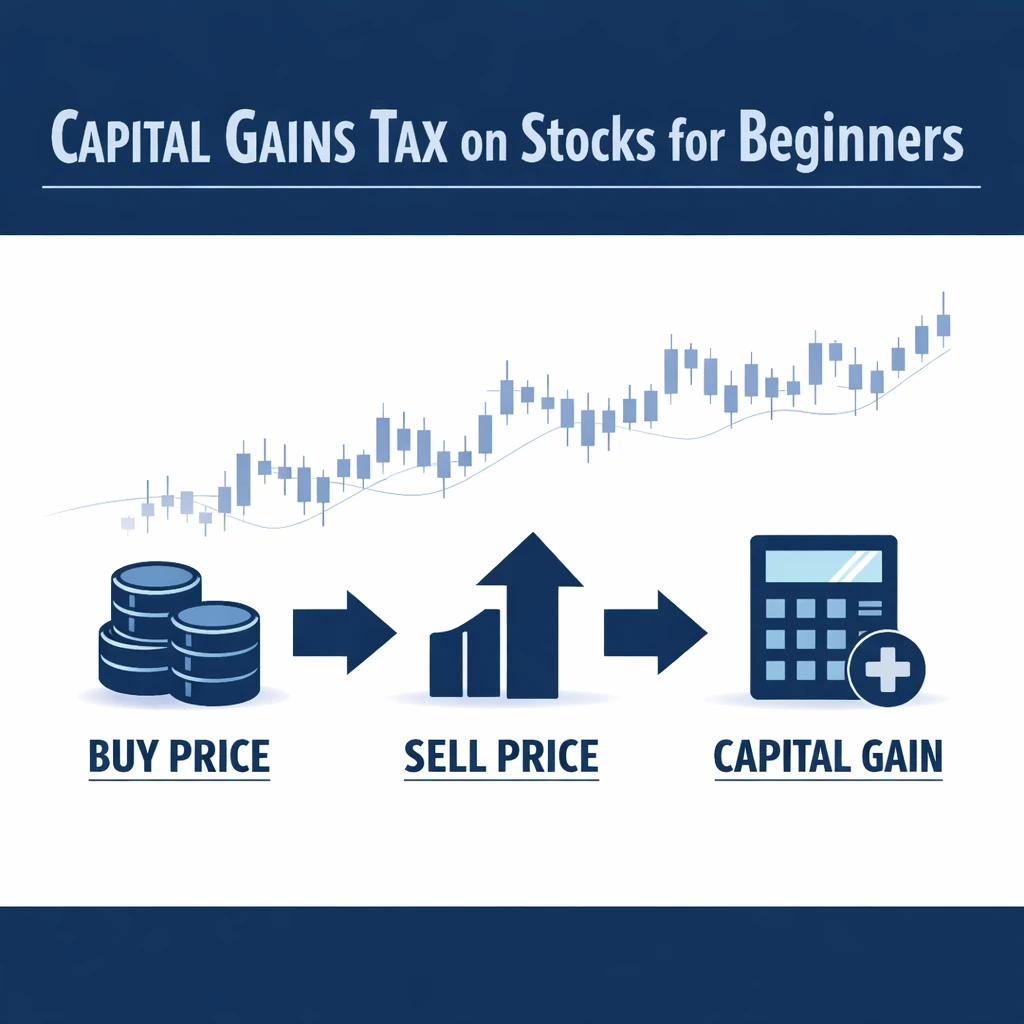
A capital gain is the profit you make when you sell something for more than you paid for it .
That’s it. Buy low, sell high, pay tax on the difference.
If you bought 10 shares of Apple at $150 each ($1,500 total) and sold them at $200 each ($2,000 total), your capital gain is $500. That’s the number the IRS cares about.
The “Unrealized” Trap (Why Your App Lies to You)
Here’s something that confuses a lot of beginners:
Your brokerage app shows your “portfolio value” going up every day. It feels like you’re making money. And technically, you are—on paper.
But you don’t owe taxes until you sell .
Those paper gains are called unrealized gains. The IRS ignores them completely. You could be up $50,000 on paper and owe zero tax. The moment you sell, they become realized gains, and the tax clock starts ticking .
tax credits vs tax deductions explained
🤔 Pause and Think:
This is actually a feature, not a bug. It means you control when you pay taxes. You can delay selling to a year when your income is lower, or hold forever and never pay. The power is in your hands.
Part 2: The Most Important Decision You’ll Make—When to Sell
Short-Term vs. Long-Term: The $500 Difference
Here’s where the tax code gets interesting—and where you can save serious money.
The IRS divides capital gains into two buckets based on how long you held the investment before selling :
| Type | Holding Period | Tax Rate |
|---|---|---|
| Short-Term | 1 year or less | Your ordinary income tax rate (10%–37%) |
| Long-Term | More than 1 year | 0%, 15%, or 20% (depending on income) |
The One-Year Magic Line
That one-year mark is the most important date in investing. Cross it, and your tax rate could drop by half.
Let’s say you’re a single filer making $60,000 a year. Your ordinary income tax rate is 22%. If you sell a stock after 11 months, you pay 22% on the profit. If you wait one more month and sell after 13 months, you pay 15% on that same profit .
On a $10,000 gain, that’s $700 in your pocket instead of the government’s.
2026 Long-Term Capital Gains Tax Rates (The Good Stuff)
The IRS announced the 2026 brackets in October 2025 . Here’s what you need to know:
| Filing Status | 0% Rate | 15% Rate | 20% Rate |
|---|---|---|---|
| Single | $0 – $49,450 | $49,451 – $545,500 | $545,501+ |
| Married Filing Jointly | $0 – $98,900 | $98,901 – $613,700 | $613,701+ |
| Head of Household | $0 – $66,200 | $66,201 – $579,600 | $579,601+ |
These numbers are your taxable income (what’s left after deductions), not your gross income. So if you’re single and your taxable income is under $49,450, you pay zero long-term capital gains tax. Zero .
what to do if you can’t pay your taxes on time
Short-Term Rates (The “Uncle Sam Takes a Bite” Rates)
Short-term gains are taxed at whatever bracket your ordinary income falls into :
| 2026 Taxable Income (Single) | Tax Rate |
|---|---|
| $0 – $11,925 | 10% |
| $11,926 – $48,475 | 12% |
| $48,476 – $103,350 | 22% |
| $103,351 – $197,300 | 24% |
| $197,301 – $250,525 | 32% |
| $250,526 – $626,350 | 35% |
| $626,351+ | 37% |
If you’re in the 22% bracket for your day job, your short-term stock profits get taxed at 22% too.
Part 3: What You Actually Pay Tax On (It’s Not What You Think)
Cost Basis: The Number You Need to Know
The IRS doesn’t just trust you to remember what you paid. They want documentation. That’s where cost basis comes in.
Cost basis is the original value of an investment, used to calculate gain or loss .
Simple formula:
Capital Gain = Sale Price – Cost Basis
can I deduct home office expenses in 2024?
What Counts in Your Cost Basis
Your cost basis isn’t just the purchase price. It also includes :
- Commissions and fees you paid to buy the stock
- Reinvested dividends (more on this later)
- Stock splits (which adjust your per-share cost)
If you paid $10 commission on a $1,000 purchase, your cost basis is $1,010. That extra $10 reduces your taxable gain.
The FIFO Problem (And How to Fix It)
If you bought shares of the same stock at different times, which ones did you sell? The IRS assumes you sold the oldest shares first—a method called FIFO (First In, First Out) .
This can hurt you. Those oldest shares probably have the lowest cost basis (because stocks usually go up over time). Selling them means a larger gain and more tax.
The Specific Share Method (Pro Moves)
Here’s the pro tip: you don’t have to use FIFO. If you’ve kept good records, you can tell your broker exactly which shares to sell .
If you bought shares at $50, $60, and $70, and the stock is now at $80, you could:
- Sell the $70 shares → $10 gain per share (least tax)
- Sell the $50 shares → $30 gain per share (most tax)
By choosing the highest-cost shares, you minimize your taxable gain. This is called the specific share identification method, and it’s perfectly legal .
tax deductions for freelancers and gig workers
Part 4: Dividends—The Sneaky Tax You Didn’t Know You Owed
Qualified vs. Non-Qualified Dividends
Dividends are payments companies make to shareholders. And yes, they’re taxable too .
But like capital gains, dividends have a preferred rate if they’re qualified:
- Qualified dividends: Taxed at long-term capital gains rates (0%, 15%, 20%)
- Non-qualified dividends: Taxed at your ordinary income rate
To be qualified, you generally must hold the stock for more than 60 days during the 121-day period around the ex-dividend date .
The Reinvestment Trap
Many investors use Dividend Reinvestment Plans (DRIPs) to automatically buy more shares with their dividends. This is great for compounding. But it creates a tax headache .
Here’s the trap: Even though you never saw the cash—it went straight into new shares—the IRS considers that dividend received. You owe tax on it .
And now you have new shares with a new cost basis (the price you paid with the reinvested dividend). Track these separately, or you’ll mess up your future gain calculations.
authorized user vs co-signer: which helps credit more?
Part 5: The Superpower—Using Losses to Offset Gains
Tax-Loss Harvesting (The Fancy Term for a Simple Idea)
Nobody likes losing money on stocks. But losses have a silver lining: they can reduce your taxes.
Tax-loss harvesting is the practice of selling losing investments to offset gains from winning ones .
Let’s say you:
- Made $5,000 on Stock A (gain)
- Lost $3,000 on Stock B (loss)
Your net capital gain is $2,000 ($5,000 – $3,000). You only pay tax on the $2,000 .
The $3,000 Rule
What if your losses exceed your gains? You can use up to $3,000 of excess loss to offset your ordinary income (like your salary) .
If your job income is $60,000 and you have $5,000 in net capital losses, you can reduce your taxable income to $57,000. That saves you whatever your marginal tax rate is.
Carryforward Losses (Your Get-Out-of-Tax-Free Card for Years)
If you still have losses left after offsetting gains and $3,000 of income, don’t worry. You can carry them forward to future years indefinitely .
Unused losses can be carried forward for up to 8 years and used to offset future gains .
| Type of Loss | Can Offset | Carryforward Period |
|---|---|---|
| Short-Term Loss | Short-term gains, long-term gains, $3,000 income | 8 years |
| Long-Term Loss | Long-term gains only | 8 years |
The Wash Sale Rule (Don’t Do This)
There’s one catch: the wash sale rule.
If you sell a stock at a loss and buy the same or substantially identical stock within 30 days before or after the sale, you can’t claim the loss . It gets added to your new shares’ cost basis instead.
The IRS does this to prevent people from selling just to create a tax loss, then immediately buying back in.
how to get a free FICO score from your bank

Part 6: The Extra 3.8% (Because of Course There’s More)
If you’re a high earner, there’s one more tax to know: the Net Investment Income Tax (NIIT) .
This is an extra 3.8% tax on the lesser of:
- Your net investment income (including capital gains and dividends), or
- The amount your modified adjusted gross income exceeds certain thresholds
The thresholds for 2026 :
| Filing Status | Threshold |
|---|---|
| Single | $200,000 |
| Married Filing Jointly | $250,000 |
| Married Filing Separately | $125,000 |
| Head of Household | $200,000 |
If you’re single and make $250,000, and you have $20,000 in capital gains, you’ll pay the regular capital gains tax PLUS 3.8% on some or all of that $20,000.
Part 7: Real Examples (So You Can See How This Works)
Example 1: Sarah the Long-Term Holder
Sarah is single with a taxable income of $45,000 from her job. She bought 100 shares of Tesla in January 2025 for $200 each ($20,000 total). In February 2026, she sells them for $300 each ($30,000 total).
- Holding period: 13 months → Long-term
- Gain: $10,000
- Her taxable income + gain = $55,000
- That puts her in the 15% long-term bracket
- Tax owed: $10,000 × 15% = $1,500
Example 2: Mike the Short-Term Trader
Mike is also single, same $45,000 job income. He bought 100 shares of the same Tesla stock in January 2025 but sold them in November 2025 (10 months later) for $30,000.
- Holding period: 10 months → Short-term
- Gain: $10,000
- His ordinary income + gain = $55,000
- That puts him in the 22% ordinary bracket
- Tax owed: $10,000 × 22% = $2,200
Same profit, $700 more tax because Mike didn’t wait two more months.
impact of credit card applications on your score
Example 3: James the Loss-Harvester
James had a mixed year:
- Sold Stock A for $8,000 gain
- Sold Stock B for $5,000 loss
- Sold Stock C for $2,000 loss
Net gain/loss: $8,000 – $7,000 = $1,000 net gain
Tax owed on $1,000 instead of $8,000. That’s the power of losses .
Part 8: How to Actually Report This Stuff
Form 1099-B: Your New Best Friend
Every January, your brokerage sends you Form 1099-B. It lists all your sales for the previous year, including :
- Dates bought and sold
- Proceeds (sale price)
- Cost basis
- Whether the gain is short or long-term
Most brokerages even calculate your gain/loss for you.
Schedule D and Form 8949
You report capital gains on Schedule D of your tax return. If you have many transactions, you might also need Form 8949 to list them individually.
Good tax software (TurboTax, TaxSlayer, etc.) will import your 1099-B directly and fill out these forms automatically. If you’re doing it by hand, well… good luck.
Part 9: Common Beginner Mistakes (And How to Avoid Them)
Mistake 1: Forgetting about reinvested dividends. They’re taxable income, even though you never saw the cash .
Mistake 2: Not tracking cost basis correctly. If you don’t know what you paid, you can’t calculate your gain accurately .
Mistake 3: Ignoring the wash sale rule. Selling a stock at a loss and buying it back within 30 days? Your loss disappears .
Mistake 4: Selling too soon. That extra month to reach one year could save you hundreds.
Mistake 5: Not harvesting losses. If you have losers sitting in your portfolio, consider selling them to offset gains .
Mistake 6: Assuming your broker’s numbers are final. Double-check. Mistakes happen.
how to dispute an error on your credit report
Frequently Asked Questions
Q: What is capital gains tax on stocks?
A: It’s the tax you pay on the profit when you sell a stock for more than you paid .
Q: What’s the difference between short-term and long-term capital gains?
A: Short-term (held ≤1 year) are taxed at your ordinary income rate. Long-term (held >1 year) get lower rates: 0%, 15%, or 20% .
Q: What are the 2026 long-term capital gains tax brackets?
A: For single filers: 0% up to $49,450; 15% up to $545,500; 20% above that .
Q: Do I pay taxes if I don’t sell my stocks?
A: No. Unrealized gains aren’t taxed. You only pay when you sell .
Q: What’s cost basis?
A: Your original purchase price, plus commissions and reinvested dividends. Used to calculate your gain .
Q: Can I use stock losses to reduce my taxes?
A: Yes. Losses offset gains. Excess losses can offset up to $3,000 of ordinary income and carry forward .
Q: What’s the wash sale rule?
A: If you sell a stock at a loss and buy it back within 30 days, you can’t claim the loss .
Q: Are dividends taxed?
A: Yes. Qualified dividends get lower rates; non-qualified are taxed at your ordinary rate .
Q: What’s the Net Investment Income Tax?
A: An extra 3.8% tax on investment income for high earners (over $200,000 single, $250,000 married) .
Q: Do I need to report every stock sale?
A: Yes. Even small gains and losses must be reported on Schedule D .
Q: What’s FIFO?
A: First In, First Out—the IRS default method assuming you sell your oldest shares first .
Q: Can I choose which shares to sell?
A: Yes, if you keep good records. The “specific share identification” method lets you minimize tax .
Q: How long can I carry forward capital losses?
A: Up to 8 years for both short-term and long-term losses .
The Emotional Bottom Line
Look, I’m not going to pretend that capital gains tax is exciting.
It’s not. It’s paperwork. It’s math. It’s one more thing to think about when all you wanted to do was grow your money and maybe buy something nice with the profits.
But here’s the thing: Understanding these rules is how you keep more of what you earn.
The difference between short-term and long-term rates isn’t abstract. It’s real money—money that could be yours instead of the government’s. The ability to harvest losses isn’t a loophole. It’s a legitimate strategy that smart investors use every year.
You don’t need to become a tax expert. You just need to know the basics:
- Wait a year if you can
- Track your cost basis
- Use your losses
- Check the brackets
That’s it. That’s 80% of the game.
Now go forth and invest. And when tax season comes, you’ll be ready.
You’ve got this.