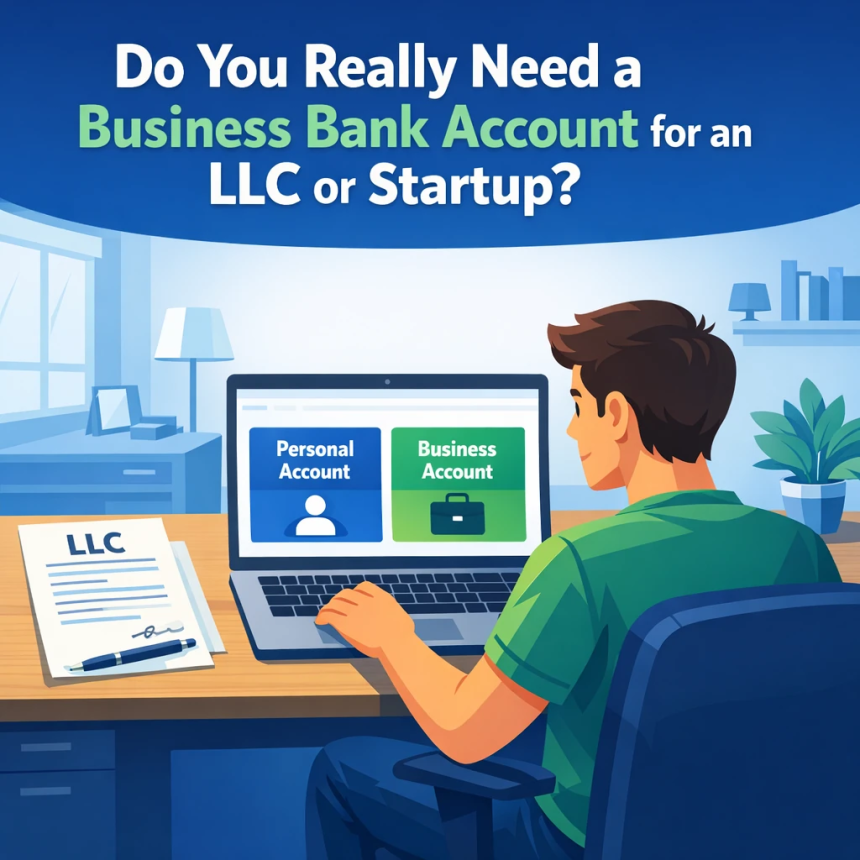
Do You Really Need a Business Bank Account for an LLC or Startup?
Author: Peiman Daneshgar
Contact: daneshgar781@gmail.com
Published: February 26, 2026
Reading Time: 9 minutes
Table of Contents
- The Question Keeping You Up at Night
- What Happens When You Skip the Business Account
- The Legal Truth: Your LLC Is a Lie Without a Separate Account
- The Tax Truth: The IRS Is Watching
- The Credibility Truth: Looking Like a Real Business
- The Growth Truth: Building Business Credit
- But What If You’re a Solopreneur?
- What About Startups That Haven’t Launched Yet?
- The One Exception (Yes, There’s One)
- How to Open One Without Overcomplicating It
- Real Stories: What Happens to Business Owners Who Didn’t Listen
- Frequently Asked Questions
- The Bottom Line: Stop Reading and Start Opening
The Question Keeping You Up at Night
Let me guess why you clicked on this article.
You just formed your LLC. Or maybe you’re in the middle of launching your startup. You paid the state fees, you filed the paperwork, and you’re officially a “business” now. Congrats.
But there’s this one thing nagging at you. This little voice that says:
“Do I really need a separate business bank account? I mean… really? Can’t I just use my personal account for now? It’s free. It’s already set up. I’ll open a business account later when I’m actually making money.”
I know that voice. I’ve heard it from a hundred entrepreneurs. And honestly? It makes sense. You’re busy. You’re bootstrapping. Every dollar counts. Why add another thing to your plate?
Maybe you’ve even tried the “good enough” approach. You opened a second personal account at a different bank and told yourself that counts as separate. Or you’re using PayPal and Venmo for business payments and just… hoping it all works out.
Here’s what no one tells you: That little voice? It’s lying to you. And its lies could cost you everything.
But here’s the good news. By the time you finish this article, you won’t just know whether you need a business bank account. You’ll understand exactly why it’s non-negotiable for protecting your personal assets, saving on taxes, and building a real company. And I’m going to share the insider knowledge that CPAs and business attorneys wish every new LLC owner knew—before it’s too late.
Quick gut check: If your business got sued tomorrow, would your personal savings, your car, and your house be safe? If you’re not 100% sure, keep reading.
What Happens When You Skip the Business Accountcapital gains tax on stocks for beginners
Before we dive into the legal stuff, let’s look at what actually happens when entrepreneurs try to skip the business bank account.
The “I’ll Just Use PayPal” Trap
Meet Sarah. She started a consulting business. Formed an LLC. Paid the fees. But she thought, “I’m a modern business. I don’t need a bank account. I’ll just use PayPal and Venmo.”
For six months, it worked fine. Clients paid her through PayPal. She paid contractors through Venmo. Life was good.
Then tax season arrived.
Sarah spent three weeks downloading spreadsheets, trying to figure out which PayPal transactions were business income and which were her sending money to friends. She missed deductions worth thousands of dollars because she couldn’t find the receipts. And her accountant charged her double because of the mess.
That’s the “I’ll figure it out later” tax happening in real time.
The “Separate Personal Account” Illusion
Then there’s Mike. He owned a landscaping business. He knew he shouldn’t use his main personal account, so he opened a second personal account at a different bank. “It’s separate,” he thought. “Good enough.”
One day, a client slipped on a wet lawn and sued his business. Mike wasn’t worried—he had an LLC. His personal assets were protected.
Except… when the lawyers looked at his finances, they saw that his “business” money was in a personal account. They argued that Mike wasn’t really running a separate business—he was just a guy with a second checking account. The court agreed.
They pierced the corporate veil. Mike lost his LLC protection. They came after his house.
That’s not a scare story. That’s real life. And it happens more often than you’d think.
best tax software for small business owners
The “I’m Not Making Enough Money Yet” Excuse
And then there’s you. Maybe you’re thinking, “I’ll open a business account when I’m actually making money.”
Here’s the thing: the best time to open a business account is before you need it.
Because when that first big payment comes in—the one that makes this feel real—you want it to go into your business account. Not your personal account that you’ll have to untangle later. Not your PayPal that doesn’t integrate with your books.
You want to start clean.
Pause for a second: Think about your business right now. If you got a $10,000 payment today, where would it go? Is that where you want it to go?
The Legal Truth: Your LLC Is a Lie Without a Separate Account
Let’s get into the heavy stuff. Because this is the part that keeps business attorneys in business.
What “Piercing the Corporate Veil” Actually Means
You formed an LLC for a reason. Probably because someone told you it protects your personal assets if your business gets sued. And they were right—if you run it correctly.
An LLC creates a legal separation between you and your business. It’s called the “corporate veil.” Think of it like a force field around your personal assets. As long as the veil is intact, business creditors can’t touch your house, your car, or your savings.
But here’s the catch: That force field only works if you treat your business like a separate entity.
And the single biggest thing that destroys the corporate veil? Mixing money.
When you run business income and expenses through your personal bank account, you’re telling the world—and more importantly, the courts—that your business isn’t really separate. It’s just you, doing stuff.

how to file taxes as a married couple for the first time
What Courts Look For
When a judge decides whether to pierce the corporate veil, they look at things like:
- Did you keep separate bank accounts?
- Did you maintain separate books and records?
- Did you use your business for personal expenses?
- Did you follow corporate formalities?
The very first question on that list is the easiest one to get right. Separate bank accounts. If you fail that one, the others almost don’t matter.
Real Case, Real Consequences
In a famous case, In re Sitar, a business owner formed an LLC but used his personal account for business. When the business went bankrupt, creditors came after his personal assets. The court ruled that because he didn’t maintain a separate business account, the LLC wasn’t really a separate entity. He lost everything .
That’s not a theoretical risk. That’s a real outcome that happens to real business owners who thought “it’s fine for now.”
The Bottom Line on Legal Protection
If you have an LLC or corporation, a separate business bank account isn’t optional. It’s the price of admission for liability protection.
Without it, your LLC is just a piece of paper. With it, you actually have a shield.
Think about this: Is the convenience of using your personal account really worth risking your home?
tax credits vs tax deductions explained
The Tax Truth: The IRS Is Watching
Let’s switch from lawyers to accountants. Because the tax implications of skipping a business account are almost as scary as the legal ones.
The Audit Nightmare
The IRS loves clear records. They hate confusion. And nothing creates confusion faster than mixing business and personal money.
When you run everything through your personal account, here’s what happens at tax time:
- You spend hours scrolling through statements trying to figure out which transactions are business
- You miss deductions because you can’t find the receipts
- You guess on numbers because you’re not sure
- Your accountant charges you more because it takes twice as long
And if you get audited? Good luck explaining to an IRS agent that the $500 at Target was for office supplies, not personal shopping.
The Deduction Problem
Here’s something most new business owners don’t realize: You can only deduct business expenses.
Sounds obvious, right? But when your business and personal money are in the same account, it’s incredibly easy to accidentally claim personal expenses as business deductions. Not because you’re trying to cheat—but because you genuinely can’t remember.
And if the IRS decides you’re intentionally claiming personal expenses? That’s fraud. Even if it was an accident.
The Estimated Tax Trap
If you’re making money as a business, you’re supposed to pay quarterly estimated taxes. But when your business income is mixed with personal money, it’s hard to know exactly how much you made—and how much you owe.
Suddenly, you’re scrambling in April with a huge tax bill you didn’t see coming. And penalties for underpayment? Those hurt.
What the IRS Actually Wants
The IRS doesn’t care which bank you use. They don’t care if you have a fancy business account. But they care deeply about clear, separate records.
A business bank account makes those records automatic. Every transaction in that account is business. Every deposit is income. Every withdrawal is either an expense or money you paid yourself.
Clean. Simple. Audit-proof.
Quick question: If the IRS audited you next month, could you produce clean records of every business transaction? If the answer is no, you need a business account.
what to do if you can’t pay your taxes on time
The Credibility Truth: Looking Like a Real Business
Let’s talk about something less scary but just as important: how you look to customers, vendors, and partners.
The Check Test
Imagine you’re a vendor. You get two checks:
- A check from “John Smith”
- A check from “Smith Consulting LLC”
Which one do you take more seriously?
The business check, obviously. It tells you this is a real company. It tells you they’re professional. It tells you they’re not just someone’s side hustle.
The Payment Experience
When customers pay you, the experience matters. If you send them a PayPal request from your personal email, it feels… amateur. If you send an invoice that pays directly to your business account, it feels professional.
First impressions matter. Your banking setup is often part of that first impression.
The Vendor Relationship
Want better terms from suppliers? Want vendors to trust you? A business account helps.
When you pay from a business account, vendors know you’re legitimate. They’re more likely to extend credit, offer net-30 terms, and work with you when things get tight.
The Investor Question
If you ever want outside funding—investors, loans, grants—they will ask for your financial records. If those records are a mess of personal transactions, good luck.
Clean business accounts show investors that you run a real operation. They show that you understand business basics. They’re a signal that you’re worth betting on.
can I deduct home office expenses in 2024?
The Growth Truth: Building Business Credit
Here’s something most new entrepreneurs don’t know: Your business has its own credit score.
And that credit score determines whether you can get loans, credit cards, and good terms from suppliers.
How Business Credit Works
Business credit is separate from your personal credit. It’s based on your business’s financial history. And the very first step in building business credit is… you guessed it: a business bank account .
Without a business account, you don’t exist as a financial entity. You’re just a person with an idea. With a business account, you start building a history.
The EIN Connection
When you open a business account, you’ll get an EIN (Employer Identification Number) from the IRS. That EIN becomes your business’s identity for credit purposes.
Banks, credit bureaus, and lenders use that EIN to track your business’s financial behavior. Pay your bills on time? Good for business credit. Keep good balances? Even better.
The Credit Card Gateway
Once you have a business account, you can apply for a business credit card. That card reports to business credit bureaus (Dun & Bradstreet, Experian Business, Equifax Business). Use it responsibly, and you build a credit history that helps you get loans later.
Without a business account? You can’t even start.
The Loan Reality
Want to expand? Need equipment financing? Hoping for a line of credit? Lenders will ask for business bank statements. They want to see that money flows through your business, not your personal account.
If you can’t provide those statements, you won’t get the loan.
Think ahead: Where do you want your business to be in three years? Will you need financing to get there? If yes, start building business credit now—with a business account.

tax deductions for freelancers and gig workers
But What If You’re a Solopreneur?
Okay, let’s address the elephant in the room. What if you’re a solopreneur? Freelancer? Independent contractor? No employees, no partners, just you.
Do you still need a business bank account?
The Sole Proprietor Question
If you’re a sole proprietor (not an LLC), legally you can use your personal account. The IRS doesn’t require a separate account for sole props .
But should you? Almost never.
Here’s why:
- Professionalism: Clients still expect to pay a business, not a person
- Bookkeeping: Separate accounts make tax time infinitely easier
- Growth: You might become an LLC someday—start the habit now
- Psychology: When money is in a business account, you treat it like business money
The “But I’m Small” Argument
“I only make a few thousand dollars a year. Do I really need a business account?”
If that’s you, here’s my honest take: It’s not about how much you make now. It’s about building the habit of treating your business like a business.
Plus, many banks offer free business checking with no minimums. There’s almost no cost to doing it right .
The DBA Solution
If you’re a sole proprietor and don’t want to form an LLC, you can still get a business account. You’ll need a DBA (Doing Business As) certificate from your local county. It’s cheap and easy, and it lets you open an account in your business name .
authorized user vs co-signer: which helps credit more?
What About Startups That Haven’t Launched Yet?
Another common question: “I’m still in the idea stage. I haven’t launched. I haven’t made any money. Do I need a business account now?”
The Pre-Revenue Stage
If you haven’t launched and have no business income, you might not need a business account yet. But here’s when you should open one:
- You’ve formed an LLC or corporation – If you’re incorporated, you need separation from day one
- You’re spending money on the business – Domain names, software, legal fees—if you’re spending, track it separately
- You’re taking outside money – If friends, family, or investors give you money, it must go into a business account
- You’re close to launch – Better to have it ready before that first customer pays
The Startup Trap
Many startups wait too long. They bootstrap with personal money, then suddenly they have revenue—but it’s all mixed up. Untangling that mess later costs time and money.
Open the account early. Even if it’s empty. Even if you’re not sure. It costs little and saves a lot.
The One Exception (Yes, There’s One)
I’ve been pretty firm: you need a business account. And for 99% of businesses, that’s true.
But there is one exception.
The Hobby vs. Business Distinction
If what you’re doing is truly a hobby—not intended to make a profit—you might not need a business account .
The IRS distinguishes between hobbies and businesses. Hobbies don’t get business deductions. Hobbies don’t need business accounts.
But here’s the catch: If you’re reading this article, you’re probably running a business. You intend to make money. You’re taking it seriously. That’s not a hobby.
The Very First Transaction
Some entrepreneurs argue: “I’ll open an account after my first payment. That way I know it’s real.”
That’s reasonable—if that first payment is days away. But if months pass and you still haven’t opened one, you’re making excuses.
The moment you decide this is a business, open the account.
how to get a free FICO score from your bank
How to Open One Without Overcomplicating It
Okay, you’re convinced. You need a business bank account for your LLC or startup. Now what?
Here’s the simplest path:
Step 1: Get Your EIN
If you have an LLC or corporation, you need an EIN. Go to IRS.gov. It’s free. Takes 15 minutes. Get it instantly .
Step 2: Gather Your Documents
You’ll need:
- EIN (for LLCs/corporations) or SSN (for sole props)
- Formation documents (Articles of Organization/Incorporation)
- Operating Agreement (for multi-member LLCs)
- Government ID (driver’s license/passport)
- Business license (if applicable)
- Initial deposit (some banks require it)
Step 3: Choose Your Bank
You have options:
- Traditional banks (Chase, Bank of America, local banks) – Good for cash businesses, in-person service
- Online banks (Bluevine, Mercury, Novo) – Lower fees, higher interest, great for digital businesses
- Credit unions – Lower fees, personal service, sometimes limited business offerings
Step 4: Apply
Most banks let you apply online now. Upload your documents, answer some questions, fund the account. Done.
Step 5: Start Using It
From this moment forward:
- All business income goes into this account
- All business expenses come out of this account
- Pay yourself by transferring money to personal (not by spending business money directly)
That’s it. Simple.
Real Stories: What Happens to Business Owners Who Didn’t Listen
Let me share some real examples (names changed) of what happens when entrepreneurs skip the business account.
The Etsy Seller
Maria started an Etsy shop. Formed an LLC to protect herself. Used PayPal for payments and her personal debit card for supplies.
Two years later, she was audited. The IRS couldn’t distinguish between her personal Amazon purchases and her supply purchases. She owed $8,000 in back taxes and penalties because she couldn’t prove her deductions.
Cost of skipping a business account: $8,000 + stress.
The Construction Contractor
James ran a construction company. LLC, employees, the works. But he used his personal checking account “for convenience.”
A worker got hurt on the job. Sued the company. James thought he was protected. But the plaintiff’s lawyer saw the commingled accounts and argued the LLC wasn’t real. The court agreed.
James lost his house in the settlement.
Cost of skipping a business account: Everything.
The Tech Startup
Tech startup, three founders. They raised $50,000 from friends and family. Put it in the founder’s personal account “temporarily.”
Six months later, they had investors interested. Due diligence revealed the commingled funds. The deal fell apart. Investors didn’t trust their financial discipline.
Cost of skipping a business account: A lost investment.
The Consultant
Lisa was a consultant. Used her personal account for everything. At tax time, her accountant charged her $1,500 to sort through 12 months of transactions and separate business from personal.
Her friend with a business account paid $400 for the same service.
Cost of skipping a business account: $1,100/year, forever.
These aren’t rare stories. They happen every day.
Frequently Asked Questions
Q: Do I really need a business bank account for an LLC?
A: Yes. If you have an LLC and don’t have a separate business account, you risk losing your liability protection. Courts can “pierce the corporate veil” and come after your personal assets .
Q: Can I use my personal bank account for my LLC if I’m the only owner?
A: Legally, you can. But it’s a terrible idea. It destroys the separation between you and your business, putting your personal assets at risk and making taxes a nightmare .
Q: What happens if I don’t open a business bank account for my startup?
A: You risk legal liability, tax problems, missed deductions, and difficulty building business credit. You also look less professional to customers and vendors .
Q: Can I open a business bank account before my LLC is formed?
A: Generally no. Banks require proof that your business exists (formation documents, EIN). Form the LLC first, then open the account .
Q: Do I need a business bank account if I’m a sole proprietor?
A: Not legally required, but highly recommended. It makes bookkeeping, taxes, and professionalism much easier .
Q: Can I use PayPal or Venmo instead of a business bank account?
A: No. Payment platforms are not bank accounts. They don’t offer the same legal protection, FDIC insurance, or record-keeping benefits. Use them with a business account, not instead of one .
Q: How much does a business bank account cost?
A: Many are free with no minimum balance. Others have monthly fees ($10-$25) that can be waived. Shop around .
Q: What’s the difference between a business account and a personal account?
A: Business accounts are designed for higher transaction volumes, integrate with accounting software, accept merchant payments, and maintain the legal separation needed for LLC protection .
Q: Can I open a business bank account online?
A: Yes. Most banks now offer fully online applications. You’ll upload your documents and verify your identity digitally .
Q: What documents do I need to open a business bank account for an LLC?
A: EIN, Articles of Organization, Operating Agreement (if applicable), government ID, and sometimes a business license .
Q: Do I need a business license to open a business bank account?
A: It depends on the bank and your industry. Some require it, some don’t. Check with your specific bank .
Q: Can I open a business bank account with bad personal credit?
A: Usually yes. Most business accounts check ChexSystems (banking history), not personal credit scores .
Q: How soon after forming my LLC should I open a business bank account?
A: Immediately. As soon as you have your formation documents and EIN, open the account. Don’t conduct any business without it .
Q: Can I have multiple business bank accounts for my LLC?
A: Yes. Many businesses have checking, savings, and money market accounts. Keep it organized .
impact of credit card applications on your score
The Bottom Line: Stop Reading and Start Opening
Remember that little voice from the beginning? The one that said, “Do I really need a business bank account?”
You now know the answer.
If you have an LLC or a startup, a business bank account isn’t optional. It’s essential.
It protects your personal assets from business lawsuits. It makes tax time simple instead of stressful. It makes you look professional to customers and vendors. It’s the first step in building business credit. And it forces you to treat your business like a real business—because it is.
The entrepreneurs who skip this step? They’re the ones who lose their houses in lawsuits. They’re the ones who pay thousands in extra accounting fees. They’re the ones who miss deductions and get audited.
You’re not them.
You’re the entrepreneur who took 20 minutes to read this guide and decided to do it right. You’re the one who understands that the foundation matters. You’re the one who’s building something real.
So here’s your action plan:
- If you haven’t formed your LLC yet: Do that first.
- Get your EIN: Free from the IRS website.
- Choose a bank: Compare options, pick one that fits your business.
- Open the account: Apply online or in person.
- Move all business money there: From day one.
That’s it. Simple. Done.
Your future self—the one with protected assets, clean books, and a thriving business—will thank you.