
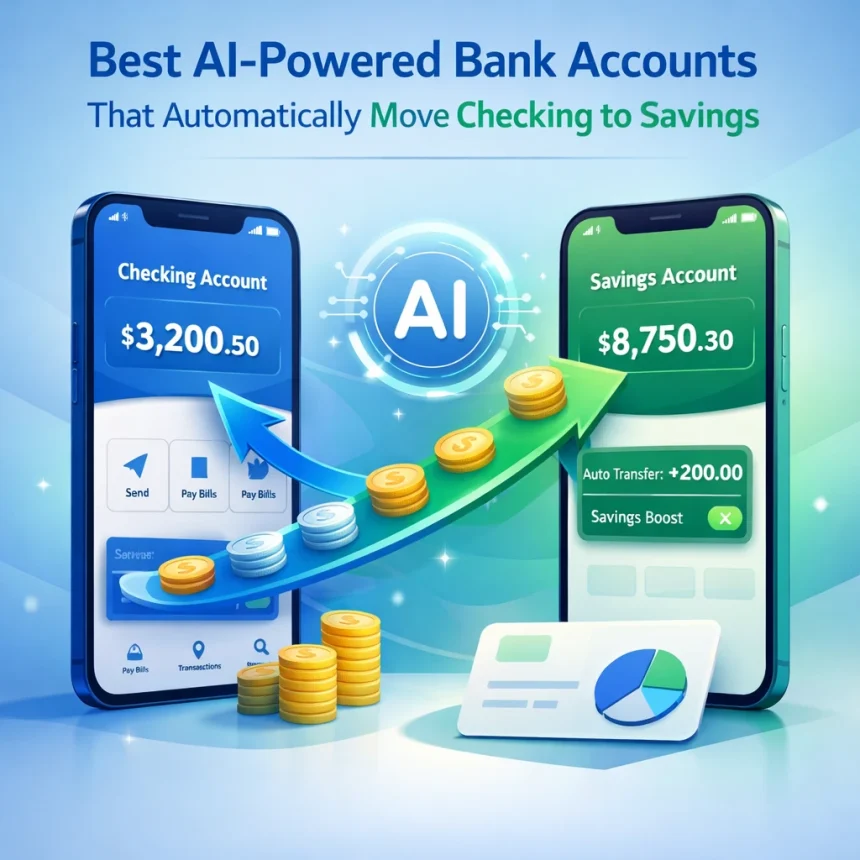
Best AI-Powered Bank Accounts That Automatically Move Checking to Savings
- Author: Peiman Daneshgar
- Email: daneshgar781@gmail.com
Table of Contents
- Introduction: The Silent Struggle of the “Responsible” Saver
- What Exactly is an AI-Powered Bank Account? (The “Invisible Banker”)
- How Do These “Smart” Transfers Actually Work?
- The All-Stars: Best AI Bank Accounts for Automatic Savings
- AI-Powered Savings vs. The “Old Way”: A Side-by-Side Comparison
- Is an AI Bank Account Safe? Addressing the Elephant in the Room
- The Future of Banking: Why Your Bank Will Soon Be an AI
- Frequently Asked Questions (FAQs)
- Conclusion: You Are Now Ahead of the Curve
Introduction: The Silent Struggle of the “Responsible” Saver
You know that feeling.
It’s the end of the month. You’re tired—mentally, not just physically. You open your banking app, not with excitement, but with a sense of quiet dread. You scroll through your transactions, mentally calculating, trying to remember if you bought that thing or paid that bill.
Then you look at your checking account. There’s some money left. Not a fortune, but something. And a tiny, exhausted voice in your head says, “You should move some of that to savings. You know, for a rainy day. For that trip. For just… in case.”
You yawn. You’re drained. The thought of logging into a separate savings account, fiddling with transfer amounts, and hoping you don’t accidentally transfer next month’s rent money feels like a second job. A job you’re not getting paid for. A job you’re too tired to do.
So, you close the app. You tell yourself, “I’ll do it tomorrow.” But tomorrow is just as busy, just as exhausting. And the cycle repeats.
You’ve tried the old methods. The “set it and forget it” automatic transfer of $50 every Friday? Yeah, that worked great until that Friday your car needed repairs, and the automatic transfer overdrafted your account. You tried the “save your change” apps, but they felt gimmicky, moving pennies when you needed to move dollars.
You’re not lazy. You’re not bad with money. You’re just a busy human being who is tired of managing a system that feels like it was built in the 1980s.
I get it. We all get it.
But here’s the thing: there’s a new generation of bank accounts that doesn’t treat you like a bank teller. They treat you like a person. They use artificial intelligence to do the thinking, the worrying, and the moving for you.
🧠 Quick Brain Break
Think about your phone for a second. Does it ask you to manually connect to every Wi-Fi network you’ve ever seen? No. It remembers. It learns. It just… works. So why is your bank account still making you do everything manually?
In this guide, we’re not going to bore you with the technical jargon about machine learning algorithms. You are going to discover the specific, battle-tested AI-powered bank accounts that act like a financial assistant—quietly, intelligently, and automatically moving money from your checking to your savings so you finally build that nest egg without the mental gymnastics. This isn’t just about saving money; it’s about getting your mental energy back.
Let’s find you an invisible banker.
Scroll down to see how this “invisible banker” actually thinks
What Exactly is an AI-Powered Bank Account? (The “Invisible Banker”)
Okay, so what are we actually talking about here? Is it a robot in a suit sitting at a desk in your phone? Not quite. But let’s use that image for a second.
Imagine you had a super-discreet, incredibly smart personal assistant whose only job was to look at your money. This assistant doesn’t sleep. It doesn’t get tired. It just watches.
It sees you get paid on the 1st and the 15th. It notices that your rent, your Netflix subscription, and your gym membership all come out at specific times. It sees you buy coffee on weekdays but cook in on weekends. It learns your rhythm.
Now, at the end of the week, this assistant comes to you and whispers, “Hey, I’ve looked at everything. You’ve got about $75 in your checking that you’re absolutely, positively not going to need for bills or spending this week. I’ve already moved it to your savings. You’re welcome.”
That’s it. That’s the promise of an AI-powered bank account that automatically moves checking to savings. It’s not magic. It’s math, but math that’s been taught to care about your specific life.
These accounts connect to your primary checking account (or have one built-in). They use complex algorithms to analyze your:
- Income patterns: How much and how often do you get paid?
- Spending habits: Where does your money actually go? Rent, utilities, takeout, gas?
- Bill schedule: When are your recurring payments due?
- Account buffers: How low does your balance usually get before you get nervous?
Based on all that data, it makes micro-movements of cash. Sometimes it’s $5, sometimes it’s $100. The key word here is “safe to save.” The AI calculates the exact amount you can move without causing an overdraft or impacting your lifestyle.
This is the part where your brain might be going, “Wait, an algorithm is going to touch my money? That feels weird.” And you’re right to be skeptical. But before we dive into the safety stuff (which we will, I promise), let’s pull back the curtain on how these algorithms actually think. It’s way less creepy and way more genius than you think.
Curious how an algorithm calculates your “safe to save” amount? Let’s break it down.
How Do These “Smart” Transfers Actually Work?
So, how does a bunch of code know you can afford to save $20 on a Tuesday? It’s not guessing. It’s using a process that’s actually quite logical. Let’s walk through the life of a dollar in an AI-powered system.
1. The Analysis Phase: Getting to Know You
When you first link an AI savings app or open an AI-powered bank account, it goes into “observation mode.” For the first week or two, it mostly just watches. It connects to your transaction history and starts building a financial profile. It’s like a new friend learning your quirks.
It’s figuring out:
- Your “Floor”: What is the lowest your checking account has ever dipped? It uses this to determine your safety net.
- Your “Ceiling”: How much cash usually just sits there, doing nothing, at the end of the month?
- Your Rhythm: Are you a spender or a saver? Do you get a sudden urge to order pizza every Friday night?
- Business Bank Accounts Explained: A Complete Guide for New Entrepreneurs
2. The Calculation: The “Safe-to-Save” Formula
This is the secret sauce. The AI uses a predictive model. It looks at your upcoming bills, your historical spending for this time of month, and your current balance. It then calculates the probability of you needing that specific dollar in your checking account before your next paycheck.
If the probability is low (say, under 10%), that dollar is flagged as “safe to save.” The AI doesn’t just do this once a month; it does this constantly, sometimes daily.
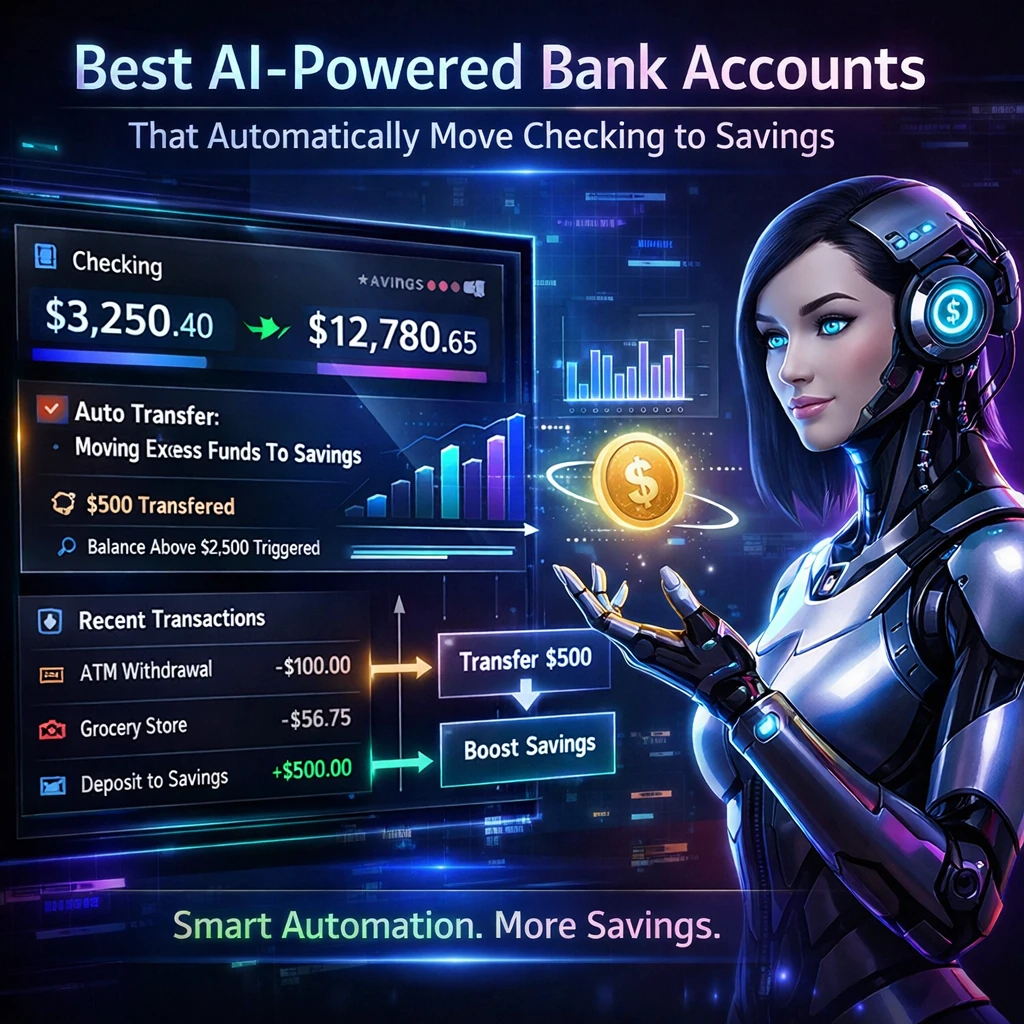
Checking vs savings accounts: what’s the real difference?
3. The Action: The Invisible Nudge
Once it identifies a safe amount, it automatically initiates a transfer from your checking to your savings. This can happen in a few ways:
- Round-Ups: You buy a coffee for $4.50. The AI rounds it up to $5.00 and moves the $0.50 to savings. It’s small, but it adds up.
- Smart Transfers: You have $600 in your account after all your known bills are paid. The AI calculates you only need a $400 buffer. It automatically moves the extra $200 to savings.
- Scheduled Boosts: Some apps let you set a goal (“Save $1000 for a trip in 3 months”) and the AI figures out the optimal amount to move every few days to hit that goal without you feeling the pinch.
- How to Open a Business Bank Account Step by Step (2026 Edition)
⚡ Reality Check
Think of it like a smart thermostat. You could get up and adjust the temperature every few hours to save on energy bills. Or, you could let the thermostat learn your schedule and do it for you, keeping you comfortable and saving money without any effort. This is the same idea, but for your wallet.
4. The Protection: The Overdraft Shield
This is the most important part. A good AI bank account is paranoid about overdrafts. If it senses any risk—like a large, unusual bill is about to hit—it will actually pull money back from savings to cover you, often free of charge. This two-way intelligence is what separates a real AI tool from a simple automatic transfer.
So, it’s not just “move money out.” It’s a holistic system designed to optimize your cash flow 24/7.
Now that you know the “how,” you’re probably ready to meet the players. Which of these “invisible bankers” is the right fit for your life?
Bank Fees Explained: The Complete Guide to Understanding Your Statement
Ready to meet the top contenders? Let’s look at the best AI bank accounts on the market.
The All-Stars: Best AI Bank Accounts for Automatic Savings
Okay, let’s get down to business. Here are the top-tier AI-powered bank accounts and apps that are changing the game. I’ve broken them down by their superpower, so you can find the one that clicks with your personality.
1. Digit: The Original AI Savings Companion
Best for: The person who wants a “set it and truly forget it” experience.
Digit is the OG in this space. It’s not a full bank account itself (though it offers an FDIC-insured savings account), but it connects securely to your existing checking accounts. Its algorithm is famously aggressive and smart.
- The Superpower: Digit’s AI analyzes your income and spending down to the minute. It moves money every single day, in small, unnoticeable amounts. Some days it might be $5, other days $30. You’ll often get a text or notification saying, “Hey, I moved $12.34 to your savings. You didn’t even miss it, did you?”
- Why It Wins: It handles the complexity so you don’t have to. It also has “Overdraft Advance” which can automatically pull up to $100 from your savings to cover a checking shortfall, no questions asked, and with no fee.
- The Catch: It has a monthly fee ($5/month), but for many, the amount it saves them makes the fee more than worth it. They offer a 30-day free trial so you can see the magic before you pay.
- Vibe: The quiet, hyper-efficient roommate who does the dishes before you even realize they’re dirty.
- Checking vs savings account for beginners: a simple guide
2. Qube: The “Money Pile” Master
Best for: The person who loves structure but hates the maintenance. The “envelope system” fanatic.
Qube is a full-fledged bank account that completely rethinks how you interact with money. Instead of one big checking pot, you get “Qubes”—virtual envelopes for every expense (Rent, Groceries, Gas, Fun Money).
- The Superpower: You turn on a Qube to spend from it. The AI part comes in with “Auto-Qubes.” You can set up rules like, “Every time I get paid, put $200 in the Grocery Qube and $50 in the Fun Money Qube.” The AI doesn’t move money after you spend; it helps you allocate your money before you spend it, ensuring your savings are funded first.
- Why It Wins: It’s proactive, not reactive. Your savings Qube grows untouched because you’ve already designated that money as “off-limits” for daily spending. It’s the most powerful tool for intentional budgeting I’ve ever seen.
- The Catch: It requires a slight shift in mindset. You have to be willing to engage with the Qubes when you spend. But once the habit forms, it’s life-changing. Free and paid plans available.
- Vibe: The Marie Kondo of banking. It brings tidy, joyful order to your financial chaos.
- Business Checking vs. Business Savings Accounts: What’s the Difference?
3. SoFi: The All-in-One Financial Ecosystem
Best for: The person who wants everything in one place and loves gamified rewards.
SoFi started as a student loan refinancer and has exploded into a full-on financial services powerhouse. Their “SoFi Money” checking and savings account is packed with AI-driven features.
- The Superpower: “Vaults.” You can create multiple savings Vaults for different goals (Emergency Fund, New Laptop, Vacation). The AI power comes from “Roundups” and “Auto-Vault.” When you spend with your SoFi debit or credit card, the transaction is rounded up to the nearest dollar, and that spare change is automatically swept into a Vault of your choice.
- Why It Wins: It’s a sticky ecosystem. If you get your direct deposit with SoFi, you unlock high savings APYs (Annual Percentage Yield), cashback rewards, and other perks. It makes saving feel like a game you’re winning.
- The Catch: The AI is less about complex predictive analysis and more about automated, rule-based saving (round-ups, recurring transfers). It’s simpler, but still incredibly effective. No monthly fees.
- Vibe: The friendly, over-achieving student who invites you to study with them and suddenly your grades improve.
- A Beginner’s Guide to Every Common Bank Fee You’ll Encounter in 2026
4. Empower (Formerly Personal Capital): The Hybrid Powerhouse
Best for: The person who wants to save and invest, and get a holistic view of their entire financial life.
Empower is two tools in one: a fantastic, free financial dashboard for tracking all your accounts (investments, bank accounts, credit cards) and a suite of wealth management services. Their “Cash” account is where the AI savings magic happens.
- The Superpower: “Smart Savings.” You can link your external checking account to your Empower Cash account. The app analyzes your cash flow and automatically sweeps any “extra” money above a threshold you set into your Empower savings account. It’s like a bouncer for your cash, keeping only what you need at the door and letting the rest into the VIP section (your savings).
- Why It Wins: It gives you the bird’s-eye view. You’re not just saving money in a silo; you’re seeing how it fits into your retirement goals, your investment portfolio, and your net worth. It’s for the financially curious.
- The Catch: The advanced investment tools are for high-net-worth individuals, but the free dashboard and the Smart Savings feature on their Cash account are accessible to everyone.
- Vibe: The wise, experienced financial planner who gives you the big-picture advice you desperately needed.
- Do You Really Need a Business Bank Account for an LLC or Startup?
5. Chime: The Spot-Me Saver
Best for: The person new to automatic saving who wants a simple, fee-free banking experience with powerful core features.
Chime is one of the most popular neobanks out there, and for good reason. It’s simple, transparent, and has two killer automated saving features.
- The Superpower: “Save When I Get Paid.” You can set it to automatically transfer 10% (or any percentage you choose) of every direct deposit from your checking to your savings. It happens the moment your paycheck lands, so you never even see the money in your spending account. They also have a standard round-up feature called “Round Ups.”
- Why It Wins: It removes all complexity. There’s no algorithm to learn your habits; it just follows the simple, powerful rule of “pay yourself first.” It’s automatic, predictable, and incredibly effective for building a habit.
- The Catch: It’s not “smart” in the predictive sense. It doesn’t analyze your spending to find “safe-to-save” money; it just takes a cut of your income. But for millions of people, that’s exactly the right level of automation. No fees.
- Vibe: The reliable, no-drama friend who shows up on time and always has your back.
- Is a checking or savings account better for everyday use?
📝 Quick Summary Box
- Digit: Best for hands-off, micro-saving.
- Qube: Best for structured, envelope-style budgeting.
- SoFi: Best for an all-in-one, reward-driven experience.
- Empower: Best for combining saving with investment tracking.
- Chime: Best for simple, “pay-yourself-first” automation.
Picking one can feel overwhelming, I know. But here’s a secret: you can try most of them for free. Download two, connect a small account, and see which interface feels right.
But a question is probably bubbling up in your mind. “This all sounds great, but is it actually safe? Is some random startup going to run off with my cash?”
Let’s tackle the safety question head-on.
AI-Powered Savings vs. The “Old Way”: A Side-by-Side Comparison
To really drive home why this is a leap forward, let’s look at a simple comparison. It’s not just about saving more; it’s about saving smarter.
| Feature | The “Old Way” (Manual Transfers) | The “New Way” (AI-Powered Accounts) |
|---|---|---|
| The Process | You remember, you log in, you transfer. Requires willpower and mental energy. | It analyzes, it calculates, it moves. Requires zero willpower. It’s passive. |
| Timing | Usually on payday or at the end of the month, when cash flow is most volatile. | Constantly. It looks for “safe-to-save” money daily, catching small amounts you’d never notice. |
| Risk of Overdraft | High. A rigid $50 auto-transfer can hit right before a big bill, draining your account. | Low. It builds in an “overdraft shield,” analyzing your upcoming bills before moving a cent. |
| Handling of Windfalls | You might see an extra $200 in your account and mentally spend it on takeout. | It flags the surplus, deems it “safe,” and quietly tucks it away in savings before you can spend it. |
| Savings Growth | Inconsistent. Depends on your discipline and memory. “Feast or famine.” | Consistent. It’s like a dripping faucet of savings—drip, drip, drip—that fills the bucket over time. |
| Your Mental State | Guilt, anxiety, procrastination. “I should be saving more.” | Relief, calm, pleasant surprise. “Oh wow, I have how much saved?” |
Is an AI Bank Account Safe? Addressing the Elephant in the Room
Okay, deep breath. Let’s talk about safety and security. This is the number one concern, and it’s completely valid. You’re trusting a piece of software to have its digital hands on your money.
Here’s the breakdown of why, in almost all cases, it is perfectly safe.
1. FDIC Insurance is Key
This is the big one. Any legitimate AI-powered bank account will be backed by FDIC insurance. This means your money is insured up to $250,000 per depositor, per bank. If the company goes under tomorrow, your money is protected by the U.S. government. Apps like Digit hold your money in FDIC-insured partner banks. Full-fledged accounts like SoFi and Chime are FDIC-insured themselves. Always check for the FDIC logo on their website. If it’s not there, run.
2. Bank-Level Encryption
These companies live and die by their security reputation. They use the same 256-bit encryption that major banks use. This is the gold standard for scrambling your data so that even if someone intercepted it, they couldn’t read it.
3. Read-Only Access (For Apps)
Apps like Digit that connect to your existing bank account use services like Plaid or Yodlee. These services don’t give the app your actual login password. They give it a secure, read-only token. This means the app can see your transactions to analyze them, but it cannot touch your money in that external account. It can only move money out of that account if you authorize it, and even then, it’s a standard, traceable ACH transfer.
4. Regulatory Oversight
These aren’t fly-by-night operations. They are regulated financial institutions or partners of regulated institutions. They have to comply with strict federal laws designed to protect consumers.
The only real “risk” isn’t theft, but the risk of the AI making a mistake. And yes, while rare, it can happen. An unexpected bill or a sudden change in spending habits can sometimes confuse the algorithm. This is why you should always keep an eye on your account, especially in the first few weeks. Think of it like training a new puppy. You trust it, but you still check to make sure it didn’t chew your shoes.
🔐 Bottom Line on Safety
Are these accounts safer than keeping cash under your mattress? Infinitely. Are they as safe as a traditional brick-and-mortar bank? Yes, arguably more so in terms of fraud prevention, because their whole business model is built on intelligent, real-time monitoring of your account.
The Future of Banking: Why Your Bank Will Soon Be an AI
We’re standing at the edge of a massive shift. Right now, choosing an AI-powered bank account feels like a “hack” or a clever trick. In five years, it will just be… banking.
Think about it. Why would you want a bank that just holds your money and occasionally sends you a confusing statement? Or one that charges you $35 for accidentally spending $5 more than you had?
The future of banking is invisible. It’s proactive, not reactive. Here’s what’s coming:
- Predictive Bill Negotiation: Your AI won’t just pay your cable bill; it will see you’re overpaying, negotiate a lower rate on your behalf, and switch you to a better plan.
- Automated Investing: Based on your risk tolerance (which it learns by watching your spending), it will automatically invest a portion of your “safe-to-save” money into a diversified portfolio.
- Hyper-Personalized Offers: Instead of getting spammy credit card offers, your bank’s AI will know you’re planning a trip to Europe in 6 months and will proactively find you a travel rewards card with no foreign transaction fees and a 0% APR for the next 9 months.
- Financial Wellness Coaching: It will be able to say, “Hey, I noticed you’ve been spending 15% more on restaurants this month. Your savings goal for the new bike is only 5% away. Want me to bump up your ‘safe-to-save’ transfers for the next two weeks to get you there faster?”
The banks and apps on this list are the pioneers. They’re building the roadmap. By getting on board now, you’re not just saving a few extra dollars; you’re getting comfortable with a fundamentally better way of managing your financial life.
Frequently Asked Questions (FAQs)
1. Will the AI ever move money I need for bills?
No, a well-designed AI’s primary function is to prevent that. It analyzes your bill schedule and spending patterns precisely to avoid moving money that’s spoken for. It’s more cautious than you are.
2. What happens if I have a low balance? Can I turn it off?
Most apps have a “Pause” or “Safety Mode” feature. You have 100% control. If you know you’re going into a high-spending period (like the holidays), you can tell the AI to chill out and stop moving money for a while.
3. Are these accounts better than a regular savings account at a big bank?
For the purpose of building savings, absolutely. A regular savings account is a passive container. These AI accounts are active tools that fill the container for you. Many also offer much higher interest rates (APYs) than traditional banks.
4. Do I have to switch banks completely?
Not necessarily. Apps like Digit let you keep your current bank and just add a layer of AI intelligence on top. Full-service banks like SoFi or Qube require you to switch your primary checking, but they offer a more integrated experience.
5. What if I don’t have a steady income? Can this still work?
Yes, in fact, it can be even more helpful. Freelancers and gig workers with variable income often struggle with saving. A smart AI that analyzes cash flow can be a lifesaver, moving money during the good weeks to cover the lean ones.
6. How do I know which one to choose?
Think about your personality. Do you want to be completely hands-off? Go with Digit. Do you want more control? Go with Qube. Do you want a sleek, all-in-one app? Go with SoFi. Most have no monthly fees for basic features, so you can try them out risk-free.
Conclusion: You Are Now Ahead of the Curve
Remember that feeling from the beginning of this article? The tiredness. The quiet guilt. The mental load of having to be your own financial manager at the end of a long day.
You now know that doesn’t have to be your reality.
While everyone else is still stuck in the 20th century, manually logging in, doing calculations in their head, and hoping they don’t mess up, you’ve just been given the keys to a new world. A world where your money works for you, quietly and intelligently. A world where you get those delightful little notifications that say, “Hey, you’ve saved $500 this month. Nice work.”
You are now ahead of the curve. You understand that the best AI-powered bank accounts that automatically move checking to savings aren’t just a tech gimmick. They are a tool for reclaiming your mental energy. They are a path to financial growth that doesn’t require a second job in budgeting.
The information is here. The tools are ready. The only thing left is to take that first step.
Pick one. Sign up. Connect your account. And then go do something else. Let the AI do the heavy lifting for once. You’ve earned a break.
This article was written by Peiman Daneshgar. For questions or collaborations, please reach out at daneshgar781@gmail.com.


